
Selecting an LED parking lot light involves more than choosing wattage and lumen output. The fixture must also distribute those lumens in the right directions.
Type II, Type III, Type IV and Type V light distributions produce different coverage patterns and can serve different pole locations within the same parking lot.
A fixture with adequate lumen output but the wrong distribution can send too much light outside the property, leave dark areas between poles, create poor uniformity or require more fixtures than a better-matched optical system.
Understanding parking lot light distribution helps match the fixture to the pole location, mounting height, spacing and site geometry.
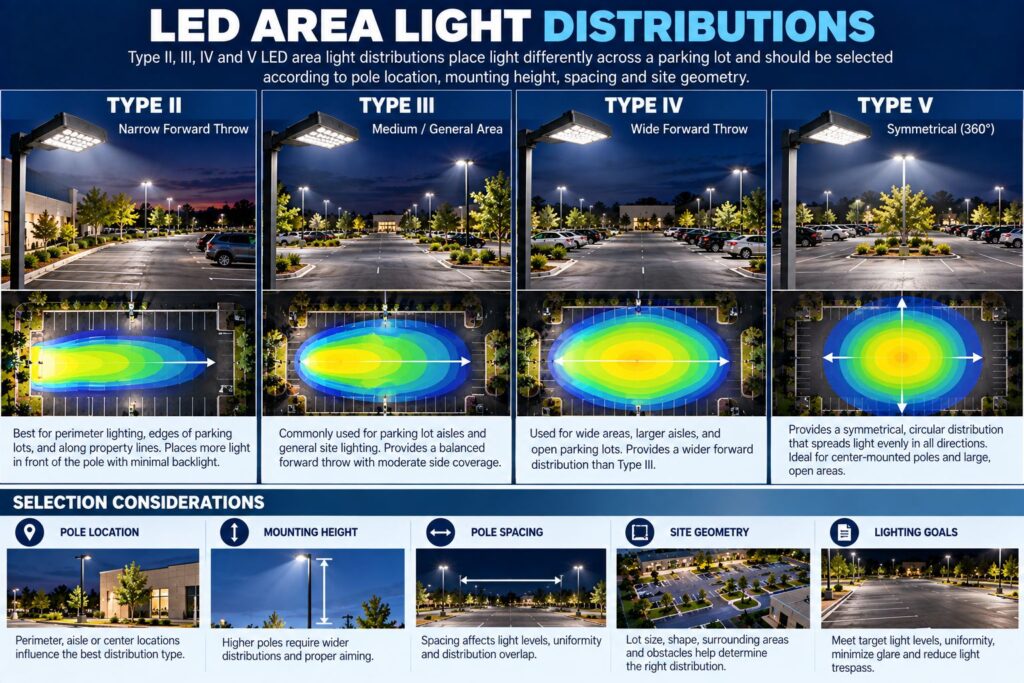
Type II, III, IV and V LED area light distributions place light differently across a parking lot and should be selected according to pole location, mounting height, spacing and site geometry.
Selecting the Right Optical Distribution for Your Parking Lot?
Choosing the correct optical distribution can improve coverage and uniformity without simply increasing fixture wattage or lumen output.
LED PROS WorldWide can help identify LED parking lot lights with Type II, Type III, Type IV and Type V distributions based on your pole locations, mounting heights, spacing, site dimensions and required lighting performance.
Explore our LED Parking Lot Lights. Request a Quote or call 844-533-7767 with your project information.
What Is Parking Lot Light Distribution?
Light distribution describes how a luminaire directs its output across the area surrounding the fixture.
For parking lot and area lighting, the Illuminating Engineering Society classification system provides standardized descriptions of horizontal light-distribution patterns.
These classifications help designers compare how luminaires distribute light relative to the mounting location.
The distribution type does not tell you everything about how a fixture will perform on a particular property. Actual coverage also depends on lumen output, mounting height, pole spacing, fixture orientation, optical design and site geometry.
Why Distribution Matters in Parking Lot Lighting
Consider two LED area lights with the same wattage and approximately the same lumen output.
One might concentrate most of its useful light forward from a perimeter pole.
Another might spread light more broadly around an interior pole.
Although their wattage and total lumens are similar, their installed performance can be substantially different.
Selecting distribution according to the pole’s position can help:
-
Put more light on the intended parking surface
-
Improve uniformity
-
Reduce dark areas
-
Limit unnecessary backlight
-
Reduce light beyond property boundaries
-
Make better use of available fixture lumens
-
Coordinate coverage from adjacent poles
Distribution is therefore part of the lighting layout, not simply a specification listed on the fixture data sheet.
Selecting Type II, III, IV or V optics is ultimately about installed performance, not simply choosing a distribution label. Our Parking Lot Lighting Uniformity Guide explains how optical patterns from multiple fixtures work together to reduce hot spots and dark areas across the parking surface.
Type II Parking Lot Light Distribution
Type II distribution has a relatively narrow lateral pattern compared with broader area-light distributions.
It is commonly associated with roadway-oriented applications and can also be useful in parking lots where the geometry requires illumination along a narrower path or elongated area.
Potential parking lot applications include:
-
Narrow drive lanes
-
Perimeter roadways
-
Access roads
-
Long, relatively narrow parking areas
-
Some edge-mounted pole locations
Type II should not automatically be selected merely because a pole is near a roadway. The actual photometric pattern of the fixture should be evaluated against the site.
Type III Parking Lot Light Distribution
Type III distribution provides broader lateral coverage than Type II and is widely used in outdoor area-lighting applications.
It can be particularly useful where a fixture is mounted near the edge of a parking area and needs to project light forward while also covering a substantial area to either side.
Potential applications include:
-
Parking lot perimeter poles
-
Edge-mounted poles
-
Commercial parking areas
-
Drive lanes
-
Building-side parking areas
-
Some roadway and site-lighting applications
Type III is common, but that does not make it the correct choice for every parking lot pole.
Type IV Parking Lot Light Distribution
Type IV distribution is strongly forward-oriented and can be useful where the luminaire is positioned near the edge of the area being illuminated.
This characteristic can make Type IV useful where light needs to extend into a parking area while limiting illumination behind the fixture.
Potential applications include:
-
Perimeter poles
-
Property-edge locations
-
Building-mounted area lighting
-
Parking areas beside property boundaries
-
Locations where forward projection is particularly important
A Type IV distribution can be useful for controlling where the majority of the light goes, but property-line performance still needs to be evaluated from the actual fixture photometry and layout.
Type V Parking Lot Light Distribution
Type V distribution provides light broadly around the luminaire.
This can make it useful for poles positioned within the parking area rather than only around its perimeter.
Potential applications include:
-
Interior parking lot poles
-
Central parking areas
-
Large open areas
-
Locations requiring broad surrounding coverage
Type V can reduce the need to aim several strongly directional fixtures in different directions in some layouts.
However, broad distribution is not automatically preferable. Near property lines or other sensitive boundaries, a more directional distribution may provide better control.
Type II vs Type III vs Type IV vs Type V
The basic differences can be summarized this way:
| Distribution | General Pattern | Common Parking Lot Use |
|---|---|---|
| Type II | Narrower, elongated coverage | Drive lanes, access roads, narrow areas |
| Type III | Broader lateral and forward coverage | Perimeter and edge poles |
| Type IV | Strong forward-oriented coverage | Property edges and perimeter locations |
| Type V | Broad coverage around fixture | Interior and central poles |
This table is a starting point rather than a fixture-selection formula.
Different manufacturers can offer multiple optical variations within a distribution category, and individual fixture photometry should be evaluated for the project.
Selecting the appropriate distribution can help direct useful light into the parking area, but distribution alone does not determine boundary performance. See our parking lot glare and light trespass guide for additional guidance on backlight, shielding, fixture orientation and property-line illumination.
Pole Location Often Determines the Starting Distribution
One of the easiest ways to begin thinking about parking lot optics is to identify where the pole sits relative to the area that needs illumination.
A pole at the edge of the property generally needs to send most useful light into the site.
A pole located well inside a large parking area may need broader coverage around its position.
A pole beside a narrow drive lane may need a more elongated pattern.
This does not determine the final optic by itself, but it provides a logical starting point.
Perimeter Poles Require Different Optical Control
Perimeter poles deserve particular attention because light sent behind the fixture may leave the property.
Depending on the site, a Type III or Type IV distribution may help direct more useful illumination into the parking area.
The final selection should also consider:
-
Pole setback from the property line
-
Mounting height
-
Fixture orientation
-
Nearby roads
-
Adjacent properties
-
Residential areas
-
Required parking-lot coverage
-
Applicable light-trespass requirements
Optical distribution is only one part of controlling boundary illumination.
Interior Poles Can Use Broader Distribution
Interior poles often have parking spaces, drive lanes or pedestrian areas on multiple sides.
A broader Type V distribution may be appropriate for some of these locations.
Other interior poles may carry multiple fixtures aimed in different directions, depending on the size and geometry of the property.
Photometric analysis can compare these approaches before fixtures are ordered.
One Parking Lot Can Use Multiple Distribution Types
There is no requirement that every luminaire in a parking lot use the same distribution.
In fact, using several distributions can make sense.
A site might use:
Type IV fixtures along a sensitive property edge, Type III fixtures around other perimeter areas, and Type V fixtures on interior poles.
The purpose is not to maximize the number of optical types.
It is to match each fixture’s distribution to the area it needs to illuminate.
Distribution and Mounting Height Work Together
Optical distribution cannot be separated from mounting height.
As mounting height changes, the relationship between the fixture’s photometric distribution and the illuminated surface also changes. This can affect coverage, illumination levels, uniformity, glare, and the way adjacent fixture patterns overlap.
Mounting height should therefore be evaluated together with fixture output, optical distribution, spacing, orientation, and site geometry rather than used independently to select an optic.
Our Area Lighting Pole Height Guide explains how pole height interacts with coverage, spacing and fixture selection.
Distribution and Pole Spacing
Pole spacing determines how the coverage from adjacent fixtures overlaps.
Too little overlap can create dark areas between poles.
Excessive overlap can produce unnecessarily high illumination in some areas while increasing energy use.
The appropriate combination of distribution, mounting height, output and spacing should produce the required illumination while maintaining acceptable uniformity.
Our LED Area Lighting Layout Guide provides a broader explanation of how these variables work together.
Distribution Affects Parking Lot Uniformity
Uniformity describes how consistently illumination is distributed across the parking area.
A parking lot can have a high average light level and still perform poorly if bright areas beneath poles are separated by dark areas.
Choosing optics that complement the pole layout can help distribute light more evenly.
Uniformity should be evaluated across the complete lighting layout rather than judging a fixture solely from its maximum output.
Our Parking Lot Foot-Candle Requirements for Commercial Properties guide discusses the relationship between illumination levels and uniformity.
Distribution Can Help Control Spill Light
A parking lot luminaire does not need to illuminate everything around it.
Where the property borders residences, roadways or neighboring businesses, directing light appropriately becomes especially important.
A distribution that sends useful illumination into the parking area rather than behind the pole can help reduce unnecessary spill.
However, the distribution label alone does not establish property-line performance.
Fixture photometry, output, mounting height, setback, orientation and shielding can all influence the result.
Distribution Does Not Automatically Solve Glare
A correctly selected Type III, IV or V fixture can still create glare if the luminaire has excessive output, is mounted too low, is poorly positioned or is improperly aimed.
Glare should therefore be evaluated separately from the horizontal distribution classification.
This distinction becomes especially important around parking lot entrances, roadways and pedestrian areas.
What About Type I Distribution?
Type I is a narrow, elongated distribution primarily associated with applications where light needs to extend along a linear path.
It is less common as the primary distribution for conventional open parking areas than Types III, IV and V, but it can have applications in narrow roadways, pathways or specialized site configurations.
Its suitability should be determined from the actual layout.
What About Type V Square?
Some LED area lights offer variations of Type V designed to produce a more square-oriented coverage pattern.
This can be useful where the geometry of the illuminated area is more rectangular or square than circular.
Again, the actual photometric file provides more useful design information than the distribution name alone.
Distribution Versus Beam Angle
IES distribution types and beam angles are related to how light is directed, but they are not interchangeable specifications.
A beam angle typically describes angular spread from a luminaire or optical system.
Type II, III, IV and V classifications describe standardized horizontal distribution characteristics used for roadway and area lighting.
For parking lots, the manufacturer’s photometric data provides the most useful representation of how a particular fixture and optic distribute light.
Use IES Files and Photometric Analysis
An IES file contains photometric data describing a luminaire’s measured light distribution.
Lighting-design software can use that data to model the fixture at the proposed mounting height and location.
A parking lot photometric analysis can then evaluate:
-
Average illumination
-
Minimum illumination
-
Maximum illumination
-
Uniformity
-
Coverage between poles
-
Property-line illumination
-
Fixture quantities
-
Different optical distributions
This is far more reliable than selecting an optic from a generic diagram alone.
Do Not Choose Distribution From a Catalog Illustration Alone
Manufacturers often provide simplified diagrams showing the general shapes of Type II, III, IV and V distributions.
These diagrams are useful for understanding the concept.
They should not substitute for fixture-specific photometric data when lighting performance matters.
Two luminaires identified as Type III can still have different photometric characteristics.
The actual IES file for the selected fixture configuration should be used for project-specific calculations.
Choosing Distribution for an LED Parking Lot Retrofit
Existing pole locations often cannot be changed economically during a retrofit.
That makes optical selection especially valuable.
Different LED distributions can be evaluated at the existing mounting locations to determine which configuration provides the best coverage.
Our LED Parking Lot Lighting Retrofit Guide explains how existing poles, mounting, electrical conditions, light levels, optics and controls should be evaluated together before replacement fixtures are selected.
Parking Lot Distribution Selection Checklist
| Site Condition | Distribution Consideration |
|---|---|
| Pole along perimeter | Directional coverage into parking area |
| Pole near property line | Limit unnecessary backlight |
| Interior pole | Broader surrounding coverage may be useful |
| Narrow drive lane | More elongated distribution may be appropriate |
| Fixed retrofit poles | Test optics using existing locations |
| Large pole spacing | Evaluate coverage and overlap |
| Low mounting height | Consider glare as well as coverage |
| Adjacent residences | Evaluate spill and property-line illumination |
| Multiple site geometries | Consider more than one distribution |
| Defined light-level requirements | Verify with photometric analysis |
Inline Buyer Q&A
Which light distribution is best for a parking lot?
There is no single best distribution for every parking lot. Pole location, mounting height, spacing, site geometry and required illumination determine which distribution is appropriate.
Is Type III good for parking lots?
Type III is commonly useful for parking lot perimeter and edge locations because it can provide broad lateral and forward coverage. Fixture-specific photometrics should still be evaluated.
When should Type IV parking lot lights be used?
Type IV can be useful where fixtures are near the edge of an area and need strong forward-oriented coverage into the property.
Where is Type V typically used?
Type V can be useful for interior or central pole locations where broad coverage around the fixture is desired.
Can I use Type III and Type V fixtures in the same parking lot?
Yes. Different pole locations can benefit from different distributions. A single parking lot can use several optical distributions when the layout supports them.
Does a higher wattage compensate for the wrong distribution?
Not necessarily. Increasing wattage adds light but does not automatically place it where it is needed. The correct optic can be as important as lumen output.
Match the Parking Lot Fixture and Optics to Your Site
LED PROS WorldWide supplies LED parking lot and area lights with optical distributions for new construction, property upgrades, and LED retrofit projects.
Send us your site plan or property dimensions, pole locations, mounting heights, spacing, fixture quantities, voltage, existing fixtures when applicable, required light levels, and project specifications.
When photometric performance is important, fixture-specific IES data can be used to compare proposed configurations before equipment is ordered.
Explore our LED Parking Lot Lights, Request a Quote, or call 844-533-7767 for pricing, fixture selection, and project assistance.
Frequently Asked Questions About Parking Lot Light Distribution
What is the most common parking lot light distribution?
Type III, Type IV and Type V distributions are commonly encountered in parking and area-lighting applications, but the appropriate type depends on the pole location and site geometry.
Is Type III wider than Type II?
In general, Type III provides broader lateral coverage than Type II within the IES roadway and area-light distribution classification system.
Is Type IV good for perimeter poles?
It can be. Its forward-oriented characteristics can be useful where a fixture is positioned near the edge of the area being illuminated.
Is Type V only for parking lots?
No. Type V distributions are used in many area-lighting applications where broad coverage around the mounting location is appropriate.
Can changing the distribution improve parking lot uniformity?
Yes. Matching fixture optics to pole locations and spacing can improve how adjacent coverage patterns overlap. Uniformity should be confirmed from the complete lighting layout.
Do Type II, III, IV and V determine fixture brightness?
No. Distribution describes how light is directed. Lumen output and other fixture characteristics determine how much light is produced.
Should I use a photometric plan to select distributions?
For projects where light levels, uniformity, spill light or fixture quantities matter, photometric analysis is the preferred way to compare fixture-specific distributions.
Stay Connected with Our Lighting Resources
Add IndustrialLightingFixtures.org as a Preferred Source on Google to see more of our lighting guides and technical resources across Google Search experiences.
Parking Lot Optics, Layout & Design Resources
-
LED Parking Lot Lights — commercial LED area-lighting fixtures and available optical configurations.
-
LED Parking Lot Lighting Retrofit Guide — selecting LED replacements around existing poles, mounting and site conditions.
-
Parking Lot Foot-Candle Requirements for Commercial Properties — illumination levels, uniformity and photometric planning.
-
Area Lighting Pole Height Guide — mounting height, spacing, optics and coverage.
-
LED Area Lighting Layout Guide — pole placement, fixture spacing, distribution and photometric design.
-
Commercial Parking Lot Lighting Guide — broader parking lot fixture and design considerations.