
A parking lot can have enough total light and still be poorly illuminated.
Bright areas directly beneath fixtures combined with noticeably darker areas between poles can make a parking lot appear uneven and reduce visual consistency across the property.
That is why parking lot lighting design considers uniformity as well as foot-candle levels.
Parking lot lighting uniformity describes how consistently illumination is distributed across the evaluated area. Pole spacing, mounting height, fixture lumen output, optical distribution, pole location and surrounding site geometry all affect the result.
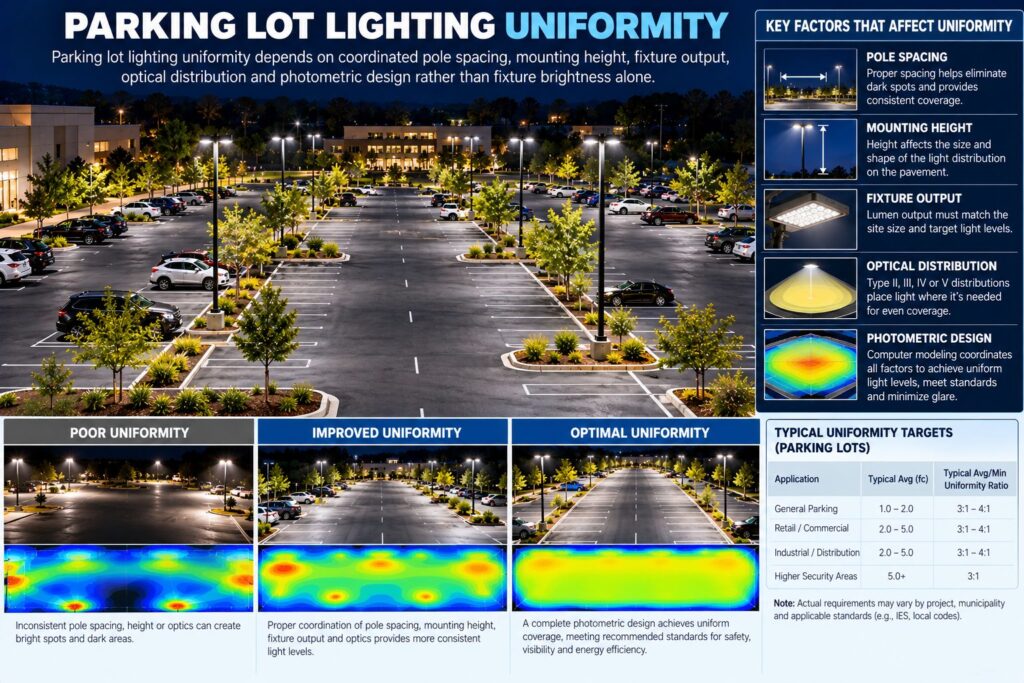
Parking lot lighting uniformity depends on coordinated pole spacing, mounting height, fixture output, optical distribution and photometric design rather than fixture brightness alone.
Planning for Better Parking Lot Lighting Uniformity?
Increasing fixture wattage does not necessarily correct an uneven parking lot.
LED PROS WorldWide can help evaluate fixture output, optical distribution, mounting height, pole spacing and photometric requirements for new parking lot lighting and LED retrofit projects.
Explore our LED Parking Lot Lights, Request a Quote, or call 844-533-7767 with your site plan, pole information, existing fixtures when applicable, and lighting requirements.
What Is Parking Lot Lighting Uniformity?
Lighting uniformity describes the relationship between brighter and darker points across an illuminated area.
In a parking lot, measurements or photometric calculations are typically taken at a grid of points across the area being evaluated.
Those values can reveal:
-
Average illumination
-
Minimum illumination
-
Maximum illumination
-
Bright areas
-
Dark areas
-
How consistently light is distributed between fixtures
A design with suitable average illumination can still have poor uniformity if the minimum values are substantially lower than the rest of the parking lot.
Why Average Foot-Candles Do Not Tell the Whole Story
Suppose two parking lots have the same calculated average illumination.
The first has relatively consistent illumination throughout the parking area.
The second contains very bright areas directly beneath the poles and substantially darker areas between them.
The average may be similar, but the visual environment is not.
This is why average foot-candles should not be evaluated by themselves.
Minimum illumination and uniformity help show whether the light is being distributed effectively across the site.
Our Parking Lot Foot-Candle Requirements for Commercial Properties guide provides a broader discussion of parking lot illumination levels.
What Is a Parking Lot Lighting Uniformity Ratio?
A uniformity ratio expresses the relationship between illumination values within the evaluated area.
Depending on the project or applicable criteria, uniformity may be expressed using relationships such as:
Average-to-minimum
or
Maximum-to-minimum
For example, an average-to-minimum ratio compares the calculated average illumination with the lowest calculated point in the defined area.
A smaller difference between those values generally indicates more consistent illumination.
However, there is no single uniformity ratio that should automatically be applied to every parking lot.
The appropriate criterion depends on the project type, authority having jurisdiction, owner requirements and applicable lighting guidance.
Average-to-Minimum Uniformity
Average-to-minimum uniformity compares the average calculated illumination with the lowest calculated value.
Conceptually:
Average illumination ÷ Minimum illumination = Average-to-minimum ratio
If a parking area averages 3 foot-candles and has a minimum of 1 foot-candle:
3 ÷ 1 = 3:1
This calculation describes the relationship between those two values.
It does not, by itself, establish whether 3:1 is acceptable for a particular project.
That determination must come from the applicable project criteria.
Maximum-to-Minimum Uniformity
Maximum-to-minimum uniformity compares the brightest calculated point with the darkest calculated point.
Conceptually:
Maximum illumination ÷ Minimum illumination = Maximum-to-minimum ratio
This can help identify large differences between bright areas near fixtures and darker portions of the parking lot.
Again, the calculated ratio is a measurement of the design. Whether a particular value satisfies the project depends on the requirements being applied.
Uniformity Is Not the Same as Brightness
A brighter parking lot is not necessarily a more uniform parking lot.
Increasing fixture lumen output can increase illumination across the site while leaving the basic relationship between bright and dark areas unresolved.
In some cases, excessive output can make the contrast even more noticeable by creating stronger hot spots beneath fixtures.
Uniformity is primarily a distribution and layout problem, not simply a wattage problem.
What Causes Poor Parking Lot Lighting Uniformity?
Several conditions can contribute to uneven illumination.
Important variables include pole spacing, mounting height, fixture distribution, lumen output, pole placement, fixture orientation and site geometry.
Existing parking lots can also have irregular pole locations that were determined by property boundaries, landscaping, utilities or previous construction.
A successful lighting design has to work with those conditions rather than assuming an ideal grid.
Pole Spacing and Uniformity
Large distances between poles can make it difficult for adjacent fixture distributions to overlap adequately.
Illumination may be strong near each pole and decline substantially toward the midpoint between poles.
Simply adding more lumens at the existing poles does not always solve the problem.
The designer may instead need to evaluate:
-
Different optical distributions
-
Different lumen packages
-
Higher mounting heights where appropriate
-
Additional fixtures
-
Additional poles
-
Different fixture orientations
The appropriate solution depends on the actual site.
Mounting Height and Uniformity
Mounting height changes the relationship between the fixture’s photometric distribution and the parking surface.
As mounting height changes, coverage, illumination levels, fixture overlap, glare and the relationship between brighter and darker areas across the site can also change.
The result depends on fixture output, optical distribution, pole spacing, fixture orientation and site geometry. Increasing or decreasing mounting height therefore does not automatically improve uniformity.
Mounting height should be evaluated as part of the complete lighting layout rather than as an independent solution to uneven illumination.
Our Area Lighting Pole Height Guide explains these relationships in greater detail.
Optical Distribution and Uniformity
Fixture optics determine where the luminaire directs its light.
Parking lot area lights may be available with Type II, Type III, Type IV and Type V distributions.
Matching those distributions to pole location can improve how adjacent coverage patterns work together.
For example, an interior pole and a perimeter pole may require very different optical patterns even though both are part of the same parking lot.
Our Parking Lot Light Distribution Guide explains how these distribution types differ.
Uniformity Often Requires Multiple Optics
A parking lot does not necessarily need the same optical distribution on every pole.
Perimeter poles may require forward-oriented distributions.
Interior poles may benefit from broader distributions.
Corner locations can present still another coverage problem.
Using the appropriate optics for individual pole locations can produce better overall uniformity than specifying one distribution for the entire property simply for convenience.
Lumen Output and Uniformity
Fixture output still matters.
A luminaire must provide enough useful light to cover its intended area.
However, the highest-output fixture is not automatically the best choice.
Excessive output can create high maximum values near fixtures while doing relatively little to correct a poorly illuminated area caused by inadequate distribution or excessive pole spacing.
The objective is to coordinate output with optics and layout.
Hot Spots Beneath Parking Lot Lights
A hot spot is an area of comparatively high illumination.
In parking lots, these frequently occur close to poles or directly beneath luminaires.
Some variation is unavoidable, but severe hot spots can indicate that the fixture output, optics, mounting height or spacing are poorly coordinated.
High maximum values can also distort the average illumination calculation.
A parking lot with several intense hot spots may report an acceptable average while still containing undesirable dark areas elsewhere.
Dark Areas Between Parking Lot Poles
Dark areas commonly occur where the useful distributions from adjacent fixtures do not overlap adequately.
They can appear:
-
Midway between widely spaced poles
-
At property corners
-
Behind poorly positioned fixtures
-
Near landscaping or physical obstructions
-
Along irregular site boundaries
-
In areas poorly served by the selected distribution
Photometric analysis can identify these conditions before fixtures are installed.
Uniformity Around Entrances and Pedestrian Areas
Parking lots often transition into sidewalks, entrances, loading areas and other pedestrian spaces.
Large changes in illumination between adjacent areas can affect the visual environment.
Lighting design should therefore consider how parking-area illumination transitions into surrounding areas rather than treating every section of the property as an isolated rectangle.
Fixture selection, pole location and distribution can help manage those transitions.
Uniformity and Parking Lot Security
Security lighting is not simply a matter of making a parking lot brighter.
Consistent illumination can support visibility by reducing extreme differences between bright and dark areas.
However, lighting is only one component of site security.
Our Parking Lot Security Lighting Guide discusses lighting alongside entrances, pedestrian areas, visibility, glare and other site considerations.
Uniformity and Glare Are Different Problems
A parking lot can have good calculated uniformity and still create uncomfortable glare.
Likewise, a low-glare fixture does not automatically produce good uniformity.
Uniformity concerns differences in illumination across the evaluated surface.
Glare concerns visual discomfort or reduced visibility caused by excessive brightness within the field of view.
Both should be considered in a complete parking lot lighting design. Our Parking Lot Lighting Glare & Light Trespass Guide explains how fixture brightness, optics, mounting height, shielding and property boundaries affect unwanted light beyond uniformity alone.
Uniformity in LED Parking Lot Retrofits
Retrofit projects can be particularly challenging because existing pole locations are usually fixed.
Older HID systems may have been designed around different fixture distributions and lumen packages.
Replacing each existing fixture with an LED of nominally equivalent output does not guarantee that the resulting system will have acceptable uniformity.
A retrofit should evaluate the new LED photometry using the existing pole locations and mounting heights.
Our LED Parking Lot Lighting Retrofit Guide explains the broader retrofit process.
Can Existing Pole Locations Produce Good Uniformity?
Often they can, particularly when the original pole layout is reasonably suited to the property.
Modern LED optics provide several distribution choices that can help adapt fixtures to existing locations.
But optics cannot overcome every site limitation.
Very large pole spacing, poor pole placement or substantial changes to the parking area’s geometry can require additional poles or other design changes.
Photometric modeling can be used to evaluate those conditions and compare fixture configurations before equipment is ordered.
Photometric Plans Show Uniformity Before Installation
Photometric analysis uses fixture-specific photometric data to model predicted illumination across a site.
A typical parking lot plan displays a grid of calculated values.
From those values, the designer can evaluate:
-
Average illumination
-
Minimum illumination
-
Maximum illumination
-
Uniformity ratios
-
Coverage between poles
-
Bright and dark areas
-
Property-line illumination
Alternative fixture outputs, optics, mounting heights and orientations can then be compared before the lighting system is installed.
Look Beyond the Average on a Photometric Plan
When reviewing a photometric plan, do not stop at the average foot-candle value.
Review the minimum and maximum values and where those values occur.
A low minimum may reveal an isolated dark area.
An unusually high maximum may indicate a hot spot.
The calculated grid can also show whether the issue is widespread or confined to a particular corner, pole or transition area.
This makes the photometric plan a diagnostic tool as well as a compliance document.
Uniformity and Property Boundaries
Improving uniformity does not justify sending excessive light beyond the property.
For perimeter locations, the designer needs to balance coverage within the parking area against spill light outside it.
Directional optics, fixture output, pole setback, mounting height, orientation and shielding can all affect this balance.
The objective is useful, reasonably consistent illumination where it is required.
Uniformity and Lighting Controls
Controls can reduce parking lot output during periods of low activity.
If fixtures dim proportionally, the general distribution pattern may remain similar while illumination levels decrease.
However, control strategies involving different fixture groups or zones can change the lighting relationships across the property.
Controls therefore should be considered as part of the overall lighting plan.
They should not be used as a substitute for correcting poor fixture distribution or placement.
New Parking Lots Versus Existing Parking Lots
New construction offers greater flexibility because pole locations, mounting heights and fixture quantities can potentially be coordinated from the beginning.
Retrofits typically have more constraints because existing poles, underground wiring and site improvements may remain.
Both can achieve good lighting performance, but the design process is different.
For retrofit projects, fixture optics and photometric modeling become especially important because the designer has fewer opportunities to change the physical layout.
Parking Lot Uniformity Design Checklist
| Variable | Effect on Uniformity |
|---|---|
| Pole spacing | Determines distance between overlapping fixture coverage |
| Mounting height | Influences coverage area and light spread |
| Optical distribution | Determines where fixture lumens are directed |
| Lumen output | Determines available light for the intended area |
| Pole location | Establishes geometry of the lighting system |
| Fixture orientation | Changes direction of the photometric pattern |
| Site geometry | Creates different coverage requirements |
| Property boundaries | Can limit useful distribution |
| Obstructions | Can create localized dark areas |
| Existing infrastructure | Can restrict retrofit design choices |
| Photometric analysis | Predicts the combined result before installation |
Inline Buyer Q&A
What is good parking lot lighting uniformity?
There is no single uniformity ratio appropriate for every parking lot. The required ratio depends on the project, property type, applicable guidance, owner requirements and local criteria.
Is a lower uniformity ratio better?
For ratios such as average-to-minimum or maximum-to-minimum, a smaller numerical difference generally represents more consistent illumination. Whether a particular ratio is acceptable depends on the project’s criteria.
Can I improve uniformity by installing brighter LED fixtures?
Not necessarily. Higher output may increase light levels without correcting poor distribution or excessive pole spacing. Optics, mounting height and layout should also be evaluated.
What causes dark spots between parking lot poles?
Common causes include excessive pole spacing, insufficient fixture output, inappropriate optical distribution, low mounting height, poor fixture orientation and irregular pole placement.
Can different optics improve uniformity?
Yes. Using distributions suited to perimeter, interior and corner locations can improve how fixture coverage overlaps across the property.
Do I need photometrics to evaluate uniformity?
Photometric analysis is the preferred method when uniformity is important because it shows calculated illumination throughout the site rather than relying on fixture wattage or lumen output alone.
Improve Parking Lot Lighting Performance Before Installation
LED PROS WorldWide supplies commercial LED parking lot and area lighting for new construction, property upgrades, and LED retrofit projects.
Send us your site plan or property dimensions, existing or proposed pole locations, mounting heights, pole spacing, fixture quantities, voltage, existing fixture information when applicable, required light levels, and project specifications.
Fixture-specific photometric data can be used to compare output, optical distributions and fixture configurations when uniformity and overall lighting performance are important project considerations.
Explore our LED Parking Lot Lights, Request a Quote, or call 844-533-7767 for pricing, fixture selection, and project assistance.
Frequently Asked Questions About Parking Lot Lighting Uniformity
What does a 3:1 lighting uniformity ratio mean?
For an average-to-minimum calculation, 3:1 means the average illumination is three times the minimum illumination. The ratio describes the relationship; it does not by itself establish whether the design satisfies a particular project’s requirements.
Why is minimum illumination important?
The minimum value helps identify the lowest calculated illumination within the evaluated area. Looking only at the average can conceal darker areas.
Why is maximum illumination important?
The maximum can reveal very bright areas or hot spots. A high maximum can also increase the difference between the brightest and darkest portions of the parking lot.
Does pole height affect parking lot uniformity?
Yes. Mounting height affects how broadly light can be distributed and how coverage from neighboring fixtures overlaps.
Does Type V automatically provide better uniformity?
No. Type V provides broad coverage that can be useful for some interior locations, but the correct distribution depends on the pole position and site geometry.
Can an LED retrofit make uniformity worse?
It can if replacement fixtures are selected without considering the existing pole layout, mounting height and photometric distribution. LED technology alone does not guarantee better uniformity.
Can a parking lot have too much light and still have poor uniformity?
Yes. High-output fixtures can create bright areas while other parts of the parking lot remain comparatively dark. Total brightness and uniformity are different design considerations.
Stay Connected with Our Lighting Resources
Add IndustrialLightingFixtures.org as a Preferred Source on Google to see more of our lighting guides and technical resources across Google Search experiences.
Parking Lot Light Levels, Uniformity & Photometric Design Resources
-
LED Parking Lot Lights — commercial LED area-lighting fixtures for parking facilities.
-
Parking Lot Foot-Candle Requirements for Commercial Properties — illumination levels and project-specific lighting criteria.
-
Parking Lot Light Distribution Guide — Type II, III, IV and V optical distributions.
-
LED Parking Lot Lighting Retrofit Guide — evaluating existing poles, fixtures and photometric performance during an LED conversion.
-
Area Lighting Pole Height Guide — mounting height, coverage, spacing and optics.
-
LED Area Lighting Layout Guide — fixture placement, spacing, distribution and photometric planning.
-
Parking Lot Security Lighting Guide — visibility, pedestrian areas, entrances and security-oriented lighting considerations.