Discover Why Suspended Ceiling Lighting Remains the Preferred Choice for Commercial Interiors
Walk into almost any office building, school, healthcare facility, government office, retail store, or professional building, and chances are you’ll find a suspended, or “drop,” ceiling overhead. While these ceiling systems have been a staple of commercial construction for decades, the lighting installed within them has evolved dramatically. Today’s LED drop ceiling lighting provides greater energy efficiency, improved illumination, lower maintenance costs, and longer service life than the fluorescent fixtures that once dominated commercial interiors.
A drop ceiling, also known as a suspended ceiling or lay-in ceiling, consists of a lightweight metal grid suspended below the building’s structural ceiling. Ceiling panels rest within the grid, creating a finished appearance while concealing HVAC ductwork, electrical wiring, plumbing, fire protection systems, and communication infrastructure. This accessible plenum space makes maintenance and future renovations significantly easier than in buildings with exposed or permanently finished ceilings.
One of the greatest advantages of suspended ceilings is their flexibility when integrating lighting systems. Standard ceiling grids are designed to accommodate a variety of fixture types, including LED troffers, flat panels, recessed luminaires, and specialty ceiling fixtures. Modern LED technology has further enhanced these systems by providing brighter, more uniform illumination while consuming substantially less electricity and requiring far less maintenance.
Whether you’re renovating an older office building, upgrading a school, modernizing a healthcare facility, or designing a new commercial space, understanding the benefits of drop ceiling lighting helps ensure you select a lighting solution that supports productivity, visual comfort, and long-term operational savings.
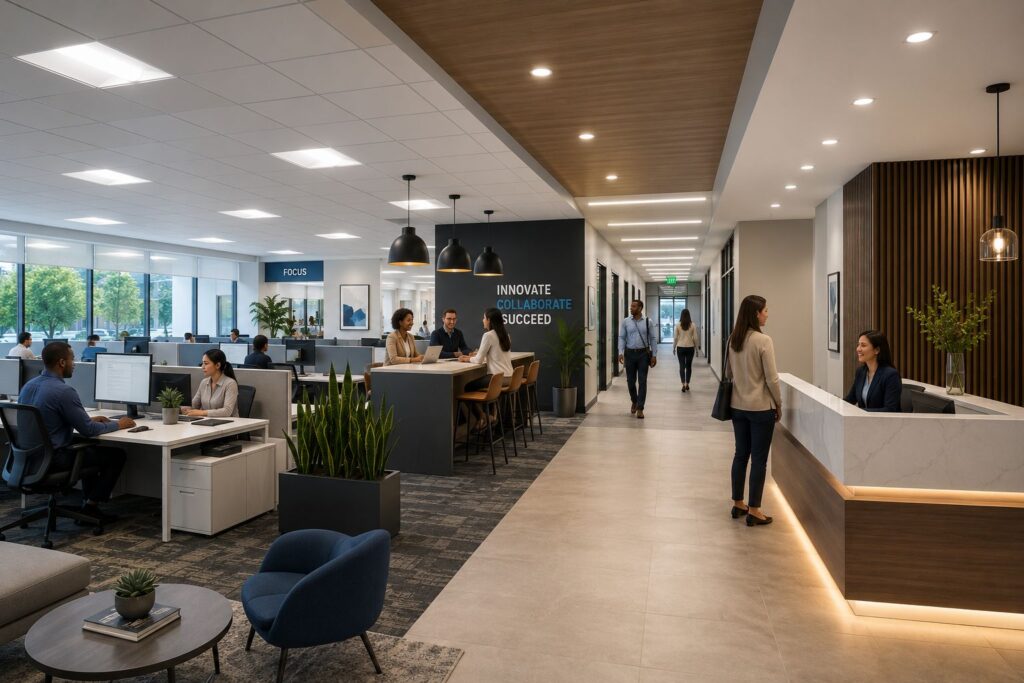
Commercial drop ceiling lighting systems provide flexible installation, simplified maintenance, and energy-efficient illumination for offices, schools, healthcare facilities, and other commercial buildings.
Upgrade Your Commercial Ceiling Lighting with LED
Replacing outdated fluorescent fixtures with modern LED lighting is one of the most effective ways to improve indoor lighting quality while reducing maintenance and energy costs.
Our lighting specialists can help you select the right fixtures for office buildings, schools, healthcare facilities, retail spaces, municipal buildings, and other commercial applications.
We Can Help With
✔ LED Troffers
✔ LED Flat Panels
✔ Commercial Ceiling Lights
✔ Lighting Layout Assistance
✔ Commercial Project Pricing
✔ Premium 5-Year and 10-Year Warranty Options
📞 Call 1-844-533-7767 to discuss your project.
What Is Drop Ceiling Lighting?
Drop ceiling lighting refers to fixtures specifically designed for installation within suspended ceiling systems. These ceilings typically use a metal grid supporting removable ceiling tiles, allowing lighting fixtures to fit neatly into the grid while maintaining easy access to the space above.
Unlike finished drywall ceilings, suspended ceilings simplify building maintenance because ceiling panels can be removed individually to access wiring, HVAC equipment, plumbing, network cabling, and fire protection systems. This flexibility has made drop ceilings the preferred choice for many commercial, institutional, and public buildings.
Modern LED fixtures designed for suspended ceilings are available in numerous configurations, allowing designers to tailor lighting systems to the specific needs of each space while maintaining a clean, professional appearance.
🛠️ Design Insight
Suspended ceilings are more than an architectural feature—they provide an accessible service space that simplifies future renovations and maintenance. Choosing lighting fixtures that integrate seamlessly with the ceiling grid helps reduce installation time and supports easier upgrades throughout the building’s life.
Drop ceiling lighting is just one component of a complete Indoor Lighting strategy, where fixture selection, lighting layout, and control systems work together to create comfortable, energy-efficient commercial interiors.
Why Commercial Buildings Continue to Use Suspended Ceilings
Drop ceilings remain popular because they offer practical advantages beyond lighting.
Easy Access for Maintenance
Removable ceiling panels allow maintenance personnel to inspect and service HVAC equipment, electrical wiring, plumbing, and communications infrastructure without damaging finished ceilings.
Flexible Building Renovations
As office layouts, classrooms, or healthcare spaces evolve, suspended ceilings make it easier to relocate lighting fixtures, add wiring, or reconfigure building systems.
Improved Acoustics
Acoustical ceiling tiles help absorb sound, creating quieter and more comfortable environments for offices, schools, healthcare facilities, and conference rooms.
Professional Appearance
Drop ceilings conceal structural components while creating a clean, finished interior that complements modern commercial architecture.
Efficient Lighting Integration
Standard grid systems accommodate a wide variety of LED fixtures, allowing designers to combine ambient, task, and accent lighting within the same ceiling system.
🏢 Project Spotlight
During the renovation of a municipal office building, the existing suspended ceiling grid was retained while aging fluorescent fixtures were replaced with LED troffers and flat panels. Reusing the ceiling system reduced construction costs, minimized disruption to building operations, and provided employees with brighter, more energy-efficient lighting.
Benefits of Upgrading to LED Drop Ceiling Lighting
Modern LED fixtures have transformed commercial ceiling lighting by delivering measurable improvements in efficiency, reliability, and occupant comfort.
Key advantages include:
- Lower electrical consumption
- Longer fixture life
- Reduced maintenance requirements
- Improved light uniformity
- Better color rendering
- Instant-on operation
- Lower heat output
- Compatibility with occupancy sensors and smart controls
- Reduced total cost of ownership
Compared to fluorescent lighting, LED systems eliminate routine lamp and ballast replacements while providing consistent illumination throughout their service life.
⚡ Energy Savings Snapshot
Many commercial buildings upgrading from fluorescent fixtures to LED suspended ceiling lighting reduce lighting energy consumption by 40–70%, while also lowering maintenance expenses and improving overall lighting quality.
Where Commercial Drop Ceiling Lighting Works Best
Suspended ceiling systems have become the standard for many commercial, institutional, and public buildings because they provide an ideal balance of aesthetics, accessibility, and lighting flexibility. Combined with modern LED fixtures, drop ceiling lighting delivers consistent illumination while simplifying maintenance and future renovations.
Although nearly every commercial building has unique lighting requirements, several applications consistently benefit from suspended ceiling systems and integrated LED lighting.
Office Buildings
Office environments require lighting that promotes employee productivity while creating a comfortable atmosphere for daily work. Drop ceilings provide convenient access to HVAC systems, electrical wiring, and network infrastructure, making future office reconfigurations significantly easier.
LED ceiling lighting is commonly installed in:
- Open office workstations
- Private offices
- Conference rooms
- Break rooms
- Reception areas
- Administrative offices
Many office renovations now replace aging fluorescent fixtures with LED troffers or flat panel fixtures that provide more uniform illumination while reducing maintenance and electrical costs.
🏢 Project Spotlight
A regional accounting firm modernized its headquarters by replacing fluorescent lay-in fixtures with LED flat panels and upgrading conference rooms with recessed downlights. The suspended ceiling system allowed electricians to complete the lighting retrofit with minimal disruption to daily operations.
Many office renovations replace aging fluorescent fixtures with LED Troffers, which are specifically designed to fit standard suspended ceiling grids while providing uniform ambient illumination throughout workspaces
Schools and Universities
Educational facilities rely on dependable lighting that supports concentration, reduces eye strain, and creates safe learning environments. Suspended ceilings simplify maintenance during school breaks while allowing future technology upgrades without major construction.
Drop ceiling lighting is frequently used in:
- Classrooms
- Libraries
- Computer labs
- Administrative offices
- Faculty lounges
- Student common areas
Modern LED lighting also helps school districts reduce maintenance costs by eliminating frequent fluorescent lamp and ballast replacements.
📐 Specification Tip
For most classrooms, specify fixtures with 4000K color temperature and a minimum CRI of 80 to provide bright, comfortable illumination that supports reading, writing, and digital learning environments.
Healthcare Facilities
Hospitals, clinics, medical offices, and outpatient centers often utilize suspended ceilings because they provide quick access to critical building systems while maintaining clean, professional interiors.
LED drop ceiling lighting is commonly installed in:
- Waiting rooms
- Examination rooms
- Administrative offices
- Corridors
- Laboratories
- Staff work areas
Many healthcare facilities select high-quality LED fixtures because of their long service life, consistent light output, and reduced maintenance requirements.
Retail Stores
Retail lighting must create an inviting shopping experience while accurately displaying merchandise. Suspended ceilings provide flexibility for relocating lighting as store layouts change.
Retail applications commonly combine:
- LED flat panels
- Ceiling fixtures
- Recessed downlights
- Accent lighting
Together these fixtures create layered lighting designs that improve customer comfort while highlighting products.
Municipal and Government Buildings
Government offices, courthouses, libraries, community centers, and administrative buildings often require lighting systems that balance durability, efficiency, and long-term operating costs.
Suspended ceilings simplify ongoing maintenance while providing flexibility for future renovations as building requirements evolve.
Many municipalities continue replacing fluorescent fixtures with LED systems as part of broader energy-efficiency initiatives.
Financial Institutions and Professional Offices
Banks, law firms, insurance offices, and engineering firms benefit from clean, professional lighting that creates a welcoming atmosphere for both employees and clients.
Modern LED ceiling lighting improves visual comfort while reducing glare across workstations, reception areas, and meeting rooms.
Common Commercial Drop Ceiling Lighting Fixtures
One of the greatest advantages of suspended ceilings is the ability to accommodate several different lighting solutions. Rather than relying on a single fixture type, designers often combine multiple luminaires to create comfortable, energy-efficient interior environments.
LED Troffers
LED troffers remain the most widely specified fixture for suspended-grid ceilings. Available in standard 1×4, 2×2, and 2×4 sizes, they provide broad, uniform illumination across offices, classrooms, healthcare facilities, and administrative spaces.
Troffers are an excellent choice when consistent ambient lighting is the primary objective.
➡ Explore our LED Troffers.
LED Flat Panel Fixtures
Flat panel fixtures provide a sleek, contemporary appearance while delivering soft, evenly distributed illumination. They are frequently selected for modern office buildings, educational facilities, healthcare environments, and professional interiors where visual comfort is a priority.
Their slim profile and clean architectural appearance make them an increasingly popular alternative to traditional fluorescent fixtures.
Surface-Mounted Ceiling Lights
Surface-mounted LED ceiling lights are commonly used where recessed installation is impractical or where finished ceilings require direct-mounted fixtures.
Typical applications include:
- Utility rooms
- Corridors
- Apartment common areas
- Stairwells
- Mechanical rooms
- Small commercial offices
➡ Learn more about our Commercial LED Ceiling Lights.
Commercial Recessed Downlights
Downlights provide focused illumination for reception areas, conference rooms, hospitality spaces, and retail environments. While they are not typically used as the primary ambient lighting source throughout an entire suspended ceiling system, they work exceptionally well when combined with troffers or flat panels.
➡ Explore Commercial LED Recessed Downlights.
Architectural Lighting
Decorative pendants and architectural fixtures add visual interest to entrances, executive offices, conference rooms, and collaborative spaces. These fixtures complement ambient ceiling lighting while reinforcing the building’s interior design.
➡ View Architectural Indoor Lighting Solutions.
🛠 Design Insight
The most effective commercial lighting systems rarely rely on a single fixture type. Combining troffers or flat panels for ambient lighting with recessed downlights and architectural fixtures creates layered illumination that improves comfort, enhances aesthetics, and supports a variety of visual tasks throughout the building.
Choosing the Right Fixture for Your Ceiling System
Selecting the proper lighting fixture depends on both the ceiling construction and the activities taking place within the space.
| Ceiling Type | Recommended Fixture |
|---|---|
| Suspended Grid | LED Troffers, Flat Panels |
| Finished Drywall | Surface-Mounted Ceiling Lights, Downlights |
| Open Structure | Linear Strip Fixtures |
| Decorative Lobby | Architectural Fixtures |
| Utility Areas | Surface-Mounted Ceiling Lights |
| Corridors | Surface-Mounted Ceiling Lights or Flat Panels |
No single fixture is ideal for every application. Evaluating ceiling construction, room function, desired illumination levels, and future maintenance requirements helps ensure the lighting system delivers reliable performance while supporting the building’s long-term operational goals.
Designing an Effective Commercial Drop Ceiling Lighting System
Selecting the right fixtures is only one part of a successful lighting project. The overall lighting design—including fixture placement, light levels, color quality, controls, and long-term maintenance planning—determines how well a space performs for years to come.
A thoughtfully designed LED drop ceiling lighting system enhances occupant comfort, improves visibility, lowers operating costs, and creates a professional environment that supports the building’s intended purpose.
Suspended ceiling systems provide an ideal platform for modern LED lighting upgrades. To learn why organizations across every industry are replacing older fluorescent fixtures, read Why Businesses Are Upgrading to Commercial LED Ceiling Lights.
Match Lighting to the Function of the Space
Different areas within the same building often require different lighting strategies. A conference room has very different illumination needs than a storage room or corridor.
Consider the primary activities taking place within each space before selecting fixtures.
| Building Area | Primary Lighting Goal | Recommended Fixtures |
|---|---|---|
| Open Offices | Comfortable ambient lighting | LED Troffers or Flat Panels |
| Conference Rooms | Balanced lighting with reduced glare | Flat Panels with Downlights |
| Classrooms | Uniform illumination for learning | LED Troffers or Flat Panels |
| Healthcare Offices | Comfortable, low-glare lighting | Flat Panels |
| Reception Areas | Professional appearance | Downlights with Architectural Fixtures |
| Corridors | Safe, consistent illumination | Surface-Mounted Ceiling Lights |
| Break Rooms | Comfortable ambient lighting | Surface-Mounted Fixtures |
| Utility Rooms | Functional task lighting | Surface-Mounted Ceiling Lights |
🛠 Design Insight
Rather than selecting the same fixture throughout an entire building, successful commercial lighting projects use different fixture types to support the unique visual tasks performed in each area. This layered approach improves both aesthetics and functionality.
Consider Ceiling Height Before Selecting Fixtures
Ceiling height directly affects fixture selection, spacing, and overall lighting performance.
Lower ceilings generally benefit from wider light distribution and lower wattages, while taller ceilings often require fixtures with higher lumen output or more focused optical distributions.
Typical Ceiling Heights
| Ceiling Height | Common Applications |
|---|---|
| 8–9 feet | Small offices, medical offices, retail |
| 9–10 feet | Classrooms, conference rooms |
| 10–12 feet | Large offices, libraries |
| 12–15 feet | Municipal buildings, commercial spaces |
| 15+ feet | Atriums and specialty interiors |
As ceiling heights increase, fixture spacing should be evaluated carefully to maintain uniform illumination and minimize shadows.
📐 Specification Tip
Selecting a higher-wattage fixture does not automatically produce better lighting. Proper fixture spacing and optical distribution are often more important than simply increasing lumen output.
Selecting the Right Color Temperature
Color temperature has a significant impact on how occupants perceive a space.
Commercial LED fixtures are commonly available in several color temperatures.
| Color Temperature | Appearance | Typical Applications |
|---|---|---|
| 3000K | Warm White | Hospitality, lounges |
| 3500K | Neutral White | Offices, meeting rooms |
| 4000K | Cool Neutral | Schools, healthcare, offices |
| 5000K | Daylight | Warehouses, utility areas |
Many commercial buildings standardize on 4000K, providing a bright, comfortable environment suitable for a wide range of professional applications.
💡 Pro Tip
Standardizing color temperature throughout a facility creates a more consistent appearance and simplifies future maintenance when additional fixtures are installed.
Color Rendering Matters
While brightness receives most of the attention, Color Rendering Index (CRI) also influences how comfortable and productive an interior feels.
Higher CRI values allow colors to appear more natural, improving visibility and occupant satisfaction.
General recommendations include:
- CRI 80 for most commercial applications
- CRI 90+ where accurate color perception is important, such as healthcare, design studios, retail displays, and showrooms
Good color rendering helps employees distinguish documents, products, finishes, and equipment more accurately.
Reducing Glare Improves Occupant Comfort
Poorly designed lighting can create excessive glare on computer monitors, whiteboards, polished floors, and other reflective surfaces.
Modern LED fixtures often include advanced optical systems that diffuse light more evenly while minimizing uncomfortable brightness.
Good lighting design considers:
- Fixture spacing
- Lens design
- Ceiling reflectance
- Wall reflectance
- Workstation orientation
- Viewing angles
Reducing glare improves employee comfort while helping reduce visual fatigue during extended work periods.
🏢 Project Spotlight
An engineering firm’s conference rooms experienced significant screen glare from aging fluorescent fixtures. During a lighting renovation, the fixtures were replaced with LED flat panels featuring low-glare diffusers, resulting in improved presentation visibility and a more comfortable meeting environment.
Incorporating Lighting Controls
One of the greatest advantages of LED lighting is compatibility with modern lighting control systems.
Common control options include:
- Occupancy sensors
- Vacancy sensors
- Daylight harvesting
- Programmable schedules
- Networked lighting controls
- Building Management System (BMS) integration
These technologies help reduce unnecessary energy consumption while extending fixture life.
Emergency Lighting Considerations
Commercial buildings often require emergency illumination to support occupant safety during power interruptions.
Depending on local building and fire codes, emergency lighting may include:
- Emergency drivers integrated into LED fixtures
- Dedicated emergency luminaires
- Illuminated exit signs
- Battery backup systems
- Generator-supported lighting circuits
Planning emergency lighting during the initial design phase helps simplify installation and supports code compliance.
📐 Specification Tip
Always verify local building codes and life-safety requirements before specifying emergency lighting equipment. Requirements may vary depending on occupancy classification and jurisdiction.
Long-Term Maintenance Planning
Although LED fixtures require significantly less maintenance than fluorescent systems, maintenance planning should still be considered during the design process.
Questions to ask include:
- Are drivers easily replaceable?
- Will replacement fixtures remain available?
- Can maintenance personnel safely access the ceiling?
- Are controls standardized throughout the facility?
- Is warranty coverage appropriate for the building’s operating schedule?
Selecting commercial-grade fixtures backed by dependable manufacturer warranties helps minimize future maintenance costs.
⚡ Energy Savings Snapshot
Many commercial LED ceiling fixtures are rated for 50,000 to 100,000 hours of operation. In a typical office operating 10 hours per day, five days per week, that can translate to well over a decade of dependable service before significant lumen depreciation occurs, substantially reducing maintenance compared to legacy fluorescent systems.
Planning for Future Flexibility
One of the greatest strengths of suspended ceiling systems is adaptability. As organizations grow, departments relocate, or technology changes, lighting systems can often be modified with minimal disruption.
Choosing standardized fixture sizes, compatible controls, and scalable lighting layouts today makes future renovations faster, more cost-effective, and less disruptive to building occupants.
Commercial Drop Ceiling Lighting Buyer's Planning Checklist
Before selecting LED drop ceiling lighting for your facility, review the following considerations to help ensure the lighting system meets both your operational requirements and long-term maintenance goals.
✓ Building Information
- Building type
- Ceiling height
- Suspended ceiling grid size (2×2 or 2×4)
- Existing lighting system
- New construction or retrofit
✓ Lighting Requirements
- Required light levels
- Color temperature
- Color Rendering Index (CRI)
- Glare control requirements
- Occupancy patterns
✓ Controls
- Occupancy sensors
- Daylight harvesting
- Dimming capability
- Emergency lighting
- Building automation compatibility
✓ Long-Term Considerations
- Expected operating hours
- Warranty requirements
- Driver accessibility
- Future renovations
- Maintenance staffing
Planning these items before purchasing fixtures often reduces installation costs while improving long-term performance.
Inline Buyer Q&A
Should I replace fluorescent fixtures or retrofit them?
Both approaches can be appropriate.
Complete fixture replacement provides an opportunity to update the housing, optics, driver, controls, appearance, and overall lighting performance. Retrofit solutions may reduce installation work and allow portions of an existing fixture to remain in service.
The better choice depends on fixture age and condition, existing components, ceiling access, labor costs, desired lighting performance, controls, maintenance objectives, and project budget.
Are LED flat panels better than LED troffers?
Neither fixture type is universally better.
LED troffers provide a familiar recessed appearance and are widely used in traditional suspended-grid ceilings. Flat panels typically have a thinner profile and broad luminous surface that can create a different architectural appearance.
The appropriate choice depends on the ceiling system, room geometry, desired appearance, optical performance, glare considerations, controls, and project requirements.
Can LED drop ceiling lighting reduce maintenance costs?
It can. LED fixtures eliminate routine fluorescent lamp replacement and can provide longer service intervals than many older fluorescent systems.
Actual maintenance savings depend on fixture and driver quality, operating hours, accessibility, environmental conditions, existing maintenance requirements, and the replacement system selected.
Can occupancy sensors be used with drop ceiling lighting?
Yes. Many commercial LED ceiling fixtures can be integrated with occupancy or vacancy sensors, daylight-responsive controls, dimming, scheduling, and other lighting-control systems.
Compatibility depends on the fixture, driver, sensor, and control architecture, so required controls should be identified before equipment is selected.
What warranty should I look for?
Warranty coverage varies considerably among commercial lighting products and manufacturers.
Rather than selecting a fixture based solely on warranty length, evaluate the warranty terms together with driver and LED quality, thermal management, published performance, serviceability, manufacturer support, controls, and expected operating conditions.
💡 Pro Tip
Don’t evaluate fixtures solely on purchase price. Consider energy savings, maintenance costs, warranty coverage, light quality, and expected operating life to determine the true long-term value of a commercial lighting system.
Why Choose LED Pros WorldWide?
Selecting the right commercial lighting partner is just as important as choosing the right fixtures. At LED Pros WorldWide, we work with facility managers, electrical contractors, architects, engineers, municipalities, schools, healthcare providers, and commercial property owners to deliver dependable lighting solutions tailored to each project’s needs.
Our team can assist with:
- Commercial fixture recommendations
- Lighting layout guidance
- Energy-efficient retrofit planning
- Product comparisons
- Photometric support
- Competitive project pricing
- Large-volume commercial orders
- Premium fixtures backed by 5-year and 10-year warranties
Whether you’re renovating a small office or designing lighting for a multi-building campus, we can help you select commercial LED ceiling lighting that delivers reliable performance for years to come.
Ready to Upgrade Your Commercial Drop Ceiling Lighting?
Suspended-ceiling lighting projects involve more than selecting a fixture that fits the ceiling grid. Fixture type, room dimensions, ceiling height, required illumination, controls, glare, color temperature, existing equipment, and long-term maintenance can all affect the appropriate solution.
Whether you’re renovating an office, school, healthcare facility, municipal building, or other commercial interior, our lighting specialists can help compare troffers, flat panels, recessed fixtures, retrofit options, controls, and lighting layouts.
Explore our Commercial LED Ceiling Lights or call 1-844-533-7767 to discuss your commercial drop-ceiling lighting project.
Frequently Asked Questions
What is commercial drop ceiling lighting?
Commercial drop ceiling lighting refers to fixtures designed for use with suspended ceiling-grid systems commonly found in offices, schools, healthcare facilities, retail spaces, government buildings, and other commercial and institutional interiors.
Fixtures can be recessed into the grid or incorporated into the ceiling system in other configurations depending on the product and application.
What fixtures work best in suspended ceilings?
Common options include LED troffers, flat panels, recessed downlights, and other fixtures designed or appropriately mounted for suspended-ceiling applications.
The best choice depends on the ceiling system, room dimensions, visual tasks, desired appearance, illumination requirements, controls, and project specifications.
Why are suspended ceilings common in commercial buildings?
Suspended ceilings can create a finished interior surface while providing accessible space above the ceiling for electrical wiring, communications, HVAC components, plumbing, fire-protection systems, and other building services.
Their modular grid construction can also simplify access, ceiling-tile replacement, and integration of lighting fixtures.
How long do commercial LED ceiling fixtures last?
Commercial LED ceiling fixtures can provide operating lives measured in tens of thousands of hours. Published lifetime ratings vary by fixture and manufacturer.
Actual service life depends on LED and driver quality, thermal management, operating hours, ambient conditions, electrical conditions, controls, and other operating factors.
What color temperature is best for offices?
There is no single color temperature appropriate for every office.
3500K and 4000K are commonly considered for commercial office environments, while warmer or cooler selections may be appropriate depending on the desired appearance, visual tasks, daylight, interior finishes, and overall lighting design.
CCT-selectable fixtures can provide additional flexibility during installation or renovation projects.
Can existing fluorescent fixtures be upgraded to LED?
Yes. Existing fluorescent ceiling systems may be upgraded through complete LED fixture replacement, retrofit components, or compatible replacement lamps depending on the existing equipment and project objectives.
Fixture condition, ballasts, sockets, wiring, controls, labor, expected maintenance, and desired lighting performance should be evaluated before choosing an approach.
Do LED ceiling lights qualify for utility rebates?
Some commercial LED lighting upgrades may qualify for utility or energy-efficiency incentive programs.
Eligibility, approved equipment, documentation, incentive amounts, and program requirements vary by utility and location. Requirements should be confirmed before equipment is purchased when incentives are part of the project’s financial analysis.
Are LED ceiling fixtures compatible with emergency lighting systems?
Some commercial LED ceiling fixtures are available with emergency drivers or other emergency-lighting provisions.
Emergency and life-safety lighting must satisfy the codes, equipment requirements, operating duration, illumination criteria, testing provisions, and other requirements applicable to the facility and jurisdiction. Emergency capability should therefore be addressed during system design rather than assumed from the fixture type alone.
What is the difference between a drop ceiling light and a recessed downlight?
Drop-ceiling lighting is a broad category covering fixtures incorporated into suspended ceiling systems. Troffers and flat panels are commonly used to provide relatively broad general illumination across a room.
Recessed downlights typically provide illumination from smaller ceiling apertures and can be used for corridors, reception areas, conference rooms, retail spaces, architectural applications, and other areas where a different distribution or appearance is desired.
Stay Connected with Our Lighting Resources
Add IndustrialLightingFixtures.org as a Preferred Source on Google to see more of our lighting guides and technical resources across Google Search experiences.

Related Commercial Ceiling Lighting Resources
- Commercial LED Ceiling Lights — Explore the broader commercial ceiling-lighting category for offices, schools, healthcare facilities, retail spaces, and institutional interiors.
- LED Troffers — Compare commercial LED troffers designed specifically for suspended-grid ceiling systems and general overhead illumination.
- Using Drop Ceiling Light Fixtures Makes Sense — Review practical considerations for selecting 1×4, 2×2, 2×4, and other fixture configurations for commercial drop ceilings.
- Commercial Recessed Downlights — Explore recessed downlighting as an alternative or complementary solution for conference rooms, reception areas, corridors, retail spaces, and other interiors.
- Indoor Lighting — Explore the broader commercial indoor-lighting category, including ceiling, recessed, architectural, and other interior lighting systems.