Businesses today face increasing pressure to reduce operating expenses, improve workplace productivity, and meet sustainability goals without compromising the quality of their facilities. One of the most effective ways to achieve these objectives is by upgrading outdated fluorescent lighting systems to modern LED technology. Commercial LED ceiling lights have become the preferred choice for offices, schools, healthcare facilities, retail stores, municipal buildings, and countless other commercial environments because they deliver brighter, more uniform illumination while consuming significantly less energy.
Unlike older fluorescent fixtures that require frequent lamp and ballast replacements, today’s LED ceiling lights are engineered for long service life, reduced maintenance, and improved lighting performance. Many commercial fixtures feature selectable wattages, adjustable color temperatures, advanced optical systems, and compatibility with occupancy sensors and building automation controls, giving facility managers greater flexibility while lowering long-term operating costs.
Beyond the financial savings, upgrading to LED ceiling lighting improves the overall experience for employees, customers, students, patients, and visitors. Better light quality enhances visibility, reduces glare, supports productivity, and creates more inviting indoor environments. Whether you’re renovating an existing building or designing a new commercial facility, investing in Commercial LED Ceiling Lights is one of the smartest long-term improvements you can make to your lighting system.
This guide explains why organizations across virtually every industry are making the switch to LED ceiling lighting, the measurable benefits they are realizing, and the key factors to consider when planning a successful lighting upgrade.
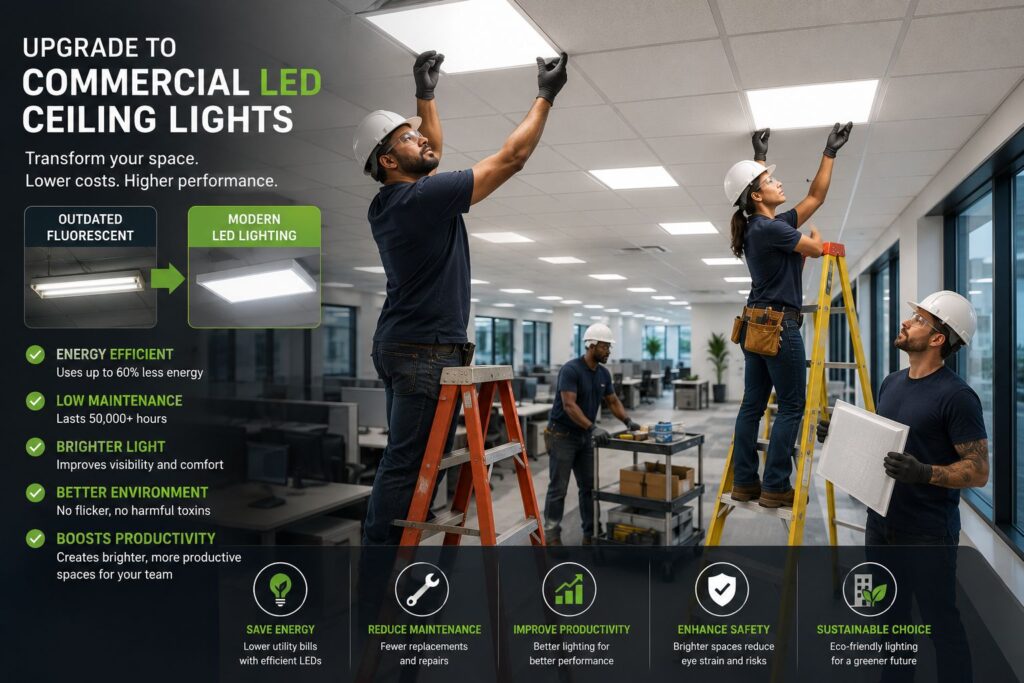
Businesses are replacing outdated fluorescent lighting with commercial LED ceiling lights to improve energy efficiency, reduce maintenance, and create brighter, more productive indoor environments.
Ready to Upgrade Your Commercial Ceiling Lighting?
Replacing aging fluorescent fixtures with modern LED technology is one of the fastest ways to lower operating costs while improving lighting quality throughout your facility.
Whether you’re renovating an office building, upgrading a school, modernizing a healthcare facility, or planning a new commercial development, our lighting specialists can help you select the right solution.
We Can Help With
✔ Commercial LED Ceiling Lights
✔ LED Troffers
✔ Commercial Lighting Layout Assistance
✔ Energy-Efficient Retrofit Solutions
✔ Commercial Project Pricing
✔ Premium Fixtures with 5-Year and 10-Year Warranty Options
📞 Call 1-844-533-7767 to discuss your project or request a quote today.
Why Businesses Are Moving Beyond Fluorescent Ceiling Lighting
For decades, fluorescent ceiling fixtures were the standard lighting solution for commercial buildings. They provided acceptable illumination at a reasonable cost and became commonplace in offices, schools, hospitals, retail stores, government buildings, and countless other facilities. However, advances in LED technology have fundamentally changed the commercial lighting industry.
Today’s Commercial LED Ceiling Lights provide significantly higher energy efficiency, longer operating life, better light quality, and lower maintenance costs than legacy fluorescent systems. As a result, facility managers, property owners, architects, and electrical contractors are increasingly choosing LED fixtures for both renovation projects and new construction.
Beyond reducing electricity consumption, LED ceiling lighting helps create brighter, more comfortable indoor environments that support employee productivity, improve customer experiences, and simplify long-term building maintenance. For many organizations, upgrading lighting has become one of the most cost-effective building improvements available.
Lower Energy Costs Continue to Drive LED Adoption
Reducing operating expenses remains one of the primary reasons businesses replace fluorescent ceiling fixtures with LED technology.
Modern commercial LED fixtures convert significantly more electrical energy into usable light while producing less wasted heat. This allows buildings to maintain—or often improve—illumination levels while consuming substantially less electricity.
Facilities operating lighting systems for ten or more hours each day can realize meaningful utility savings over the life of the fixtures.
Common facilities benefiting from LED upgrades include:
- Office buildings
- Schools and universities
- Healthcare facilities
- Retail stores
- Municipal buildings
- Warehouses
- Professional offices
- Apartment common areas
⚡ Energy Savings Snapshot
Depending on the existing lighting system, many commercial LED ceiling lighting upgrades reduce lighting energy consumption by 40% to 70% while providing improved illumination and lower maintenance requirements.
Reduced Maintenance Means Lower Operating Costs
Maintenance costs often exceed the purchase price of lighting fixtures over the life of a commercial building. Replacing lamps, ballasts, and other aging fluorescent components requires labor, replacement materials, equipment, and in some cases after-hours scheduling to minimize disruption.
Commercial LED ceiling fixtures dramatically reduce these ongoing maintenance requirements.
Instead of replacing lamps every few years, many commercial-grade LED fixtures are designed to operate for 50,000 to 100,000 hours, depending on the product and operating conditions.
For organizations managing multiple buildings, this reduction in maintenance translates into measurable labor savings and fewer service interruptions.
🛠️Design Insight
When evaluating lighting upgrades, calculate the total cost of ownership rather than focusing solely on fixture price. Energy savings, maintenance reductions, and warranty coverage often produce a significantly greater return than the initial purchase cost alone.
Improved Lighting Quality Creates Better Work Environments
Modern LED lighting delivers more than lower utility bills. It also enhances the visual environment for employees, students, patients, customers, and visitors.
Compared to aging fluorescent fixtures, commercial LED ceiling lights provide:
More uniform illumination
Improved color rendering
Reduced flicker
Instant-on operation
Better light distribution
Lower glare
Greater visual comfort
These improvements help create professional interiors that support productivity while making commercial spaces feel brighter and more welcoming.
Many renovation projects combine LED Troffers with modern ceiling fixtures to achieve consistent ambient lighting throughout offices, classrooms, and administrative areas.
LED Technology Continues to Improve
Commercial LED lighting has advanced rapidly over the past decade. Today’s fixtures produce substantially more light using less energy than earlier generations of LED products, while offering better optics, improved thermal management, and longer operating life.
Many modern fixtures also feature:
- Selectable wattages
- Adjustable color temperatures
- Dimming capability
- Occupancy sensor compatibility
- Daylight harvesting controls
- Networked lighting options
These features provide building owners with greater flexibility while helping reduce future operating expenses.
📐 Specification Tip
Select fixtures that offer field-adjustable wattage and color temperature whenever possible. These features provide additional flexibility during installation and simplify future renovations or tenant improvements without requiring fixture replacement.
Field-Selectable Wattage and Color Temperature Offer Greater Flexibility
One of the most significant advancements in commercial LED ceiling lighting is the introduction of field-selectable wattage and adjustable color temperature (CCT) technology. These features allow a single fixture to be configured during installation, giving contractors and facility managers greater flexibility while reducing the need to stock multiple fixture models.
Field-Selectable Wattage
Traditional fluorescent fixtures—and even many first-generation LED fixtures—were manufactured with a fixed wattage and light output. If the illumination level wasn’t appropriate for the space, the only option was to replace the fixture with a different model.
Today’s commercial LED ceiling lights often include field-selectable wattage, allowing the installer to choose from multiple lumen output settings before the fixture is energized. This flexibility helps optimize lighting for different ceiling heights, room sizes, and occupancy needs while simplifying project planning.
Benefits include:
- Greater flexibility during installation
- Ability to fine-tune light levels without replacing fixtures
- Reduced inventory requirements for contractors and distributors
- Simplified future renovations and tenant improvements
- Lower project costs by using one fixture across multiple applications
Adjustable Color Temperature (CCT)
Modern commercial LED fixtures increasingly feature selectable color temperatures, enabling installers to choose the light appearance that best suits the application. Instead of purchasing separate fixtures for different environments, one fixture can often be configured to provide:
- 3000K – Warm White for hospitality areas, lounges, and welcoming spaces
- 3500K – Neutral White for executive offices and conference rooms
- 4000K – Cool Neutral White, the most common choice for offices, schools, and healthcare facilities
- 5000K – Daylight White for utility rooms, maintenance areas, and task-oriented environments
This flexibility allows building owners to create consistent lighting throughout a facility while accommodating the unique requirements of different spaces.
🛠️ Design Insight
Field-selectable wattage and color temperature have become valuable specification tools because they allow a single commercial LED fixture to serve multiple applications. For contractors, this means fewer product variations to order and stock. For facility managers, it provides the flexibility to adjust lighting during renovations or tenant improvements without replacing the entire fixture.
📐 Specification Tip
When comparing commercial LED ceiling lights, prioritize fixtures with both field-selectable wattage and CCT-selectable technology. These features simplify installation, reduce inventory requirements, accommodate future building changes, and provide greater long-term value than fixed-output fixtures.
Supporting Sustainability Goals
Many organizations have established sustainability initiatives focused on reducing energy consumption, lowering carbon emissions, and minimizing waste. Upgrading to commercial LED ceiling lighting supports these objectives by reducing electricity use and eliminating the routine disposal of fluorescent lamps and ballasts.
LED fixtures also generate less heat than many legacy lighting technologies, which can contribute to lower cooling loads in conditioned commercial buildings.
For businesses pursuing energy-efficiency certifications or utility incentive programs, LED lighting upgrades are often among the most practical and cost-effective improvements available.
🏢 Project Spotlight
A multi-tenant office complex upgraded several hundred fluorescent ceiling fixtures to commercial LED ceiling lights during a phased renovation. The project reduced maintenance calls, improved lighting consistency across tenant spaces, and lowered annual energy consumption while modernizing the appearance of the building’s interior.
As organizations continue to modernize their facilities, commercial LED ceiling lighting remains one of the smartest investments for improving operational efficiency, occupant comfort, and long-term building performance.
For a comprehensive overview of available fixture types—including surface-mounted fixtures, flat panels, troffers, and architectural solutions—explore our Commercial LED Ceiling Lights guide. You can also visit our Indoor Lighting resource center for additional planning guides and commercial lighting solutions.
Where Businesses Benefit Most from Commercial LED Ceiling Lights
Although nearly every commercial facility can benefit from upgrading to LED lighting, the return on investment often varies depending on how the building is used. Factors such as operating hours, occupancy patterns, maintenance accessibility, and visual requirements all influence the value of replacing legacy fluorescent lighting with modern LED ceiling fixtures.
Organizations that operate lighting systems for extended periods each day generally realize the fastest payback through reduced electrical consumption and lower maintenance costs. At the same time, improved lighting quality creates more comfortable environments for employees, customers, students, patients, and visitors.
Office Buildings
Modern offices require lighting that supports productivity while creating a comfortable work environment. Employees spend much of the day reading documents, using computers, attending meetings, and collaborating with coworkers. Poor lighting can contribute to eye strain, glare, and reduced visual comfort.
Commercial LED ceiling lights provide uniform illumination with improved color rendering and reduced flicker compared to aging fluorescent fixtures. Many office renovations combine LED Troffers with Commercial Recessed Downlights to create layered lighting in conference rooms, reception areas, and executive offices.
Benefits include:
Improved employee comfort
Reduced glare on computer monitors
Lower maintenance interruptions
Reduced operating costs
Better overall workplace appearance
🏢 Project Spotlight
A professional services firm replaced aging fluorescent fixtures throughout its headquarters with LED ceiling lights featuring selectable wattage and 4000K color temperature. The project improved lighting consistency, reduced maintenance calls, and created a brighter, more inviting workspace for employees and clients.
Schools and Universities
Educational facilities operate lighting systems for long hours throughout the academic year, making energy efficiency and reliability especially important.
Commercial LED ceiling lights provide consistent illumination that supports reading, writing, classroom instruction, and digital learning while reducing maintenance requirements during the school year.
Common applications include:
Classrooms
Libraries
Computer labs
Administrative offices
Student centers
Faculty workspaces
Many school districts are also upgrading to LED lighting as part of broader sustainability and operating cost reduction initiatives.
📐 Specification Tip
Many educational facilities standardize on 4000K color temperature with a minimum 80 CRI, providing bright, comfortable illumination suitable for both traditional classroom instruction and computer-based learning.
Healthcare Facilities
Hospitals, medical offices, outpatient clinics, and healthcare campuses require dependable lighting that supports patient care while creating comfortable environments for staff and visitors.
Commercial LED ceiling lighting offers several advantages for healthcare applications, including:
Uniform illumination
Reduced maintenance disruptions
Improved visual comfort
Instant-on performance
Compatibility with occupancy controls
Waiting rooms, examination areas, administrative offices, and corridors frequently combine ceiling-mounted fixtures with Commercial LED Recessed Downlights to create welcoming, professional interiors.
Retail Stores and Shopping Centers
Lighting plays a direct role in the customer experience. Bright, evenly illuminated interiors help merchandise stand out while making stores feel safer, cleaner, and more inviting.
Modern LED ceiling lighting provides:
Better color rendering
Reduced shadows
Consistent illumination
Lower maintenance
Lower operating costs
Retail spaces often combine LED ceiling fixtures with accent lighting and downlights to highlight displays and architectural features.
Municipal and Government Buildings
Government offices, libraries, courthouses, and community centers frequently operate within fixed budgets, making long-term operating costs a major consideration.
Commercial LED ceiling lighting helps municipalities:
Reduce utility expenses
Lower maintenance costs
Improve occupant comfort
Extend fixture replacement cycles
Support energy-efficiency initiatives
Because many municipal buildings continue operating for decades, lighting upgrades often provide substantial lifecycle savings.
Apartment and Condominium Common Areas
Property managers continually look for ways to reduce maintenance while improving resident satisfaction.
Commercial LED ceiling lights are commonly installed in:
Interior corridors
Lobbies
Clubhouses
Fitness centers
Community rooms
Laundry facilities
The long operating life of LED fixtures reduces service calls while providing brighter, more consistent illumination throughout common areas.
Hospitality and Hotels
Hotels, conference centers, and resorts depend on lighting that creates a welcoming atmosphere while operating efficiently around the clock.
Commercial LED ceiling lights improve guest comfort while reducing maintenance in:
Guest corridors
Meeting rooms
Conference facilities
Business centers
Administrative offices
Employee work areas
Architectural ceiling fixtures may also be incorporated into lobbies and reception areas to enhance the overall appearance of the property. Learn more about our LED Architectural Indoor Lighting solutions.
🛠️ Design Insight
Different areas within the same building often require different fixture types. While LED ceiling lights provide dependable ambient illumination, combining them with troffers, recessed downlights, or architectural fixtures creates layered lighting that improves visual comfort and supports the specific activities performed in each space.
Retrofit or Replace?
One of the first decisions during a commercial lighting upgrade is whether to retrofit existing fluorescent fixtures or replace them entirely with new LED ceiling lights.
While retrofit kits may appear to reduce upfront costs, complete fixture replacement often provides greater long-term value.
Advantages of replacing fixtures include:
New drivers and electronic components
Improved optical performance
Higher energy efficiency
Modern appearance
Longer warranty coverage
Reduced maintenance
Better compatibility with lighting controls
For many commercial facilities, installing new Commercial LED Ceiling Lights offers the best combination of performance, reliability, and lifecycle cost savings.
⚡ Energy Savings Snapshot
Facilities replacing fluorescent ceiling fixtures with modern LED systems often reduce lighting energy consumption by 40% to 70%, while significantly lowering maintenance costs through longer fixture life and the elimination of lamp and ballast replacements.
Understanding the Return on Investment (ROI) of Commercial LED Ceiling Lights
For many organizations, upgrading to commercial LED ceiling lights is more than a maintenance project—it’s a long-term investment in lower operating costs, improved building performance, and a better indoor environment. While the initial purchase price of LED fixtures may be higher than replacing fluorescent lamps or ballasts, the total cost of ownership often tells a very different story.
By reducing energy consumption, minimizing maintenance, and extending fixture life, commercial LED lighting frequently delivers a return on investment that continues for years after installation.
Not sure whether a troffer or flat panel is right for your project? Compare the two in our detailed LED Troffers vs. LED Flat Panels guide.
Lower Energy Consumption Means Immediate Savings
Lighting represents a significant portion of a commercial building’s electrical usage. In offices, schools, retail stores, healthcare facilities, and municipal buildings where lights operate for extended hours, even modest improvements in efficiency can produce meaningful reductions in utility costs.
Modern LED ceiling fixtures produce more lumens per watt than traditional fluorescent lighting, allowing businesses to maintain or improve illumination levels while consuming substantially less electricity.
Facilities that operate lighting systems:
- 10 hours per day
- Multiple shifts
- Seven days per week
- Year-round
often realize the greatest financial benefit from upgrading to LED technology.
⚡ Energy Savings Snapshot
Advances in LED technology have dramatically improved fixture efficiency over the past decade. Early commercial LED fixtures commonly produced around 100 lumens per watt, while many of today’s premium commercial fixtures approach or exceed 180–200 lumens per watt, delivering significantly more usable light with the same or even lower energy consumption.
Maintenance Savings Continue Year After Year
Replacing fluorescent lamps, ballasts, and failed components requires labor, replacement materials, equipment, and scheduling. For organizations managing multiple facilities, these maintenance costs can quickly exceed the original purchase price of the lighting system.
Commercial LED ceiling lights help reduce these ongoing expenses through:
- Longer operating life
- Fewer replacement components
- Reduced maintenance labor
- Less disruption to building occupants
- Lower inventory requirements
Many commercial facilities experience years of reliable operation before significant maintenance is required.
Better Lighting Improves Productivity
Although energy savings are often the primary motivation for upgrading lighting, improved lighting quality can also positively influence employee comfort and productivity.
Modern LED fixtures provide:
- More uniform illumination
- Reduced glare
- Better color rendering
- Instant-on performance
- Minimal flicker
- Consistent light output throughout their service life
Comfortable lighting can help reduce eye fatigue while creating professional environments that employees and visitors appreciate.
🏢 Project Spotlight
During the renovation of a regional insurance company’s headquarters, outdated fluorescent ceiling fixtures were replaced with LED ceiling lights featuring low-glare optics and selectable color temperature. Employees reported improved visual comfort during computer-intensive work, while facility managers noted a significant reduction in maintenance requests related to lighting.
Utility Rebates Can Reduce Project Costs
Many electric utilities encourage businesses to improve energy efficiency by offering rebates or incentive programs for qualifying LED lighting upgrades.
Depending on the utility provider and project scope, incentives may be available for:
- Fixture replacement projects
- New construction
- Lighting controls
- Occupancy sensors
- Daylight harvesting systems
- Comprehensive energy-efficiency improvements
Although rebate programs vary by region and change over time, they can significantly reduce the overall cost of a commercial lighting upgrade.
💡 Pro Tip
Before beginning a lighting retrofit, check with your local electric utility or ask your lighting supplier whether rebate programs are available. Applying before installation is often required to qualify for incentives.
Smart Lighting Controls Increase Savings
Today’s commercial LED ceiling lights integrate seamlessly with modern lighting control systems that further reduce energy consumption while improving occupant convenience.
Popular control options include:
- Occupancy sensors
- Vacancy sensors
- Daylight harvesting
- Programmable schedules
- Wireless lighting controls
- Building Management System (BMS) integration
By automatically adjusting lighting based on occupancy and available daylight, these systems help eliminate unnecessary energy use while extending fixture life.
📐 Specification Tip
If your building already uses a Building Management System (BMS), consider selecting LED ceiling fixtures and controls that integrate with your existing platform. Centralized monitoring and scheduling can simplify facility management while maximizing energy savings.
Sustainability Goals and Environmental Benefits
Many organizations have established environmental, sustainability, or ESG initiatives that prioritize reducing energy consumption and greenhouse gas emissions.
Commercial LED ceiling lighting supports these objectives by:
- Consuming less electricity
- Producing less waste through longer service life
- Eliminating routine fluorescent lamp disposal
- Reducing maintenance vehicle trips
- Lowering cooling loads through reduced heat generation
These benefits can contribute to corporate sustainability goals while reducing long-term operating expenses.
Why Warranties Matter
Commercial lighting systems are expected to perform reliably for many years. Warranty coverage is often a reflection of the quality of the fixture’s components, including the LED chips, drivers, thermal management, and overall construction.
Many commercial LED ceiling fixtures include a 5-year warranty, while premium models may be backed by 10-year warranties, providing additional confidence for facility owners investing in long-term building improvements.
When comparing products, consider:
- Warranty length
- Driver quality
- Fixture construction
- Expected operating hours
- Manufacturer reputation
- Availability of replacement components
A lower-priced fixture may cost less initially, but a higher-quality product with longer warranty coverage often delivers greater value over its service life.
🛠 Design Insight
The least expensive fixture is not always the most economical choice. Commercial property owners should evaluate the total lifecycle cost—including energy consumption, maintenance, warranty coverage, and expected service life—rather than focusing solely on the initial purchase price.
Planning for Future Building Needs
Commercial buildings rarely remain unchanged throughout their lifespan. Departments expand, tenants change, offices are reconfigured, and new technologies are introduced.
Modern LED ceiling lighting supports these changes through features such as:
- Field-selectable wattage
- Adjustable color temperature
- Smart controls
- Long operating life
- Standardized fixture sizes
These capabilities make future renovations easier while helping organizations adapt their lighting systems without extensive fixture replacement.
Commercial LED Ceiling Lights Buyer's Planning Checklist
Upgrading to commercial LED ceiling lights is an investment that can deliver energy savings, lower maintenance costs, and improved lighting performance for many years. Before selecting fixtures, take time to evaluate your facility’s current lighting system and future operational needs.
✓ Evaluate Your Existing Lighting
- Current fixture type
- Fluorescent or LED
- Fixture condition
- Ceiling height
- Ceiling construction
- Existing lighting controls
✓ Determine Lighting Requirements
- Required illumination levels
- Building occupancy
- Operating hours
- Preferred color temperature
- Color Rendering Index (CRI)
- Glare reduction requirements
✓ Consider Advanced Features
- Field-selectable wattage
- Adjustable color temperature (CCT)
- Dimming capability
- Occupancy sensors
- Daylight harvesting
- Smart lighting controls
✓ Review Long-Term Value
- Energy savings
- Maintenance requirements
- Warranty coverage
- Driver quality
- Replacement component availability
- Expected fixture life
Planning ahead helps ensure your investment delivers reliable performance, lower operating costs, and greater flexibility as your facility evolves.
Inline Buyer Q&A
Should I replace fluorescent fixtures or simply change the lamps?
It depends on the condition of the existing fixtures and the objectives of the project.
Replacing fluorescent lamps may extend the useful life of an existing system, while complete LED fixture replacement can provide an opportunity to improve optical performance, efficiency, controls, appearance, and long-term maintenance.
Existing housings, ballasts, sockets, lenses, wiring, fixture age, operating hours, and installation costs should all be considered when comparing the options.
How much energy can businesses save by upgrading to LED ceiling lights?
Energy savings vary according to the existing lighting system, replacement fixture wattage and quantity, operating hours, controls, required illumination, and how the space is used.
Facilities replacing older fluorescent or other legacy lighting can often reduce lighting energy consumption substantially, but project-specific savings should be calculated from the existing and proposed systems rather than assuming a fixed percentage.
Are commercial LED ceiling lights compatible with lighting controls?
Many commercial LED ceiling fixtures are available with dimming, occupancy sensing, daylight-responsive controls, wireless controls, scheduling, or integration with broader building-control systems.
Available capabilities depend on the fixture, driver, sensor, and control architecture. Required controls should be identified during fixture selection.
Which color temperature should I choose?
There is no single color temperature appropriate for every commercial interior.
3000K and 3500K can provide a warmer appearance for hospitality, reception, residential-style, and customer-facing spaces. 3500K and 4000K are commonly considered for offices, schools, healthcare environments, and other commercial interiors, while other applications may use different color temperatures according to the desired appearance and visual requirements.
Color rendering, glare, surrounding finishes, daylight, and overall lighting design should also be considered.
What warranty should I expect from a commercial LED ceiling fixture?
Warranty coverage varies by manufacturer and product.
When comparing fixtures, review warranty duration and terms along with driver quality, LED components, construction, thermal management, serviceability, controls, published performance data, and manufacturer support.
A longer warranty can be valuable, but warranty length alone should not determine fixture quality.
Should I request a photometric layout before purchasing ceiling fixtures?
For larger spaces, renovations involving substantial layout changes, or projects with specific illumination and uniformity objectives, photometric analysis can help evaluate fixture quantity, spacing, output, and predicted light levels before installation.
This can reduce the likelihood of substantially over-lighting or under-lighting the space and allows different fixture configurations to be compared before equipment is ordered.
Why Choose LED Pros WorldWide?
Commercial lighting projects involve more than selecting fixtures. Ceiling type, room dimensions, mounting height, existing lighting, required illumination, controls, energy objectives, and long-term maintenance can all influence the appropriate solution.
LED Pros WorldWide works with facility managers, electrical contractors, architects, engineers, municipalities, schools, healthcare providers, and commercial property owners on new construction and retrofit lighting projects.
Our team can assist with fixture selection, retrofit planning, product comparisons, photometric guidance, commercial project pricing, and large-volume orders.
Ready to Upgrade to Commercial LED Ceiling Lights?
Whether you’re replacing aging fluorescent fixtures or planning lighting for a new commercial facility, our specialists can help evaluate fixture types, controls, lighting requirements, and retrofit options.
Explore our Commercial LED Ceiling Lights or call 1-844-533-7767 to discuss your commercial ceiling-lighting project.
Frequently Asked Questions
Why are businesses replacing fluorescent ceiling lights with LED?
LED ceiling fixtures can reduce energy consumption and maintenance requirements compared with many older fluorescent systems while providing opportunities for improved optical control, dimming, sensing, and selectable output or color-temperature features.
The benefits of a particular retrofit depend on the existing system and the replacement equipment selected.
How long do commercial LED ceiling lights last?
Commercial LED ceiling fixtures can provide operating lives measured in tens of thousands of hours. Published lifetime ratings vary by fixture and manufacturer.
Actual service life depends on LED and driver quality, thermal management, operating hours, ambient temperature, electrical conditions, controls, and other operating factors.
Are LED ceiling lights suitable for retrofit projects?
Yes. LED ceiling fixtures are widely used to modernize offices, schools, healthcare facilities, retail spaces, institutional buildings, and other commercial interiors.
Depending on the existing ceiling and lighting system, a project may involve complete fixture replacement, retrofit components, or replacement lamps.
Can LED ceiling lights improve employee productivity?
Appropriate lighting can support visual comfort and task performance by providing suitable illumination, controlling glare, improving color rendering, and reducing distracting variations in light levels.
However, productivity is influenced by many environmental and organizational factors, so lighting should not be treated as an independent guarantee of improved employee performance.
What is field-selectable wattage?
Field-selectable wattage allows installers to choose from multiple fixture power or output settings, typically using a switch or other adjustment provided by the manufacturer.
This can allow one fixture model to accommodate different room sizes, mounting conditions, or illumination requirements while simplifying product selection and inventory.
What is CCT-selectable lighting?
CCT-selectable fixtures allow installers or users to select from multiple correlated color temperatures provided by the fixture.
Available settings vary by product and may include options such as 3000K, 3500K, 4000K, or 5000K. The selection method and whether adjustment is intended before or after installation depend on the fixture design.
Do LED ceiling lights generate less heat than fluorescent lighting?
LED lighting can reduce electrical input compared with less-efficient legacy systems while delivering the required illumination, which can reduce the amount of lighting-related heat introduced into a space.
However, LEDs still generate heat and require effective thermal management. Any effect on building cooling requirements depends on the difference in system wattage, operating hours, building design, HVAC system, and other conditions.
Can LED ceiling lights qualify for utility rebates?
Some commercial LED lighting projects may qualify for utility or energy-efficiency incentives.
Program availability, eligible equipment, technical requirements, documentation, and incentive amounts vary by utility, location, and program. Eligibility should be confirmed before purchasing equipment when an incentive is part of the project’s financial analysis.
Stay Connected with Our Lighting Resources
Add IndustrialLightingFixtures.org as a Preferred Source on Google to see more of our lighting guides and technical resources across Google Search experiences.

Related Commercial Indoor Lighting Resources
- Commercial LED Ceiling Lights — Explore LED ceiling-lighting solutions for offices, schools, healthcare facilities, retail spaces, institutional properties, and other commercial interiors.
- Indoor Lighting — Review the broader commercial indoor-lighting category, including fixture selection for different ceiling types, spaces, and applications.
- Benefits of Commercial Drop Ceiling Lighting — Learn when drop-ceiling fixtures can provide an effective solution for offices, schools, healthcare facilities, and other grid-ceiling environments.
- LED Troffers — Explore commercial LED troffers designed for suspended-grid ceilings and common office, institutional, and commercial applications.
- Commercial Recessed Downlights — Review recessed LED downlights for reception areas, conference rooms, retail spaces, corridors, and other commercial interiors.