Recommended Foot-Candle Levels: Start With the Application
If you’re planning an LED lighting project, one of the first questions is usually:
How many foot-candles should I have?
The fastest way to begin answering that question is to identify what people actually do in the space.
A bulk-storage warehouse may need relatively modest illumination. Employees picking products and reading small labels need more. Detailed manufacturing and inspection can require substantially higher illumination.
Even within one building, the appropriate lighting level can change from one work area to another.
This guide is designed as a practical application reference for facility managers, contractors, building owners, and buyers who need a starting point for commercial and industrial lighting projects.
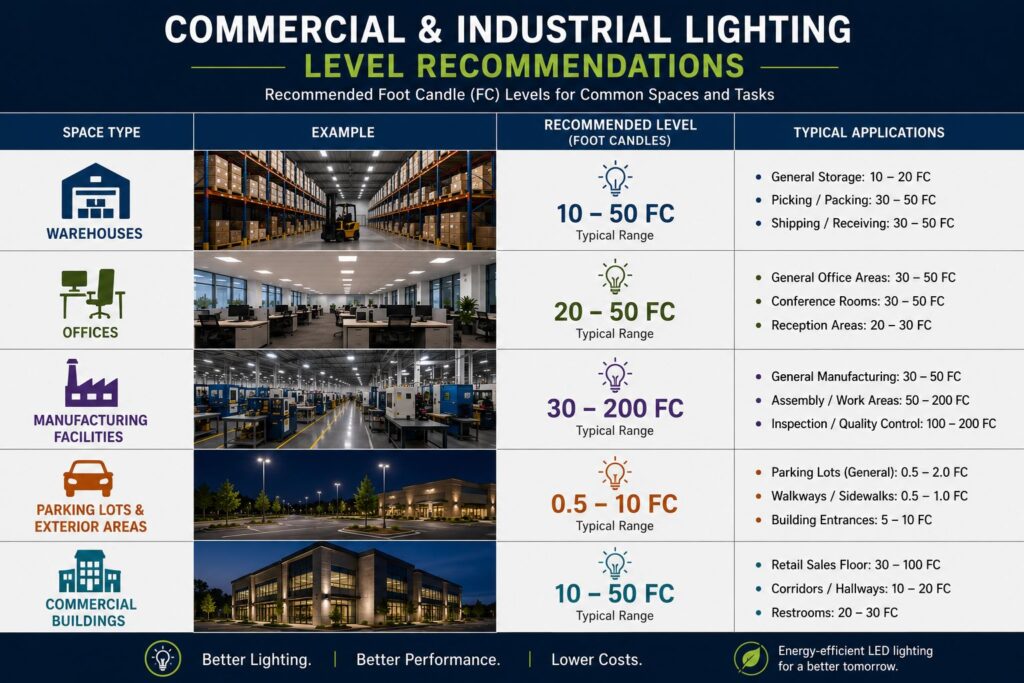
Recommended lighting levels vary by application, task complexity, safety requirements, and facility type. Proper foot candle levels help improve visibility, productivity, and occupant comfort.
Need Help Selecting Lighting for Your Application?
Provide your facility dimensions, mounting height, application, existing fixture information, and desired lighting levels, and we can help evaluate appropriate commercial or industrial LED fixtures for your project.
👉 Review Commercial Lighting Standards & Recommended Light Levels or call 1-844-533-7767 to discuss your lighting project.
Commercial & Industrial Lighting Level Quick Reference
| Application | Typical Starting Range | Primary Lighting Consideration |
|---|---|---|
| Bulk warehouse storage | 10–20 fc | Navigation and pallet identification |
| General warehouse | 20–30 fc | Material movement and general visibility |
| Warehouse aisles | 20–30 fc | Rack visibility and aisle activity |
| Picking areas | 30–50 fc | Labels, SKUs and product identification |
| Packing stations | 30–50+ fc | Labels, paperwork and product verification |
| Shipping & receiving | 20–30 fc | Material handling and documentation |
| General manufacturing | 20–50 fc | Production process and task complexity |
| Rough assembly | 30–50 fc | Component size and contrast |
| Fine assembly | 50–100 fc | Small components and detailed work |
| Inspection / quality control | 75–150+ fc | Defect detection and visual precision |
| Precision visual tasks | 100–200+ fc | Fine detail and low-contrast work |
| General offices | 30–50 fc | Reading, computer and desk tasks |
| Retail sales areas | 30–50 fc | Merchandise visibility |
| Cold storage | 10–30 fc | Storage vs. active picking |
| Food processing | 30–50+ fc | Production and inspection tasks |
| Loading docks | 10–30 fc | Loading activity and documentation |
| Parking lots | 0.5–5 fc | Vehicle and pedestrian visibility |
| Pedestrian walkways | 0.5–5 fc | Navigation and pedestrian activity |
These ranges are useful starting points for project planning. The appropriate target can change with the visual task, project conditions, and specific requirements.
For the technical side—IES recommendations, lighting criteria, specifications, uniformity, maintained illumination, and photometric planning—see our Commercial Lighting Standards & Recommended Light Levels.
🏭 Warehouse Lighting: Match the Level to the Activity
The term warehouse lighting level can be misleading because warehouses rarely contain only one type of activity.
Consider the difference between these areas:
| Warehouse Area | Typical Starting Range | What Workers Need to See |
|---|---|---|
| Bulk pallet storage | 10–20 fc | Aisles, pallets, large labels |
| General storage | 20–30 fc | Products, racks, travel paths |
| Active aisles | 20–30 fc | Rack locations, equipment, inventory |
| Picking | 30–50 fc | SKUs, labels, barcodes |
| Packing | 30–50+ fc | Products, paperwork, shipping labels |
| Shipping / receiving | 20–30 fc | Freight, documentation, vehicle movement |
This is why specifying:
“The warehouse needs 30 foot-candles.”
may not tell the entire story.
Thirty foot-candles could be appropriate for much of the facility while selected picking, packing, or inspection areas benefit from higher localized illumination.
📦 Bulk Storage: 10–20 Foot-Candles
Bulk-storage areas generally involve relatively simple visual tasks.
Employees need to identify:
- Travel paths
- Pallet locations
- Large labels
- Storage bays
- Equipment
- Obstructions
When employees aren’t continuously picking individual products or reading small labels, extremely high illumination may provide little additional operational value.
The objective is dependable general visibility rather than maximizing brightness.
🚜 General Warehouse Areas: 20–30 Foot-Candles
Active warehouse areas commonly require more illumination because employees and material-handling equipment move throughout the facility.
Workers may need to identify:
- Rack locations
- Products
- Forklifts
- Pallets
- Floor markings
- Safety signs
- Other employees
For many general warehouse applications, 20–30 fc provides a useful early planning range.
The final fixture selection will depend heavily on ceiling height, rack layout, and the size and configuration of the facility.
For fixture options used in these environments, see our Industrial LED High Bay Lighting resources.
🏷️ Picking Areas: 30–50 Foot-Candles
Picking operations are more visually demanding than general storage.
Employees may continuously:
Locate SKUs
Read labels
Scan barcodes
Identify products
Verify quantities
The ability to see vertical rack faces becomes especially important.
A warehouse can appear bright at floor level while product labels several feet above the floor remain difficult to read.
For active picking operations, 30–50 fc is a more useful starting range than the lower levels commonly associated with basic storage.
📦 Packing Stations: 30–50+ Foot-Candles
Packing stations often combine several visual tasks in a relatively small area.
Employees may:
Verify products
Read invoices
Print and apply shipping labels
Inspect packaging
Read small text
Use computer terminals
Instead of increasing illumination throughout the entire warehouse, higher illumination can be concentrated around the packing operation.
This is one of the simplest examples of matching the lighting level to the task rather than the building.
🚚 Shipping & Receiving: 20–30 Foot-Candles
Shipping and receiving areas combine material movement with paperwork and product identification.
Employees may need to see:
Freight labels
Pallet markings
Shipping documents
Forklifts
Dock equipment
Trailer interiors
Pedestrians
A general 20–30 fc starting range may be appropriate for many shipping and receiving areas, with additional lighting provided where detailed documentation or inspection takes place.
Dock geometry is also important because trailers, dock doors, and equipment can create shadows that aren’t apparent from the general illumination level alone.
🏗️ Don't Light the Entire Warehouse for the Most Difficult Task
Suppose a 100,000-square-foot distribution center contains:
70,000 sq. ft. of storage
20,000 sq. ft. of picking and packing
and
10,000 sq. ft. of inspection and specialized work.
If inspection requires substantially higher illumination, it doesn’t automatically make sense to operate the entire 100,000-square-foot facility at the inspection-level target.
A more practical strategy may be:
Storage → appropriate general illumination
Picking/packing → higher working illumination
Inspection → higher localized illumination or dedicated task lighting
That approach can improve visibility where employees actually need it without unnecessarily over-lighting the entire facility.
📐 Warehouse Height: A Practical Starting Point
Once you’ve identified the desired lighting level, mounting height becomes one of the next pieces of information needed for fixture selection.
| Approximate Mounting Height | Typical Fixture Direction |
|---|---|
| 12–20 ft | Lower- to medium-output industrial fixture |
| 20–30 ft | Standard LED high bay range |
| 30–40 ft | Higher-output high bay |
| 40+ ft | High-output fixture with application-specific optical evaluation |
This table isn’t intended to specify a particular wattage.
Two fixtures mounted at 30 feet can produce very different results depending on lumen output, optics, spacing, and fixture design.
Instead, mounting height helps narrow the type and output range of fixture worth evaluating.
Open Warehouse vs. Rack Aisles
Fixture selection should also reflect the physical layout.
Open Warehouse
Open storage or production areas generally need illumination distributed across relatively large floor areas.
Wider distributions may work well depending on mounting height and fixture spacing.
Rack Aisles
Tall racks create a different problem.
The lighting needs to reach:
the aisle floor
and
the vertical rack faces.
Depending on rack height and aisle width, fixtures or optics intended for aisle applications may provide better visibility than simply increasing the lumen output of a general high bay.
For warehouse projects involving long rows of racking, our LED Linear High Bay Lighting resources provide additional fixture options for aisle and open-area applications.
💡 Warehouse Project Shortcut
When requesting a warehouse lighting recommendation, start with these six pieces of information:
1. Building dimensions
2. Fixture mounting height
3. Existing fixture quantity
4. Existing fixture type and wattage
5. Primary warehouse activity
6. Rack height and aisle configuration
If the facility contains significantly different work areas—such as storage, picking, packing, and inspection—identify those areas separately.
That makes it much easier to recommend lighting based on how the facility actually operates.
🏗️ Manufacturing Lighting Levels by Task
Manufacturing facilities are among the most difficult buildings to describe with a single recommended lighting level.
A worker moving raw materials through a production area performs a very different visual task from someone assembling small electrical components or inspecting a machined surface for defects.
For that reason, a more useful question than:
How many foot-candles does a manufacturing facility need?
is:
What does the employee need to see to perform the task accurately, efficiently, and safely?
The following ranges provide practical starting points for different manufacturing activities.
Manufacturing Foot-Candle Quick Reference
| Manufacturing Task | Typical Starting Range | Primary Visual Need |
|---|---|---|
| Material handling | 10–20 fc | Movement, equipment, large objects |
| General production | 20–30 fc | Machinery, materials, work areas |
| Rough assembly | 20–30 fc | Large components and high-contrast tasks |
| Medium assembly | 30–50 fc | Moderate-size components and markings |
| Fine assembly | 50–100 fc | Small components and detailed work |
| Precision assembly | 100–150+ fc | Very small components and fine detail |
| General inspection | 50–100 fc | Product condition and obvious defects |
| Detailed inspection | 75–150+ fc | Small defects and surface irregularities |
| Precision quality control | 100–200+ fc | Fine defects, measurements and low contrast |
| Machine workstations | 30–50+ fc | Controls, tools and workpiece visibility |
| Maintenance / repair | 50–100+ fc | Components, wiring and mechanical details |
The ranges overlap intentionally.
A task doesn’t suddenly change from “medium” to “fine” assembly at a particular foot-candle number. Component size, contrast, speed, worker position, surface characteristics, and the precision required all influence the appropriate level.
🚜 Material Handling: 10–20 Foot-Candles
Material-handling areas typically involve relatively large visual targets.
Employees may need to see:
- Pallets
- Containers
- Raw materials
- Forklifts
- Conveyors
- Travel paths
- Floor markings
- Other employees
The primary goal is usually general visibility and movement rather than fine-detail recognition.
For many material-handling areas, 10–20 fc can provide a useful preliminary range, although active production and vehicle/pedestrian interaction may justify evaluating higher levels.
The important point is that a raw-material staging area doesn’t necessarily need the same illumination as the production equipment it serves.
⚙️ General Production: 20–30 Foot-Candles
General manufacturing operations often involve machinery, larger components, material movement, and relatively straightforward visual tasks.
Workers may need to identify:
- Machine positions
- Controls
- Materials
- Tools
- Work surfaces
- Equipment movement
- Safety markings
A starting range around 20–30 fc may be appropriate for many general production areas.
But the type of manufacturing matters.
Producing large structural components presents a very different visual environment from manufacturing small mechanical, electrical, or electronic products.
That is why the task should always take precedence over the broad label “manufacturing.”
🔩 Rough Assembly: 20–30 Foot-Candles
Rough assembly generally involves larger components and relatively easy-to-see details.
Examples might include:
- Large fabricated components
- Structural assemblies
- Large mechanical parts
- Equipment frames
- Major subassemblies
When components are large and provide good visual contrast, extremely high illumination may offer limited additional benefit.
The lighting should provide clear visibility of the work area without creating unnecessary glare around reflective machinery or materials.
🔧 Medium Assembly: 30–50 Foot-Candles
As components become smaller and assembly becomes more detailed, illumination generally needs to increase.
Medium assembly may involve:
- Smaller mechanical components
- Fasteners
- Connectors
- Wiring
- Product markings
- Alignment points
- Moderate-detail fabrication
A 30–50 fc starting range is useful for many of these operations.
At this point, fixture placement begins to matter more because workers, machinery, and equipment can cast shadows directly over the work.
An overhead lighting system can meet the general foot-candle target while still leaving the actual assembly point poorly illuminated.
🔬 Fine Assembly: 50–100 Foot-Candles
Fine assembly places greater demands on visual performance.
Workers may need to distinguish:
- Small components
- Fine markings
- Small fasteners
- Wiring
- Connectors
- Alignment features
- Similar-looking parts
For these operations, 50–100 fc may provide a more appropriate starting range.
But simply increasing overhead fixture output isn’t always the best solution.
If the detailed work occurs at specific benches or machines, supplemental task lighting can deliver additional illumination directly where it’s needed.
🎯 Precision Assembly: 100–150+ Foot-Candles
Precision assembly can involve very small components, low-contrast details, exact positioning, or other visually demanding work.
Examples may include:
- Small electrical assemblies
- Precision mechanical components
- Instrument assembly
- Fine wiring
- Detailed component positioning
These tasks may justify 100–150 fc or higher, depending on the work.
At these illumination levels, localized lighting becomes particularly useful.
Instead of designing the entire production floor around the most demanding workstation, the facility can maintain appropriate general lighting while adding higher-output task lighting at precision work areas.
🔍 Inspection Lighting: The Smaller the Defect, the More Demanding the Task
Inspection is one of the strongest examples of why manufacturing lighting shouldn’t be represented by one foot-candle number.
Consider the difference between looking for:
A missing component
and
A hairline surface defect.
Both are inspection tasks.
Their visual demands are completely different.
👀 General Inspection: 50–100 Foot-Candles
General inspection may involve identifying:
- Missing components
- Obvious damage
- Incorrect assembly
- Large surface defects
- Packaging problems
- Major dimensional issues
A starting range of 50–100 fc may be appropriate depending on the product and inspection process.
If the object has good contrast and the defect is relatively large, the lower end of the range may be adequate.
As defect size decreases, lighting demands generally increase.
🔎 Detailed Inspection: 75–150+ Foot-Candles
Detailed inspection may involve:
- Small scratches
- Surface imperfections
- Fine machining defects
- Printing errors
- Small dimensional differences
- Minor assembly problems
- Small markings
For these tasks, 75–150+ fc may be appropriate as an initial planning range.
But illumination level alone doesn’t determine inspection quality.
The direction of the light can be equally important.
For example, certain surface defects become easier to identify when illumination reaches the component from an angle rather than directly overhead.
That means an inspection station may benefit more from properly positioned task lighting than simply increasing the output of the facility’s high bays.
🧪 Precision Quality Control: 100–200+ Foot-Candles
Quality-control operations involving very fine details, precise measurements, or low-contrast defects may require substantially higher illumination.
Examples can include:
- Precision-machined components
- Fine surface inspection
- Small printed markings
- Measurement equipment
- Detailed electrical components
- Low-contrast defects
A 100–200+ fc starting range may be appropriate for demanding visual inspection.
However, this is exactly where facility-wide illumination becomes inefficient.
If only 5% of the production floor performs precision inspection, illuminating the remaining 95% to 150 or 200 foot-candles generally makes little sense.
💡 When Task Lighting Makes More Sense
Manufacturing facilities frequently benefit from a layered approach:
General Lighting
Provides overall illumination for:
- Navigation
- Material movement
- General production
- Equipment operation
Task Lighting
Adds concentrated illumination for:
- Fine assembly
- Inspection
- Quality control
- Machine work
- Maintenance
- Detailed bench work
For example:
Production floor: 30 fc
Assembly workstation: 50–75 fc
Detailed inspection station: 100+ fc
Rather than:
Entire facility: 100 fc
This allows the lighting system to follow the actual work being performed.
🛠️ Machine Workstations: 30–50+ Foot-Candles
Machine operators may need to see several different things simultaneously:
- Workpieces
- Machine controls
- Gauges
- Displays
- Cutting areas
- Tools
- Materials
A general range of 30–50+ fc may provide a useful starting point, but machine configuration can dramatically affect actual visibility.
Large equipment can block overhead illumination and create shadows exactly where the operator needs to see.
Machine-integrated or supplemental task lighting may therefore be more effective than increasing general overhead illumination.
🔧 Maintenance and Repair: 50–100+ Foot-Candles
Maintenance tasks often involve smaller components than normal production.
Technicians may need to identify:
- Fasteners
- Wiring
- Connectors
- Mechanical components
- Fluid lines
- Labels
- Equipment damage
They may also work inside machinery where overhead lighting provides little useful illumination.
For maintenance shops and dedicated repair areas, 50–100+ fc can provide a practical starting range.
Portable or localized work lights may still be necessary when employees work inside equipment or in areas shadowed from the general lighting system.
Surface Color and Contrast Can Change the Practical Need
Consider two assembly operations.
Operation A
A worker installs a large black component onto a white assembly.
Operation B
A worker installs a small dark-gray component onto a black assembly.
Even if the component size were similar, Operation B would generally be more visually demanding because there is less contrast between the component and surrounding surface.
Manufacturing lighting decisions should therefore consider:
What does the employee actually need to distinguish?
not simply:
How large is the room?
Reflective Materials Need Special Attention
Manufacturing facilities often contain reflective materials such as:
- Polished metal
- Stainless steel
- Aluminum
- Glass
- Glossy coatings
- Plastic
- Machine surfaces
Higher illumination directed poorly onto reflective materials can create glare that makes the task harder to see.
In these environments, fixture positioning and light direction can matter as much as raw foot-candle levels.
This is particularly important at inspection and quality-control stations.
One Production Floor, Four Lighting Levels
Consider a manufacturing facility containing four major work zones:
| Work Zone | Starting Lighting Level |
|---|---|
| Material staging | 15–20 fc |
| General production | 25–30 fc |
| Fine assembly | 50–75 fc |
| Detailed inspection | 100–150+ fc |
The entire facility operates under one roof.
But each zone has a different visual purpose.
This is the central principle behind manufacturing lighting recommendations:
Don’t light the building type. Light the task.
📋 Manufacturing Lighting Project Worksheet
When requesting fixture recommendations for a manufacturing facility, identify each major work area separately.
General Facility Information
Building dimensions: __________
Mounting height: __________
Voltage: __________
Existing fixture quantity: __________
Existing fixture type/wattage: __________
Production Areas
General manufacturing: __________ sq. ft.
Assembly: __________ sq. ft.
Inspection / quality control: __________ sq. ft.
Material handling: __________ sq. ft.
Maintenance: __________ sq. ft.
Visual Tasks
Smallest component/detail employees need to see: __________
Is color identification important? Yes / No
Are reflective materials present? Yes / No
Does machinery block overhead illumination? Yes / No
Is localized task lighting currently used? Yes / No
Target foot-candle level, if known: __________
A floor plan showing the different work zones is particularly valuable for facilities where lighting requirements vary substantially across the production floor.
💡 Manufacturing Project Shortcut
If you only know one thing about a proposed manufacturing lighting project, don’t start with the existing fixture wattage.
Start with:
What does the worker need to see?
Then identify:
How small is it?
How much contrast does it have?
How long does the employee perform the task?
Can overhead lighting actually reach the work surface?
Does the task occur everywhere or only at selected workstations?
Those answers provide a much better starting point for determining whether the operation needs general production lighting, higher assembly illumination, or dedicated task lighting for inspection and precision work.
🏢 Commercial, Exterior & Specialized Lighting Levels by Application
Warehouses and manufacturing facilities account for some of the widest variations in recommended lighting levels, but many commercial projects have a different challenge: several distinct environments may exist on the same property.
A commercial facility might include offices at 30–50 foot-candles, loading areas at 10–30 foot-candles, a parking lot operating at only a few foot-candles, and specialized work areas requiring considerably more illumination.
The practical approach is the same:
Identify the activity first, then establish an appropriate starting lighting level for that area.
Commercial Lighting Quick Reference
| Application | Typical Starting Range | Primary Visual Need |
|---|---|---|
| General offices | 30–50 fc | Reading, computer and desk tasks |
| Conference rooms | 30–50 fc | Meetings, documents, presentations |
| Corridors | 10–20 fc | Navigation |
| Retail sales areas | 30–50 fc | Merchandise and customer navigation |
| Retail displays | 50–100+ fc | Product emphasis and detail |
| Parking lots | 0.5–5 fc | Vehicles, pedestrians and obstacles |
| Parking garages | 1–5+ fc | Vehicle/pedestrian visibility |
| Pedestrian walkways | 0.5–5 fc | Navigation and obstacle recognition |
| Building entrances | 5–20 fc | Doors, people, steps and access points |
| Loading docks | 10–30 fc | Freight movement and documentation |
| Cold storage | 10–30+ fc | Storage, picking and product handling |
| Food processing | 30–50+ fc | Production and product visibility |
Rather than treating these as fixed specifications, use them to identify the general scale of illumination appropriate to the activity.
🏢 Office Lighting: 30–50 Foot-Candles
General office environments commonly fall within a 30–50 fc starting range.
Typical visual tasks include:
- Reading documents
- Writing
- Computer work
- Meetings
- Filing
- General administrative tasks
Unlike manufacturing environments, office lighting isn’t usually about detecting tiny mechanical defects or illuminating moving machinery.
The challenge is providing comfortable illumination for extended periods of work.
Typical Office Areas
| Office Area | Typical Starting Range |
|---|---|
| Corridors | 10–20 fc |
| Reception | 20–30+ fc |
| General offices | 30–50 fc |
| Private offices | 30–50 fc |
| Conference rooms | 30–50 fc |
| Detailed document work | 40–50+ fc |
A facility doesn’t necessarily need the same lighting level in its corridors as it does over employee workstations.
That provides another opportunity to match the lighting to how each portion of the building is actually used.
🖥️ Computer Work Changes the Office Lighting Strategy
Today’s office employee may spend considerably more time looking at a computer monitor than at a printed document.
Simply increasing overhead illumination doesn’t necessarily improve that environment.
Excessive illumination can create reflections on displays and uncomfortable brightness around workstations.
Where detailed paper-based tasks require additional illumination, localized task lighting may sometimes be more useful than increasing the output of every ceiling fixture.
Compare our Commercial LED Ceiling Lights for offices, conference rooms, corridors, and other commercial interiors.
For fixture types used throughout offices and other commercial interiors, see our Commercial Indoor Lighting resources.
🛍️ Retail Lighting: 30–50 Foot-Candles for General Sales Areas
Retail lighting needs to help customers navigate the space while allowing products to be seen clearly.
A general sales floor may use approximately 30–50 fc as a starting point.
But retail lighting frequently uses different illumination levels intentionally.
| Retail Area | Typical Starting Range |
|---|---|
| General circulation | 20–30 fc |
| General sales floor | 30–50 fc |
| Checkout | 30–50 fc |
| Product displays | 50–100+ fc |
| Stockroom | 10–30 fc |
The display lighting doesn’t need to become the general lighting level throughout the entire store.
Higher illumination or accent lighting can be concentrated where merchandise needs additional visual emphasis.
🚗 Parking Lot Lighting: Usually Much Lower Than Indoor Lighting
Parking-lot illumination levels can look surprisingly low when compared with indoor commercial applications.
A parking area may operate at only a few foot-candles while an office inside the same property operates at 30–50 fc.
That’s because the visual tasks are different.
Parking-lot users primarily need to recognize:
- Vehicles
- Pedestrians
- Curbs
- Travel lanes
- Obstacles
- Entrances and exits
Parking Lot Starting Ranges
| Parking Application | Typical Starting Range |
|---|---|
| Low-activity parking | 0.5–1 fc |
| General commercial parking | 1–3 fc |
| Higher-activity areas | 2–5 fc |
| Vehicle/pedestrian conflict areas | Project dependent |
The goal should not be:
Make the parking lot as bright as possible.
Instead, provide useful illumination across the areas where drivers and pedestrians need visibility.
For commercial parking lot projects, explore our LED Parking Lot Lighting fixtures to compare available pole-mounted solutions and request project pricing.
For a deeper application-specific discussion, see our Parking Lot Foot-Candle Requirements guide.
🅿️ Parking Garages: 1–5+ Foot-Candles
Parking garages present different lighting conditions from open parking lots.
Even during daylight hours, interior areas can remain relatively dark.
Drivers and pedestrians need to identify:
- Other vehicles
- Columns
- Ramps
- Curbs
- Pedestrians
- Parking spaces
- Directional signage
- Elevators and stairwells
A 1–5+ fc range can provide a useful early starting point depending on the area and activity.
For enclosed and multilevel parking facilities, explore our LED Parking Garage Lighting fixtures designed for commercial parking structures.
Entrances and transition zones may need separate consideration because drivers’ eyes are adapting between outdoor daylight and the darker garage interior.
🚶 Pedestrian Walkways: 0.5–5 Foot-Candles
Pedestrian pathways generally require much less illumination than indoor work environments.
Users need enough visibility to identify:
- Path boundaries
- Curbs
- Steps
- Changes in elevation
- Obstacles
- Other pedestrians
Typical Starting Points
| Pedestrian Area | Typical Starting Range |
|---|---|
| Low-activity pathway | 0.5–1 fc |
| General walkway | 1–2 fc |
| Higher-activity walkway | 2–5 fc |
| Plaza / gathering area | 2–5+ fc |
For these applications, simply increasing brightness can be counterproductive.
Pedestrian-scale fixtures such as bollards and shielded decorative post tops can place illumination closer to the area where it’s needed.
For projects involving nighttime environmental or local outdoor-lighting requirements, see our Dark Sky Compliant Post Lights.
🚪 Building Entrances: 5–20 Foot-Candles
Building entrances combine pedestrian activity, access, architectural features, and transitions between exterior and interior lighting.
Depending on the type and activity of the entrance, 5–20 fc can provide a useful preliminary range.
Users may need to identify:
- Doors
- Handles
- Steps
- Ramps
- Access controls
- Intercoms
- Signage
- Other people
Higher-activity commercial entrances may justify more illumination than a secondary employee entrance.
The important distinction is that the entrance itself may require a different lighting level from the surrounding walkway or parking lot.
🚚 Loading Docks: 10–30 Foot-Candles
Loading docks combine several activities:
🚛 Trucks arriving and departing
🚜 Forklifts moving freight
👷 Employees working around vehicles
📦 Product identification
📋 Shipping and receiving documentation
A general 10–30 fc starting range may be appropriate for many loading and receiving environments.
However, detailed work areas can require additional illumination.
For example, employees reading shipping documents or inspecting freight may benefit from localized lighting rather than increasing illumination across every dock position.
Trailer Interiors Can Be the Real Problem
A loading dock may appear adequately illuminated while the inside of a trailer remains dark.
This is a practical issue that a general dock foot-candle number doesn’t necessarily solve.
The building-mounted lighting may illuminate:
the dock apron
and
the dock door
without delivering useful light deep into the trailer.
Dedicated dock or task lighting may therefore be needed where employees routinely enter or load trailers.
This is another example of why the lighting level should follow the actual work location, not simply the room or exterior area.
🧊 Cold Storage Lighting: 10–30+ Foot-Candles
Cold-storage facilities can include several different activities.
| Cold Storage Area | Typical Starting Range |
|---|---|
| Bulk frozen storage | 10–20 fc |
| General refrigerated storage | 20–30 fc |
| Active picking | 30–50 fc |
| Packing / handling | 30–50+ fc |
A freezer used primarily for pallet storage doesn’t necessarily need the same illumination as a refrigerated distribution center with continuous picking operations.
But cold-storage lighting adds another important question:
Can the fixture reliably operate at the actual facility temperature?
The correct foot-candle target doesn’t help if the LED driver, sensors, or other components aren’t suitable for the operating environment.
For those applications, see our Cold Storage Lighting resources.
🥩 Food Processing: Lighting the Work, Not Just the Room
Food-processing facilities may require approximately 30–50+ fc for many general production activities, while inspection or detailed processing areas may need considerably higher illumination.
Typical visual tasks can include:
- Product preparation
- Cutting
- Sorting
- Packaging
- Label verification
- Inspection
- Quality control
Again, it is more useful to divide the operation according to the task than to assign one lighting level to the entire facility.
Example
General processing: 30–50 fc
Detailed preparation: 50–75+ fc
Inspection / quality control: 75–100+ fc or task-specific evaluation
The appropriate fixture must also be suitable for the physical environment.
Washdown, moisture, sanitation, corrosion resistance, and food-processing requirements can influence fixture selection independently of the foot-candle target.
🧼 Higher Foot-Candles Don’t Make the Wrong Fixture Suitable
Suppose a food-processing area needs 50 foot-candles.
A standard indoor high bay may be capable of producing that illumination.
But if the fixture isn’t appropriate for:
washdown
moisture
sanitation procedures
or
the facility’s environmental requirements,
then it may still be the wrong fixture.
The same principle applies to:
🧊 Cold storage
🔥 High-temperature facilities
💥 Hazardous locations
💧 Wet environments
Lighting level determines how much illumination is needed.
The operating environment determines which fixtures are appropriate for providing it.
Food-processing and sanitary production environments may require fixtures with specific NSF certifications and environmental ratings. Explore our NSF-Certified LED Lighting solutions for qualifying applications.
One Commercial Property Can Have Dramatically Different Lighting Levels
Consider a distribution facility containing offices, a warehouse, loading docks, and a parking lot:
| Area | Example Starting Range |
|---|---|
| Parking lot | 1–3 fc |
| Walkway | 1–2 fc |
| Building entrance | 5–20 fc |
| Warehouse storage | 10–20 fc |
| Active warehouse | 20–30 fc |
| Loading dock | 10–30 fc |
| Picking / packing | 30–50 fc |
| Offices | 30–50 fc |
| Inspection station | 75–150+ fc |
This single property could contain working illumination ranging from roughly 1 foot-candle outdoors to more than 100 foot-candles at a detailed inspection station.
That’s why the most useful lighting recommendation isn’t:
“Commercial buildings need X foot-candles.”
It’s:
“What happens in each area of the property?”
📋 Commercial Project Shortcut
For a property containing multiple applications, create a simple project inventory before selecting fixtures:
Parking areas: __________ sq. ft.
Walkways: __________
Entrances: __________
Warehouse/storage: __________ sq. ft.
Production areas: __________ sq. ft.
Loading docks: __________
Offices: __________ sq. ft.
Inspection/task areas: __________
Then identify the approximate target lighting level for each area separately.
This makes fixture selection far more useful than trying to apply one foot-candle number across the entire property.
💡 Application Selection Shortcut
When evaluating any commercial lighting area, ask three questions:
1. What are people doing here?
Walking, driving, storing products, reading, assembling, inspecting?
2. What do they need to see?
Large objects, labels, documents, small components, surface defects?
3. Where do they need to see it?
Floor level, desktop height, rack face, machine surface, loading dock, parking surface?
Those three answers will often tell you more about the appropriate lighting level than the square footage alone.
From Lighting Levels to Fixture Selection
Once you’ve identified a reasonable starting lighting level for each area, the next step is translating those targets into actual fixture selections.
For many projects, the most useful information isn’t simply:
“I need 30 foot-candles.”
It’s:
“I need approximately 30 foot-candles in a 40,000-square-foot warehouse with 28-foot mounting heights, pallet racks, active picking aisles, and existing 400-watt metal-halide fixtures.”
That information gives a fixture supplier a much clearer picture of the project.
🏗️ Project Spotlight: Distribution Center With Multiple Lighting Zones
Consider a distribution center planning a complete LED retrofit.
The property includes:
- Parking and pedestrian areas
- Shipping and receiving docks
- Bulk pallet storage
- Active picking aisles
- Packing stations
- Offices
- Product inspection stations
Instead of selecting one LED fixture and applying the same lighting level everywhere, the project is divided into functional zones.
| Area | Preliminary Target | Lighting Approach |
|---|---|---|
| Parking lot | 1–3 fc | Pole-mounted area lighting |
| Pedestrian walkways | 1–2 fc | Controlled pedestrian-scale lighting |
| Shipping / receiving | 20–30 fc | General + dock/task lighting |
| Bulk storage | 10–20 fc | General warehouse lighting |
| Active warehouse | 20–30 fc | High bay lighting |
| Picking aisles | 30–50 fc | Aisle-focused illumination |
| Packing stations | 30–50+ fc | General + localized task lighting |
| Offices | 30–50 fc | Commercial indoor lighting |
| Inspection | 75–150+ fc | Higher localized illumination |
This approach prevents a common mistake:
Designing the entire property around its most demanding visual task.
The inspection stations may require 100 foot-candles or more, but that doesn’t mean the warehouse storage areas—or certainly the parking lot—should operate anywhere near that level.
Each area receives lighting appropriate to what happens there.
Why This Matters When Buying Fixtures
A commercial lighting project may involve several different fixture families even when everything is part of one facility.
The distribution center above might require:
LED area lights for parking
Bollards or post-top fixtures for pedestrian areas
Wall packs around the building perimeter
High bays for open warehouse areas
Linear high bays for selected rack aisles
Dock/task lights for shipping and receiving
Commercial ceiling fixtures for offices
Task lighting for inspection stations
The foot-candle target helps determine what each lighting system needs to accomplish.
It doesn’t mean one fixture type should solve every application.
💬 Buyer Q&A
What Foot-Candle Level Should I Give a Lighting Supplier?
If the project already has an established target, provide it.
For example:
Target: 30–40 maintained foot-candles at floor level.
If you don’t have a target, provide the application and describe what employees do in the space.
For example:
28-foot warehouse with pallet racks and active order picking. Employees regularly read product labels and scan barcodes.
That information can be more useful than simply saying:
“I need warehouse lights.”
What If I Don’t Know the Required Foot-Candle Level?
That’s common, particularly with retrofit projects.
Start by providing:
- Application
- Dimensions
- Mounting height
- Existing fixture quantity
- Existing fixture wattage/type
- Description of the work being performed
- Photographs or drawings
Typical application ranges can then be used as an initial reference.
If the project has architectural, engineering, owner, municipal, or other specified lighting criteria, those requirements should also be provided.
Can I Replace My Existing Fixtures One-for-One?
Sometimes—but it shouldn’t automatically be assumed.
A one-for-one retrofit can work well when the existing:
- Fixture locations are appropriate
- Spacing is reasonable
- Lighting levels are satisfactory
- New LED distribution matches the application
But if the existing system has dark areas, excessive spacing, poor aisle coverage, or inadequate illumination, replacing every fixture in exactly the same location may preserve some of those problems.
An LED retrofit is an opportunity to evaluate whether the existing layout is worth duplicating.
How Do I Replace a 400-Watt Metal Halide Fixture?
Don’t select the replacement based on wattage alone.
Two facilities using 400-watt metal-halide fixtures may require very different LED replacements because of differences in:
- Mounting height
- Existing spacing
- Required illumination
- Fixture type
- Application
- Optics
- Existing lighting performance
A lower-wattage LED can often provide substantial energy savings, but the correct replacement should be based on delivered illumination, not simply an advertised wattage equivalency.
Should I Use High Bays or Linear High Bays?
Both can be appropriate for warehouses and manufacturing facilities.
Traditional high bays work well across many open industrial spaces.
Linear high bays can be particularly useful where fixture geometry and distribution match:
- Warehouse aisles
- Long production areas
- Retail warehouse environments
- Existing fluorescent high-bay layouts
The better choice depends on the mounting height, spacing, layout, and desired distribution.
Do I Need Separate Lighting for Inspection Areas?
Often, yes.
If inspection requires substantially more illumination than general production, localized task lighting can be more practical than increasing overhead illumination across the entire facility.
This is especially useful for:
- Quality control
- Fine assembly
- Precision manufacturing
- Product inspection
- Maintenance benches
When Should I Request a Photometric Layout?
Photometric analysis becomes increasingly useful when:
- The project is large
- Mounting heights are substantial
- Fixture spacing is uncertain
- Foot-candle targets must be documented
- Uniformity is important
- Multiple fixture optics are being considered
- Outdoor property boundaries matter
- A project specification must be satisfied
For a simple replacement in a small existing space, detailed photometrics may not always be necessary.
For a large warehouse, manufacturing plant, parking lot, sports facility, or new construction project, photometric planning can significantly reduce uncertainty before fixtures are purchased.
Ready to Determine the Right Lighting Level and Fixtures?
Whether you’re upgrading a warehouse, manufacturing facility, office, loading dock, parking lot, cold-storage facility, or an entire commercial property, start with what happens in each area.
Provide the application, dimensions, mounting heights, existing fixtures, and desired lighting levels, and we can help identify LED fixtures appropriate for the project.
👉 Request Commercial & Industrial LED Lighting Recommendations or call 1-844-533-7767 to discuss your project.
Frequently Asked Questions
How many foot-candles should a warehouse have?
It depends on the activity.
Bulk storage may begin around 10–20 fc, while active warehouse areas may use approximately 20–30 fc and picking or packing areas may benefit from 30–50 fc or more.
How many foot-candles are recommended for manufacturing?
General manufacturing may begin around 20–50 fc, depending on the task.
Fine assembly, inspection, and precision work can require substantially higher illumination—often 50–150+ fc, with very demanding visual tasks potentially requiring more.
How many foot-candles are recommended for an office?
General office areas commonly use approximately 30–50 fc as a planning range.
The appropriate level depends on the visual tasks and how the space is used.
How many foot-candles should a parking lot have?
Many commercial parking areas operate within approximately 0.5–5 fc, depending on activity and site conditions.
Average illumination alone shouldn’t determine the design.
For more detail, see our Parking Lot Foot-Candle Requirements.
How many foot-candles are needed for inspection?
Inspection requirements vary substantially.
General inspection may begin around 50–100 fc, while detailed inspection and precision quality-control tasks may require approximately 75–150+ fc or more depending on defect size, contrast, and task difficulty.
Are more foot-candles always better?
No.
The objective is to provide appropriate illumination for the visual task.
Higher illumination where it isn’t needed can increase energy consumption and may not improve visual performance.
Stay Connected with Our Lighting Resources
Add IndustrialLightingFixtures.org as a Preferred Source on Google to see more of our lighting guides and technical resources across Google Search experiences.
Related Commercial & Industrial Lighting Resources
- Commercial Lighting Standards & Recommended Light Levels — Understand lighting criteria, maintained illumination, uniformity, and technical requirements for commercial projects.
- Parking Lot Foot-Candle Requirements — Review outdoor parking illumination levels, uniformity considerations, and photometric planning requirements.
- Industrial LED High Bay Lighting — Compare high bay fixtures for warehouses, manufacturing facilities, and elevated mounting applications.
- LED Linear High Bay Lighting — Explore linear high bay fixtures for warehouse aisles, production areas, and distribution facilities.
- Cold Storage Lighting — Evaluate lighting solutions for refrigerated warehouses, freezer facilities, and temperature-controlled operations.
- Industrial Lighting Guide — Learn how facility conditions, mounting heights, optical distribution, and operating requirements influence industrial fixture selection.
- LED Area Lighting Layout Guide — Understand fixture placement, spacing, distribution, and illumination uniformity for outdoor commercial sites.