
FAA aircraft warning lights are used to increase the conspicuity of structures that may affect navigable airspace. Depending on the structure, location, height, and FAA determination, obstruction marking may include red lights, white flashing lights, dual red/white systems, paint or other marking, or a combination of these methods.
FAA obstruction marking and lighting guidance is currently addressed in Advisory Circular AC 70/7460-1N, Obstruction Marking and Lighting, while obstruction-light equipment specifications are addressed separately under applicable FAA equipment standards.
Communication towers, broadcast structures, wind turbines, industrial stacks, utility structures, buildings, cranes, and other elevated installations may require evaluation based on their actual height, location, surrounding airspace, and project conditions.
For structure owners, contractors, engineers, and procurement teams, the first question is not simply which aircraft warning light to purchase—it is what marking and lighting configuration applies to the specific structure.
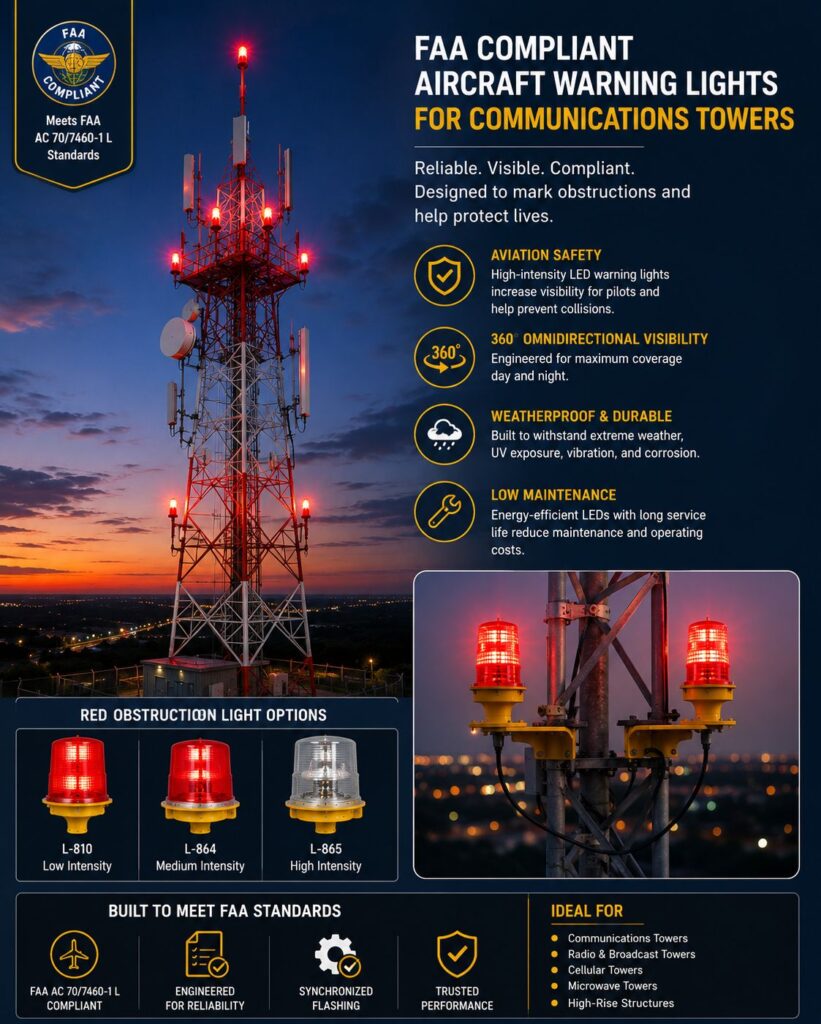
FAA aircraft warning lights provide obstruction marking on communications towers and other elevated structures where aviation visibility requirements apply.
Selecting Aircraft Warning Lights for an Obstruction-Marking Project?
Aircraft warning light selection depends on the applicable obstruction-lighting configuration, structure characteristics, mounting location, electrical requirements, and project specifications.
Explore our LED Aircraft Warning Lights, Request a Quote, or call 844-533-7767 with the structure type, height, project location, required FAA light type or specification, quantity, voltage, mounting requirements, and project documents when available.
What Are FAA Aircraft Warning Lights?
FAA aircraft warning lights are obstruction lights used as part of marking and lighting systems for structures that may present an obstruction to navigable airspace. Depending on the applicable FAA determination and lighting configuration, these systems may use red obstruction lights, flashing white lights, dual red/white systems, or other specified marking and lighting methods.
Aircraft warning lights are commonly associated with structures such as:
- Communications and broadcast towers
- Industrial stacks and elevated structures
- Utility and transmission structures
- Wind turbines
- Tall buildings and rooftop structures
- Construction cranes
- Water towers and similar elevated structures
The required lighting configuration should not be selected from structure type or height alone. The FAA evaluation, applicable obstruction-lighting guidance, and project specifications should determine the required marking, light type, placement, and operating characteristics.
Planning a tower lighting retrofit project? Learn how LED obstruction lighting can reduce maintenance and operating costs.
FAA Aircraft Warning Light Requirements
Structure height is an important consideration in determining whether FAA obstruction marking and lighting may apply, but height alone does not determine the required aircraft warning light configuration.
In general, structures exceeding 200 feet (61 meters) above ground level, or structures exceeding applicable obstruction standards under 14 CFR Part 77, may require FAA evaluation for marking and/or lighting. Structures below 200 feet may also require consideration because of their location or relationship to navigable airspace.
The FAA’s aeronautical study of a proposed or existing structure can result in specific marking and lighting recommendations. These may address the type of obstruction lights, their placement, operating characteristics, painting or other marking, and additional project-specific requirements.
For procurement purposes, use the applicable FAA determination and project specifications to identify the required obstruction-light types and system configuration rather than selecting equipment solely from structure height.
The FAA itself describes the 200-foot threshold as a general rule rather than an absolute standalone fixture-selection rule.
Why FAA Obstruction Lighting Matters
FAA obstruction lighting is used to increase the conspicuity of structures that may affect navigable airspace. The required marking and lighting configuration can vary according to the structure, height, location, FAA determination, and applicable project requirements.
A communications tower, wind turbine, industrial stack, building, or construction crane should not automatically be assumed to require the same obstruction-lighting system.
Selecting equipment that matches the applicable FAA light type and project requirements is one part of implementing the specified marking and lighting configuration. Overall compliance also depends on factors such as fixture placement, operating characteristics, controls, monitoring where applicable, and the complete system configuration.
For a broader explanation of why structures may require obstruction marking and lighting, review our Why Aircraft Warning Lights Are Required guide.
Common FAA Obstruction Lighting Applications
FAA obstruction lighting is used across a range of elevated structures and aviation-obstruction applications.
Telecommunications Towers
Communications towers are a common application for FAA obstruction marking and lighting. Required tower lighting depends on factors including structure height, location, FAA determination, and specified lighting configuration.
Broadcast Towers
Broadcast towers may require obstruction marking and lighting based on their height, location, and FAA determination.
Wind Turbines
Wind turbines represent a specialized obstruction-lighting application. Required lighting should be based on the applicable FAA determination and current obstruction-marking guidance.
Industrial Facilities
Industrial stacks, process towers, and other elevated structures may require FAA evaluation and obstruction lighting depending on their height, location, and relationship to navigable airspace.
Buildings
Tall buildings, rooftop structures, antennas, and other elevated building components may require FAA evaluation depending on their height, location, and surrounding airspace.
Construction Cranes
Temporary and permanent cranes may require obstruction marking or lighting depending on their height, location, duration, and relationship to navigable airspace.
For additional structure-specific examples, review our Applications for Aviation Warning Lights guide.
FAA Obstruction Lighting Types
FAA obstruction-lighting systems use specific light types and configurations depending on the marking and lighting requirements for the structure.
L-810 Obstruction Lights
L-810 lights are low-intensity red obstruction lights used in specified obstruction-marking configurations.
L-864 Red Obstruction Lights
L-864 lights are flashing red obstruction lights used in applicable nighttime obstruction-lighting systems.
L-865 White Obstruction Lights
L-865 lights are medium-intensity flashing white obstruction lights used in applicable obstruction-marking configurations.
Dual Red/White Obstruction Lighting Systems
Dual systems combine red and white obstruction-lighting functions for different operating conditions when specified for the structure.
Other FAA obstruction-light types and configurations may apply depending on the project.
Need information on obstruction lighting system design? Review our: Obstruction Lighting Systems for Aviation Safety
FAA Compliance Considerations
When evaluating an aircraft warning lighting project, common considerations include:
- Structure height
- Structure location
- Airspace considerations
- Lighting configuration
- Monitoring requirements
- Maintenance access
- Visibility objectives
- System redundancy
Each project should be evaluated based on its specific operational requirements.
LED Aircraft Warning Lights
LED light sources are used in many modern aircraft warning and obstruction-lighting products. Depending on the product and application, LED technology can provide lower power consumption and reduce routine lamp-replacement requirements compared with older source technologies.
However, LED technology alone does not establish suitability for an FAA obstruction-lighting application.
The selected obstruction light should match the required FAA light designation, operating characteristics, system configuration, electrical requirements, mounting requirements, and applicable project specifications.
For retrofit projects, evaluate the existing light designation, voltage, mounting arrangement, controls, monitoring system, and required operating characteristics before selecting replacement equipment.
For a more detailed look at LED technology and product selection, review our LED Aircraft Warning Lights Guide.
FAA Tower Lighting and Monitoring Systems
Monitoring capabilities are incorporated into some aircraft warning and obstruction-lighting systems to provide information about fixture or system operating status.
Depending on the system, monitoring may help operators:
- Verify reported operating status
- Identify fixture or system faults
- Identify conditions requiring inspection
- Support maintenance planning
- Monitor multiple obstruction-lighting components
Monitoring requirements vary by project and should be evaluated along with the required obstruction-light types, controls, power supply, communications, redundancy, and applicable FAA or project requirements.
Maintenance should address the complete obstruction-lighting system rather than the light source alone, including fixtures, controls, monitoring components, wiring, mounting hardware, and other applicable system components.
Inline Buyer Q&A
What does FAA compliant mean for an aircraft warning light?
For equipment selection, the product should match the applicable FAA obstruction-light type and performance requirements specified for the project. Overall project compliance also depends on the required system configuration, fixture placement, operation, controls, monitoring where applicable, and the FAA determination or project specification.
What structures use aircraft warning lights?
Aircraft warning lights are used on many types of elevated structures, including communications and broadcast towers, industrial stacks, utility structures, wind turbines, buildings, rooftop installations, cranes, and other structures requiring obstruction marking.
Are LED aircraft warning lights FAA compliant?
LED technology is used in many obstruction-lighting products, but an LED fixture is not automatically suitable for every FAA application. Confirm the required FAA light designation and applicable product specifications for the project.
What are FAA tower lighting requirements?
FAA tower lighting requirements depend on the structure, height, location, FAA determination, and required obstruction-marking configuration. The FAA determination and applicable project documents should be used to establish the required light types and placement.
What information should I provide when requesting aircraft warning lights?
Provide the structure type, project location, height, required FAA light designation or obstruction-lighting configuration, quantity, voltage, mounting requirements, controls or monitoring requirements, and environmental conditions. Include the FAA determination, engineering specifications, fixture schedule, existing fixture model, drawings, or photographs when available.
Match the Aircraft Warning Lights to Your FAA Project Requirements
LED PROS WorldWide supplies aircraft warning and obstruction-lighting products for communications towers, broadcast structures, industrial facilities, utility structures, wind turbines, buildings, cranes, and other elevated installations.
For pricing and product selection, send us the structure type, project location, structure height, required FAA light designation or lighting configuration, quantity, voltage, mounting requirements, controls or monitoring requirements, and environmental conditions.
When available, include the FAA determination, engineering specification, fixture schedule, existing fixture model, drawings, or approved-equal requirements. For retrofit projects, photographs and information about the existing obstruction-lighting system can also help identify suitable options.
Explore our LED Aircraft Warning Lights, Request a Quote, or call 844-533-7767 for pricing and application assistance.
Frequently Asked Questions
What are FAA aircraft warning lights?
FAA aircraft warning lights are aviation obstruction lighting systems used to improve structure visibility for pilots.
What is FAA obstruction lighting?
FAA obstruction lighting refers to lighting systems installed on structures that may affect aircraft operations.
What structures use FAA compliant aircraft warning lights?
Towers, buildings, wind turbines, cranes, industrial facilities, and utility structures commonly use these systems.
What is FAA tower lighting?
FAA tower lighting is aircraft warning lighting used on communications towers and similar structures.
Why are FAA aircraft warning lights important?
They improve obstacle visibility and support aviation safety objectives.
Are LED aircraft warning lights commonly used?
Yes. LED light sources are used in many modern obstruction-lighting products. Suitability for a particular project still depends on the required FAA light type, operating requirements, and project specifications.
Can existing structures be upgraded with FAA compliant lighting?
Many existing obstruction-lighting systems can be evaluated for LED replacement or system upgrades. Retrofit selection should account for the existing FAA light type, controls, monitoring, voltage, mounting configuration, FAA determination, and project requirements.
Are monitoring systems available?
Many aviation lighting systems incorporate monitoring capabilities.
What lighting configurations are available?
FAA obstruction-lighting configurations can include red, white, and dual red/white systems, along with other marking and lighting arrangements specified for particular applications. Use the FAA determination and applicable project requirements to identify the correct configuration.
What is the purpose of aviation obstruction marking?
The purpose is to improve visibility and identification of structures that may affect aircraft operations.
What are FAA aircraft warning light requirements?
FAA aircraft warning light requirements depend on the structure’s height, location, relationship to navigable airspace, FAA determination, and applicable obstruction-marking guidance. Structure height alone should not be used to select the required light type or system configuration.
What information should I provide when requesting FAA aircraft warning lights?
Provide the structure type, location, height, required FAA light designation or lighting configuration, quantity, voltage, mounting requirements, controls or monitoring requirements, and applicable FAA determination or engineering specification when available.
Stay Connected with Our Lighting Resources
Add IndustrialLightingFixtures.org as a Preferred Source on Google to see more of our lighting guides and technical resources across Google Search experiences.
Related Aircraft Warning & Obstruction Lighting Resource
- What You Need to Know About LED Aircraft Warning Lights — Learn about LED aircraft warning light types, operation, selection considerations, and applications.
- Why Are LED Aircraft Warning Lights Necessary? — Understand why elevated structures may require aircraft warning and obstruction lighting.
- How Aviation Warning Lights Are Making a Difference in the Aviation Industry — Explore LED technology, monitoring, maintenance, and modernization considerations.
- Obstruction Lighting in Aviation — Review obstruction-lighting systems, configurations, and applications for elevated structures.
- LED Aircraft Warning Lights — Explore commercial aircraft warning and obstruction-lighting products for aviation applications.
- Solar Aviation Obstruction Lights — Review off-grid aviation obstruction-lighting options for remote applications.