
Aircraft warning lights are used to increase the conspicuity of towers, buildings, wind turbines, industrial structures, cranes, utility infrastructure, and other elevated structures that may affect aviation operations.
Depending on the applicable aviation requirements, obstruction-lighting systems may use red obstruction lights, flashing white lights, dual red/white configurations, or other specified marking and lighting arrangements.
LED aircraft warning lights are widely used in modern aviation obstruction-lighting systems. Depending on the equipment and application, LED technology can reduce power consumption and routine lamp-replacement requirements compared with older source technologies.
Selecting an aircraft warning-light system requires more than choosing a fixture. Structure characteristics, project location, required light type and operating mode, controls, monitoring, electrical requirements, mounting, environmental conditions, and applicable aviation requirements should be evaluated together.
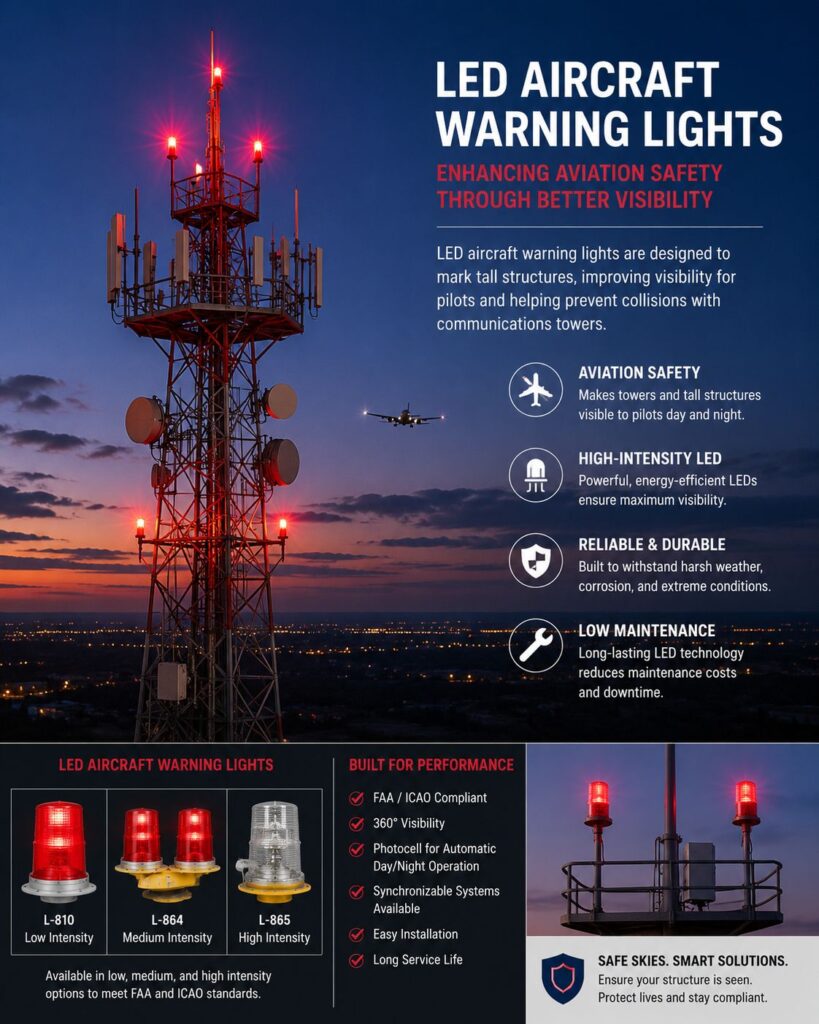
Aircraft warning lights increase the conspicuity of communications towers, buildings, wind turbines, cranes, and other elevated structures requiring aviation obstruction marking.
Selecting Aircraft Warning Lights for a Tower, Building, or Elevated Structure?
Aircraft warning-light selection depends on the structure, project location, required obstruction-lighting configuration, voltage, mounting requirements, controls, monitoring, and applicable aviation requirements.
Explore our LED Aircraft Warning Lights, Request a Quote, or call 844-533-7767 with the structure type, height, location, required light designation when known, quantity, voltage or solar-power requirements, mounting information, and project documents.
What Are Aircraft Warning Lights?
Aircraft warning lights, also called aviation obstruction lights, are lighting devices and systems used to increase the conspicuity of structures that may present obstructions to aviation.
Depending on the applicable requirements, aircraft warning lighting may operate during daytime, twilight, nighttime, or specified combinations of operating conditions.
Modern systems can include:
-
Red obstruction lights
-
Flashing white obstruction lights
-
Dual red/white lighting systems
-
LED aviation obstruction lights
-
Controllers and power supplies
-
Monitoring and alarm equipment
-
Communications components
-
Mounting and electrical infrastructure
Aircraft warning lights may be installed at the top and/or intermediate levels of a structure according to the required obstruction-marking configuration. Placement should be based on the applicable aviation requirements and project specifications rather than assuming every light belongs only at the highest point.
For detailed U.S. regulatory considerations, review our FAA Aircraft Warning Light Requirements and Compliance Guide.
Why Aircraft Warning Lights Are Used
Aircraft warning lights increase the conspicuity of structures that require aviation obstruction marking, helping pilots identify marked obstacles under the operating conditions for which the lighting system is designed.
Their purpose is specifically related to obstacle identification and visibility. The required lighting configuration depends on the structure and applicable aviation requirements.
For a deeper explanation of obstruction visibility, structure types, nighttime operations, and when lighting may apply, review our Why Aircraft Warning Lights Are Required guide.
Common Structures That Use Aircraft Warning Lights
Aircraft warning and obstruction lighting is used across many types of elevated structures. Whether lighting is required and which configuration applies depends on the structure, location, aviation environment, and applicable determination or project requirements.
Communication and Broadcast Towers
Communication and broadcast towers are common obstruction-lighting applications. Tower height, location, structure configuration, and applicable aviation requirements can affect the required lighting system.
Buildings and Rooftop Structures
Aircraft warning lights for buildings may be used on high-rise structures, rooftop antennas, mechanical structures, or other elevated components when obstruction marking or lighting is required.
Wind Turbines
Wind-energy projects can use coordinated aviation obstruction-lighting systems based on the applicable requirements and project configuration.
Industrial Structures
Stacks, process towers, elevated equipment, and other industrial structures may require obstruction lighting depending on their height, location, and relationship to navigable airspace.
Cranes
Temporary and permanent cranes may require aviation marking or lighting depending on their height, location, duration, and applicable aviation evaluation.
Utility and Infrastructure Structures
Transmission structures, water towers, and other elevated infrastructure can also require aircraft warning lighting in applicable locations.
For more structure-specific examples, review our Applications for Aviation Warning Lights guide.
Types of Aircraft Warning Lights
Aircraft warning-light systems can use different light types, intensities, colors, and operating modes. The required configuration should be established from the applicable aviation requirements and project specifications.
Red Obstruction Lights
Red obstruction lighting is commonly used for specified nighttime obstruction-marking applications. Systems can include steady-burning and/or flashing red lights depending on the required configuration.
White Flashing Obstruction Lights
White obstruction-lighting systems use flashing lights with operating characteristics appropriate to the specified application. Different systems may be used during daytime, twilight, nighttime, or combinations of these operating periods.
Dual Red/White Systems
Dual systems combine red and white obstruction lighting to provide different operating modes under specified conditions.
Low-, Medium-, and High-Intensity Obstruction Lighting
Obstruction-lighting equipment is also categorized by intensity and performance characteristics. The appropriate intensity class depends on the required system rather than owner preference or structure height alone.
LED Aviation Obstruction Lights
LED light sources are available across multiple aircraft warning-light categories. LED technology describes the light source; it does not by itself determine the required obstruction-light type, intensity, flash characteristics, placement, or operating mode.
For U.S. FAA light designations and compliance considerations, review our FAA Aircraft Warning Light Requirements and Compliance Guide.
Why LED Technology Is Widely Used in Aircraft Warning Lights
LED technology is widely used in modern aviation obstruction-lighting equipment. Depending on the product and application, LED systems can provide:
-
Lower power consumption
-
Reduced routine lamp replacement
-
Longer maintenance intervals
-
Immediate light output
-
Compact optical systems
-
Compatibility with modern controls and monitoring systems
Reduced routine lamp replacement can be particularly valuable on towers, rooftops, wind turbines, stacks, and other structures where access requires specialized personnel or equipment.
Actual service life, maintenance requirements, power consumption, and system performance depend on the specific equipment, operating environment, electrical conditions, controls, and installation.
LED technology should therefore be considered as one part of equipment selection—not as evidence that a fixture automatically meets the aviation requirements for a particular project.
Aircraft Warning Light System Components
An aircraft warning-light system may include more than the obstruction fixtures themselves. Depending on the project, system components can include:
Obstruction Lights and Flash Heads
Provide the required visual obstruction marking according to the specified light type and operating characteristics.
Controllers and Power Supplies
Manage power and, where applicable, operating modes, flash characteristics, synchronization, or other system functions.
Monitoring and Alarm Equipment
Monitoring systems can identify fixture or system status and provide alarms or notifications when specified conditions occur.
Communications Equipment
Remote installations may incorporate communications equipment for status reporting, monitoring, or maintenance coordination.
Surge and Electrical Protection
Electrical protection can be an important system consideration, particularly for exposed tower and elevated-structure installations.
Wiring and Mounting Hardware
Cabling, junction components, mounting brackets, supports, and related installation hardware must be compatible with the equipment and structure.
The required components depend on the obstruction-lighting configuration and project specifications. A replacement fixture should therefore be evaluated for compatibility with the existing controller, monitoring system, electrical supply, mounting, and other system components.
Aircraft Warning Light Controls and Monitoring
Aircraft warning-light systems can incorporate controls and monitoring appropriate to the required operating configuration.
Depending on the system, controls may manage functions such as:
-
Operating modes
-
Flashing characteristics
-
Day/night transitions
-
Synchronization
-
Alarm functions
-
System status reporting
-
Remote communications
Monitoring equipment can help operators identify fixture or system faults and support inspection and maintenance planning. Monitoring does not prevent failures; its role is to provide information about system status and specified alarm conditions.
For retrofit projects, compatibility between new LED obstruction lights and existing controllers, monitoring equipment, communications, electrical systems, and required operating characteristics should be confirmed before replacement equipment is selected.
Aircraft Warning Lights and Maintenance Access
Towers, rooftops, wind turbines, industrial stacks, and other elevated structures can require specialized personnel and equipment for lighting maintenance.
Equipment selection should therefore consider not only the warning light itself, but also access requirements, expected maintenance intervals, controllers, monitoring equipment, electrical components, environmental exposure, and availability of replacement components.
LED systems can reduce routine lamp-replacement requirements compared with older source technologies, but the complete obstruction-lighting system still requires appropriate inspection and maintenance.
Inline Buyer Q&A
How do I determine which aircraft warning lights are required for a structure?
The appropriate obstruction-lighting system depends on factors such as structure type, height, location, surrounding terrain, proximity to airports or flight paths, and the requirements or determinations applicable to the project.
Do not select an obstruction-lighting configuration solely by structure height or fixture type. Applicable FAA requirements, project documentation, and other governing criteria should be reviewed before equipment is specified.
What information should I provide when selecting LED aircraft warning lights?
Helpful information includes the structure type, overall height, project location, existing lighting system for retrofit projects, available voltage, required lighting configuration, monitoring requirements, and any FAA determination, marking and lighting specification, or project documentation available for the structure.
This information helps determine the appropriate fixtures, controllers, monitoring equipment, and system configuration.
What is the difference between red obstruction lights, white strobes, and dual systems?
Different obstruction-lighting configurations are used depending on the structure and applicable requirements.
Red obstruction lighting is commonly associated with nighttime marking. White flashing systems can be used for daytime and/or nighttime operation depending on the system and application. Dual systems combine red and white lighting modes to provide different obstruction-marking characteristics under different operating conditions.
The required configuration should be based on the applicable marking and lighting requirements for the structure rather than owner preference alone.
Can LED aircraft warning lights replace an existing obstruction-lighting system?
Many existing systems can be upgraded to LED technology, but a retrofit should preserve or satisfy the required obstruction-lighting configuration for the structure.
Existing fixture locations, flash characteristics, intensity requirements, controls, monitoring, electrical service, backup provisions, and applicable aviation requirements should be evaluated before equipment is replaced.
Do aircraft warning light systems require monitoring?
Monitoring requirements depend on the structure, system, and applicable requirements.
Obstruction-lighting systems can incorporate controllers, alarms, remote monitoring, communications, and other features that help operators identify fixture or system failures. Required monitoring and reporting provisions should be confirmed for the specific installation.
Can aircraft warning lights be installed on buildings?
Yes, aircraft warning and obstruction lighting can be used on buildings and rooftop structures when required by the applicable aviation determination or project requirements. Building height alone does not determine the lighting configuration. Project location, rooftop structures, surrounding airspace, required light type, mounting, electrical service, controls, and monitoring should also be considered.
Select the Aircraft Warning-Light System for Your Project
Aircraft warning and obstruction-lighting equipment should be selected according to the structure, project location, required light type and operating configuration, electrical system, mounting requirements, controls, monitoring, environmental conditions, and applicable aviation requirements.
For pricing and product selection, send us your structure type, height, project location, required FAA or aviation-authority light designation when known, quantity, voltage or solar-power requirements, mounting information, controls or monitoring requirements, and environmental conditions.
For retrofit projects, include the existing fixture model, controller or monitoring information, photographs, drawings, and existing electrical information when available. FAA determinations, engineering specifications, fixture schedules, and approved-equal requirements are also helpful.
Explore our LED Aircraft Warning Lights, Request a Quote, or call 844-533-7767 for pricing and application assistance.
Frequently Asked Questions
What are aircraft warning lights?
Aircraft warning lights, commonly referred to as obstruction lights, are lighting systems used to increase the conspicuity of structures that may present an obstruction to aviation.
The required marking and lighting configuration depends on the structure and applicable aviation requirements.
Why are aircraft warning lights important?
Their purpose is to make applicable structures more conspicuous to pilots, particularly during nighttime or reduced-visibility conditions.
Obstruction lighting is one component of aviation obstacle marking and should be installed and operated according to the requirements applicable to the structure.
What structures use aircraft warning lights?
Applications can include communication and broadcast towers, wind turbines, cranes, tall buildings, smokestacks, utility structures, industrial facilities, and other elevated structures.
However, the presence of a tall structure does not by itself establish a particular lighting requirement. Requirements depend on factors including structure height, location, aviation environment, and applicable regulatory determinations.
What types of aircraft warning lights are available?
Obstruction-lighting equipment can include steady-burning or flashing red lights, medium- and high-intensity white flashing systems, and dual red/white configurations.
The appropriate system depends on the structure and applicable marking and lighting requirements.
Why are LED aircraft warning lights widely used?
LED obstruction lights can provide lower energy consumption and longer maintenance intervals compared with many older lighting technologies.
Their solid-state construction can also reduce routine lamp replacement, which can be particularly valuable on towers and other difficult-to-access structures.
Actual service life and maintenance requirements depend on the equipment and operating environment.
Can aircraft warning lights be retrofitted?
Many older obstruction-lighting systems can be upgraded with LED equipment.
A retrofit should account for the required lighting configuration, fixture characteristics, controllers, monitoring system, electrical compatibility, backup provisions where applicable, and any other requirements governing the structure.
Replacing an older lamp or fixture with an LED product should not be treated as a simple wattage substitution.
Are aircraft warning lights used on wind turbines?
Wind turbines can require aviation obstruction lighting depending on the project and applicable requirements.
Wind-energy projects may involve coordinated lighting configurations across multiple turbines rather than treating every installation as an independent single-fixture application.
Are aircraft warning lights used on communication towers?
Yes. Communication and broadcast towers are common applications for obstruction marking and lighting.
The required system can vary according to tower height, location, structure characteristics, and applicable aviation requirements.
Do aircraft warning lights require monitoring?
Some obstruction-lighting installations require monitoring or notification procedures associated with lighting failures.
Modern systems can provide local alarms, remote monitoring, communications, and automated status reporting. The required monitoring configuration should be determined from the requirements applicable to the structure.
Are all tall structures required to use the same aircraft warning lights?
No. There is no single obstruction-lighting configuration for every tall structure.
Structure height, type, location, proximity to aviation activity, surrounding conditions, and regulatory determinations can affect whether marking or lighting is required and which system is appropriate.
What should be checked before ordering an aircraft warning-light system?
Confirm the structure type and height, project location, applicable FAA determination or project requirements, required lighting configuration, voltage, controls, monitoring requirements, environmental conditions, and existing equipment when performing a retrofit.
This information should be established before individual fixtures and system components are selected.
Stay Connected with Our Lighting Resources
Add IndustrialLightingFixtures.org as a Preferred Source on Google to see more of our lighting guides and technical resources across Google Search experiences.
Related Aircraft Warning & Obstruction Lighting Resources
- LED Aircraft Warning Lights — Explore LED obstruction-lighting solutions for towers, wind turbines, buildings, industrial structures, and other aviation obstacle-marking applications.
- Why Aircraft Warning Lights Are Required — Learn why obstruction marking and lighting may be required and the factors that influence aviation visibility requirements for elevated structures.
- FAA Aircraft Warning Light Requirements — Review FAA-related considerations affecting obstruction-lighting configurations and elevated structures.
- Obstruction Lighting Systems for Aviation Safety — Take a broader look at obstruction-lighting systems, applications, configurations, and their role in aviation obstacle visibility.
- Applications for Aviation Warning Lights — Explore common structures and environments where aviation warning and obstruction-lighting systems are used.
- Solar Aviation Obstruction Lights — Explore off-grid obstruction-lighting options for remote structures and locations without readily available utility power.