
Color-changing LED flood lights allow commercial properties to transform building façades and architectural features with programmable colors while using the same fixtures for a variety of lighting effects. Depending on the fixture configuration, RGB and RGBW systems can produce static colors, coordinated color changes, and dynamic architectural displays.
These fixtures are commonly used on commercial buildings, hotels and resorts, campuses, landmarks, municipal properties, entertainment venues, bridges, fountains, and other architectural features where lighting contributes to the property’s nighttime appearance.
This guide covers the primary applications, benefits, fixture considerations, and basic selection factors for commercial color-changing LED flood lights and architectural flood lighting.
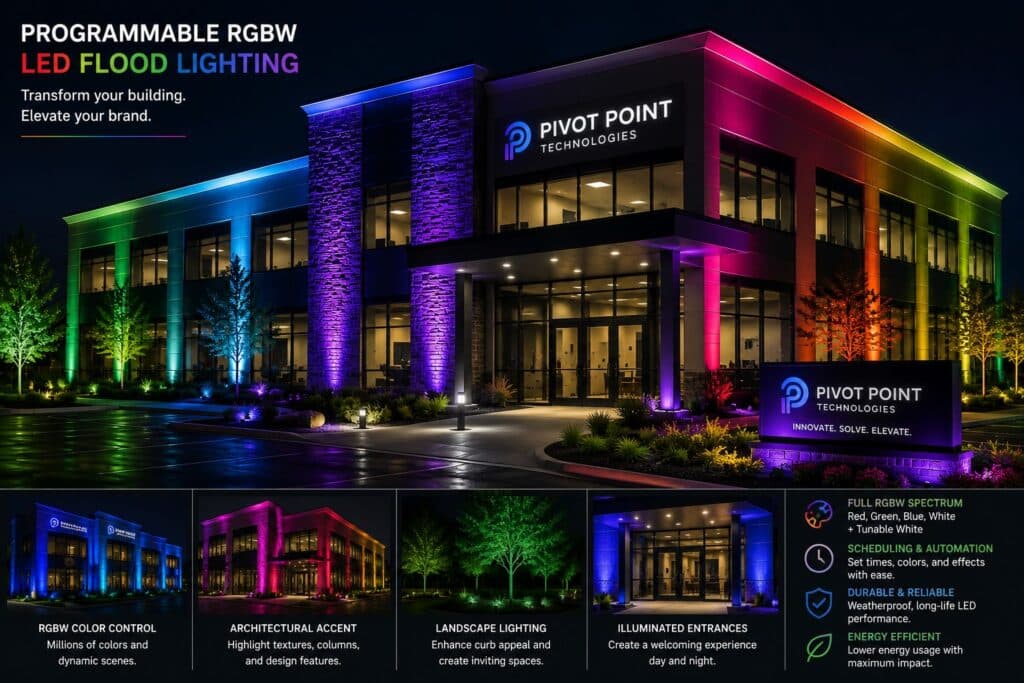
Color-changing LED flood lights provide programmable architectural lighting for commercial buildings, façades, landmarks, hospitality properties, and public spaces.
Need Color-Changing Flood Lights for a Commercial Project?
LED PROS WorldWide can help identify RGB and RGBW fixtures for building façades, architectural features, hospitality properties, campuses, landmarks, and other commercial applications. Explore our RGB LED Lights for commercial color-changing fixture options.
Request a Quote or call 844-533-7767 with your project drawings or building elevations, fixture quantities, voltage, mounting information, desired lighting effects, and control requirements.
What Are Color-Changing LED Flood Lights?
Color-changing LED flood lights use multiple LED color channels to produce programmable colors for architectural and exterior lighting applications. Commercial fixtures commonly use RGB or RGBW configurations.
RGB combines red, green, and blue LED channels to create a wide range of colors. RGBW adds a dedicated white channel, allowing the same fixture to provide color-changing effects and white illumination.
These fixtures can be used individually to highlight architectural features or coordinated across multiple fixtures to illuminate larger façades, buildings, and structures.
For a detailed comparison of the different color systems, see our RGB vs RGBW vs RGBWW Lighting Guide.
Commercial Applications for Color-Changing LED Flood Lights
Color-changing LED flood lights are used where architectural lighting needs to change for branding, holidays, events, community celebrations, or different nighttime environments.
Common commercial applications include:
-
Building façades and architectural features — Illuminate walls, columns, entrances, rooflines, and other prominent building elements.
-
Hotels, resorts and restaurants — Create changing nighttime environments for hospitality properties, events, and seasonal displays.
-
Corporate properties — Display brand colors or change exterior lighting for special events and campaigns.
-
Universities and campuses — Use school colors for athletics, celebrations, graduations, and campus events.
-
Municipal buildings and landmarks — Change colors for holidays, civic events, awareness campaigns, and community celebrations.
-
Bridges, fountains and public spaces — Add programmable color to prominent architectural and landscape features.
-
Multifamily and gated communities — Highlight entrances, clubhouses, fountains, landscape features, and shared amenities.
The appropriate fixture depends on the size and material of the illuminated surface, mounting distance, required output, beam distribution, environmental conditions, and desired lighting effect.
Benefits of Color-Changing LED Flood Lights
Color-changing LED flood lights give commercial properties greater flexibility than fixed-color architectural lighting.
Key benefits include:
-
Programmable architectural color — Change building colors for branding, holidays, events, athletics, or community programs without replacing fixtures.
-
Multiple lighting effects from one system — Create static colors, coordinated changes, dimming, and programmed scenes when supported by the control system.
-
White-light capability with RGBW — RGBW fixtures add a dedicated white channel for projects that also require conventional white architectural illumination.
-
Coordinated building-wide lighting — Compatible fixtures can operate together across façades and architectural features to create a unified nighttime appearance.
-
LED service life and reduced maintenance — Commercial LED fixtures can reduce lamp replacement and maintenance compared with older color-changing lighting technologies.
For properties that regularly change architectural lighting for different occasions, a programmable system provides flexibility without requiring separate fixtures for each color or effect.
How to Select Color-Changing LED Flood Lights
Commercial color-changing flood lights should be selected for the specific building, mounting conditions, and desired architectural effect rather than by wattage alone.
Key considerations include:
-
RGB or RGBW configuration — Determine whether the project requires primarily color effects or both programmable colors and dedicated white illumination.
-
Light output — Match fixture output to the size of the illuminated surface, mounting distance, ambient light, and desired intensity.
-
Beam angle — Select optics that provide the required coverage without excessive hot spots or light outside the intended area.
-
Mounting location and distance — Consider fixture placement, aiming, obstructions, and distance from the target surface.
-
Controls — Establish requirements for colors, dimming, scenes, synchronization, scheduling, and building-wide operation before final fixture selection.
-
Outdoor environment — Verify that the fixture and associated components are suitable for the installation conditions and required environmental exposure.
For detailed guidance on output, beam angles, mounting distance, and white-light CCT, see our RGBW Flood Light Brightness, Beam Angle & Color Temperature Guide.
Mounting Options
Commercial color-changing LED flood lights are available with different mounting options to accommodate building façades, landscape areas, architectural features, and other exterior installations.
Common options include:
-
Trunnion/yoke mounts — Provide adjustable aiming for façades, walls, signs, monuments, and architectural features.
-
Slip-fitter mounts — Allow adjustable installation on poles or tenons where elevated floodlighting is required.
-
Surface or wall mounts — Attach fixtures directly to buildings or structures for architectural accent lighting.
-
Ground or landscape mounting — Positions fixtures near grade for uplighting walls, columns, trees, monuments, and other features.
Mounting method should be selected based on the installation surface, fixture weight, aiming requirements, electrical access, and environmental conditions. Confirm the available mounting hardware for the specific fixture before ordering.
Choosing the Right Control System
The control system determines how color-changing LED flood lights are operated and how multiple fixtures work together. The appropriate control method depends on the size of the project and the lighting effects required.
Common considerations include:
-
Basic color selection and dimming — Suitable for smaller installations requiring simple color changes and brightness control.
-
Scenes and programmed effects — Allow properties to create preset colors and lighting sequences for holidays, events, branding, or special occasions.
-
Multiple fixtures and zones — Larger projects may require fixtures to operate together or in independently controlled areas.
-
Scheduling — Automated controls can change colors, scenes, or operating times according to a programmed schedule.
-
DMX512 control — Commonly used for commercial architectural projects requiring coordinated colors, dimming, scenes, and dynamic effects across multiple fixtures.
The control strategy should be established before fixtures are ordered to ensure compatibility between the fixtures, drivers, controllers, wiring, and desired lighting effects.
For more complex systems, see our DMX512 Architectural Lighting Guide.
Commercial Installation Considerations
Color-changing architectural lighting should be planned as part of the property’s overall commercial and industrial lighting system. Fixture location, aiming, electrical requirements, controls, and environmental conditions all affect the completed installation.
Before specifying fixtures, consider:
-
Mounting locations — Confirm fixtures can be positioned and aimed at the intended architectural surfaces.
-
Voltage and electrical requirements — Match fixtures and control components to the available electrical system.
-
Outdoor exposure — Verify appropriate environmental ratings for rain, moisture, dust, temperature, and other site conditions.
-
Fixture access — Consider future access to fixtures, drivers, controllers, and connections for service or adjustment.
-
Light spill and glare — Select optics and aiming that keep light on the intended architectural features.
-
Controls and wiring — Plan the control architecture and required wiring before installation, particularly for synchronized multi-fixture systems.
Project drawings, building elevations, mounting information, and control requirements can help identify potential installation issues before fixtures are ordered.
Controls and Color-Changing Effects
The control system determines how commercial color-changing LED flood lights create and coordinate colors, dimming, scenes, and programmed effects across a property.
Depending on the project, controls may provide:
-
Static color selection
-
Dimming and intensity adjustment
-
Color transitions and programmed scenes
-
Fixture synchronization
-
Scheduled lighting changes
-
Building-wide control of multiple fixtures or zones
The control strategy should be established before final fixture selection to ensure compatibility between the fixtures, drivers, controllers, and other system components.
For larger architectural RGBW systems requiring coordinated control, see our DMX512 Architectural Lighting Guide.
Commercial Color-Changing Flood Light Buyer Checklist
Before requesting a quote, gather as much of the following project information as possible:
-
Building elevations, drawings, or site photographs
-
Dimensions of the surfaces or architectural features being illuminated
-
Fixture mounting locations and distances
-
Estimated fixture quantities
-
Available voltage
-
RGB or RGBW preference, if already determined
-
Desired colors, effects, or white-light requirements
-
Control requirements, including dimming, scenes, scheduling, or synchronization
-
Outdoor or environmental conditions
-
Existing specifications or photometric requirements, if available
If fixture quantity, output, beam angle, or control method has not yet been determined, provide the available project information and describe the architectural lighting effect you want to achieve.
Buyer Q&A
Q: How do I determine how many color-changing flood lights my project needs?
A: Fixture quantity depends on the size and shape of the illuminated surfaces, mounting distance, fixture output, beam angle, and desired lighting effect. Building elevations or project drawings are especially helpful when evaluating coverage.
Q: Should I specify RGB or RGBW flood lights?
A: RGB may be appropriate when programmable color effects are the primary objective. RGBW is generally a better fit when the same fixtures also need to provide dedicated white illumination.
Q: Can color-changing flood lights be synchronized across an entire building?
A: Yes, when compatible fixtures and controls are specified. Multiple fixtures or zones can be coordinated for matching colors, dimming, scenes, and programmed effects.
Q: Can you help if I don’t have a completed lighting design?
A: Yes. Provide available drawings, photographs, building dimensions, mounting information, voltage, and the lighting effect you want to achieve. LED PROS WorldWide can help evaluate appropriate commercial fixture options.
Q: What should I send with an RFQ?
A: Send available building elevations or drawings, target dimensions, mounting locations, quantities, voltage, desired colors or white-light requirements, control requirements, and any existing fixture specifications.
Get Help With Your Commercial Color-Changing Lighting Project
LED PROS WorldWide can help identify RGB and RGBW flood lights for building façades, hospitality properties, campuses, corporate facilities, municipalities, landmarks, and other architectural lighting projects.
Send us your building elevations or drawings, target dimensions, mounting locations, fixture quantities, voltage, desired colors and white-light requirements, and control specifications. If some details have not yet been determined, send what you have and describe the lighting effect you want to achieve.
Request a Quote or call 844-533-7767 to discuss your project.
Frequently Asked Questions About Color-Changing LED Flood Lights
What are color-changing LED flood lights?
Color-changing LED flood lights use multiple LED color channels to produce programmable colors for architectural and exterior lighting. Commercial systems commonly use RGB or RGBW technology.
What is the difference between RGB and RGBW flood lights?
RGB fixtures use red, green, and blue LED channels to create different colors. RGBW fixtures add a dedicated white channel, allowing the fixture to provide both color-changing effects and white illumination.
Where are color-changing LED flood lights used?
Common applications include building façades, hotels and resorts, corporate properties, universities, municipal buildings, landmarks, bridges, fountains, entertainment venues, and other architectural features.
Can color-changing flood lights illuminate an entire building façade?
Yes. Fixture quantity, output, beam angle, mounting distance, aiming, and building dimensions must be considered to achieve the desired coverage across a façade.
Can multiple color-changing flood lights operate together?
Yes. Compatible fixtures and controls can coordinate colors, dimming, scenes, and programmed effects across multiple fixtures or lighting zones.
Are color-changing LED flood lights suitable for outdoor use?
Many commercial color-changing flood lights are designed for outdoor installations, but the environmental and ingress-protection ratings of the specific fixture should be verified for the project conditions.
How are commercial color-changing LED flood lights controlled?
Control methods vary by system. Depending on the fixtures and project, controls can provide color selection, dimming, scenes, scheduling, synchronization, and coordinated operation across multiple fixtures.
Stay Connected with Our Lighting Resources
Add IndustrialLightingFixtures.org as a Preferred Source on Google to see more of our lighting guides and technical resources across Google Search experiences.
Related RGB & Architectural Lighting Resources
-
RGB LED Lights — Explore commercial RGB and RGBW lighting fixtures for façades, buildings, and architectural applications.
-
RGB vs RGBW vs RGBWW Lighting Guide — Compare color-changing technologies and determine which configuration fits your project.
-
RGBW Flood Light Brightness, Beam Angle & Color Temperature Guide — Learn how to select output, optics, mounting distance, and white-light CCT for commercial RGBW flood lights.
-
DMX512 Architectural Lighting Guide — Understand controls, scenes, dimming, and coordinated operation for commercial RGBW lighting systems.