
Selecting the proper wattage for commercial LED flood lights involves much more than choosing the brightest fixture available. Today’s high-efficiency LEDs produce significantly more lumens per watt than older lighting technologies, making factors such as mounting height, beam angle, fixture spacing, and application far more important than wattage alone.
Commercial flood lighting projects require balancing illumination levels, energy efficiency, optical performance, and long-term operating costs. Whether lighting a warehouse yard, parking lot, sports facility, building façade, or municipal streetscape, the goal is to deliver the right amount of light where it is needed while minimizing glare, light trespass, and wasted energy.
Understanding how professional lighting designers select flood lights helps ensure every project achieves reliable, efficient, and visually comfortable illumination.
Explore our Commercial LED Flood Lights product page to compare specification-grade fixtures for industrial, municipal, architectural, security, and sports lighting applications.
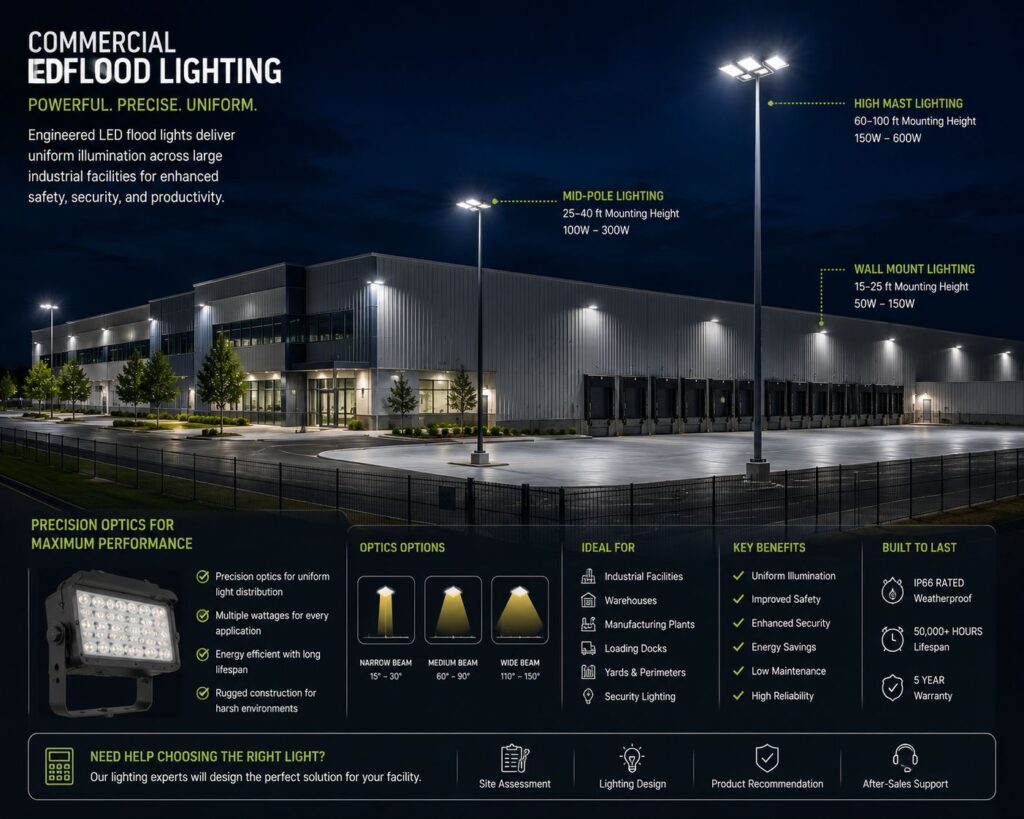
Selecting the proper wattage for commercial LED flood lights requires evaluating mounting height, beam angle, target illumination, and the specific application rather than simply choosing the highest output fixture.
Need help selecting the right commercial flood light for your project?
Our lighting specialists help contractors, engineers, municipalities, architects, and facility managers choose commercial LED flood lights that provide excellent illumination, long service life, and exceptional energy efficiency.
👉 Explore our complete collection of Commercial LED Flood Lights for security, sports, industrial facilities, architectural lighting, and outdoor commercial applications.
Flood Light Selection at a Glance
| Selection Factor | Why It Matters |
|---|---|
| Lumens | Determines total light output |
| Mounting Height | Affects fixture spacing and coverage |
| Beam Angle | Controls light distribution |
| Throw Distance | Determines effective illumination range |
| Application | Influences required illumination levels |
| Optical Distribution | Improves uniformity and reduces glare |
| Controls | Improves efficiency and operating costs |
Think Lumens, Not Just Watts
One of the biggest changes brought about by LED technology is that wattage is no longer the best indicator of lighting performance.
Traditional metal halide flood lights consumed large amounts of power to produce relatively modest light output. Modern LED fixtures deliver substantially more lumens while using significantly less electricity.
Today’s commercial LED flood lights often achieve efficiencies approaching 200 lumens per watt, nearly double the performance of many early-generation LED fixtures that averaged around 100 lumens per watt.
As LED technology continues to improve, lighting professionals increasingly compare fixtures based on:
- Total lumens
- Optical efficiency
- Beam distribution
- Color rendering (CRI)
- Driver quality
- Thermal management
rather than wattage alone.
Field Experience
One of the most common specification mistakes we encounter is selecting flood lights based solely on wattage.
Experienced lighting designers typically begin with the mounting height, beam angle, target illumination levels, and application before determining the appropriate lumen package. Two fixtures with identical wattage can produce dramatically different lighting results depending on their optical design and beam distribution.
Mounting Height Changes Everything
Mounting height has a significant influence on flood light performance.
Higher mounting positions allow fixtures to illuminate larger areas but generally require higher lumen output and carefully selected optics.
Lower mounting heights often provide:
- Better uniformity
- Reduced glare
- Smaller coverage areas
- Improved pedestrian comfort
Higher mounting heights typically require:
- Narrower beam distributions
- Increased lumen packages
- Greater fixture spacing
- More precise aiming
Rather than selecting wattage first, professional lighting designers determine the mounting height before calculating the appropriate fixture output.
Beam Angle Is Just as Important as Wattage
A flood light’s beam angle determines how efficiently its light is distributed across the target area.
Common beam patterns include:
- Narrow beam for long throw applications
- Medium beam for balanced coverage
- Wide beam for shorter mounting heights
- Asymmetric optics for wall washing and façade lighting
Selecting the correct optical distribution often improves lighting quality more than simply increasing fixture wattage.
Different Applications Require Different Wattages
Commercial flood lights are used in a wide variety of outdoor applications, each with unique illumination requirements.
| Application | Typical Considerations |
|---|---|
| Parking Lots | Uniform coverage and vehicle visibility |
| Industrial Yards | High-output illumination for safety and operations |
| Building Façades | Controlled beam angles to highlight architecture |
| Sports Facilities | Higher mounting heights and precise aiming |
| Security Lighting | Uniform perimeter illumination with minimal glare |
| Billboard Lighting | Asymmetric optics for vertical sign illumination |
| Municipal Parks | Pedestrian comfort, safety, and energy efficiency |
Rather than applying a single wattage recommendation to every project, lighting professionals tailor the fixture selection to the specific environment and performance goals.
Flood lights are commonly used for outdoor advertising. Learn how beam distribution, aiming, and optical control influence billboard illumination in our Commercial Billboard Lighting Design Guide.
Specification Tip
Commercial projects rarely begin by asking, “How many watts do we need?”
Instead, engineers typically establish:
- Mounting height
- Target foot-candle levels
- Beam distribution
- Fixture spacing
- Environmental conditions
- Control strategy
Only after these factors are evaluated is the appropriate lumen package selected. This approach produces better illumination while reducing energy consumption and long-term operating costs.
Commercial LED flood lights support far more than security lighting. Visit our Commercial LED Flood Light Applications Guide to explore how different optics, mounting methods, and fixture configurations are used across industrial facilities, sports complexes, municipal properties, transportation infrastructure, and architectural projects.
Use LED Equivalency as a Starting Point
Many commercial flood lighting projects involve replacing older metal halide, high-pressure sodium, or mercury vapor fixtures.
While LED wattage is much lower, today’s high-performance fixtures often deliver equal or superior illumination.
| Existing HID Fixture | Typical LED Replacement* |
|---|---|
| 175W Metal Halide | 60–100W LED |
| 250W Metal Halide | 100–150W LED |
| 400W Metal Halide | 150–240W LED |
| 750W Metal Halide | 300–450W LED |
| 1000W Metal Halide | 400–600W LED |
*Actual replacement wattage depends on optical efficiency, mounting height, beam angle, and required illumination levels.
Rather than matching wattage, compare the expected lighting performance using photometric data and fixture optics.
Multiple Smaller Fixtures vs. One Large Fixture
A common misconception is that one high-output flood light always produces the best results.
In many commercial applications, multiple properly spaced fixtures provide superior lighting performance.
Advantages of multiple fixtures include:
- Improved illumination uniformity
- Reduced hot spots
- Better control of shadows
- Increased system redundancy
- Lower glare
- Greater flexibility during future expansions
This approach is commonly used for:
- Parking lots
- Equipment yards
- Building façades
- Sports facilities
- Municipal plazas
- Distribution centers
🛠️ Field Experience
One large flood light mounted high on a building may appear less expensive initially, but we often find that two or three lower-output fixtures with properly selected optics create a more uniform, comfortable, and energy-efficient lighting solution.
The objective is balanced illumination—not simply maximum brightness.
Smart Controls Improve Efficiency
Modern flood lighting systems often include controls that reduce energy consumption without sacrificing safety.
Common control options include:
- Photocells
- Motion sensors
- Occupancy sensors
- Astronomical time clocks
- Programmable schedules
- Wireless lighting controls
- Remote monitoring systems
Many commercial facilities combine these technologies to illuminate outdoor spaces only when lighting is actually required.
Environmental Conditions Matter
Outdoor flood lights must perform reliably under a wide range of environmental conditions.
Before selecting a fixture, evaluate:
- Coastal salt exposure
- Heavy rainfall
- Snow and ice
- Desert heat
- Wind loading
- Dust and airborne contaminants
- Industrial pollutants
- Chemical exposure
Projects located near oceans, marinas, ports, or wastewater treatment facilities often specify marine-grade powder-coated finishes and stainless-steel hardware to maximize corrosion resistance.
🏗️Project Spotlight – Municipal Sports Complex
Municipal parks and sports complexes illustrate why wattage alone rarely determines the best lighting solution.
A single project may require flood lights for:
- Athletic fields
- Parking lots
- Walking paths
- Building entrances
- Scoreboards
- Flagpoles
- Public art
- Monument signs
Although all of these fixtures are classified as flood lights, each application may require a different lumen package, beam angle, mounting height, and control strategy.
Professional lighting designers evaluate each application independently to achieve consistent illumination, minimize energy consumption, and improve long-term maintenance.
📋Specification Tip
When preparing commercial lighting specifications, avoid standardizing flood light wattage across every application.
Instead, standardize performance criteria such as:
- Target illumination levels
- Optical distribution
- Surge protection
- Voltage
- Correlated Color Temperature (CCT)
- Color Rendering Index (CRI)
- Control compatibility
- Finish requirements
This approach provides greater design flexibility while improving lighting quality and simplifying future maintenance.
Common Wattage Selection Mistakes
Avoid these frequent specification errors:
- Choosing fixtures based only on wattage
- Ignoring mounting height
- Selecting the wrong beam angle
- Oversizing fixtures and creating glare
- Undersizing fixtures and creating dark areas
- Mixing color temperatures
- Ignoring future maintenance access
- Failing to evaluate environmental conditions
- Not reviewing photometric layouts before installation
Most lighting performance problems stem from improper application rather than inadequate fixture quality.
Commercial Flood Light Selection Checklist
| Question | Why It Matters |
|---|
| Have mounting heights been established? | Determines beam spread and lumen requirements |
| Have photometric calculations been reviewed? | Confirms illumination targets |
| Is the beam angle appropriate? | Controls coverage and glare |
| Are environmental conditions considered? | Improves durability |
| Are controls specified? | Reduces operating costs |
| Is surge protection included? | Protects electrical components |
| Is maintenance access available? | Reduces future service costs |
| Will future expansion use the same fixture family? | Simplifies maintenance and inventory |
| Application | Typical Mount | Preferred Optics | Typical CCT | Primary Goal |
|---|---|---|---|---|
| Building Façade | Wall/Trunnion | Wide | 3000K–4000K | Architectural appearance |
| Security Perimeter | Pole/Wall | Medium | 5000K | Visibility & security |
| Sports Field | Pole | Narrow | 5000K | Long throw & uniformity |
| Billboard | Top Mount | Asymmetric | 4000K–5000K | Even vertical illumination |
| Flagpole | Ground | Narrow | 4000K | Accent lighting |
Inline Buyer Q&A
Q: Should I choose the highest-wattage flood light available?
Not necessarily. Commercial lighting professionals typically prioritize photometric performance, beam angle, mounting height, and target illumination levels before determining the appropriate lumen package.
Q: Why are lumens more important than watts?
Watts measure electrical consumption, while lumens measure light output. Because modern LEDs are much more efficient than older technologies, two fixtures with similar wattage can produce very different lighting performance.
Q: Are multiple smaller flood lights better than one large fixture?
In many commercial applications, yes. Multiple fixtures often improve illumination uniformity, reduce glare, minimize shadows, and provide greater flexibility for future modifications.
Selecting the Right Flood Light Starts with Performance Goals
The best commercial flood lighting systems are designed around illumination requirements rather than fixture wattage alone. By considering mounting height, beam angle, lumens, optical distribution, environmental conditions, and control strategies together, facility owners can create outdoor lighting systems that are safer, more efficient, easier to maintain, and better suited to the needs of each project.
Ready to Select Commercial LED Flood Lights?
Whether you’re illuminating a distribution center, sports complex, municipal facility, industrial plant, parking lot, or commercial building, our lighting specialists can help you choose commercial LED flood lights that deliver reliable performance and long-term value.
Explore our complete selection of Commercial LED Flood Lights and discover how professional-grade luminaires can improve safety, efficiency, and nighttime visibility across virtually any outdoor application.
Frequently Asked Questions
What color temperature is most common for commercial flood lighting?
Most commercial installations specify 4000K or 5000K, depending on the application, desired visual appearance, and local lighting standards.
Can existing metal halide flood lights be upgraded to LED?
Yes. Many commercial facilities replace older HID fixtures with LED flood lights to reduce energy consumption, improve light quality, and lower maintenance costs while utilizing existing mounting locations.
Do commercial flood lights qualify for utility rebates?
Many do. DLC Listed commercial LED flood lights frequently qualify for utility rebate programs, making them attractive for municipalities, schools, industrial facilities, and other large commercial projects. Always verify current rebate requirements with the local utility provider before specifying equipment.
Stay Connected with Our Lighting Resources
Add IndustrialLightingFixtures.org as a Preferred Source on Google to see more of our lighting guides and technical resources across Google Search experiences.
