Why Sign Lighting Matters
Your sign works twenty-four hours a day—even when your business is closed.
Proper illumination helps customers:
- Locate your business
- Read your signage
- Identify entrances
- Build brand recognition
- Navigate commercial properties
- Feel more confident visiting after dark
Poorly illuminated signs can reduce visibility, diminish curb appeal, and make an otherwise attractive property appear dated or neglected.
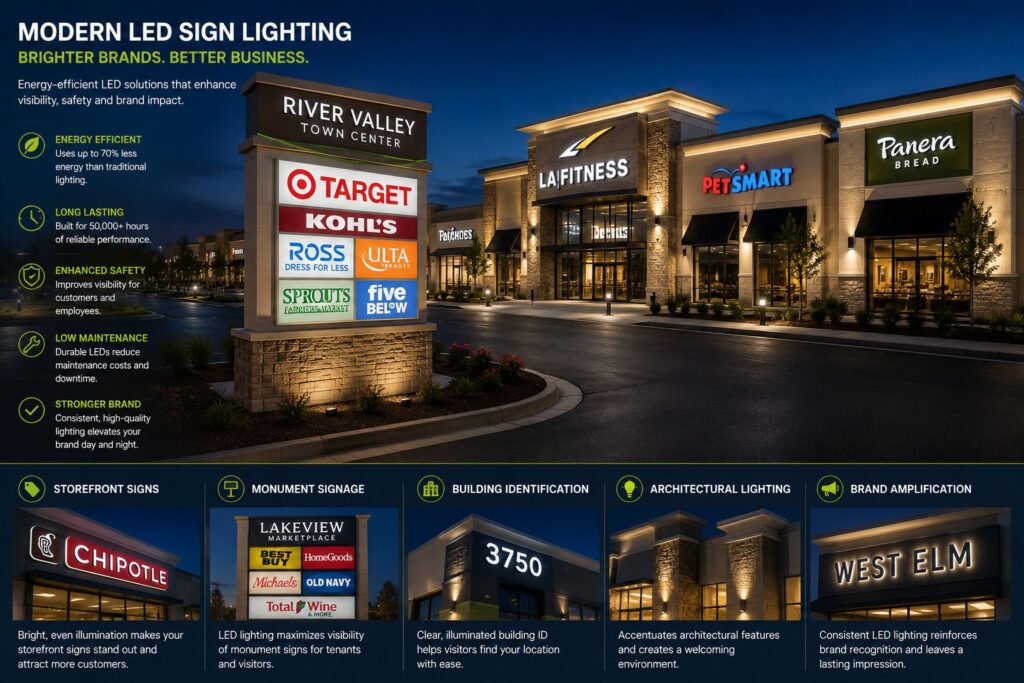
Commercial LED sign lighting improves business visibility, enhances brand recognition, and creates attractive nighttime signage while reducing energy and maintenance costs.
Your sign is often the first thing customers notice after dark.
Choosing the right commercial LED sign lighting improves visibility, reinforces your brand, and creates a professional first impression while reducing long-term operating costs.
Our lighting specialists can help you select the right fixtures or retrofit solution for your signage.
Speak with a Sign Lighting Specialist – – https://industriallightingfixtures.org/
Commercial Sign Lighting Applications
LED sign lighting is used throughout commercial properties.
Typical applications include:
- Shopping centers
- Restaurants
- Hotels
- Office buildings
- Banks
- Healthcare facilities
- Universities
- Gas stations
- Industrial facilities
- Churches
- Municipal buildings
- Entertainment venues
Each application requires different fixture types, mounting methods, and lighting objectives.
Once you’ve selected the right fixtures, discover how effective lighting influences customer attraction, branding, and curb appeal in our Business Visibility Guide.
Types of Commercial Sign Lighting
Selecting the correct lighting system depends on the type of sign being illuminated.
Cabinet Signs
Internally illuminated signs commonly retrofitted with LED sign tubes or LED modules.
Monument Signs
Typically illuminated using exterior LED flood lights or dedicated sign lighting fixtures.
Pylon Signs
Require high-output fixtures capable of evenly illuminating tall freestanding signs.
Building Identification Signs
Often illuminated using gooseneck fixtures, flood lights, or linear LED sign lights depending on mounting height and architectural design.
Ready to upgrade an existing fluorescent sign cabinet? Our LED Sign Cabinet Retrofit Guide covers ballast bypass, installation considerations, and retrofit planning.
Choosing the Right Fixture
Several factors influence fixture selection.
Evaluate:
- Sign size
- Mounting height
- Viewing distance
- Beam angle
- Brightness requirements
- Sign material
- Existing electrical service
- Environmental conditions
- Maintenance accessibility
The proper fixture produces uniform illumination without creating excessive glare or uneven hot spots.
Explore our complete line of Commercial LED Sign Lighting solutions, including sign fixtures, LED sign tubes, retrofit products, and architectural lighting options.
Don't Buy Sign Lighting by Wattage Alone
Modern LED fixtures should never be selected solely by wattage.
Instead, evaluate:
- Lumen output
- Beam distribution
- Fixture spacing
- Mounting distance
- Optical performance
- Uniformity
- Color rendering
- Long-term maintenance
Today’s LED optics often allow lower-wattage fixtures to outperform older HID systems while consuming significantly less electricity.
Color Temperature Matters
The appearance of a sign changes dramatically depending on the selected white light.
| Color Temperature | Typical Applications |
|---|---|
| 3000K | Restaurants, hospitality, historic buildings |
| 4000K | Office buildings, retail centers, healthcare |
| 5000K | Gas stations, industrial facilities, transportation |
Choosing the proper color temperature improves readability while complementing the building’s architecture and branding.
Learn how effective sign lighting attracts customers, strengthens branding, and enhances curb appeal in our Business Visibility Guide.
Understanding Nominal vs. Actual LED Sign Tube Lengths
One of the most common mistakes when ordering replacement LED sign tubes is assuming the fluorescent lamp’s nominal length matches the physical length of the LED replacement.
It does not.
Traditional fluorescent sign lamps are identified by nominal sizes, such as:
- 2-foot
- 3-foot
- 4-foot
- 5-foot
- 6-foot
- 8-foot
- 10-foot
However, LED sign tubes are intentionally manufactured slightly shorter to allow installers to fit the lamp between the sockets and rotate it into place during installation.
For example, a 4-foot fluorescent sign lamp is replaced with an LED sign tube measuring approximately 45.91 inches—not 48 inches.
Understanding this distinction helps prevent ordering mistakes, shipping delays, and installation problems.
After selecting the right lighting approach, explore our LED Sign Cabinet Retrofit Guide for practical advice on converting fluorescent cabinet signs to LED technology.
Nominal vs. Actual LED Sign Tube Lengths
| Nominal Fluorescent Lamp | Typical LED Sign Tube Length |
|---|---|
| 2 ft | ~22.56 in. |
| 3 ft | ~34.56 in. |
| 4 ft | 45.91 in. |
| 5 ft | ~58.03 in. |
| 6 ft | ~70.03 in. |
| 8 ft | ~93.78 in. |
| 10 ft | ~117.40 in. |
Always verify dimensions with the manufacturer’s specifications before ordering, as actual dimensions may vary slightly between manufacturers.
Don't Measure the Existing Tube
Many buyers remove an existing fluorescent lamp, measure it with a tape measure, and order an LED tube based on that measurement.
A better approach is to identify the fluorescent lamp designation.
For example:
- F48T12
- F60T12
- F72T12
- F96T12
- F120T12
Using the lamp designation instead of the measured length helps ensure the correct replacement tube is ordered.
Standard LED Tubes vs. LED Sign Tubes
Although they appear similar, standard LED tubes and LED sign tubes are designed for different applications.
| Standard LED Tubes | LED Sign Tubes |
|---|---|
| Interior lighting | Sign cabinets |
| Office ceilings | Outdoor signs |
| Warehouses | Monument and cabinet signs |
| Standard nominal lengths | Sign-specific lengths |
| Indoor environments | Outdoor-rated applications |
| General illumination | Uniform sign illumination |
LED sign tubes are specifically engineered for illuminated sign cabinets and should not be confused with standard interior LED replacement tubes.
LED Sign Tube Retrofit Options
Many commercial properties continue to operate fluorescent sign cabinets that are excellent candidates for LED retrofits.
Rather than replacing the entire sign, businesses can often upgrade the internal lighting system while retaining the existing cabinet.
Common retrofit benefits include:
- Reduced energy consumption
- Lower maintenance costs
- Improved sign brightness
- Better color consistency
- Instant-on operation
- Longer service life
- Elimination of mercury-containing fluorescent lamps
A properly designed LED retrofit can dramatically improve both the appearance and operating efficiency of an existing sign.
Ballast Bypass vs. Existing Ballast Systems
One of the first decisions during a sign retrofit is determining how the new LED tubes will be powered.
Most commercial retrofit projects fall into one of two categories.
Ballast Bypass
With a ballast bypass retrofit, the fluorescent ballast is removed and line voltage is wired directly to the LED sign tube.
Advantages include:
- Eliminates ballast failures
- Lower maintenance
- Improved reliability
- Better energy efficiency
- Simplified future servicing
For many aging sign cabinets, ballast bypass is the preferred long-term solution.
Existing Ballast Compatible Systems
Some LED sign tubes are designed to operate with compatible electronic ballasts.
Advantages include:
- Faster installation
- Less rewiring
- Reduced labor for certain projects
However, the ballast remains a future maintenance item and may eventually require replacement.
When retrofitting older sign cabinets, many owners choose ballast bypass to maximize long-term reliability.
Uniform Illumination Is the Goal
The purpose of sign lighting is not simply to make a sign brighter.
The objective is to create uniform illumination across the entire sign face.
Proper lighting design minimizes:
- Bright spots
- Dark corners
- Shadowing
- Uneven lettering
- Distracting glare
Consistent illumination improves readability while presenting a more professional image.
Exterior Sign Lighting Options
Not all commercial signs are internally illuminated.
Exterior fixtures remain the preferred solution for many monument signs, architectural signs, and building identification signs.
Common fixture types include:
Gooseneck Fixtures
Ideal for:
- Historic districts
- Restaurants
- Boutique retail
- Office buildings
- Decorative architectural applications
LED Flood Lights
Best suited for:
- Monument signs
- Pylon signs
- Large building signage
- Multi-tenant shopping centers
- Industrial facilities
Adjustable flood lights allow installers to fine-tune aiming and beam distribution for even illumination.
Linear Sign Lighting
Linear LED fixtures provide continuous, even illumination across long signs.
Common applications include:
- Building identification
- Corporate headquarters
- Shopping centers
- Architectural canopies
- Continuous fascia signage
Beam Angles Matter
Choosing the proper beam angle is just as important as selecting the fixture.
Different signs require different optical distributions.
| Beam Angle | Typical Applications |
|---|---|
| 15° | Narrow monument signs |
| 25° | Building lettering |
| 40° | Medium-sized wall signs |
| 60° | Wide monument signs |
| 90°–120° | Large façade signage and broad wall washing |
The correct beam angle minimizes spill light while producing even illumination across the entire sign face.
Weather Resistance Is Essential
Commercial sign lighting operates outdoors year-round.
Look for fixtures featuring:
- Powder-coated aluminum housings
- UV-resistant finishes
- Corrosion-resistant hardware
- Silicone gasketing
- Wet-location ratings
- Marine-grade finishes for coastal environments
- High-quality optics
Durable construction protects the lighting system while reducing maintenance over its service life.
Surge Protection Extends Fixture Life
Outdoor lighting systems are exposed to electrical surges caused by lightning, switching events, and utility disturbances.
Many commercial fixtures include integrated surge protection to help safeguard:
- LED drivers
- Electronic components
- LEDs
- Control systems
Investing in surge-protected fixtures can reduce service calls and extend the life of the lighting system.
Long-Term Maintenance Savings
One of the greatest advantages of LED sign lighting is reduced maintenance.
Compared to fluorescent systems, modern LED solutions typically provide:
- Longer operating life
- Fewer service interruptions
- Reduced labor costs
- Lower replacement part inventory
- Consistent light output
- Improved reliability
These benefits are particularly valuable for tall pylon signs, shopping centers, and facilities where service access requires specialized equipment.
Common Sign Lighting Mistakes
Avoid these common specification errors:
- Ordering LED tubes based on measured length instead of lamp designation
- Selecting the wrong beam angle
- Ignoring sign setback and mounting distance
- Over-lighting the sign
- Creating glare for drivers
- Mixing color temperatures
- Retaining aging ballasts unnecessarily
- Ignoring surge protection
- Failing to verify electrical compatibility
- Choosing fixtures without considering future maintenance access
Proper planning helps ensure the lighting system performs reliably while presenting the sign in the best possible way.
Commercial Buyer Checklist
Before requesting a quotation, gather:
✓ Sign type (cabinet, monument, pylon, or building sign)
✓ Sign dimensions
✓ Existing lamp designation (F48T12, F96T12, etc.)
✓ Cabinet depth
✓ Mounting height
✓ Electrical service voltage
✓ Preferred color temperature
✓ Existing ballast information
✓ Site photographs
✓ Desired lighting objectives
Providing complete project information helps lighting specialists recommend the most effective fixture or retrofit solution.
Inline Buyer Q&A
Why isn’t a 4-foot LED sign tube actually 48 inches long?
LED sign tubes are intentionally manufactured slightly shorter than their nominal fluorescent counterparts to allow proper installation into existing sign sockets.
Should I measure my existing fluorescent lamp?
No. Always identify the lamp designation (such as F48T12 or F96T12) rather than relying on a tape measure.
Is ballast bypass recommended?
For many older sign cabinets, yes. Removing aging ballasts improves long-term reliability and reduces future maintenance.
What color temperature is best for commercial signs?
Most commercial applications use 5000K because it produces crisp, highly readable white light. Certain architectural or hospitality projects may prefer 4000K or 3000K depending on the desired appearance.
Can LED sign lighting reduce maintenance?
Absolutely. Long-life LEDs dramatically reduce lamp replacements, ballast failures, and service calls compared to fluorescent systems.
Illuminate Your Brand with the Right Sign Lighting
Commercial LED sign lighting is more than a replacement for older fluorescent or HID systems—it’s an investment in your business’s visibility, professional image, and long-term operating efficiency. By selecting the right fixtures, beam angles, color temperatures, and retrofit approach, you can create signage that attracts attention, enhances your brand, and performs reliably for years.
Ready to Upgrade Your Commercial Sign Lighting?
Whether you’re illuminating a cabinet sign, monument sign, pylon sign, or building identification sign, our lighting specialists can help you choose the right products for your application.
Explore our complete selection of Commercial LED Sign Lighting solutions and create brighter, more effective signage that stands out day and night.
Frequently Asked Questions
Can I retrofit my existing fluorescent sign cabinet?
In many cases, yes. Existing sign cabinets can often be upgraded with LED sign tubes or LED modules, improving brightness while reducing operating costs.
What is the difference between LED sign tubes and standard LED tubes?
LED sign tubes are manufactured specifically for illuminated sign cabinets and use sign-specific lengths and electrical configurations. Standard interior LED tubes are generally not intended for commercial sign applications.
Are LED sign lights weatherproof?
Commercial exterior sign lighting fixtures are typically designed for outdoor use with weather-resistant housings and wet-location ratings. Always verify the fixture’s environmental rating for your application.
How long do LED sign lights last?
Many commercial LED sign lighting products are rated for 50,000 to 100,000 hours, depending on the fixture design and operating conditions.
Can LED lighting improve the appearance of my business?
Yes. Uniform, high-quality illumination enhances readability, reinforces your brand, improves curb appeal, and helps customers locate your business more easily after dark.
Stay Connected with Our Lighting Resources
Add IndustrialLightingFixtures.org as a Preferred Source on Google to see more of our lighting guides and technical resources across Google Search experiences.