
Modern commercial security lighting does far more than simply turn lights on and off. Today’s intelligent lighting systems combine motion sensors, photocells, programmable dimming, and networked controls to deliver light precisely where and when it is needed.
For warehouses, manufacturing facilities, office campuses, schools, healthcare facilities, municipal buildings, and distribution centers, motion sensor technology helps improve safety while reducing unnecessary operating costs. Rather than operating every fixture at full brightness throughout the night, intelligent controls automatically adjust lighting levels based on occupancy, available daylight, and facility operations.
When properly specified, motion sensor security lighting becomes an integral part of an efficient, layered outdoor lighting strategy.
Compare our Commercial LED Outdoor Security Lights with integrated motion sensors, bi-level dimming capabilities, and smart-ready control options for commercial and industrial facilities.
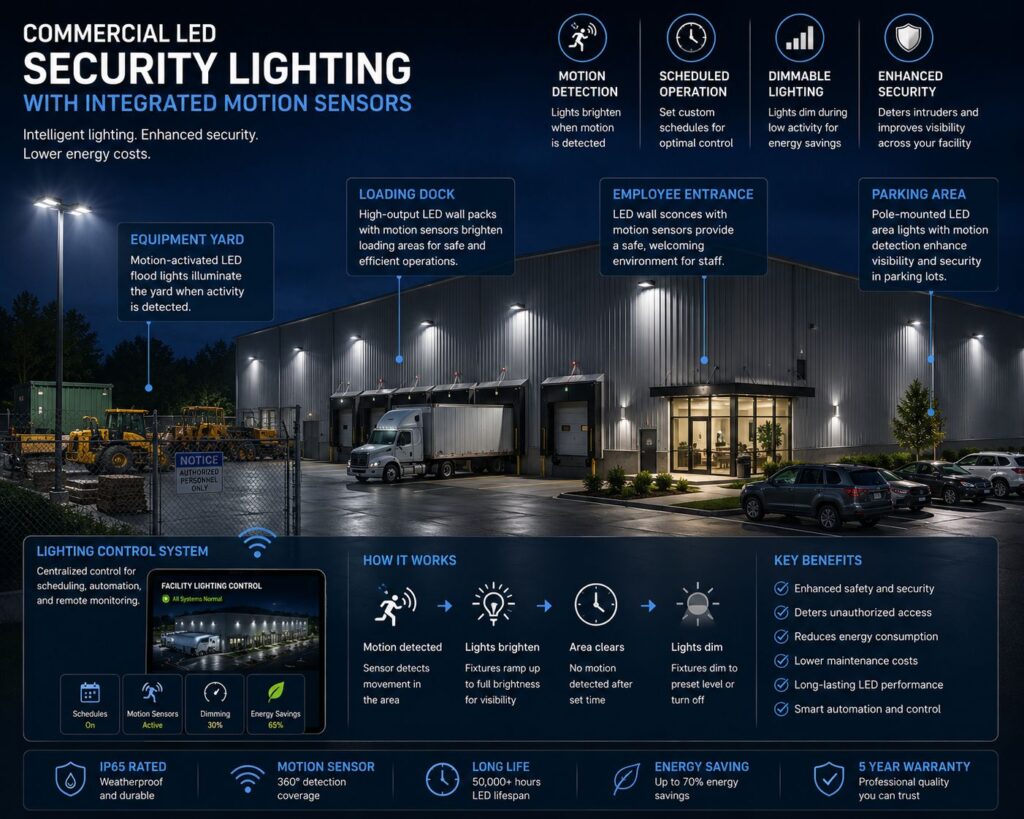
Commercial motion sensor security lighting combines intelligent controls, bi-level operation, and LED technology to improve safety while reducing energy consumption.
Looking for intelligent commercial security lighting?
Our lighting specialists can help you select specification-grade LED security fixtures with integrated motion sensors, bi-level controls, photocells, and smart-ready options for virtually any commercial application.
👉 Explore our complete collection of Commercial LED Outdoor Security Lights.
Motion Sensor Lighting at a Glance
| Feature | Primary Benefit |
|---|---|
| Motion Detection | Improved security |
| Bi-Level Dimming | Lower energy costs |
| Photocell | Automatic dusk-to-dawn operation |
| Adjustable Hold Time | Operational flexibility |
| Smart Controls | Remote monitoring |
| NEMA Receptacle | Future control upgrades |
How Commercial Motion Sensors Work
Unlike residential motion lights, commercial systems are designed for larger spaces, higher mounting heights, and more demanding operating conditions.
Most systems detect activity within a defined coverage area and automatically increase fixture output when movement is detected. After a programmed period of inactivity, fixtures either return to a lower light level or switch off, depending on the selected control strategy.
Modern systems may combine:
- Motion detection
- Ambient daylight sensing
- Programmable hold times
- Adjustable sensitivity
- Dimming controls
- Centralized lighting management
Together, these features improve both security and energy efficiency.
🛠️ Field Experience
Many service calls result from improperly adjusted sensors rather than fixture failures. Sensors aimed toward busy streets, neighboring properties, or moving tree branches can trigger unnecessary lighting cycles throughout the night.
Proper commissioning—including sensor orientation, sensitivity adjustment, and hold-time programming—is just as important as selecting the right fixture.
PIR vs. Microwave Motion Sensors
Commercial lighting systems commonly use one of two sensing technologies.
| PIR Sensors | Microwave Sensors |
|---|---|
| Detect changes in heat signatures | Detect movement using microwave signals |
| Lower initial cost | Greater detection range |
| Excellent for predictable pedestrian movement | Performs well around larger open spaces |
| Less sensitive to distant movement | Can detect movement through some non-metallic materials |
Some specification-grade fixtures combine both technologies to improve reliability while reducing false activations.
📋 Specification Tip
Selecting the appropriate sensor technology depends on the application. Passive Infrared (PIR) sensors often perform well around pedestrian entrances, sidewalks, and building access points, while microwave sensors are frequently specified for larger industrial spaces where longer detection distances and broader coverage are beneficial.
Bi-Level Lighting Controls
One of the most requested commercial lighting features is bi-level operation.
Instead of switching completely off after motion is no longer detected, fixtures automatically reduce to a lower output level while maintaining continuous background illumination.
Typical commercial applications include:
- Distribution centers
- Manufacturing facilities
- Employee parking lots
- Loading docks
- Equipment storage yards
- School campuses
- Municipal facilities
- Self-storage properties
Bi-level operation helps reduce energy consumption while maintaining visibility for security personnel, surveillance cameras, and employees working during overnight hours.
Building entrances, service doors, and loading docks frequently use Commercial LED Wall Pack Lights equipped with motion sensors or photocells to improve safety while reducing unnecessary energy consumption.
Typical Bi-Level Settings
Although settings vary by manufacturer, many commercial fixtures allow programmable options similar to the following:
| Parameter | Typical Setting |
|---|---|
| High Output | 100% |
| Dimmed Output | 10–50% |
| Motion Hold Time | 30 seconds to 30 minutes |
| Daylight Threshold | Adjustable |
| Detection Distance | Based on mounting height and sensor type |
These settings allow facility managers to customize lighting operation based on property activity and operating schedules.
NEMA Receptacles & Smart-Ready Fixtures
Many specification-grade commercial security fixtures are available with ANSI C136-compliant NEMA receptacles, allowing lighting controls to be upgraded without replacing the luminaire.
This standardized interface simplifies future maintenance while providing flexibility for changing operational requirements.
Common NEMA Configurations
| Configuration | Typical Function | Common Applications |
|---|---|---|
| 3-Pin | Standard photocell | Parking lots, wall packs, flood lights |
| 5-Pin | Photocell + 0–10V dimming | Bi-level security lighting |
| 7-Pin | Smart control nodes | Municipal, campus, and networked lighting |
What is a 3-Pin NEMA Receptacle?
The 3-pin NEMA receptacle is the most common control interface used on commercial outdoor lighting.
It accepts a standard twist-lock photocell that automatically turns fixtures on at dusk and off at dawn, making it an economical solution for parking lots, wall packs, flood lights, and general security lighting.
What Makes 5-Pin NEMA Different?
A 5-pin NEMA receptacle adds low-voltage dimming capability in addition to standard photocell operation.
This allows fixtures to support:
- Bi-level lighting
- Motion sensor integration
- Scheduled dimming
- Energy management strategies
- Adaptive lighting controls
Many new commercial projects specify 5-pin receptacles to provide greater flexibility as operational requirements evolve.
📋 Specification Tip
Even if a project initially requires only dusk-to-dawn operation, many engineers specify 5-pin NEMA receptacles because they provide a convenient upgrade path for future motion sensors, bi-level dimming, or advanced lighting controls without replacing fixtures or modifying wiring.
7-Pin NEMA Receptacles & Smart Lighting Systems
As commercial lighting systems become more connected, many engineers and municipalities specify 7-pin NEMA receptacles to support advanced lighting controls.
In addition to standard power and dimming functions, 7-pin receptacles accommodate smart control nodes that communicate with centralized lighting management platforms.
These systems may provide:
- Remote fixture monitoring
- Individual fixture scheduling
- Energy reporting
- Automatic fault notifications
- Asset management
- Utility demand response
- Smart city integration
- Remote dimming and programming
Because the control node can often be replaced without changing the luminaire, 7-pin receptacles provide excellent long-term flexibility for commercial properties anticipating future technology upgrades.
🛠️ Field Experience
Many facility owners initially install standard photocells because they are inexpensive and easy to maintain. However, when parking lots, campuses, or industrial sites later require adaptive lighting or remote monitoring, upgrading fixtures without smart-ready receptacles can become costly.
Specifying 5-pin or 7-pin NEMA receptacles during the original installation often adds only a modest upfront cost while making future control upgrades significantly easier.
Best Commercial Applications for Motion Sensor Lighting
Motion-controlled lighting is particularly effective in areas with intermittent occupancy rather than constant activity.
Ideal applications include:
Loading Docks
Automatically increases lighting levels during deliveries while reducing output after operations conclude.
Equipment Storage Yards
Provides continuous low-level visibility while increasing illumination when vehicles or personnel enter the area.
Employee Parking Areas
Maintains background lighting overnight while improving visibility as employees arrive or depart during early morning or evening hours.
Service Roads
Improves driver visibility only when traffic is present, reducing unnecessary energy consumption during inactive periods.
Warehouses & Distribution Centers
Supports around-the-clock operations by adapting lighting levels to changing occupancy throughout the facility.
Municipal Facilities
Provides efficient lighting for maintenance yards, public works buildings, water treatment facilities, and fleet operations.
Many motion-controlled perimeter lighting systems utilize Commercial LED Flood Lights with precision optics and programmable controls to protect building exteriors, storage yards, and equipment areas.
When Motion Sensors May Not Be the Best Choice
Although motion sensors offer many advantages, they are not appropriate for every outdoor lighting application.
Areas with constant activity often benefit more from continuous illumination or scheduled dimming.
Examples include:
- Main public sidewalks
- Emergency egress routes
- Hospital emergency entrances
- Transit terminals
- Active retail parking lots
- Primary campus walkways
- High-traffic building entrances
For these locations, photocells, astronomical timers, or networked lighting controls frequently provide more consistent lighting while maintaining safety and occupant comfort.
📋 Specification Tip
Control strategies should match how a property is actually used—not simply maximize energy savings.
Areas with predictable occupancy often benefit from scheduled dimming, while locations with intermittent activity are better suited for motion-based bi-level operation. Combining multiple control methods across a property frequently produces the best balance of safety, efficiency, and operating cost.
🏗️ Project Spotlight – Distribution Warehouse
A regional distribution warehouse operates twenty-four hours a day but experiences varying activity levels throughout the night.
The facility uses several coordinated lighting control strategies:
- Employee parking remains at approximately 30% output until vehicles arrive.
- Loading dock fixtures increase to 100% output during deliveries.
- Equipment storage yards brighten automatically when maintenance personnel enter the area.
- Building entrances remain fully illuminated throughout operating hours.
- Parking lot fixtures gradually dim during low-traffic periods while maintaining sufficient illumination for surveillance cameras.
By combining motion sensors, photocells, and programmable dimming, the facility reduces energy consumption while maintaining continuous security lighting across the property.
Common Motion Sensor Specification Mistakes
Many lighting performance issues result from improper sensor configuration rather than fixture selection.
Common mistakes include:
- Selecting the wrong sensor technology
- Mounting sensors too high or too low
- Aiming sensors toward roadways
- Ignoring detection coverage patterns
- Programming hold times that are too short
- Leaving fixtures completely off instead of using bi-level operation
- Failing to coordinate sensors with photocells
- Specifying 3-pin receptacles where future dimming is anticipated
- Not considering surveillance camera requirements
Proper planning and commissioning help ensure lighting controls perform reliably throughout the life of the installation.
Motion Sensor Application Matrix
| Application | Recommended Control | Typical Operation | Preferred NEMA Configuration |
|---|---|---|---|
| Employee Parking | Motion + Bi-Level | 30–50% → 100% | 5-Pin |
| Loading Dock | Motion + Photocell | Dim → Full Output | 5-Pin |
| Equipment Yard | Motion + Timer | Bi-Level | 5-Pin |
| Building Entrance | Photocell | Continuous Operation | 3-Pin |
| Service Road | Motion Sensor | Bi-Level | 5-Pin |
| Municipal Campus | Smart Node | Scheduled Dimming | 7-Pin |
| University Campus | Network Controls | Adaptive Lighting | 7-Pin |
Inline Buyer Q&A
Should commercial motion sensor lights turn completely off?
In many commercial applications, no. Maintaining a low background illumination level through bi-level operation often provides better security, improves camera performance, and creates a safer environment than complete shutoff.
Can one motion sensor control multiple fixtures?
Yes. Depending on the lighting system and control configuration, a single sensor can often trigger multiple luminaires, making it easier to illuminate larger loading docks, parking areas, or equipment yards.
Should I specify a 3-pin or 5-pin NEMA receptacle?
A 3-pin receptacle is suitable for standard dusk-to-dawn photocell operation. If bi-level dimming, motion sensors, or future lighting control upgrades are anticipated, many engineers recommend specifying a 5-pin receptacle.
Intelligent Lighting Controls Improve Commercial Security
Motion sensors have evolved from simple occupancy switches into sophisticated lighting control systems that enhance safety, reduce operating costs, and support modern facility management. By combining motion detection, bi-level dimming, photocells, programmable controls, and smart-ready NEMA receptacles, commercial properties can create outdoor lighting systems that adapt to changing conditions while maintaining dependable illumination and long-term flexibility.
Ready to Specify Commercial Motion Sensor Security Lighting?
Whether you’re upgrading a warehouse, distribution center, office campus, healthcare facility, school, or municipal property, our lighting specialists can help you select specification-grade LED security lighting with advanced control options tailored to your operational requirements.
Explore our complete selection of Commercial LED Outdoor Security Lights designed for intelligent, energy-efficient outdoor lighting.
Frequently Asked Questions
Which motion sensor technology is best for commercial outdoor lighting?
Passive Infrared (PIR) sensors are commonly used around pedestrian entrances and walkways, while microwave sensors are often preferred for larger industrial areas where longer detection ranges are beneficial. Some specification-grade fixtures combine both technologies for enhanced performance.
Do motion sensors work with LED fixtures?
Yes. LED fixtures respond instantly to motion detection, making them well suited for occupancy-based lighting control and bi-level dimming strategies.
Can motion sensors improve energy efficiency?
Absolutely. By reducing light output during periods of inactivity, motion-controlled LED fixtures can significantly lower energy consumption while maintaining appropriate lighting levels for safety and security.
What is the advantage of a 7-pin NEMA receptacle?
A 7-pin receptacle allows smart lighting nodes to be installed, enabling remote monitoring, scheduling, energy reporting, and adaptive lighting control without replacing the fixture.