
Why Commercial Outdoor Lighting Matters
Commercial outdoor lighting serves many purposes beyond simply illuminating a property after sunset.
A professionally designed lighting system helps:
- Improve customer safety
- Enhance employee security
- Support surveillance camera performance
- Increase property value
- Improve nighttime navigation
- Strengthen brand image
- Highlight architectural features
- Reduce maintenance costs
- Lower energy consumption
Whether lighting a retail center, manufacturing facility, office park, healthcare campus, or municipal property, selecting the proper fixture for each application creates a safer and more attractive environment.
Planning to replace older lighting systems? Our Commercial LED Lighting Retrofit Guide explains how to modernize commercial properties using today’s advanced LED technology.
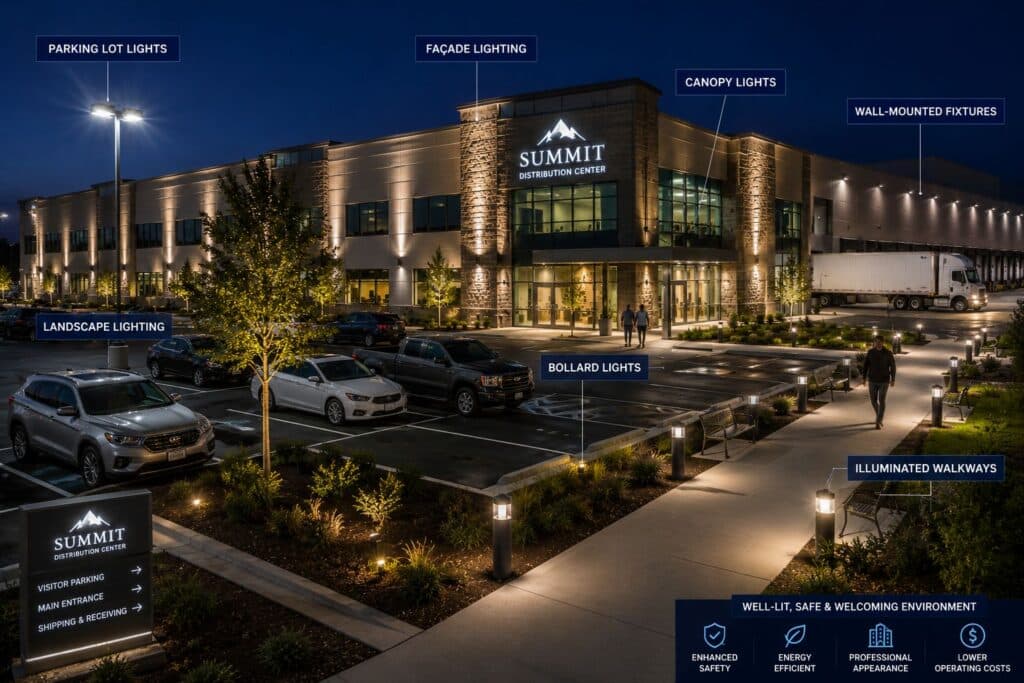
Commercial properties use multiple outdoor LED lighting systems to improve safety, enhance appearance, support security, and create inviting environments for employees, customers, and visitors.
Need Help Choosing Outdoor LED Lighting for Your Property?
Parking lots, building exteriors, walkways, roadways, loading areas, entrances, and other commercial spaces require different fixture types and light distributions. Mounting height, pole or wall location, target light levels, uniformity, glare, site layout, controls, and environmental exposure should all be considered before selecting fixtures.
Explore our Commercial Outdoor LED Lighting solutions or call 844-533-7767 for help selecting fixtures and planning the right lighting for your property.
Outdoor Lighting Should Be Layered
Successful commercial properties rarely rely on one fixture type.
Instead, they combine multiple lighting systems working together.
Typical layers include:
Area Lighting
Provides illumination for parking lots, vehicle circulation, loading areas, and large outdoor spaces. Parking lots are among the most demanding outdoor lighting applications. Learn how proper fixture placement, illumination levels, and lighting layouts improve safety and surveillance in our Parking Lot Security Lighting Guide.
Pedestrian Lighting
Illuminates sidewalks, plazas, pathways, and gathering areas.
Architectural Lighting
Highlights building façades, entrances, monuments, landscaping, and corporate identity.
Security Lighting
Protects building perimeters, service areas, equipment yards, and restricted access locations.
Wayfinding Lighting
Helps visitors identify entrances, directional signage, parking areas, and pedestrian routes.
Combining these lighting layers creates a balanced environment while improving visibility throughout the property.
Choosing the right outdoor fixtures is only part of creating an attractive commercial property. Learn how layered lighting enhances curb appeal, improves customer experience, and increases property value in our Commercial Building Exterior Lighting Guide.
Retail Shopping Centers
Retail centers depend heavily on attractive, uniform exterior lighting.
Customers often form their first impression before entering the building.
Typical lighting includes:
- Parking Lot Lights
- Canopy Lighting
- Sign Lighting
- Façade Lighting
- Bollard Lighting
Proper illumination improves customer confidence while increasing visibility throughout parking areas and pedestrian walkways.
Office Buildings
Office complexes often require lighting during early morning and evening hours.
Recommended applications include:
- Parking areas
- Building entrances
- Sidewalks
- Courtyards
- Monument signs
- Landscape lighting
Architectural lighting also reinforces a professional corporate image after dark.
Warehouses and Distribution Centers
Industrial facilities typically prioritize safety, truck movement, and loading operations.
Common lighting applications include:
- Truck courts
- Employee parking
- Loading docks
- Shipping entrances
- Equipment yards
- Building perimeters
Uniform illumination improves both worker safety and operational efficiency.
Hospitals and Healthcare Facilities
Healthcare campuses operate continuously and require dependable exterior lighting.
Typical lighting systems include:
- Emergency entrances
- Ambulance loading areas
- Visitor parking
- Employee parking
- Walkways
- Building entrances
- Heliport lighting (where applicable)
Proper lighting supports patient safety while improving navigation for visitors and emergency responders.
Schools and Universities
Educational campuses combine vehicle traffic, pedestrian movement, athletic facilities, and public gathering spaces.
Common outdoor lighting applications include:
- Parking lots
- Sidewalks
- Campus pathways
- Courtyards
- Athletic facilities
- Student gathering areas
- Building entrances
Layered lighting improves campus safety while creating an attractive nighttime environment.
Hotels and Hospitality Properties
Hospitality lighting balances aesthetics with guest safety.
Recommended fixture applications include:
- Parking lots
- Main entrances
- Porte-cochères
- Landscape lighting
- Architectural lighting
- Walkways
- Monument signs
Creating a welcoming arrival experience begins with professionally designed exterior lighting.
Choosing Fixtures for Different Applications
| Property Area | Recommended LED Fixture |
|---|
| Parking Areas | LED Parking Lot Lights |
| Building Entrances | LED Canopy Lights |
| Pedestrian Walkways | LED Bollard Lights |
| Building Façades | LED Façade Lighting |
| Landscaped Areas | LED Inground Lighting |
| Business Signage | LED Sign Lighting |
| Recreational Facilities | LED Sports Lighting |
| Aviation Facilities | Aircraft Warning & Heliport Lighting |
For parking areas, explore LED Parking Lot Lights. Building entrances often benefit from LED Canopy Lighting, while sidewalks are commonly illuminated with LED Bollard Lights. Architectural features can be highlighted using LED Façade Lighting and LED Inground Lighting, while business visibility is enhanced with LED Sign Lighting.
Matching the Fixture to the Environment
Every outdoor lighting application presents unique challenges.
When selecting fixtures, consider:
- Mounting height
- Pole spacing
- Environmental exposure
- Wind loading
- Corrosion resistance
- Operating hours
- Desired illumination levels
- Security requirements
- Maintenance accessibility
Choosing fixtures designed specifically for the environment improves long-term performance while reducing maintenance costs.
After determining the appropriate lighting applications for your property, continue with our Commercial LED Building Lights Installation Guide to learn the best mounting locations around commercial buildings.
Apartment Communities and HOA Communities
Multifamily residential developments require outdoor lighting that balances safety, comfort, aesthetics, and respect for neighboring properties.
Common applications include:
- Resident parking lots
- Clubhouses
- Sidewalks
- Mail kiosks
- Recreational facilities
- Dog parks
- Pool areas
- Building entrances
These properties often benefit from decorative lighting that complements the architecture while minimizing glare into nearby residences.
Municipal and Government Facilities
Cities, counties, and public agencies operate a wide variety of outdoor facilities that require dependable, energy-efficient lighting.
Typical applications include:
- City halls
- Libraries
- Police stations
- Fire stations
- Public works facilities
- Transit centers
- Parks
- Community centers
Modern LED lighting improves public safety while reducing long-term operating and maintenance costs for taxpayers.
Manufacturing Plants and Industrial Facilities
Industrial facilities often operate around the clock and require lighting that supports productivity, vehicle movement, and workplace safety.
Typical outdoor lighting includes:
- Employee parking
- Shipping and receiving
- Loading docks
- Equipment storage yards
- Truck circulation
- Building perimeters
- Security checkpoints
Commercial LED fixtures provide reliable illumination while reducing maintenance interruptions in demanding industrial environments.
Sports and Recreation Facilities
Outdoor recreational facilities require higher illumination levels than many commercial properties.
Common applications include:
- Tennis courts
- Pickleball courts
- Baseball fields
- Football stadiums
- Soccer fields
- Running tracks
- Public parks
Professional sports lighting improves player visibility while reducing glare for spectators.
Airports, Heliports, and Aviation Facilities
Aviation lighting represents one of the most specialized commercial lighting applications.
Typical systems include:
- Airfield lighting
- Aircraft warning lights
- Heliport lighting
- Helideck lighting
- Taxiway lighting
- Apron lighting
- Windsock illumination
These lighting systems are designed to improve operational safety while meeting applicable aviation requirements.
Controlling Spill Light, Glare, and Light Trespass
A successful outdoor lighting system is not measured simply by brightness—it is measured by how effectively light is directed where it is needed.
Poorly designed lighting can create excessive glare, unnecessary sky glow, and light trespass onto neighboring properties. These issues not only reduce lighting quality but can also generate complaints from nearby businesses, homeowners, and municipalities.
Modern commercial lighting emphasizes lighting control rather than simply increasing wattage.
Properly designed systems help:
- Improve driver visibility
- Enhance pedestrian safety
- Increase surveillance camera effectiveness
- Reduce eye fatigue
- Minimize nuisance lighting
- Improve energy efficiency
- Support Dark Sky initiatives
- Reduce unnecessary light pollution
The goal is to illuminate the intended area—not neighboring properties or the night sky.
Why Beam Distribution Is Critical
One of the most overlooked aspects of commercial outdoor lighting is optical distribution, sometimes referred to as the beam pattern.
Selecting the proper optic often has a greater impact on lighting quality than simply choosing a higher-wattage fixture.
Different applications require different light distributions.
| Application | Typical Optical Distribution |
|---|---|
| Narrow Sidewalks | Type II |
| Roadways | Type II or Type III |
| Parking Lot Perimeters | Type III |
| Large Parking Lots | Type V |
| Building Perimeters | Type III or Type IV |
| Large Open Areas | Type V |
Using the correct beam distribution improves illumination uniformity while reducing glare and unnecessary spill light.
Instead of increasing wattage to eliminate dark areas, proper optics direct light exactly where it is needed.
House-Side Shields Help Control Light Trespass
Many modern LED parking lot fixtures are available with optional house-side shields, backlight shields, or full-cutoff shielding.
These accessories physically block a portion of the light output, preventing illumination from extending beyond the intended area.
House-side shielding is especially valuable when parking lots are located adjacent to:
- Residential neighborhoods
- Apartment communities
- Hotels
- Schools
- Churches
- Medical facilities
- Office buildings
- Environmentally sensitive areas
- Property lines
Proper shielding allows businesses to maintain excellent parking lot visibility while reducing unwanted light on neighboring properties.
Combining Optics and Shielding
The most effective commercial lighting systems combine:
- Proper pole spacing
- Correct mounting heights
- Precision optics
- House-side shielding
- Photometric analysis
- Appropriate fixture wattage
Rather than solving lighting problems with brighter fixtures, these design elements work together to produce uniform illumination while minimizing glare and wasted light.
The result is a lighting system that is more comfortable for pedestrians, improves visibility for drivers, performs better for surveillance cameras, and consumes less energy.
Common Outdoor Lighting Mistakes
Many commercial lighting problems can be traced to a few common design errors.
Avoid:
- Selecting fixtures based only on wattage
- Ignoring beam distribution
- Installing poles too close together or too far apart
- Creating excessive glare
- Mixing different color temperatures
- Over-lighting parking lots
- Under-lighting pedestrian areas
- Failing to use house-side shields near property lines
- Ignoring photometric lighting layouts
- Choosing residential fixtures for commercial applications
Thoughtful fixture selection and lighting design produce safer, more attractive outdoor environments.
After selecting the proper outdoor lighting, ongoing maintenance and system optimization help maximize performance. Read our Commercial Lighting Best Practices guide to keep your lighting system operating efficiently.
Commercial Outdoor Lighting Buyer Checklist
Before requesting a quotation, gather the following information:
✓ Property type
✓ Site dimensions
✓ Existing fixture types
✓ Pole heights
✓ Pole spacing
✓ Mounting heights
✓ Electrical service voltage
✓ Hours of operation
✓ Security requirements
✓ Architectural goals
✓ Adjacent residential or commercial properties
✓ Existing site plans or aerial photographs
This information allows lighting specialists to recommend fixtures, optics, and controls that best match your project.
Inline Buyer Q&A
Which commercial properties benefit most from LED outdoor lighting?
Nearly every commercial property—including retail centers, office parks, schools, healthcare campuses, industrial facilities, hotels, apartment communities, and municipal properties—benefits from professionally designed LED outdoor lighting.
Why is beam angle important?
The beam distribution determines where the light is delivered. Proper optics improve illumination, reduce glare, and minimize light trespass while providing better lighting uniformity.
What is a house-side shield?
A house-side shield is an accessory installed on many parking lot fixtures that blocks light from projecting toward neighboring properties or environmentally sensitive areas.
Should parking lot fixtures always use the highest wattage?
No. Proper fixture selection depends on mounting height, optical distribution, pole spacing, and required illumination levels. Higher wattage alone does not guarantee better lighting performance.
Can outdoor lighting improve security?
Yes. Uniform illumination helps pedestrians and drivers navigate safely while improving visibility for security personnel and surveillance cameras.
Illuminate Every Commercial Property with Confidence
Every commercial property has unique outdoor lighting requirements. From parking lots and office buildings to hospitals, schools, hotels, industrial facilities, sports complexes, and aviation environments, selecting the right LED fixtures for each application improves safety, enhances appearance, reduces operating costs, and supports long-term reliability.
A successful lighting system combines application-specific fixtures, precision optics, proper beam distribution, photometric planning, and intelligent controls to deliver light exactly where it is needed while minimizing glare, spill light, and maintenance.
Ready to Design Your Commercial Outdoor Lighting System?
Our lighting specialists can help you select the ideal fixtures, recommend optical distributions, develop a professional lighting layout, and specify shielding options that improve performance while reducing light trespass and operating costs.
Explore our complete selection of Commercial Lighting Fixtures and let us help design the right outdoor lighting solution for your next project.
Frequently Asked Questions
What color temperature is recommended for commercial outdoor lighting?
Most commercial properties use 4000K or 5000K LED fixtures because they provide excellent visibility and a clean, professional appearance.
Can existing poles usually be reused?
In many retrofit projects, existing poles remain suitable if they are structurally sound and compatible with the new fixtures.
What are BUG ratings?
BUG stands for Backlight, Uplight, and Glare. These ratings help designers evaluate how effectively a fixture controls light distribution and minimizes unwanted light outside the intended area.
Is a photometric lighting plan recommended?
Yes. A professional photometric analysis helps determine fixture placement, illumination levels, uniformity, and beam distribution before installation.
Are shields required on every parking lot fixture?
Not always. However, fixtures located along property boundaries or adjacent to residential neighborhoods often benefit from house-side shielding to reduce light trespass and improve lighting control.
Related Commercial Lighting Resources
Commercial Lighting Fixtures
Commercial Lighting Guide
Commercial Site Lighting Design Guide
Commercial Lighting Best Practices
Types of Commercial LED Lighting Fixtures
Commercial LED Lighting Retrofit Guide
Commercial Building Exterior Lighting
Parking Lot Security Lighting Guide
Parking Lot Foot Candle Requirements