
Why Fixture Selection Matters
Choosing the proper parking garage fixture is one of the most important decisions in any lighting project.
The fixture determines:
- Light distribution
- Visibility
- Energy consumption
- Maintenance costs
- Driver comfort
- Pedestrian safety
- Security camera performance
- Long-term operating expenses
Even the best lighting layout cannot compensate for selecting the wrong luminaire.
Modern LED fixtures are engineered to provide uniform illumination while minimizing glare and reducing maintenance for many years.
Explore our complete selection of Commercial LED Parking Garage Lighting fixtures, including models with field-selectable wattage, selectable CCT, occupancy sensor compatibility, emergency battery backup, and innovative up-and-down illumination.
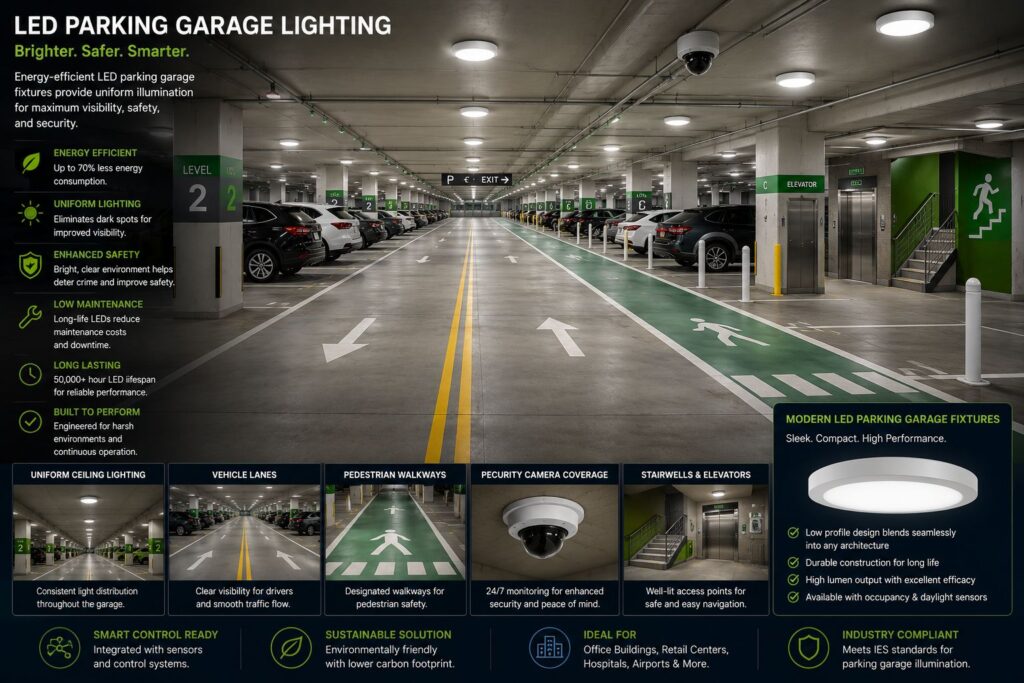
Selecting the right commercial LED parking garage fixture improves visibility, energy efficiency, safety, maintenance, and the overall parking experience.
The right parking garage fixture delivers far more than illumination.
Modern commercial LED luminaires improve safety, reduce operating costs, enhance security, and create a brighter, more welcoming parking environment.
Our lighting specialists can help you select the ideal fixture for your parking structure.
Parking Garage Fixtures Are Different
Parking garage lighting differs significantly from parking lot or warehouse lighting.
Fixtures must operate reliably in environments that include:
- Low concrete ceilings
- Vehicle exhaust
- Dust and dirt
- Moisture
- Temperature fluctuations
- Continuous daily operation
- Heavy traffic
- Occasional vibration
For these reasons, commercial parking garage fixtures are typically built with durable housings, long-life drivers, and optics designed specifically for low mounting heights.
Modern fixture technologies help create a better visitor experience. Continue with our Customer Safety & Experience Guide to learn how lighting influences comfort, confidence, and security
Features to Look for in Modern Parking Garage Fixtures
Commercial LED technology has advanced dramatically over the past several years.
Today’s premium fixtures often include:
- High-efficacy LEDs
- Field-selectable wattage
- Field-selectable color temperature
- 0–10V dimming
- Occupancy sensor compatibility
- Emergency battery backup
- Surge protection
- Long-life LED drivers
- Wide beam optics
- Up-and-down illumination
These features improve both lighting performance and long-term operating costs.
Once you’ve selected the right fixture, learn about lighting layouts, foot-candle recommendations, occupancy sensors, retrofit planning, and safety strategies in our Commercial LED Parking Garage Lighting Guide.
Don't Buy Fixtures by Wattage Alone
One of the biggest mistakes made during parking garage projects is selecting fixtures solely by wattage.
Modern LED fixtures should instead be selected based on:
- Required lumen output
- Mounting height
- Beam distribution
- Fixture spacing
- Ceiling reflectance
- Desired foot-candle levels
- Occupancy sensor requirements
- Long-term maintenance goals
Today’s LED optics allow lower wattage fixtures to often outperform older, higher-wattage luminaires through more efficient light distribution.
Lighting affects more than visibility. Discover how modern parking garage lighting improves customer confidence, wayfinding, security, and property value in our Customer Safety & Experience Guide.
Field-Selectable Wattage Simplifies Every Project
One of the newest advances in commercial parking garage lighting is field-selectable wattage.
Instead of purchasing separate 40W, 60W, 80W, and 100W fixtures, many modern luminaires allow installers to adjust wattage using an internal switch.
Typical advantages include:
- One fixture for multiple applications
- Reduced inventory
- Faster project changes
- Better photometric tuning
- Lower energy consumption
- Simplified future renovations
This flexibility allows contractors to optimize lighting levels after installation without replacing fixtures.
Field-Selectable Color Temperature
Many commercial parking garage fixtures now include selectable white color temperatures.
Common settings include:
| Color Temperature | Typical Applications |
|---|---|
| 3000K | Hotels, residential garages, mixed-use developments |
| 4000K | Office buildings, hospitals, universities |
| 5000K | Municipal garages, industrial facilities, transportation centers |
Being able to select the color temperature during installation provides greater design flexibility while reducing the number of fixture models that must be stocked.
Up-and-Down Illumination Changes the Parking Experience
One of the newest developments in commercial parking garage lighting is the introduction of up-and-down LED fixtures.
Unlike traditional luminaires that direct nearly all of their light downward, these advanced fixtures also provide controlled uplight that softly illuminates the ceiling.
The result is a brighter, more comfortable environment throughout the parking structure.
Benefits include:
- Reduced cave effect
- Brighter ceilings
- Improved visual comfort
- Better perceived safety
- Enhanced security camera performance
- More attractive architectural appearance
- Improved light uniformity
Many newer commercial fixtures combine adjustable wattage, selectable color temperature, occupancy sensor compatibility, and optional uplight in one luminaire, making specification easier while providing greater flexibility for future projects. These dual-distribution fixtures are designed to illuminate both the parking surface and the ceiling while offering selectable wattage and CCT options for a variety of applications.
Fixture Construction Matters
Parking garage fixtures operate for thousands of hours each year in demanding environments.
Quality construction helps maximize reliability.
Look for fixtures featuring:
- Die-cast aluminum housings
- Corrosion-resistant finishes
- UV-resistant polycarbonate lenses
- Tempered glass options where required
- Efficient thermal management
- Long-life LED drivers
- High-quality gaskets
- Wet-location ratings
- Surge protection
Well-designed fixtures maintain their appearance and performance over many years while minimizing maintenance costs.
Common Mounting Options
Commercial parking garage fixtures are available with several mounting configurations depending on the structure.
Surface Mount
The most common installation method.
Ideal for:
- Concrete ceilings
- Parking decks
- Low mounting heights
- Retrofit projects
Pendant Mount
Used where additional fixture clearance is required.
Often specified for:
- Higher parking structures
- Open parking decks
- Areas with exposed conduit
Conduit Mount
Many commercial fixtures provide threaded conduit entries that simplify installation while protecting electrical wiring.
This mounting method is commonly used for new construction and large commercial retrofit projects.
Choosing Fixtures That Support Future Upgrades
Lighting technology continues to evolve.
Selecting fixtures with expandable features helps protect your investment.
Consider luminaires that support:
- Occupancy sensors
- 0–10V dimming
- Emergency battery backup
- Field-selectable wattage
- Field-selectable CCT
- Up-and-down illumination
- Networked lighting controls
Future-ready fixtures make it easier to adapt the lighting system as operational requirements change.
Occupancy Sensors and Bi-Level Dimming
Lighting every fixture at 100% output around the clock is no longer the most efficient approach for commercial parking garages.
Modern LED parking garage fixtures are commonly paired with occupancy sensors that automatically adjust light levels based on vehicle and pedestrian activity.
A typical operating sequence includes:
- Dimmed lighting during periods of low occupancy
- Automatic full output when movement is detected
- Adjustable hold time
- Return to energy-saving mode after the area is vacant
Benefits include:
- Reduced electrical consumption
- Extended fixture life
- Lower maintenance costs
- Improved sustainability
- Better compliance with modern energy codes
Occupancy sensors are especially beneficial on upper parking levels, employee parking areas, and garages with fluctuating traffic throughout the day.
Emergency Battery Backup
Parking garages serve as primary paths of travel during emergencies.
Many commercial LED fixtures are available with integrated emergency battery backup, allowing designated fixtures to remain illuminated during power outages.
Emergency lighting helps occupants safely navigate to:
- Exit doors
- Stairwells
- Elevator lobbies (where permitted)
- Emergency call stations
- Building entrances
Battery backup options simplify installation while improving life safety and helping facilities meet emergency lighting requirements.
Wide Beam Distribution Improves Uniformity
Parking garage fixtures typically use wide beam optics to maximize fixture spacing while maintaining excellent illumination uniformity.
Instead of producing concentrated pools of light, wide-distribution optics provide:
- Better overlap between fixtures
- Fewer dark areas
- Improved driver visibility
- Comfortable pedestrian lighting
- Better ceiling illumination
- Reduced glare
Proper optical distribution often produces greater improvements than simply increasing fixture wattage.
Fixture Spacing Matters
Even premium LED fixtures cannot compensate for poor layout design.
Professional photometric layouts evaluate:
- Mounting height
- Fixture spacing
- Ceiling reflectance
- Structural columns
- Drive lanes
- Parking stalls
- Pedestrian pathways
- Stair towers
- Elevator lobbies
Proper spacing creates consistent illumination throughout the garage while minimizing unnecessary fixture counts.
Lighting Designed for Security Cameras
Today’s parking structures rely heavily on surveillance systems.
Lighting should support camera performance by providing balanced illumination throughout the field of view.
Well-designed LED lighting improves:
- Facial recognition
- Vehicle identification
- License plate visibility
- Color accuracy
- Video clarity
- Reduced shadowing
Up-and-down illumination further enhances camera performance by reducing the contrast between dark ceilings and brightly illuminated floors.
Parking Garage Retrofit Considerations
Many existing parking garages continue to operate outdated lighting systems, including:
- Metal halide fixtures
- High-pressure sodium fixtures
- Fluorescent strip fixtures
LED retrofit projects provide numerous benefits beyond energy savings.
Typical improvements include:
- Better light quality
- Lower maintenance costs
- Instant-on operation
- Improved uniformity
- Better color rendering
- Occupancy sensor compatibility
- Emergency battery backup options
- Longer service life
Because modern LED fixtures produce significantly more usable light, retrofit projects often require fewer watts while delivering better overall visibility.
Selecting Fixtures for Different Garage Types
Different parking facilities have different lighting priorities.
| Facility Type | Primary Fixture Considerations |
|---|---|
| Hospital | Safety, emergency backup, camera performance |
| Airport | High reliability, uniformity, long service life |
| Office Building | Occupancy sensors, energy efficiency |
| University | Pedestrian visibility, security |
| Hotel | Customer experience, attractive appearance |
| Mixed-Use Development | Uniform lighting, modern aesthetics |
| Apartment Garage | Comfort, security, low maintenance |
| Municipal Garage | Long life, low operating cost |
Selecting fixtures based on the facility’s operational goals results in better long-term performance.
Common Fixture Selection Mistakes
Avoid these common specification errors:
- Selecting fixtures based only on wattage
- Ignoring beam distribution
- Over-lighting vehicle lanes
- Under-lighting pedestrian areas
- Ignoring occupancy sensor compatibility
- Omitting emergency battery backup
- Choosing fixtures without surge protection
- Ignoring future maintenance requirements
- Skipping photometric layouts
- Failing to consider up-and-down illumination
Thoughtful planning produces a safer, more efficient parking structure while reducing long-term operating costs.
Commercial Buyer Checklist
Before requesting a lighting proposal, gather:
✓ Garage dimensions
✓ Ceiling heights
✓ Existing fixture information
✓ Electrical service voltage
✓ Desired foot-candle levels
✓ Mounting locations
✓ Occupancy sensor requirements
✓ Emergency battery backup requirements
✓ Preferred color temperature
✓ Up-and-down lighting preference
✓ Site photographs
Providing this information allows lighting specialists to develop accurate fixture recommendations and photometric layouts.
Inline Buyer Q&A
Should every parking garage use occupancy sensors?
For most commercial garages, yes. Occupancy sensors reduce energy consumption while maintaining safe illumination whenever vehicles or pedestrians are present.
Are field-selectable fixtures worth specifying?
Absolutely. Field-selectable wattage and color temperature simplify inventory, provide installation flexibility, and allow lighting levels to be fine-tuned without replacing fixtures.
Why are up-and-down fixtures becoming more popular?
They illuminate both the parking surface and the ceiling, reducing the cave effect, improving perceived brightness, enhancing camera performance, and creating a more welcoming parking environment.
Do parking garage fixtures need emergency battery backup?
Many facilities—including hospitals, airports, office buildings, and public parking structures—benefit from integrated emergency lighting that supports safe egress during power interruptions.
Is a photometric layout necessary?
Yes. A photometric analysis verifies fixture spacing, illumination levels, and uniformity before installation, helping avoid costly adjustments later.
Select Fixtures Designed for Long-Term Performance
The right parking garage fixture does more than illuminate a parking space. It improves safety, enhances security, supports surveillance systems, reduces maintenance, and creates a more comfortable experience for drivers and pedestrians. By selecting fixtures with modern features such as high-efficacy LEDs, field-selectable wattage, occupancy sensors, emergency battery backup, and up-and-down illumination, facility owners can build lighting systems that deliver reliable performance for years to come.
Ready to Choose the Right Parking Garage Fixture?
Our lighting specialists can help you compare fixture options, develop photometric layouts, and specify commercial LED luminaires that meet your project’s performance, efficiency, and budget goals.
Explore our complete line of Commercial LED Parking Garage Lighting fixtures and let us help you create a safer, brighter, and more efficient parking facility.
Frequently Asked Questions
What is the best color temperature for parking garage lighting?
4000K is the most common choice because it provides a clean, neutral appearance with excellent visibility. Hospitality and residential garages may prefer 3000K, while industrial and municipal facilities often select 5000K.
How long do commercial LED parking garage fixtures last?
Many premium commercial fixtures are rated for 100,000 hours or more, dramatically reducing lamp replacement and maintenance compared to HID and fluorescent systems.
Can existing parking garages be retrofitted with LED fixtures?
Yes. Most parking garages can be upgraded using LED fixtures that improve visibility, reduce maintenance, lower energy costs, and support advanced controls.
Are up-and-down fixtures suitable for every garage?
Not always. They provide the greatest value in hospitals, hotels, airports, office buildings, universities, and mixed-use developments where customer experience, aesthetics, and perceived safety are priorities.
Can lighting controls reduce operating costs?
Yes. Combining high-efficacy LED fixtures with occupancy sensors, dimming controls, and field-selectable settings can significantly reduce energy consumption while maintaining safe illumination.
Stay Connected with Our Lighting Resources
Add IndustrialLightingFixtures.org as a Preferred Source on Google to see more of our lighting guides and technical resources across Google Search experiences.