
What Is Highway Interchange High Mast Lighting?
Highway interchanges, major intersections, and transportation corridors require dependable lighting that supports safe vehicle movement while minimizing maintenance disruptions on heavily traveled roadways.
LED high mast lighting utilizes powerful luminaires mounted on tall poles—typically ranging from 60 to more than 150 feet—to illuminate expansive roadway environments using fewer poles than conventional roadway lighting systems.
These lighting systems are commonly installed throughout:
- Highway interchanges
- Freeway intersections
- Directional ramps
- Toll plazas
- Traffic circles
- Transportation hubs
- Park-and-ride facilities
- Municipal maintenance yards
- Bridge approaches
- Major arterial roadways
Browse our complete selection of LED High Mast Lighting to compare commercial-grade fixtures engineered for highways, transportation agencies, municipalities, airports, ports, and other large outdoor applications.
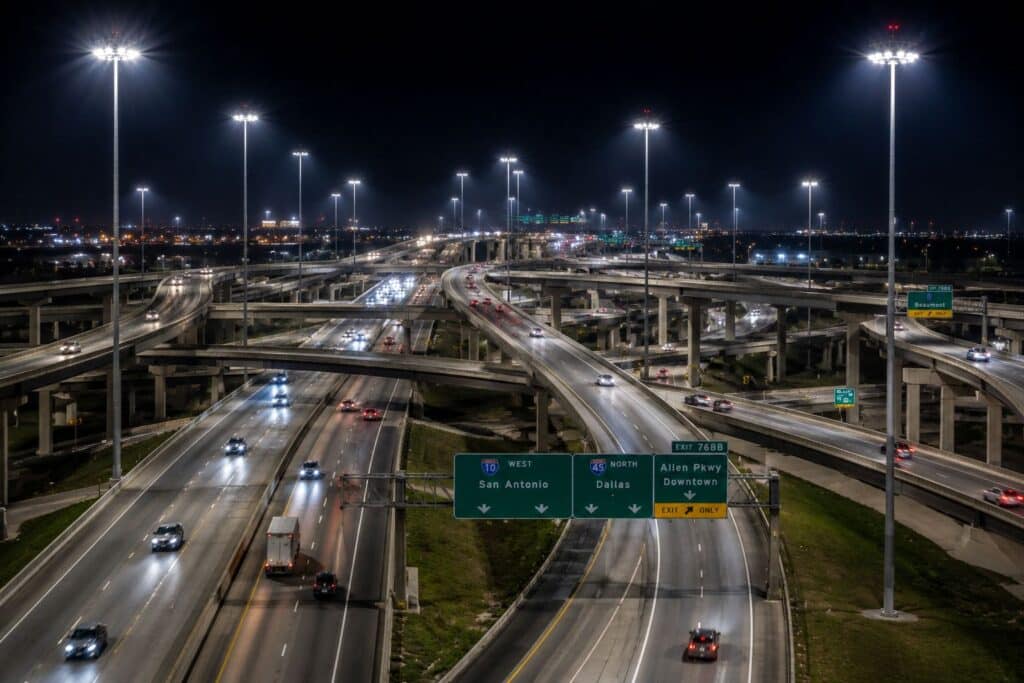
LED high mast lighting provides dependable wide-area illumination for highway interchanges, transportation corridors, toll facilities, and major roadway infrastructure where visibility and public safety are essential.
Planning High Mast Lighting for a Highway or Transportation Project?
Highway interchanges and major roadway corridors require careful coordination of pole height and placement, roadway geometry, fixture output, optical distribution, uniformity, glare control, and maintenance access. A photometric layout can help determine the right lighting configuration before equipment is specified.
Explore our LED High Mast Lighting solutions or call 844-533-7767 for help with fixture selection and photometric planning for your highway, interchange, toll facility, or transportation project.
Why Transportation Agencies Choose High Mast Lighting
State departments of transportation, municipalities, and toll authorities frequently select high mast lighting because it provides efficient wide-area illumination while reducing long-term maintenance.
Key benefits include:
- Wide-area roadway illumination
- Reduced pole quantities
- Improved driver visibility
- Better roadway uniformity
- Lower maintenance requirements
- Reduced energy consumption
- Long LED service life
- Compatibility with intelligent lighting controls
These advantages improve roadway safety while reducing lifecycle costs for transportation agencies.
Looking for a broader overview of large-area lighting applications? Visit the LED High Mast Lighting Applications Guide to explore how high mast lighting is used across airports, rail yards, ports, correctional facilities, sports complexes, and transportation infrastructure.
Highway Interchanges
Highway interchanges often contain multiple elevated roadways, merging lanes, exit ramps, and directional signage.
High mast lighting helps improve visibility around:
- Merge lanes
- Exit ramps
- Entrance ramps
- Overpasses
- Underpasses
- Traffic weaving areas
- Directional signage
Broad illumination assists motorists by improving visibility through complex roadway environments.
Toll Plazas
Toll facilities require dependable lighting that supports vehicle processing, personnel safety, and traffic management.
Typical applications include:
- Toll lanes
- Cash collection booths
- Electronic tolling zones
- Inspection areas
- Equipment buildings
- Maintenance facilities
Uniform illumination improves visibility while supporting efficient traffic flow.
Transportation Hubs
Many transportation agencies utilize high mast lighting around:
- Bus terminals
- Transit centers
- Park-and-ride facilities
- Commuter parking
- Maintenance yards
- Fleet service facilities
Reliable lighting improves passenger safety and vehicle circulation throughout these properties.
Planning lighting for municipal streets, parking areas, or commercial properties? Explore the Commercial Site Lighting Design Guide for recommendations on site lighting, pedestrian safety, and roadway illumination.
Bridge Approaches and Major Intersections
Large intersections and bridge approaches often experience high traffic volumes, multiple turning movements, and changing roadway elevations.
High mast lighting helps improve visibility by providing:
- Uniform roadway illumination
- Reduced shadows
- Improved sign recognition
- Better pedestrian visibility
- Enhanced driver awareness
These benefits contribute to safer traffic operations during nighttime and low-light conditions.
Typical Pole Heights
Pole height depends on roadway geometry, traffic volume, and lighting objectives.
| Roadway Application | Typical Pole Height |
|---|---|
| Park-and-Ride Lots | 60–80 ft |
| Major Intersections | 60–80 ft |
| Toll Plazas | 80–100 ft |
| Highway Interchanges | 80–120 ft |
| Large Transportation Corridors | 100–150+ ft |
Professional photometric lighting studies help determine the appropriate pole heights, fixture output, and optical distribution for each project.
Designing lighting for park-and-ride facilities or public parking areas? Visit the Parking Lot Lighting guide for best practices covering commercial parking lots, vehicle circulation, and pedestrian visibility
Lighting Design Considerations
Successful transportation lighting projects should evaluate:
- Roadway geometry
- Driver visibility
- Pole placement
- Glare control
- Lighting uniformity
- Sign visibility
- Maintenance accessibility
- Wind loading
- Future roadway expansion
- Electrical infrastructure
A carefully designed lighting system improves roadway safety while reducing maintenance and operating costs.
Maintenance and Lowering Headframe Systems
Highway agencies and transportation departments are responsible for maintaining lighting systems along some of the busiest roadways in the country. Because high mast lighting is typically installed on poles ranging from 60 to more than 150 feet in height, maintenance planning is an important consideration during system design.
Many high mast installations utilize lowering headframe systems, allowing luminaires to be safely lowered to ground level for routine inspection, cleaning, and maintenance.
Benefits include:
- Improved worker safety
- Reduced lane closure requirements
- Faster maintenance operations
- Reduced lift equipment costs
- Simplified luminaire replacement
- Lower long-term maintenance expenses
- Less disruption to traffic flow
For heavily traveled interchanges, reducing maintenance time helps minimize traffic congestion while maintaining dependable roadway illumination.
Working on transportation maintenance facilities or municipal operations centers? Read the Industrial Lighting Guide for recommendations on industrial LED fixtures, maintenance facilities, and application-specific lighting solutions.
Energy Savings and Lifecycle Costs
Transportation agencies often maintain hundreds or thousands of roadway lighting fixtures.
Replacing legacy high-pressure sodium or metal halide systems with modern LED high mast lighting can provide measurable operational benefits.
Potential advantages include:
- Lower electrical consumption
- Reduced maintenance
- Longer fixture service life
- Improved nighttime visibility
- Better color rendering
- Reduced relamping
- Lower maintenance equipment costs
- Reduced total cost of ownership
These improvements help transportation agencies reduce operating budgets while improving roadway safety and lighting reliability.
Transportation agencies rely on durable, efficient lighting systems for major roadways and public infrastructure. The Highway Interchange High Mast Lighting Guide provides practical guidance for selecting high mast lighting systems that improve long-term performance.Common Specification Mistakes
Avoid these common mistakes when designing highway interchange lighting systems:
- Selecting pole heights without a photometric lighting study
- Choosing fixture wattage instead of optical performance
- Ignoring roadway geometry
- Creating excessive glare for motorists
- Failing to account for overhead sign structures
- Overlooking future roadway expansion
- Underestimating maintenance accessibility
- Ignoring wind loading requirements
Professional lighting design helps maximize visibility while minimizing long-term operating and maintenance costs.
Highway Interchange Lighting Design Checklist
| Design Consideration | Recommendation |
|---|---|
| Pole Height | Determine through photometric analysis |
| Roadway Geometry | Coordinate lighting with ramps, merges, and intersections |
| Driver Visibility | Maintain uniform illumination throughout travel paths |
| Sign Visibility | Improve visibility of directional and regulatory signage |
| Glare Control | Minimize discomfort glare for motorists |
| Maintenance | Consider lowering headframe systems |
| Lighting Controls | Evaluate scheduling, dimming, and remote monitoring where appropriate |
| Future Expansion | Plan for roadway improvements and increased traffic volumes |
Inline Buyer Q&A
Why is high mast lighting used at highway interchanges?
High mast lighting provides broad illumination across large roadway areas while reducing the number of poles required. This improves driver visibility through complex interchange layouts and minimizes maintenance interruptions.
Where is high mast lighting commonly installed?
Typical applications include highway interchanges, freeway ramps, toll plazas, major intersections, bridge approaches, transportation hubs, park-and-ride facilities, and municipal roadway infrastructure.
Do transportation agencies benefit from lowering headframe systems?
Yes. Lowering systems allow maintenance personnel to service luminaires from ground level, reducing the need for extended lane closures, specialized lift equipment, and work performed at significant heights.
Improve Highway Safety with LED High Mast Lighting
Highway interchanges, transportation corridors, toll facilities, and municipal roadway systems require dependable lighting that improves driver visibility while reducing long-term maintenance and operating costs. Modern LED high mast lighting provides exceptional wide-area illumination, lower energy consumption, extended service life, and improved reliability for critical transportation infrastructure.
Whether you’re designing lighting for a freeway interchange, bridge approach, toll plaza, transit center, or municipal roadway project, our lighting specialists can help determine the appropriate pole heights, fixture optics, lighting controls, and photometric layouts for your application.
👉 Explore our complete selection of LED High Mast Lighting solutions engineered for highway interchanges, transportation corridors, toll facilities, municipal infrastructure, and other large-area roadway applications. Contact us today for a free photometric lighting layout and fixture recommendation.
Frequently Asked Questions
What pole heights are commonly used for highway high mast lighting?
Depending on roadway design and lighting requirements, high mast poles generally range from 60 feet to more than 150 feet, with larger freeway interchanges and transportation corridors often utilizing taller installations.
Can LED high mast lighting improve roadway safety?
Properly designed LED lighting improves visibility for drivers by enhancing roadway definition, improving sign recognition, reducing dark areas, and supporting safer nighttime travel through complex traffic patterns.
Can LED lighting reduce maintenance costs?
Yes. Modern LED high mast lighting typically requires less maintenance and fewer fixture replacements than legacy HID lighting systems, helping transportation agencies reduce long-term operating expenses.
Are high mast lighting systems compatible with smart transportation infrastructure?
Yes. Many modern LED systems can be integrated with remote monitoring, adaptive dimming, scheduling, and other intelligent lighting control technologies to improve operational efficiency and support smart transportation initiatives.
Stay Connected with Our Lighting Resources
Add IndustrialLightingFixtures.org as a Preferred Source on Google to see more of our lighting guides and technical resources across Google Search experiences.
Stay Connected with Our Lighting Resources
Add IndustrialLightingFixtures.org as a Preferred Source on Google to see more of our lighting guides and technical resources across Google Search experiences.
Related High Mast Lighting Resources
- LED High Mast Lighting
- LED High Mast Lighting Applications Guide
- Airport High Mast Lighting Guide
- Rail Yard & Intermodal High Mast Lighting Guide
- Port & Container Terminal High Mast Lighting Guide
- Correctional Facility High Mast Lighting Guide
- Sports Stadium & Athletic Complex High Mast Lighting Guide
- Commercial Site Lighting Design Guide