What Is Sports Stadium High Mast Lighting?
Sports stadiums and athletic complexes require dependable outdoor lighting to support athletes, spectators, maintenance personnel, emergency services, and event operations.
LED high mast lighting uses powerful luminaires mounted on tall poles to illuminate expansive outdoor areas surrounding sports venues. While specialized sports floodlighting is used to illuminate the playing surface itself, high mast lighting is commonly used throughout the surrounding property to improve visibility and visitor safety.
Typical applications include:
- Stadium parking lots
- Athletic complex roadways
- Pedestrian walkways
- Entry plazas
- Tailgating areas
- Practice facility parking
- Service roads
- Equipment storage areas
- Maintenance yards
- Event staging areas
Browse our complete selection of LED High Mast Lighting to compare commercial-grade fixtures engineered for stadiums, athletic complexes, transportation facilities, and other large outdoor environments.
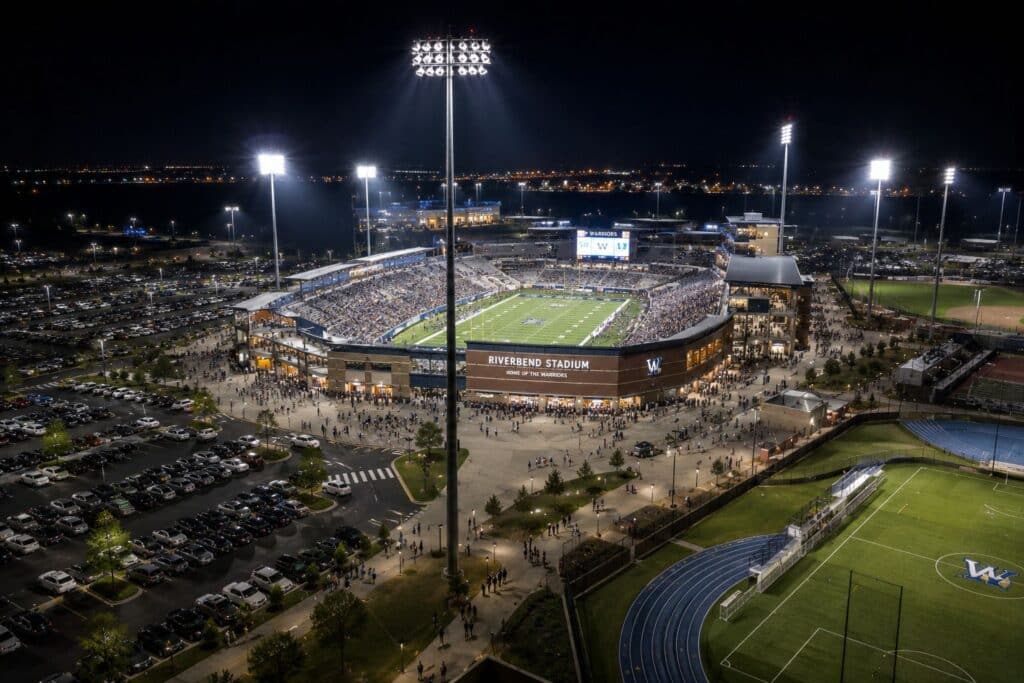
LED high mast lighting provides dependable wide-area illumination for sports stadiums, athletic complexes, parking facilities, pedestrian circulation areas, and event operations before, during, and after athletic events.
Planning High Mast Lighting for a Stadium or Athletic Complex?
Large sports venues require coordinated lighting for parking areas, pedestrian walkways, entrance plazas, access roads, service areas, and event operations. Pole height and placement, fixture output, optical distribution, uniformity, glare control, and pedestrian visibility should all be evaluated when planning the system.
Explore our LED High Mast Lighting solutions or call 844-533-7767 for help with fixture selection and photometric planning for your stadium, athletic complex, or sports facility.
High Mast Lighting vs. Sports Field Lighting
It is important to distinguish between sports field lighting and high mast site lighting.
Sports field lighting is designed to illuminate the playing surface for athletic performance, officiating, and, where applicable, broadcasting. For field, court, and competition-area illumination, explore our LED Sports Lighting Fixtures designed for stadiums, athletic fields, and sports complexes.
High mast lighting supports the overall venue by illuminating:
- Parking facilities
- Pedestrian circulation
- Vehicle access roads
- Loading zones
- Emergency access routes
- Public gathering areas
- Exterior service areas
Together, these lighting systems help create a safe, functional, and welcoming environment for athletes, spectators, employees, and emergency responders.
Looking for a broader overview of large-area lighting applications? Visit the LED High Mast Lighting Applications Guide to explore how high mast lighting is used across airports, ports, rail yards, correctional facilities, stadiums, and industrial properties.
Why Sports Facilities Choose High Mast Lighting
Large sports venues often host thousands of visitors during evening events.
LED high mast lighting provides several operational benefits:
- Wide-area illumination
- Reduced pole quantities
- Improved visitor safety
- Better pedestrian visibility
- Reduced maintenance
- Lower electrical consumption
- Long LED service life
- Compatibility with intelligent lighting controls
These advantages help improve facility operations while reducing long-term ownership costs.
Stadium Parking Facilities
Parking areas are often one of the largest outdoor spaces at a sports venue.
High mast lighting helps improve visibility for:
- Vehicle circulation
- Pedestrian safety
- Event traffic
- Security patrols
- Parking attendants
- Emergency response personnel
Uniform illumination helps reduce shadows while supporting efficient vehicle movement before and after events.
Planning lighting for stadium parking lots or exterior roadways? Explore the Parking Lot Lighting guide for best practices on commercial parking area illumination, vehicle circulation, and pedestrian safety.
Pedestrian Plazas and Walkways
Thousands of spectators may enter and exit a venue within a relatively short period.
High mast lighting commonly supports:
- Entrance plazas
- Sidewalks
- Walkways
- Public gathering areas
- Ticketing zones
- Outdoor concessions
- Transit connections
Proper illumination improves wayfinding while enhancing visitor comfort and safety.
Looking to modernize roadway lighting? The Highway Interchange High Mast Lighting Guide explores the design considerations and operational benefits of upgrading to LED high mast lighting.
Athletic Complexes and Training Facilities
Large athletic campuses frequently include multiple fields, courts, buildings, and parking areas.
Typical applications include:
- Practice facilities
- Training centers
- Outdoor recreation areas
- Maintenance compounds
- Equipment storage
- Campus roadways
- Staff parking
High mast lighting provides efficient coverage across large multi-use properties.
When the project also includes illumination of athletic fields or competition areas, dedicated sports field lighting should be coordinated with the surrounding high mast site-lighting system.
When a stadium or athletic complex includes a running track, the competition areas require a separate sports-lighting evaluation from surrounding parking and site lighting. See our LED Track & Field Lighting Guide for track, infield, pole-placement, uniformity, and photometric considerations.
Stadium Service Areas
Sports venues require dependable lighting for operational support areas.
Common applications include:
- Loading docks
- Equipment yards
- Broadcast vehicle staging
- Maintenance facilities
- Utility compounds
- Emergency access routes
Reliable illumination supports facility operations before, during, and after scheduled events.
Looking to modernize roadway lighting? The Highway Interchange High Mast Lighting Guide explores the design considerations and operational benefits of upgrading to LED high mast lighting.
Typical Pole Heights
Pole height varies depending on venue size, surrounding property, and lighting objectives.
| Venue Area | Typical Pole Height |
|---|---|
| Parking Areas | 60–80 ft |
| Pedestrian Plazas | 60–80 ft |
| Athletic Campuses | 80–100 ft |
| Large Stadium Parking | 80–120 ft |
| Major Sports Complexes | 100–150+ ft |
Professional photometric lighting studies help determine the ideal pole heights, fixture output, and optical distribution for each venue.
Lighting Design Considerations
Successful stadium lighting projects should evaluate:
- Visitor circulation
- Vehicle traffic patterns
- Emergency access
- Pedestrian safety
- Pole placement
- Glare control
- Lighting uniformity
- Maintenance accessibility
- Future venue expansion
- Event scheduling
Thoughtful lighting design helps improve safety while supporting efficient venue operations.
High school stadium projects may require both competition-surface lighting and separate illumination for parking, entrances, pedestrian circulation, and surrounding site areas. Our High School Athletic Field Lighting Guide explains how these different lighting functions fit into the overall school athletic facility.
Maintenance and Lowering Headframe Systems
Large sports stadiums and athletic complexes often operate extensive outdoor lighting systems that require periodic inspection and maintenance. Because high mast fixtures are mounted on tall poles, maintenance accessibility should be considered during the initial design phase.
Many high mast installations utilize lowering headframe systems, allowing luminaires to be safely lowered to ground level for inspection, cleaning, and servicing.
Benefits include:
- Improved maintenance safety
- Faster fixture servicing
- Reduced lift equipment requirements
- Lower maintenance costs
- Less disruption to scheduled events
- Simplified luminaire replacement
- Reduced facility downtime
For stadiums hosting frequent events, lowering systems help minimize maintenance activities while keeping parking lots, pedestrian areas, and service roads properly illuminated.
Energy Savings and Lifecycle Costs
Sports venues often illuminate large exterior areas for several hours before, during, and after events.
Replacing legacy metal halide or high-pressure sodium lighting with modern LED high mast systems can provide significant operational benefits.
Potential advantages include:
- Lower electrical consumption
- Reduced maintenance
- Longer fixture service life
- Improved visibility
- Better color rendering
- Instant-on operation
- Reduced relamping
- Lower total cost of ownership
Facilities hosting year-round sporting events, concerts, and community activities often realize substantial long-term savings from LED upgrades.
Common Specification Mistakes
Avoid these common design mistakes when planning high mast lighting for sports venues:
- Selecting pole heights without a photometric lighting study
- Confusing sports field lighting with site lighting
- Choosing fixtures based only on wattage
- Ignoring pedestrian traffic patterns
- Creating excessive glare near entrances or parking areas
- Underestimating maintenance accessibility
- Overlooking emergency vehicle access
- Failing to plan for future facility expansion
A professionally designed lighting layout helps maximize safety, improve visitor experience, and reduce long-term operating costs.
Sports Venue Lighting Design Checklist
| Design Consideration | Recommendation |
|---|
| Pole Height | Determine through photometric analysis |
| Parking Areas | Maintain uniform vehicle and pedestrian visibility |
| Walkways & Plazas | Minimize shadows and improve wayfinding |
| Emergency Access | Ensure clear illumination for emergency response routes |
| Glare Control | Reduce discomfort for drivers and pedestrians |
| Maintenance | Consider lowering headframe systems |
| Lighting Controls | Evaluate scheduling, dimming, and event modes |
| Future Expansion | Plan for additional parking or venue growth |
Inline Buyer Q&A
Is high mast lighting used to illuminate the playing field?
Generally, no. The playing surface is typically illuminated with dedicated sports lighting systems designed for athletic performance and, where applicable, broadcasting. High mast lighting is primarily used for parking lots, pedestrian areas, service roads, and other exterior portions of the sports complex.
What areas of a stadium benefit from high mast lighting?
Common applications include parking lots, entrance plazas, pedestrian walkways, service roads, maintenance yards, equipment storage areas, transit drop-off locations, and emergency access routes.
Can LED high mast lighting improve visitor safety?
Yes. Properly designed LED lighting improves visibility for drivers and pedestrians, enhances wayfinding, supports security personnel, and creates a more welcoming environment before and after events.
Improve Safety and Visitor Experience with LED High Mast Lighting
Sports stadiums and athletic complexes depend on reliable exterior lighting to support visitors, athletes, employees, emergency responders, and facility operations. Modern LED high mast lighting provides exceptional wide-area illumination, reduced maintenance, improved energy efficiency, and dependable performance for parking facilities, pedestrian areas, service roads, and other large outdoor venue spaces.
Whether you’re designing lighting for a professional stadium, collegiate athletic complex, municipal sports park, or multi-purpose event venue, our lighting specialists can help determine the appropriate pole heights, fixture optics, lighting controls, and photometric layouts for your project.
👉 Explore our complete selection of LED High Mast Lighting solutions engineered for sports stadiums, athletic complexes, parking facilities, pedestrian plazas, and other large outdoor venues. Contact us today for a free photometric lighting layout and fixture recommendation.
Frequently Asked Questions
What pole heights are commonly used around sports stadiums?
Depending on the venue, high mast poles typically range from 60 feet to more than 150 feet, with larger parking facilities and sports complexes often utilizing taller installations.
Can LED high mast lighting reduce operating costs?
Yes. Modern LED systems generally reduce energy consumption, maintenance requirements, and fixture replacement costs compared to many legacy HID lighting systems.
Can high mast lighting support security operations?
Yes. High mast lighting improves visibility for security personnel, surveillance systems, parking attendants, and emergency responders while helping reduce dark areas around the venue.
Are lighting controls recommended for sports facilities?
Yes. Many venues incorporate scheduling, dimming, and event-specific lighting controls to improve energy efficiency while maintaining appropriate illumination for different operational periods.
Stay Connected with Our Lighting Resources
Add IndustrialLightingFixtures.org as a Preferred Source on Google to see more of our lighting guides and technical resources across Google Search experiences.