
Track and field facilities present a more complex lighting challenge than many single-sport venues. A typical facility may combine an oval running track, sprint lanes, jumping areas, throwing events, spectator seating, and a football or soccer field within the same overall footprint.
Effective LED lighting for track and field facilities therefore requires more than selecting high-output fixtures. Pole locations, mounting heights, optical distributions, light levels, uniformity, glare control, spill light, controls, and the different visual requirements of the track and infield must work together as a complete lighting system.
Modern LED sports lighting provides precise optical control, instant operation, dimming and zoning capabilities, and substantially reduced maintenance compared with older HID and metal-halide systems. However, the final lighting design should be verified through project-specific photometric analysis.
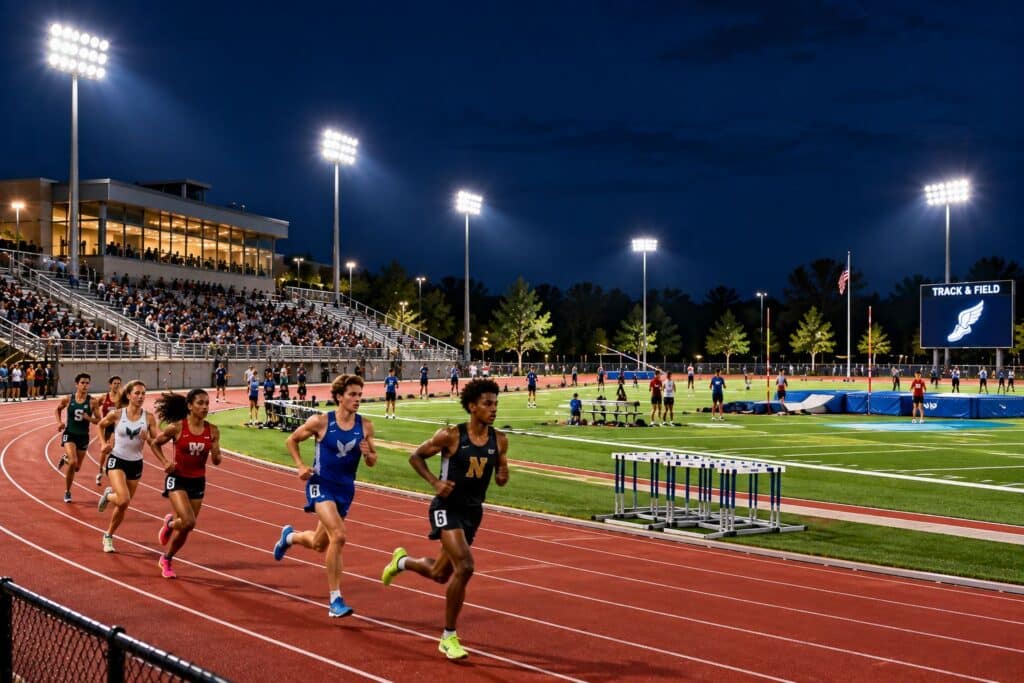
LED track and field lighting should provide balanced illumination across running lanes, infield events, competition areas, and shared athletic fields while controlling glare and spill light.
Plan Track & Field Lighting Around the Entire Facility
A successful track and field lighting project begins with the facility layout—not simply fixture wattage or lumen output.
The running track, infield, jumping areas, throwing areas, spectator zones, pole locations, mounting heights, surrounding properties, and any football or soccer field inside the track should be evaluated together.
For fixtures designed for athletic fields, stadiums, courts, and competition areas, explore our LED Sports Lighting Fixtures.
Why Track & Field Lighting Is Different
Track and field combines multiple athletic activities within one facility.
Runners need consistent visibility around the complete oval. Sprinters require good visibility through starting and finishing areas. Jumping events require illumination across approach and landing zones. Throwing events introduce larger activity areas where athletes and officials must be able to follow movement safely.
Many facilities also place a football or soccer field inside the track.
As a result, a lighting system that performs well for the central field does not automatically provide appropriate illumination around the running track.
The design must consider the entire competition environment.
Track Lighting and Infield Lighting Are Different Design Zones
One of the most important concepts in track and field lighting is recognizing the track and infield as related but distinct lighting areas.
| Area | Primary Lighting Considerations |
|---|---|
| Running track | Continuous illumination, uniformity, lane visibility, glare control |
| Sprint straightaway | Starting/finish visibility, uniform illumination |
| Long/triple jump | Approach runway and landing-area visibility |
| High jump | Approach and landing-area visibility |
| Pole vault | Runway, plant box and landing area |
| Throwing events | Athlete, official and implement visibility |
| Football/soccer infield | Sport-specific horizontal and vertical illumination |
| Spectator areas | Safe circulation and appropriate general illumination |
| Broadcast applications | Vertical illumination and camera-oriented lighting |
ANSI/IES RP-6-24 specifically addresses track and field and recognizes that these facilities are commonly designed in conjunction with football or soccer fields.
That makes coordinated photometric design particularly important.
How Many Foot-Candles Does a Track & Field Facility Need?
There is no single foot-candle requirement that applies to every track and field facility.
Required illumination depends on the level of competition, facility type, governing requirements, whether the venue is used for television or streaming, and whether the track surrounds another competitive playing field.
As general planning guidance, current IES recommendations distinguish among classes of play and between track and field areas.
| Facility / Use | Typical Planning Consideration |
|---|---|
| Recreational or limited-use track | Lower maintained illumination may be appropriate |
| High school competition | Greater illumination and uniformity are normally required |
| Collegiate competition | Higher performance requirements may apply |
| Football/soccer infield | Evaluate requirements for the sport using the central field |
| Broadcast facility | Horizontal and vertical illumination become important |
These values should not be treated as universal code requirements. Project specifications, governing athletic organizations, local requirements, and current lighting standards should be confirmed for the individual facility.
Uniformity Matters as Much as Average Light Level
Average foot-candles alone do not describe the quality of a track lighting system.
A facility could technically achieve a desired average while still containing bright areas, dark areas, or abrupt transitions that make visibility inconsistent for athletes.
Uniformity evaluates how evenly illumination is distributed.
For a running track, this is particularly important because athletes move continuously through curves and straightaways rather than remaining within one central playing area.
A photometric analysis should therefore evaluate:
- Average illumination
- Minimum illumination
- Maximum illumination
- Uniformity
- Bright and dark areas
- Transitions between the track and infield
- Light levels around starting and finishing areas
- Spill light outside the athletic facility
Pole Placement for Track & Field Lighting
Pole placement is one of the most consequential design decisions in a track and field lighting project.
Unlike a rectangular playing field, a running track extends around the perimeter of the infield. Fixtures must illuminate the oval while often reaching significant distances toward central playing areas.
Pole placement may be influenced by:
- Track dimensions
- Number of lanes
- Football or soccer field dimensions
- Bleacher locations
- Existing pole positions
- Property boundaries
- Throwing-event locations
- Maintenance access
- Utility infrastructure
- Required setbacks
- Fixture aiming distances
Existing facilities undergoing LED conversion may be able to reuse current poles, but their locations and structural capacity should be evaluated before assuming a one-for-one retrofit will produce the required lighting performance.
Track & Field Lighting Pole Height
Mounting height affects coverage, aiming angles, glare, fixture quantity, beam selection, and overall uniformity.
Higher mounting positions can allow fixtures to distribute light across greater distances, but mounting height should never be selected independently of the photometric layout.
The appropriate height depends on factors including:
- Facility dimensions
- Pole setbacks
- Competition level
- Fixture output
- Optical distribution
- Number of poles
- Number of fixtures per pole
- Required vertical illumination
- Glare limitations
- Existing infrastructure
For this reason, a universal pole-height recommendation is inappropriate for every track and field facility.
A running track can increase the distance between lighting poles and the central playing field, making mounting geometry particularly important. Our Sports Field Lighting Pole Height Guide explains how height, setback, optics, and aiming work together.
Beam Angles and Long-Throw Optics
Track and field installations frequently require multiple optical distributions.
Fixtures mounted on the same pole may serve completely different target areas.
A narrow-beam fixture may deliver light toward a distant section of the infield, while medium or wider distributions illuminate closer portions of the track.
The goal is not simply to project light as far as possible. The objective is to place usable illumination where it is needed while limiting excessive overlap, glare, and spill.
A typical project may combine:
Narrow optics for long-distance aiming.
Medium optics for intermediate portions of the track or field.
Wider optics for nearer target areas where broader distribution is required.
Photometric modeling determines the appropriate combination.
Horizontal and Vertical Illumination
Horizontal illumination describes light reaching a generally horizontal measurement plane and is fundamental to visibility across running surfaces and playing fields.
Vertical illumination becomes increasingly important when athletes, balls, equipment, spectators, or other objects must be seen vertically—or when television cameras are involved.
NCAA track-and-field broadcast guidance, for example, evaluates both horizontal lighting and vertical illumination toward camera positions.
Facilities designed for broadcasting, streaming, or high-level competition should therefore consider more than horizontal foot-candles alone.
Lighting the Running Track
The complete oval should receive consistent illumination.
Particular attention may be necessary around:
- Curves
- Sprint straightaways
- Starting areas
- Finish lines
- Relay exchange zones
- Hurdle locations
- Steeplechase areas where applicable
The objective is to minimize abrupt changes in brightness as athletes move around the facility.
Additional fixtures or different optical distributions may be required where the main field-lighting system does not adequately cover portions of the track.
Lighting Field Events
Track and field venues may include several event areas with different visual requirements.
Long Jump and Triple Jump
Lighting should support visibility along the approach runway, takeoff area, and landing pit.
High Jump
Athletes need clear visibility through the approach and landing area.
Pole Vault
The runway, plant area, bar, uprights, and landing zone require coordinated illumination.
Shot Put, Discus, Hammer and Javelin
Throwing events can occupy large areas and require careful consideration of athlete and official visibility.
Fixture locations and aiming should also account for the physical arrangement of throwing sectors and other events occurring within the facility.
Shared Football or Soccer Fields
Many high school, collegiate, and municipal tracks surround football or soccer fields.
This creates an opportunity to coordinate one lighting infrastructure around multiple sports, but it also creates additional design challenges.
The central playing field may have different illumination, uniformity, glare, and vertical-light requirements than the track.
The lighting system should therefore be modeled for each relevant playing area rather than assuming a field-lighting layout automatically satisfies the surrounding track.
For broader athletic-field applications, see our LED Sports Lighting Fixtures.
Controlling Glare for Athletes
Sports lighting fixtures are powerful luminaires mounted high above the playing environment. Poor aiming or inappropriate optics can create direct glare that interferes with athlete visibility.
Track and field can be particularly challenging because athletes face many different directions.
Runners travel around the entire oval. Jumpers and vaulters approach from defined directions. Throwers and officials occupy other orientations.
Glare control should therefore be evaluated throughout the facility rather than from one viewing direction.
Proper mounting height, optical selection, shielding where appropriate, fixture aiming, and photometric analysis can help reduce objectionable glare.
Because runners and field-event athletes face multiple directions, glare and unwanted light should be evaluated across the complete facility. See our sports field glare and spill light guide for fixture aiming, shielding, property-line illumination, and optical-control considerations.
Controlling Spill Light Beyond the Facility
Schools and municipal athletic complexes are frequently located near residential neighborhoods, roadways, campuses, or other properties.
Sports lighting should therefore be designed to illuminate the intended athletic areas without unnecessarily sending light beyond the site.
Important considerations include:
- Property-line illumination
- Backlight
- High-angle light
- Fixture shielding
- Pole location
- Aiming angles
- Mounting height
- Curfews
- Dimming
- Automatic controls
Reducing unwanted light is especially important when athletic facilities operate during evening hours.
LED Lighting Controls for Track & Field Facilities
LED technology makes it practical to operate different portions of a sports facility independently.
A facility may not need full competition-level lighting every time the track is used.
Controls can potentially provide separate operating modes for:
- Track practice
- Field practice
- Competition
- Maintenance
- Cleaning
- Special events
- Spectator areas
- Security lighting
Dimming and zoning can reduce unnecessary energy consumption while providing facility operators greater flexibility than traditional HID systems.
LED Retrofit of Existing Track & Field Lighting
Many existing athletic facilities still use metal-halide or other HID sports lighting.
LED retrofits can offer:
- Reduced energy consumption
- Instant-on operation
- Dimming capability
- Improved optical control
- Reduced relamping
- Longer service intervals
- Better control of spill light
- More flexible control strategies
However, an LED retrofit should not automatically be approached as a wattage-for-wattage or fixture-for-fixture replacement.
Existing pole height, pole locations, structural loading, electrical capacity, fixture aiming, target light levels, and uniformity should all be evaluated.
A new photometric layout can determine whether existing poles can be retained and how LED fixtures should be configured.
Existing track-and-field facilities often retain their original poles during an LED conversion, making mounting geometry a major design constraint. See our Sports Field LED Lighting Retrofit Guide for the complete retrofit process.
Photometric Design for Track & Field Lighting
A photometric study is one of the most valuable tools in a track and field lighting project.
Before fixtures are ordered, a photometric model can estimate how the proposed system will perform across the track and field.
A useful study can evaluate:
- Average foot-candles
- Minimum and maximum illumination
- Uniformity
- Pole locations
- Mounting heights
- Fixture quantities
- Fixture aiming
- Optical distributions
- Track coverage
- Infield coverage
- Spill light
- Property-line illumination
For multi-use facilities, separate calculation grids may be appropriate for the track and central playing field.
Track and field events are also hosted inside large field houses and multi-sport complexes. For high-ceiling indoor facilities, see our Indoor Field House & Sports Dome Lighting Guide, including direct and indirect lighting, glare control, vertical visibility, and controls.
Information Needed to Plan a Track & Field Lighting Project
Providing accurate project information helps produce a more useful fixture recommendation and photometric design.
Whenever possible, provide:
| Project Information | Why It Matters |
|---|---|
| Track dimensions/layout | Establishes the illuminated area |
| Number of lanes | Helps define track width |
| Infield sports | Determines additional lighting requirements |
| Existing pole locations | Important for retrofit evaluation |
| Pole heights | Affects fixture output and optics |
| Electrical voltage | Required for fixture configuration |
| Existing fixture wattage/count | Helps evaluate retrofit conditions |
| Target light levels | Establishes performance objectives |
| Competition level | Influences design criteria |
| Property boundaries | Helps evaluate spill light |
| Site drawings | Improves photometric accuracy |
Track and field facilities are frequently part of larger high school athletic complexes that also include football, soccer, baseball, and practice fields. Our High School Athletic Field Lighting Guide examines how these facilities can be planned as part of the broader school sports-lighting system.
Inline Buyer Q&A
Can existing track and field light poles be reused for LED fixtures?
Often they can, but existing pole height, location, condition, structural capacity, mounting configuration, and the proposed fixture loading should be evaluated. A photometric study can determine whether the existing pole layout can achieve the required lighting performance.
Do the track and football field need the same light levels?
Not necessarily. A track surrounding a football or soccer field can involve different lighting criteria for each activity. The design should evaluate the track and central playing field independently while coordinating them as one system.
Can one LED fixture type illuminate the entire facility?
Large track and field facilities frequently benefit from multiple optical distributions. Different beam patterns can direct light toward near, intermediate, and distant target areas from the same pole structure.
Do LED track lights require controls?
Controls are not universally required, but they can provide substantial operational benefits. Dimming and zoning allow facilities to use different lighting levels for practice, competition, maintenance, and other activities.
Should we request a photometric layout before purchasing fixtures?
For track and field projects, yes. The size and geometry of the facility, multiple event areas, high mounting heights, and potential glare or spill-light concerns make photometric modeling particularly valuable.
Planning a Track & Field LED Lighting Project?
LED PROS WorldWide can help evaluate commercial LED sports lighting for track and field facilities, including fixture selection, lumen output, optical distributions, mounting considerations, controls, and photometric planning.
Whether the project involves a high school track, municipal athletic complex, collegiate facility, shared football-and-track stadium, or LED retrofit, the lighting system should be selected around the actual facility rather than relying on fixture wattage alone.
Call 844-533-7767 to discuss your track and field lighting project or request assistance selecting LED sports lighting fixtures.
Frequently Asked Questions About Track & Field Lighting
What type of LED lights are used for track and field facilities?
Track and field facilities typically use high-output LED sports or stadium luminaires with optical distributions selected for the mounting height, pole location, aiming distance, and target area.
How many foot-candles are needed for a track?
The appropriate maintained illumination depends on the competition level and applicable standards or project requirements. Recreational, high school, collegiate, and broadcast facilities can have different criteria. Final targets should be established before completing the photometric design.
How many light poles does a track need?
There is no universal number. Track dimensions, pole setbacks, mounting heights, central-field requirements, fixture output, optics, competition level, and existing infrastructure all influence pole quantity and location.
Can the same lights illuminate a football field and running track?
Often the systems can share poles and fixtures, but the track and football field should be evaluated independently within the photometric model. Additional fixtures or different aiming may be required to achieve appropriate coverage around the track.
Why is uniformity important for track lighting?
Uniformity reduces excessive bright and dark areas and provides more consistent visibility as athletes travel around the track.
Are LED lights better than metal halide for track facilities?
LED sports lighting can provide instant operation, improved optical control, dimming, reduced energy use, and lower maintenance compared with traditional metal-halide systems. Actual savings and performance depend on the existing and proposed systems.
How can track lighting reduce glare and light spill?
Appropriate mounting heights, fixture optics, aiming, shielding where appropriate, controls, and photometric analysis can help direct illumination toward the athletic facility while reducing unwanted high-angle light and spill beyond the site.
Stay Connected with Our Lighting Resources
Add IndustrialLightingFixtures.org as a Preferred Source on Google to see more of our lighting guides and technical resources across Google Search experiences.
Track & Field and Sports Lighting Resources
- LED Sports Lighting Fixtures — commercial LED lighting for athletic fields, stadiums, courts, and sports facilities.
- Sports Field Lighting Guide — broader design considerations for outdoor athletic-field lighting.
- Outdoor Sports Lighting — LED lighting applications for outdoor athletic facilities.
- Sports Stadium & Athletic Complex High Mast Lighting Guide — high mast lighting for parking, circulation, entrances, and surrounding areas of large athletic venues.
- LED Indoor Tennis Court Lighting — specialized indoor court-lighting considerations.