
Sports field lighting provides the illumination athletes, officials, and spectators need for outdoor competition, practices, and recreational use after dark. Football fields, soccer fields, baseball and softball diamonds, lacrosse and rugby fields, and multi-purpose athletic facilities each present different lighting design requirements.
A successful athletic field lighting system must consider light levels, uniformity, horizontal and vertical illumination, pole height and placement, fixture optics, glare, spill light, controls, and the intended level of play. For new installations and LED retrofits, these factors should be evaluated together rather than selecting fixtures based on wattage or lumen output alone.
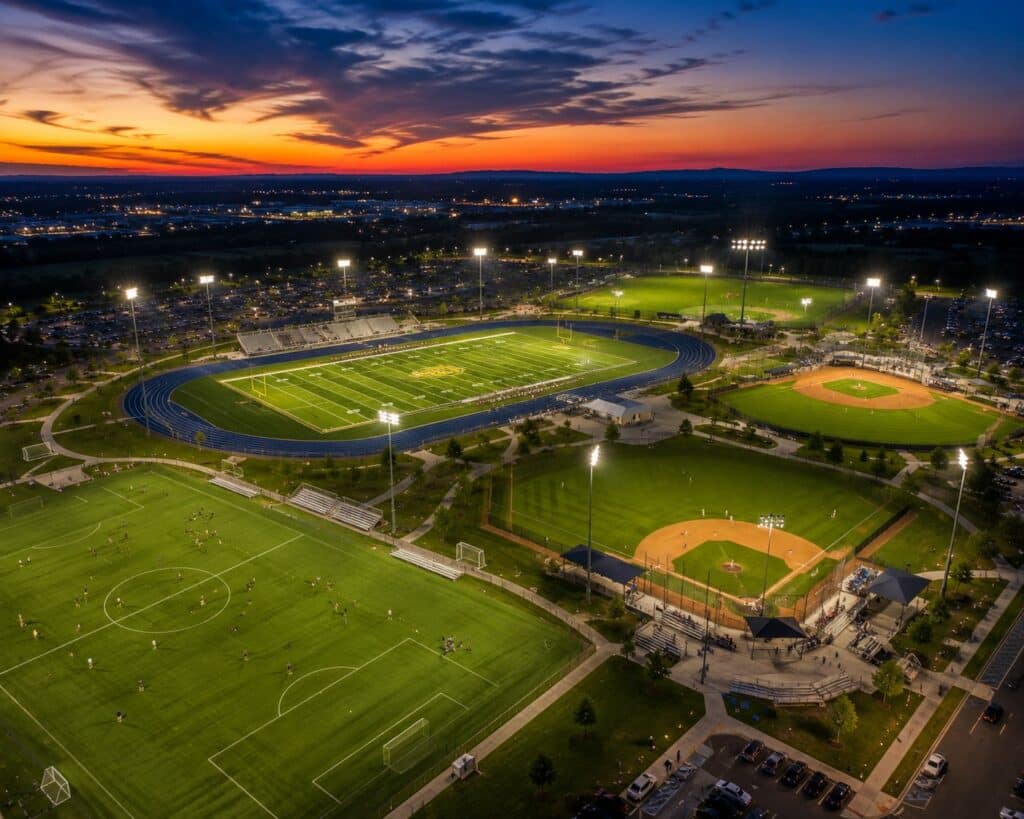
Commercial LED sports field lighting uses high-output fixtures, controlled optics, and project-specific layouts to illuminate football, soccer, baseball, softball, and multi-purpose athletic fields.
Planning a Sports Field Lighting Project?
LED Pros WorldWide can help evaluate commercial LED sports lighting for new athletic fields and existing lighting retrofits. Send us your sport, field dimensions, number and height of poles, voltage, existing fixture information, required light levels, and any available site plans or specifications. We can help evaluate fixture options and determine when project-specific photometric planning is appropriate.
Request a Quote or call 844-533-7767 to discuss your project.
Explore our Commercial LED Sports Lighting Fixtures for available sports lighting solutions
What Is Sports Field Lighting?
Sports field lighting refers to specialized outdoor lighting systems designed to illuminate athletic playing surfaces for practices, competition, and recreational use after dark.
Unlike general area or parking lot lighting, sports lighting must provide controlled illumination that supports ball tracking, player movement, field markings, officiating, and spectator visibility across large playing areas.
A complete system may include high-output LED luminaires, sports lighting poles, precision optics, mounting hardware, electrical infrastructure, surge protection, lighting controls, and photometric design. These components work together to provide consistent illumination while controlling glare and unwanted spill light.
Sports Field Lighting vs. Stadium Lighting
Although the terms are often used interchangeably, sports field lighting and stadium lighting serve different types of facilities.
Sports field lighting typically focuses on illuminating the playing surface for schools, parks, recreational complexes, municipal athletic fields, and training facilities where spectator seating is limited.
Stadium lighting supports much larger venues with grandstands, press boxes, broadcast requirements, premium seating, architectural lighting, and extensive security systems.
Both systems share similar engineering principles, but stadium projects generally involve more complex lighting controls, higher mounting heights, greater vertical illumination, and additional lighting for spectators and surrounding facilities.
Indoor athletic facilities require a different design approach from outdoor playing fields, particularly when high ceilings, reflective dome membranes, and overhead ball tracking are involved. See our Field House & Sports Dome Lighting Guide for these applications.
Large spectator venues require specialized lighting strategies beyond the playing surface. Learn more in our Stadium Lighting Design Guide.
Why LED Sports Field Lighting Has Replaced Older Technologies
Many athletic facilities are replacing metal halide sports lighting with LED systems because LEDs provide instant-on operation, lower energy consumption, longer service life, improved optical control, dimming and control capabilities, and reduced maintenance requirements.
For sports facilities, the most important advantage is not simply efficiency. Modern LED optics allow light to be distributed and aimed more precisely across the playing area, helping designers improve uniformity while controlling glare and spill light.
Designing for the Facility and Level of Play
Sports field lighting should be designed around how the facility will actually be used. A community recreation field, high school stadium, collegiate facility, and multi-field municipal sports complex may require different light levels, uniformity, vertical illumination, controls, and glare management.
Many athletic fields also support practices, tournaments, physical education, community events, and other activities beyond scheduled games. Understanding these uses early helps determine the appropriate lighting performance and control strategy without over-lighting the facility.
For school-specific applications, see our High School Athletic Field Lighting Guide.
Sports Field Applications
| Facility Type | Typical Uses |
|---|---|
| Football Fields | Practices, varsity games, tournaments |
| Soccer Fields | Youth leagues, clubs, collegiate matches |
| Baseball & Softball Fields | Recreational and competitive play |
| Lacrosse Fields | School and municipal athletics |
| Rugby & Cricket Fields | Club competition and tournaments |
| Multi-Purpose Fields | Community recreation and special events |
| Athletic Complexes | Multiple sports with shared infrastructure |
Track and field complexes introduce additional design challenges because the running oval, infield events, and a shared football or soccer field may require different lighting considerations. See our track and field lighting guide for a closer look at these multi-zone facilities.
💡 Design Insight
The best sports field lighting systems are designed around how the facility will actually be used—not simply how bright the field should be. By considering athlete safety, competition level, future expansion, maintenance, and operating costs together, facility owners can invest in a lighting system that delivers exceptional performance for many years.
Sports Field Lighting Design Fundamentals
Designing an effective sports field lighting system requires far more than selecting bright fixtures.
Athletic lighting must provide consistent illumination across the entire playing surface while minimizing glare, reducing shadows, controlling spill light, and supporting the specific requirements of each sport. Every decision—from pole placement to beam angles—affects athlete performance, spectator comfort, and long-term operating costs.
Professional lighting designers use advanced photometric software to optimize every aspect of the system before installation begins, ensuring the field performs as expected while avoiding costly adjustments later.
Understanding Foot Candles and Lux
Light levels for athletic facilities are typically measured in foot-candles (fc) in the United States and lux (lx) internationally.
A foot-candle measures the amount of light reaching one square foot of surface area, while one foot-candle equals approximately 10.76 lux.
Higher competition levels generally require greater illumination because athletes move faster, officials must make split-second decisions, and spectators expect excellent visibility.
Typical lighting levels vary based on:
- Sport
- Age group
- Recreational or competitive use
- Television broadcasting
- Live streaming
- Governing organization requirements
Rather than maximizing brightness, lighting designers focus on providing the appropriate illumination for the facility’s intended use.
Uniformity Is More Important Than Maximum Brightness
One of the most overlooked aspects of sports lighting is uniformity.
Uniformity describes how evenly light is distributed across the playing surface.
Poor uniformity creates bright spots and dark areas that force athletes’ eyes to constantly adjust while moving across the field.
Excellent uniformity helps:
- Improve depth perception
- Track fast-moving balls
- Recognize teammates
- Reduce eye fatigue
- Improve officiating
- Produce better video recordings
A balanced lighting system creates a field that appears consistently illuminated from sideline to sideline.
Horizontal Illumination
Horizontal illumination measures the light reaching the playing surface itself.
This affects how well athletes can see:
- Boundary lines
- Ball movement
- Playing surface conditions
- Equipment
- Goal areas
- Bases
- Field markings
Proper horizontal illumination is essential for safe play and accurate officiating.
Vertical Illumination
Many sports involve athletes looking well above the playing surface.
Vertical illumination improves visibility of:
- Football passes
- Soccer headers
- Baseball fly balls
- Softball pop flies
- Lacrosse passes
- Rugby kicks
- Officials
- Coaches
- Players’ faces
Higher vertical illumination also improves photography, live streaming, and broadcast-quality video.
Modern LED sports lighting is designed to balance both horizontal and vertical illumination for optimal performance.
Pole Height and Pole Placement
Pole placement directly influences lighting quality.
Poles that are positioned too close to the field may increase glare and create uneven illumination.
Conversely, properly positioned poles provide:
- Better beam overlap
- Improved uniformity
- Reduced shadows
- Enhanced vertical illumination
- Greater spectator comfort
Pole height depends on several factors, including:
- Field dimensions
- Sport
- Fixture output
- Optical distribution
- Competition level
Each project should include a photometric study to determine the ideal pole layout for the specific facility.
Pole height should be selected as part of the complete lighting layout rather than as an isolated specification. See our sports field lighting pole height guide for how mounting height affects beam distribution, aiming, glare, and uniformity.
Beam Angles and Precision Optics
Modern LED sports luminaires use precision optical systems rather than simple reflectors.
Different beam distributions allow designers to place light exactly where it is needed.
Common optical choices include:
- Narrow beam
- Medium beam
- Wide beam
- Forward throw
- Cross-field optics
- Asymmetric distributions
Combining multiple optics often produces the most uniform lighting while reducing wasted light outside the playing area.
Reducing Glare
Glare is one of the biggest challenges in sports lighting.
Athletes frequently look directly toward lighting fixtures while tracking airborne balls.
Poor glare control can affect:
- Quarterbacks
- Goalkeepers
- Outfielders
- Tennis players
- Officials
- Spectators
Modern LED fixtures reduce glare through:
- Precision optics
- Fixture shielding
- Proper aiming
- Higher mounting heights
- Carefully selected beam patterns
Good lighting design allows athletes to focus on the game—not the light source.
Controlling Spill Light and Light Trespass
Athletic facilities are increasingly located near homes, schools, businesses, and roadways.
Responsible lighting design minimizes unwanted illumination beyond the field.
Techniques include:
- Precision optics
- Fixture shields
- Accurate aiming
- Programmable lighting controls
- Curfew scheduling
- Asymmetric beam patterns
Reducing spill light improves community relations while lowering energy consumption.
Selecting the Right Color Temperature
Color temperature affects the appearance of the playing surface, surrounding facility, uniforms, and other objects under sports lighting.
Commercial LED sports lighting is available in different color temperatures, and the appropriate selection should reflect the facility requirements, level of play, surrounding environment, desired appearance, and any photography or broadcast requirements.
Rather than selecting color temperature independently, it should be considered along with fixture output, optics, glare control, color rendering, and the overall photometric design.
Color Rendering for Sports Field Lighting
Color Rendering Index (CRI) describes how accurately colors appear under a light source. In sports facilities, color quality can affect the appearance of team uniforms, playing surfaces, field markings, equipment, balls, and signage.
CRI should be considered alongside light levels, uniformity, color temperature, and any photography or video requirements when sports lighting fixtures are specified.
Professional Photometric Lighting Layouts
A photometric study is particularly valuable for commercial sports field projects with defined light-level requirements, multiple poles or fields, existing infrastructure, neighboring properties, or specific uniformity and glare-control objectives.
Photometric software can evaluate:
-
Average and minimum illumination
-
Uniformity
-
Pole locations and mounting heights
-
Fixture quantities
-
Fixture aiming
-
Spill light
-
Glare
-
Vertical illumination
This allows the proposed lighting system to be evaluated before installation and can identify potential coverage, aiming, or uniformity issues while changes can still be made.
Need assistance with fixture selection? Explore our Commercial LED Sports Lighting Fixtures to compare available wattages, optics, and mounting options.
Sports Field Lighting Design Factors
| Design Element | Why It Matters |
|---|---|
| Foot Candles | Determines overall illumination level |
| Uniformity | Eliminates bright and dark spots |
| Pole Placement | Improves coverage and reduces glare |
| Pole Height | Increases beam overlap and visibility |
| Precision Optics | Directs light exactly where needed |
| Vertical Illumination | Improves ball tracking and camera performance |
| Spill Light Control | Reduces impact on neighboring properties |
| Smart Controls | Improves flexibility and energy savings |
🏟️ Project Spotlight: Multi-Field Sports & Recreation Lighting
A regional parks department renovated a multi-field athletic complex used for football, soccer, baseball, and youth sports.
The original metal halide lighting produced uneven illumination, long warm-up times, and frequent maintenance issues.
Following a comprehensive photometric analysis, the new LED system included:
- Precision optical distributions for each field
- Improved horizontal and vertical illumination
- Higher lighting uniformity
- Reduced glare for athletes and spectators
- Smart controls with separate lighting scenes for practices and tournaments
- Improved spill light control for nearby residential neighborhoods
The completed project extended field availability, lowered annual energy costs, and significantly reduced maintenance requirements while creating a safer and more enjoyable experience for athletes and visitors.
📐 Design Insight
The brightest lighting system is not necessarily the best one. Exceptional sports field lighting is achieved by balancing illumination levels, uniformity, glare control, precision optics, and photometric planning to create a safe, efficient, and visually comfortable environment for athletes, officials, and spectators alike.
Sports Field Lighting Requirements by Sport
Different sports create different visual demands, so fixture selection, optics, aiming, pole placement, and photometric design should reflect the activity taking place on the field.
| Sport | Primary Lighting Considerations |
|---|---|
| Football | Vertical illumination, long-pass visibility, end-zone coverage, glare control |
| Soccer | Uniform coverage across a large playing surface, ball tracking, goalkeeper visibility |
| Baseball & Softball | Infield/outfield balance, long-throw optics, fly-ball visibility |
| Lacrosse | Vertical illumination, fast ball tracking, uniform coverage |
| Rugby | Uniformity, long-kick visibility, consistent sideline coverage |
| Cricket | Large-area coverage, long-throw optics, vertical illumination |
| Field Hockey | Uniformity, ball contrast, color rendering, glare control |
| Multi-Purpose Fields | Flexible fixture layouts and controls supporting multiple activities |
Football, baseball, softball, and other sports involving high or long-traveling balls place additional importance on vertical illumination. Large rectangular fields such as soccer and rugby require consistent coverage across the full playing surface, while baseball and softball often require different optical distributions for the infield and outfield.
Multi-purpose facilities should be designed around the different sports actually using the field rather than assuming one fixture distribution or operating mode will be appropriate for every activity.
Broadcast and Live Streaming Considerations
Facilities used for live streaming, photography, or broadcast may require additional attention to vertical illumination, uniformity, color quality, flicker performance, and camera exposure beyond the requirements for recreational play alone.
These requirements should be identified early because they can affect fixture selection, aiming, controls, and overall lighting design.
Facilities with grandstands, press boxes, and television production requirements often benefit from additional design considerations discussed in our Stadium Lighting Design Guide.
Selecting Commercial LED Sports Field Lighting
Selecting sports field fixtures requires more than comparing wattage or lumen output. The appropriate LED system depends on the field dimensions, mounting height, pole locations, required illumination, level of play, fixture optics, aiming, electrical requirements, and surrounding environment.
Fixture Output & Optics
High-output LED sports lights are available in different wattages and lumen packages, but greater output does not automatically produce a better lighting design. Optical distribution and fixture aiming determine where that light is delivered.
Narrower distributions can provide long-throw illumination from taller or more distant poles, while wider distributions may be appropriate for closer coverage. Many sports fields require multiple optical distributions within the same project.
Drivers, Surge Protection & Electrical Requirements
Commercial sports lighting should use drivers and electrical components appropriate for the project voltage and operating environment. Surge protection is particularly important for pole-mounted outdoor fixtures exposed to electrical disturbances and severe weather.
Voltage, controls, dimming requirements, and existing electrical infrastructure should be confirmed before fixtures are ordered.
Outdoor Construction & Environmental Protection
Sports lighting fixtures should be selected for long-term outdoor exposure. Housing construction, ingress protection, thermal management, mounting hardware, and resistance to weather and corrosion should be evaluated according to the installation environment.
Coastal, high-humidity, high-wind, or other demanding locations may require additional consideration beyond a standard outdoor installation.
Controls & Dimming
LED controls can allow facilities to operate individual fields, reduce output for practices or maintenance, schedule operation, and shut lighting off when facilities are unused.
For multi-field complexes, zoning individual fields or playing areas can provide considerably more operating flexibility than controlling the entire facility as one lighting system.
RGB & RGBW Sports Lighting
Some athletic facilities incorporate RGB or RGBW LED fixtures for team colors, player introductions, celebrations, special events, and other programmable lighting effects.
RGBW systems add a dedicated white-light channel to the color-changing capabilities of RGB fixtures, making them useful when a venue needs both functional white illumination and programmable color effects.
Color-changing sports lighting requires additional consideration for fixture output, controls, programming, communication protocols, and coordination with the facility’s normal white-light requirements.
For commercial color-changing fixtures and control options, explore our RGB LED Lights.
Sports Field Lighting Installation & Retrofit Planning
New sports field installations and LED retrofits should be planned around the complete lighting system rather than the fixtures alone. Pole locations and heights, mounting hardware, electrical service, controls, structural requirements, and photometric performance can all affect the final equipment selection.
Evaluating Existing Sports Lighting
For retrofit projects, document the existing fixture type and wattage, fixture quantity, pole height and location, crossarms or mounting hardware, voltage, controls, and current lighting performance.
Existing poles may sometimes be reused, but their condition, structural capacity, mounting configuration, and suitability for the proposed LED fixtures should be evaluated before assuming they can remain in service.
Sports field fixtures are specialized commercial industrial lighting equipment, and retrofit decisions should consider the complete installation environment rather than simply replacing an existing fixture with a lower-wattage LED.
For additional retrofit planning, see our Sports Field LED Lighting Retrofit Guide.
Installation & Commissioning
After installation, fixture aiming should be checked against the lighting design. Field measurements can then be used where required to evaluate illumination and identify any adjustments needed to fixture aiming or controls.
Large athletic facilities may also require coordination among the lighting supplier, electrical contractor, pole or structural provider, facility owner, and lighting designer.
Maintenance & Long-Term Operation
LED sports lighting can reduce routine lamp replacement compared with older metal halide systems, but the installation should still allow practical access to fixtures, drivers, controls, and electrical components.
Long-term planning should also consider surge protection, control-system support, replacement components, and warranty terms when comparing sports lighting systems.
What Affects Sports Field Lighting Cost?
Sports field lighting costs vary considerably because projects can range from replacing fixtures on existing poles to designing a complete lighting system for a new multi-field athletic complex.
Major cost factors include:
-
Number and size of fields
-
Required light levels and level of play
-
Number and height of poles
-
Fixture quantity and optical requirements
-
Existing infrastructure that can be reused
-
New poles, foundations, crossarms, or electrical work
-
Lighting controls
-
Photometric and engineering requirements
-
Installation access and site conditions
For retrofit projects, providing existing fixture and pole information can help determine whether portions of the current system may be retained. For new construction, site plans and project specifications allow a much more meaningful equipment evaluation than estimating from field size alone.
Sports Field Lighting Buyer Checklist
Before requesting fixtures or a lighting proposal, gather as much of the following project information as possible:
Facility & Field
-
Sport or sports being played
-
Field dimensions
-
Recreational, school, competitive, or tournament use
-
Required light levels or project specifications, if available
-
Nearby residences, roadways, or other spill-light concerns
Existing Infrastructure
-
Number of existing poles
-
Pole heights and locations
-
Existing fixture quantity, type, and wattage
-
Voltage and electrical service
-
Existing controls
-
Pole or structural information, if available
Lighting Requirements
-
New installation or LED retrofit
-
Horizontal and vertical illumination requirements
-
Uniformity requirements
-
Glare and spill-light restrictions
-
Photography, streaming, or broadcast requirements
-
Control or dimming requirements
Project Documents
-
Site plan or field drawings
-
Existing lighting layout
-
Fixture schedules
-
Electrical drawings
-
Project specifications
-
Available photometric files or previous lighting studies
The more complete the project information, the easier it is to evaluate fixture output, optics, quantities, mounting requirements, controls, and whether project-specific photometric planning is needed.
Sports Field Lighting Buyer Q&A
What information do you need to recommend sports field lights?
Start with the sport, field dimensions, number and height of poles, voltage, existing fixture information, and intended level of play. Site plans, specifications, pole drawings, and existing photometric information are also helpful when available.
Can you help with an existing metal halide sports field?
Yes. For an LED retrofit, provide the existing fixture wattage and quantity, pole heights and locations, voltage, and photographs or drawings of the existing mounting arrangement. This information helps determine whether an LED replacement can work with the existing layout or whether additional design evaluation is needed.
Can I select sports lights based on wattage or lumens?
Not reliably. Fixture output is only part of the design. Pole height, distance to the playing area, optics, aiming, uniformity, glare control, and required illumination all affect fixture selection.
Do I need a photometric layout before ordering?
It depends on the project. Photometric planning is particularly useful when the project has defined light-level or uniformity requirements, multiple poles or fields, existing infrastructure, nearby properties, or demanding glare and spill-light restrictions.
Can existing sports lighting poles be reused?
Potentially. Existing pole locations and heights may work well for an LED retrofit, but pole condition, foundation integrity, structural capacity, mounting configuration, and wind loading should be evaluated before new fixtures are installed.
Planning a New Sports Field Lighting System or LED Retrofit?
LED Pros WorldWide can help evaluate commercial LED sports lighting fixtures for football, soccer, baseball, softball, lacrosse, rugby, track and field, and multi-purpose athletic facilities.
For the most useful project review, send us your sport, field dimensions, pole heights and locations, voltage, existing fixture information, required light levels, and any available site plans or project specifications. We can help evaluate fixture output, optics, mounting requirements, controls, and whether project-specific photometric planning is appropriate.
Request a Quote or call 844-533-7767 to discuss your sports field lighting project.
You can also explore our Commercial LED Sports Lighting Fixtures for available fixture options.
Frequently Asked Questions
What is sports field lighting?
Sports field lighting is specialized outdoor lighting designed to provide controlled illumination across athletic playing surfaces. A complete system may include LED fixtures, poles, mounting hardware, optics, electrical infrastructure, controls, and project-specific lighting design.
How much light does a sports field need?
Required light levels depend on the sport, field dimensions, level of play, governing requirements, and whether the facility supports recreational use, competitive events, photography, streaming, or broadcast. The appropriate target should be established for the specific facility rather than applying one light level to every sports field.
How is a sports field lighting layout designed?
A sports field lighting layout considers field dimensions, pole locations and heights, fixture output, optical distributions, aiming, horizontal and vertical illumination, uniformity, glare, and spill light. Photometric modeling can be used to evaluate these factors before installation.
How tall should sports field lighting poles be?
Pole height varies according to field size, sport, pole location, fixture output, optics, and lighting requirements. Pole height should be evaluated as part of the complete lighting layout rather than selected independently.
Can existing metal halide sports lights be replaced with LED fixtures?
Yes, many existing sports fields are candidates for LED retrofits. The existing poles, mounting arrangement, electrical system, fixture quantities, voltage, and structural conditions should be evaluated before replacement fixtures are selected.
How can glare and spill light be reduced around athletic fields?
Glare and spill light can be controlled through appropriate pole placement and mounting height, fixture optics, shielding where applicable, careful aiming, and photometric planning. Nearby residences, roads, and other sensitive properties should be considered during design.
Can one lighting system serve multiple sports?
Yes, but the system should be designed around the sports and activities actually using the facility. Multi-purpose fields may require different optics, aiming strategies, illumination requirements, or control settings to accommodate different uses.
Stay Connected with Our Lighting Resources
Add IndustrialLightingFixtures.org as a Preferred Source on Google to see more of our lighting guides and technical resources across Google Search experiences.
Related Resources
-
Commercial LED Sports Lighting Fixtures — Explore commercial LED fixtures for athletic fields, stadiums, sports complexes, and indoor facilities.
-
Sports Field Lighting Pole Height Guide — Learn how mounting height affects coverage, fixture aiming, uniformity, and glare.
-
Sports Field Lighting Glare & Spill Light Control Guide — Design considerations for controlling glare, light trespass, and unwanted illumination around athletic facilities.
-
Sports Field LED Lighting Retrofit Guide — Evaluate existing poles, metal halide fixtures, electrical infrastructure, controls, and LED replacement options.
-
High School Athletic Field Lighting Guide — Lighting considerations for school football, soccer, baseball, softball, track, and multi-purpose athletic facilities.
-
LED Track & Field Lighting Guide — Plan lighting for running tracks, field events, and shared track-and-field complexes.
-
Sports Stadium & Athletic Complex High Mast Lighting Guide — Explore high-mast applications for large athletic complexes and stadium environments.