Indoor field houses and air-supported sports domes create lighting challenges that differ substantially from conventional gyms, warehouses, and outdoor athletic fields.
These large indoor athletic facilities may host soccer, baseball, softball, lacrosse, football practice, track and field, tennis, pickleball, training programs, tournaments, and community events—sometimes within the same building.
Effective LED sports dome and field house lighting must therefore provide more than high lumen output. Uniformity, glare control, mounting height, vertical visibility, ball tracking, fixture location, ceiling or membrane characteristics, controls, and photometric performance all influence the final design.
Modern LED systems also give facility operators more flexibility than traditional metal-halide lighting through instant operation, dimming, zoning, improved optical control, and reduced maintenance.
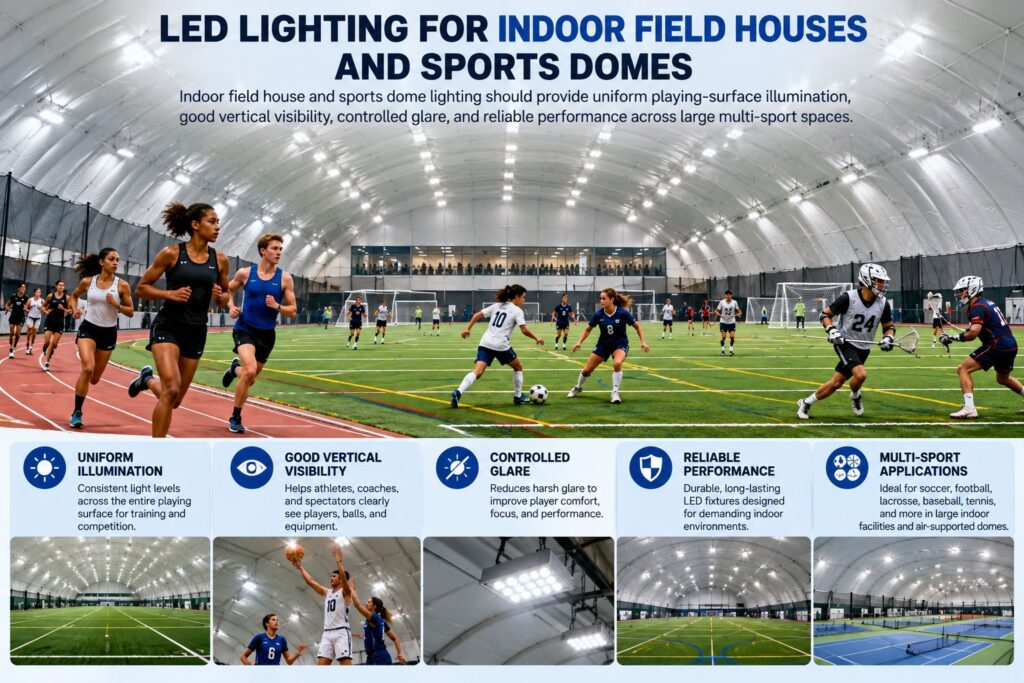
Indoor field house and sports dome lighting should provide uniform playing-surface illumination, good vertical visibility, controlled glare, and reliable performance across large multi-sport spaces.
Design Indoor Sports Lighting Around the Facility
Lighting a large indoor athletic facility starts with understanding the building and the sports being played—not simply choosing a high-output LED fixture.
A conventional field house with steel trusses can present very different mounting opportunities from an air-supported sports dome. A soccer training facility has different visual demands from an indoor track, tennis complex, or baseball training center.
The lighting system should therefore be designed around the facility’s geometry, mounting conditions, playing areas, ceiling or membrane, required light levels, and intended sports.
For commercial LED fixtures designed for athletic fields and sports facilities, explore our LED Sports Lighting Fixtures.
Field Houses and Sports Domes Are Not the Same Lighting Environment
The terms are sometimes used together, but the structures can require very different lighting strategies.
| Facility Type | Typical Lighting Considerations |
|---|---|
| Conventional field house | Steel roof structure, trusses, high mounting positions, multiple sports |
| Air-supported sports dome | Fabric membrane, limited conventional mounting structure, reflective ceiling surface |
| Indoor soccer facility | Ball tracking, vertical visibility, large playing surface |
| Indoor track facility | Continuous track illumination and uniformity |
| Baseball/softball training facility | High-ball visibility, batting and fielding areas |
| Multi-sport complex | Different activities, court/field layouts, zoning and controls |
| Tennis/pickleball facility | Glare control and ball visibility against ceiling/background |
Understanding the building type is especially important before deciding whether the project should use direct, indirect, or a combination of lighting techniques.
How Many Foot-Candles Does an Indoor Field House Need?
There is no single foot-candle requirement appropriate for every field house or sports dome.
Lighting requirements vary according to:
- Sport
- Recreational versus competitive use
- Competition level
- Facility size
- Governing requirements
- Spectator use
- Video recording or broadcasting
- Training versus competition
- Ceiling and mounting conditions
A recreational indoor practice facility may have substantially different requirements from a collegiate field house or tournament venue.
For that reason, target illumination should be established for the actual activities before fixture quantities and layouts are finalized.
A photometric study can then determine whether the proposed system provides the required average illumination, minimum levels, and uniformity.
Uniformity Is Critical in Large Indoor Sports Facilities
Average foot-candles tell only part of the story.
A field house could achieve an acceptable average while still having bright areas beneath fixtures and darker areas between them.
Athletes experience those variations while moving rapidly through the facility.
Good uniformity helps provide consistent visual conditions across:
- Playing fields
- Running tracks
- Courts
- Training areas
- Sidelines
- Goal areas
- Event zones
Uniformity becomes especially important in multi-sport facilities where the same space may be configured differently throughout the week.
Why Vertical Visibility Matters
Sports lighting is not only about putting light onto the floor.
Athletes frequently need to see objects above or in front of them.
Consider:
- A soccer goalkeeper tracking a high ball
- A baseball player following a fly ball
- A tennis player watching a lob
- A receiver tracking a football
- A volleyball player following the ball above the net
- A lacrosse player following passes
- A spectator viewing athletes across the facility
These tasks involve vertical and three-dimensional visibility.
A lighting system designed only around horizontal foot-candles can overlook an important part of the athletic visual environment.
Glare Control and Ball Tracking
Glare can be particularly disruptive in indoor sports.
Athletes routinely look upward, and a bright LED fixture directly within the line of sight can temporarily interfere with visibility.
This is one reason fixture placement and optical design are so important.
Effective glare control can involve:
- Appropriate mounting height
- Controlled beam distributions
- Fixture positioning
- Shielding where appropriate
- Indirect lighting
- Direct/indirect lighting
- Reduced contrast between fixtures and ceiling
- Photometric evaluation
The correct strategy depends heavily on the structure.
A conventional steel field house and an air-supported dome may solve the same glare problem in very different ways.
Do Air-Supported Sports Domes Still Need Indirect Lighting?
Indirect lighting has a long history in air-supported sports domes.
Traditional systems frequently used powerful fixtures aimed upward rather than directly toward the playing surface. Light striking the highly reflective interior membrane was redirected downward throughout the facility.
Modern LED technology has not eliminated the reasons this approach was used.
Instead, LED gives lighting designers additional options.
An air-supported dome can potentially use:
Indirect lighting — fixtures direct light toward the reflective membrane, which distributes illumination back into the athletic space.
Direct lighting — controlled LED optics send light toward the playing surface.
Direct/indirect lighting — the system combines both approaches.
The appropriate solution depends on the particular dome rather than a universal requirement.
Why Indirect Lighting Can Still Work Well in a Sports Dome
The membrane of an air-supported structure can become part of the lighting system.
Instead of athletes looking toward relatively small, extremely bright point sources, indirect fixtures illuminate a much larger portion of the dome surface.
Conceptually:
LED fixture → reflective membrane → athletic area
This can produce several useful effects.
Reduced Perceived Glare
Athletes participating in sports such as baseball, soccer, tennis, lacrosse, and football frequently look upward.
A brightly illuminated membrane can create a less severe visual contrast than a high-intensity fixture viewed against a dark ceiling.
Improved Visual Environment for Ball Tracking
Lighting the overhead membrane increases the brightness of the visual background against which athletes track balls.
This can be particularly useful for sports involving high trajectories.
Broad Light Distribution
The membrane can help distribute reflected illumination over a large portion of the facility.
Softer Shadows
Indirect illumination can reduce some of the hard shadowing associated with highly directional direct lighting.
More Comfortable Overhead Brightness
Instead of leaving the upper portion of the dome comparatively dark, indirect illumination creates a brighter overall visual environment.
LED Has Changed the Indirect-Lighting Equation
Older indirect dome systems often relied on high-wattage metal-halide fixtures.
Those systems could consume substantial energy and required long warm-up and restrike periods.
Modern LEDs provide:
- Higher efficacy
- Instant operation
- Dimming
- Better optical control
- Longer service life
- Reduced maintenance
- More precise system control
This means today’s designer does not necessarily need to reproduce an older metal-halide system fixture-for-fixture.
A smaller number of properly selected LED luminaires may be capable of producing substantially different results.
The correct design should be determined photometrically.
Direct vs. Indirect Sports Dome Lighting
Neither approach should automatically be considered superior for every facility.
| Consideration | Direct LED | Indirect LED |
|---|---|---|
| Optical efficiency | Light travels directly toward target | Some light is lost through reflection |
| Glare | Requires careful optical control | Can reduce direct view of bright sources |
| Membrane reflectance | Less dependent | Very important |
| Ball tracking | Depends heavily on fixture placement | Bright membrane can improve visual background |
| Shadows | Can be more pronounced | Often softer |
| Photometric control | Highly precise | Influenced by membrane characteristics |
| Mounting | Requires suitable mounting locations | Often well suited to perimeter-based dome systems |
| Ceiling appearance | Ceiling may remain relatively dark | Illuminates large portions of membrane |
In some facilities, a combination of direct and indirect lighting may provide the best balance between efficiency, visual comfort, and athletic performance.
Membrane Reflectance Matters
An indirect sports dome lighting system depends heavily on the surface receiving the light.
A clean, light-colored membrane can reflect substantial illumination back into the facility.
However, performance can change as the membrane:
- Ages
- Becomes dirty
- Discolors
- Is repaired
- Is replaced
- Changes surface characteristics
This means the membrane should not be treated as an invisible component of the lighting system.
Its reflectance can directly affect lighting performance.
Photometric calculations for indirect systems should account for realistic surface characteristics rather than assuming perfect reflection.
Lighting Conventional Field Houses
Traditional field houses usually provide more structural mounting options than air-supported domes.
Fixtures may be installed from:
- Steel roof trusses
- Beams
- Catwalks
- Structural columns
- Perimeter structures
- Dedicated mounting systems
This can make direct LED lighting practical.
However, direct lighting still requires careful fixture placement because athletes may look upward toward luminaires during play.
Indirect or direct/indirect lighting may also be appropriate when ceiling geometry and reflectance support the approach.
High Mounting Heights Require Purpose-Built Optics
Field houses are often tall structures.
A fixture capable of performing well at 20 feet may not provide appropriate performance at 40, 50, or 60 feet.
As mounting height increases, fixture selection should account for:
- Lumen output
- Beam distribution
- Aiming
- Target distance
- Fixture spacing
- Glare
- Uniformity
- Vertical illumination
- Maintenance access
High-output alone is not enough.
A fixture with the wrong optical distribution can deliver substantial lumens while still producing poor lighting on the playing surface.
Indoor Soccer Field Lighting
Indoor soccer presents several lighting challenges.
Players move rapidly throughout a large field and frequently track the ball both horizontally and vertically.
The lighting design should provide:
- Consistent field illumination
- Good vertical visibility
- Controlled glare
- Goal-area visibility
- Adequate overhead visual conditions
- Uniform illumination across the playing area
Facilities that divide a larger field into smaller training fields should also consider how lighting performs in each configuration.
Indoor Baseball and Softball Lighting
Baseball and softball training facilities create demanding visual tasks because players must follow relatively small, fast-moving balls.
Lighting considerations can include:
- Ball tracking
- Batting areas
- Pitching areas
- Fielding areas
- High fly balls
- Ceiling brightness
- Glare
- Netting
- Structural obstructions
Indirect illumination can be particularly interesting in facilities where athletes routinely look upward.
Indoor Track & Field Lighting
Large field houses frequently include indoor running tracks.
The track may surround courts or a central athletic area, creating a multi-zone lighting problem similar to outdoor track-and-field facilities.
Lighting should consider:
- Running lanes
- Curves
- Straightaways
- Starting areas
- Finish areas
- Jumping events
- Infield events
- Spectator areas
For outdoor running tracks and multi-use athletic fields, see our LED Track & Field Lighting Guide.
Multi-Sport Field House Lighting
Many field houses are not dedicated to a single sport.
A facility might host soccer in the morning, lacrosse in the afternoon, and a community event that evening.
This makes flexibility important.
The lighting system should be evaluated for the most demanding visual tasks while allowing operators to adapt illumination to different uses.
Controls become particularly valuable in this environment.
LED Lighting Controls and Zoning
One of the major advantages of LED sports lighting is controllability.
A large field house or dome may not need every fixture operating at full output whenever the building is occupied.
Controls can create operating modes such as:
- Competition
- Practice
- Recreational use
- Cleaning
- Maintenance
- Special events
- Security
- Partial-field use
Large facilities can also be divided into zones.
For example, a multi-field indoor soccer complex could illuminate only the fields being used rather than operating the entire facility.
Occupancy sensing, scheduling, dimming, and centralized controls can further reduce unnecessary operating hours.
Impact and Environmental Considerations
Indoor athletic facilities can expose lighting equipment to conditions that differ from ordinary commercial interiors.
Depending on fixture location and sport, considerations may include:
- Ball impact
- Vibration
- Dust
- Humidity
- Temperature
- Condensation
- Protective cages or guards
- Fixture ingress protection
- Mounting security
Air-supported domes may present additional environmental conditions that should be reviewed with the facility designer and fixture manufacturer.
LED Retrofit of Metal-Halide Field House Lighting
Older field houses and sports domes frequently use metal-halide lighting.
LED retrofits can provide significant operational improvements, including:
- Lower energy consumption
- Instant-on operation
- Instant restrike
- Dimming
- Zoning
- Reduced relamping
- Longer service intervals
- Improved optical control
- Better control integration
However, retrofit projects should not automatically replace each metal-halide fixture with one LED fixture.
The existing lighting system may have been designed around different optical characteristics.
A photometric analysis should determine whether existing fixture locations can be reused and what LED output and distribution are appropriate.
Maintenance Matters in High-Ceiling Sports Facilities
Maintenance costs become significant when fixtures are mounted high above playing surfaces.
Replacing lamps or servicing fixtures may require:
- Lifts
- Scaffolding
- Specialized access equipment
- Facility shutdowns
- Labor scheduling around athletic programs
Long-life LED systems can reduce the frequency of these interventions.
Fixture selection should nevertheless consider driver accessibility, surge protection, thermal management, serviceability, and warranty—not simply rated LED life.
Photometric Design for Field Houses and Sports Domes
Photometric modeling is particularly valuable for large indoor sports facilities.
A study can evaluate:
- Average illumination
- Minimum illumination
- Maximum illumination
- Uniformity
- Fixture locations
- Mounting heights
- Beam distributions
- Fixture quantities
- Aiming
- Playing-surface coverage
- Vertical illumination
- Glare considerations
- Lighting zones
For indirect dome lighting, the model should also account for the reflective characteristics of the membrane.
The objective is to evaluate the proposed lighting system before fixtures are installed.
Information Needed for an Indoor Sports Lighting Project
The more accurately the facility is documented, the more useful the lighting recommendation can be.
| Project Information | Why It Matters |
|---|---|
| Building dimensions | Establishes illuminated area |
| Ceiling/dome height | Influences output and optics |
| Structure type | Determines mounting possibilities |
| Sports played | Establishes visual requirements |
| Competition level | Helps establish lighting criteria |
| Existing fixture locations | Important for retrofit evaluation |
| Existing fixture wattage | Helps establish baseline |
| Mounting drawings | Identifies installation constraints |
| Membrane type/color | Important for indirect dome lighting |
| Electrical voltage | Required for fixture configuration |
| Control requirements | Determines zoning/dimming strategy |
| Facility drawings | Improves photometric accuracy |
Inline Buyer Q&A
Are sports dome lights supposed to point upward?
Some air-supported sports domes use indirect lighting systems in which LED fixtures are aimed toward the reflective membrane. The membrane then redirects illumination into the athletic space. However, direct and direct/indirect LED systems may also be appropriate depending on the facility.
Can LEDs replace 1,000-watt metal-halide sports dome lights?
Often, but replacement should be based on photometric performance rather than wattage alone. LED optics, fixture quantity, mounting configuration, membrane reflectance, and target illumination should all be evaluated.
Is a regular LED high bay suitable for a field house?
Sometimes, but not automatically. Large athletic facilities can require specialized optics, glare control, high lumen output, vertical illumination, impact protection, and mounting configurations that ordinary warehouse high bays may not provide.
Does indirect lighting waste more energy?
Reflection introduces optical losses, so direct lighting can deliver light to the target more efficiently. However, energy efficiency is only one design consideration. Indirect lighting may provide advantages in glare control, overhead brightness, shadows, and ball tracking.
Should an indoor sports facility have a photometric study?
For large field houses and sports domes, a photometric study is strongly recommended. It allows fixture quantities, mounting, optics, uniformity, and target light levels to be evaluated before equipment is purchased.
Planning an LED Field House or Sports Dome Lighting Project?
LED PROS WorldWide can help evaluate LED lighting for indoor athletic facilities, including conventional field houses, air-supported sports domes, indoor soccer facilities, training centers, and multi-sport complexes.
Fixture selection can be coordinated with mounting height, optical distribution, required illumination, glare control, controls, and photometric planning.
For air-supported structures, we can also evaluate whether direct, indirect, or direct/indirect LED lighting is appropriate for the facility.
Call 844-533-7767 to discuss your indoor sports lighting project or request assistance selecting commercial LED sports lighting fixtures.
Frequently Asked Questions About Field House and Sports Dome Lighting
What type of lighting is best for an indoor field house?
The appropriate system depends on ceiling height, facility dimensions, sports, mounting conditions, required illumination, and glare-control requirements. High-output LED sports fixtures or appropriately designed high-bay systems are commonly considered.
Why are some sports dome lights pointed at the ceiling?
They use the dome’s reflective membrane as part of an indirect lighting system. The fixture illuminates the membrane, which reflects light into the athletic space while reducing direct exposure to high-intensity light sources.
Is indirect lighting still used with LED fixtures?
Yes. LED technology has improved fixture efficiency and optical control, but indirect lighting remains useful in appropriate facilities, particularly air-supported sports domes with reflective membranes.
Can sports domes use direct LED lighting?
Yes. Some facilities may use direct LED systems or a combination of direct and indirect lighting. Photometric analysis should determine which approach provides the appropriate balance of efficiency, uniformity, glare control, and visibility.
How important is membrane color in a sports dome?
Very important for indirect lighting. A light-colored reflective membrane can return considerably more illumination into the facility than a darker or degraded surface.
How can glare be reduced in an indoor sports facility?
Glare can be addressed through fixture location, mounting height, optical selection, shielding where appropriate, indirect or direct/indirect lighting, and photometric design.
Can field house lighting be dimmed for practices?
LED systems can commonly incorporate dimming and zoning so facilities can operate at different output levels for practice, competition, maintenance, and other activities.
Are LED sports lights more efficient than metal halide?
LED systems generally provide substantial opportunities for reduced energy use, longer maintenance intervals, instant operation, dimming, and improved optical control. Actual savings depend on the existing system and proposed design.
Stay Connected with Our Lighting Resources
Add IndustrialLightingFixtures.org as a Preferred Source on Google to see more of our lighting guides and technical resources across Google Search experiences.
Indoor Sports Facility and Athletic Lighting Resources
- LED Sports Lighting Fixtures — commercial LED fixtures for athletic fields, stadiums, courts, and sports facilities.
- LED Track & Field Lighting Guide — lighting design considerations for running tracks, infield events, and shared athletic fields.
- Sports Field Lighting Guide — broader sports-field lighting design and fixture-selection considerations.
- Outdoor Sports Lighting — LED lighting for outdoor athletic facilities.
- LED Indoor Tennis Court Lighting — specialized lighting considerations for indoor tennis facilities.