
Outdoor sports lighting supports much more than large stadiums. Municipal parks, schools, recreation departments, community athletic complexes, sports clubs, and other outdoor facilities rely on properly designed lighting to extend playing hours and provide consistent visibility after dark.
LED sports lighting can be designed for athletic fields, outdoor courts, tracks, multi-sport complexes, and recreational facilities. Fixture selection and layout should account for the activity, facility dimensions, mounting height, level of play, surrounding properties, glare, spill light, and required illumination.
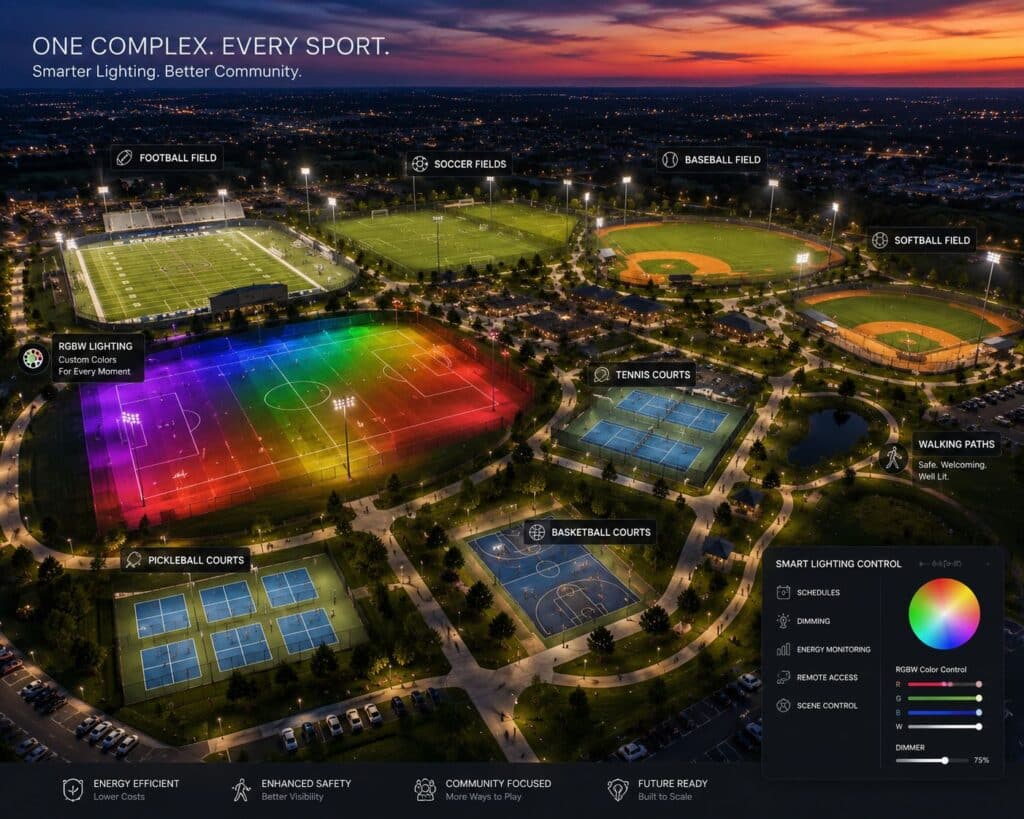
Commercial outdoor sports lighting supports athletic fields, courts, municipal parks, schools, and multi-sport recreation facilities with application-specific LED lighting.
Planning an Outdoor Sports or Recreation Lighting Project?
LED Pros WorldWide can help evaluate LED lighting for athletic fields, outdoor courts, parks, schools, and multi-sport recreation facilities. Send us the type and dimensions of the facility, number and height of existing or proposed poles, voltage, level of play, and any available plans or existing fixture information.
Request a Quote or call 844-533-7767 to discuss your project.
Explore our Commercial LED Sports Lighting Fixtures for outdoor athletic and recreation applications.
Where Outdoor Sports & Recreation Lighting Is Used
Outdoor sports lighting is used across a wide range of public, educational, and private recreation facilities. The lighting requirements vary according to the sport, facility size, level of play, operating hours, and surrounding environment.
Municipal Parks & Recreation Facilities
City and county parks may include athletic fields, basketball courts, tennis and pickleball courts, walking areas, and multi-use recreation spaces. Parks and recreation lighting should provide appropriate visibility for scheduled activities while carefully managing glare and spill light near surrounding neighborhoods and roadways.
Schools & Universities
Schools may need outdoor lighting for football, soccer, baseball, softball, track and field, tennis, and other athletic programs. Designs should account for the level of competition, spectator areas, existing poles, campus surroundings, and whether facilities are used for multiple sports.
Community Sports Complexes
Multi-field athletic complexes often combine several fields or courts within one property. Coordinated lighting design can help maintain consistent performance across the facility while addressing different pole heights, field dimensions, operating schedules, and neighboring properties.
Sports Clubs & Private Recreation Facilities
Private clubs, HOAs, resorts, and other recreational properties may require lighting for tennis, pickleball, basketball, soccer, or multipurpose athletic areas. These projects often place additional emphasis on glare control, appearance, operating costs, and minimizing unwanted light beyond the property.
Athletic Fields & Outdoor Courts
Football, soccer, baseball, softball, rugby, track and field, tennis, pickleball, and basketball each present different lighting requirements. Fixture optics, mounting height, pole locations, aiming, and required illumination should be evaluated for the specific activity rather than applying one standard layout to every outdoor sports facility.
Outdoor Sports Lighting Design Considerations
Effective outdoor sports lighting begins with the facility and activity rather than fixture wattage alone. Field dimensions, pole locations, mounting height, level of play, surrounding properties, and existing infrastructure all influence fixture selection and layout.
Light Levels & Uniformity
Required illumination varies by sport and level of competition. Recreational facilities generally have different requirements than competitive, collegiate, or broadcast venues. Uniformity is also important because large differences between bright and dark areas can affect visibility as players follow the action across the playing surface.
Pole Height & Fixture Placement
Pole height affects fixture distribution, aiming angles, glare, and the number of luminaires required to cover the playing area. Existing poles should also be evaluated for their location, height, condition, mounting configuration, and structural capacity before planning an LED retrofit.
For a closer look at this subject, see our Sports Field Lighting Pole Height Guide.
Glare & Spill Light Control
Outdoor athletic facilities frequently operate near homes, roads, schools, and other properties. Fixture optics, shielding, pole placement, and aiming should be designed to illuminate the intended playing area while controlling excessive glare and unwanted light beyond the facility.
See our Sports Field Lighting Glare & Spill Light Control Guide for additional planning considerations.
Photometric Planning
A photometric layout can model fixture locations, mounting heights, aiming, predicted light levels, and uniformity before installation. This is especially valuable for multi-field complexes, existing-pole retrofits, facilities with neighboring properties, and projects with defined lighting requirements.
Existing Sports Lighting Retrofits
Replacing metal halide sports lighting with LED should not be approached as a simple watt-for-watt substitution. Existing poles, crossarms, electrical service, fixture locations, mounting heights, and current light levels should be evaluated before selecting replacement fixtures.
For existing facilities, see our Sports Field LED Lighting Retrofit Guide.
Municipal Parks & Recreation Lighting
Municipal parks and recreation departments often manage a mix of athletic fields, outdoor courts, community sports complexes, and multipurpose recreation areas. Unlike a single-sport facility, these projects may need to accommodate different activities, schedules, levels of play, and surrounding land uses within one property.
Important planning considerations can include:
-
Types and dimensions of fields or courts
-
Recreational versus competitive use
-
Existing and proposed pole locations
-
Pole heights and structural condition
-
Required light levels and uniformity
-
Glare and spill light near homes, streets, and adjacent properties
-
Individual field or court control
-
Operating schedules and energy use
-
Future expansion or changes in facility use
For municipalities upgrading older sports lighting, existing poles and electrical infrastructure may sometimes be retained, but their suitability should be evaluated before LED fixtures are selected. Photometric planning can then determine whether the proposed lighting system provides appropriate coverage while controlling unwanted light outside the recreation area.
Well-planned LED lighting can also allow parks departments to operate individual fields or courts independently rather than illuminating an entire complex when only part of the facility is being used.
🏟️ Project Spotlight: Lighting for Municipal Parks & Recreation Facilities
LED Pros WorldWide has worked with several park and recreation lighting projects, providing experience with the different requirements that can arise when lighting public athletic and recreational facilities.
Park projects are rarely as simple as selecting a fixture based on wattage. Existing poles, multiple fields or courts, surrounding neighborhoods, operating schedules, electrical infrastructure, and different levels of recreational use can all affect the lighting approach.
Several practical considerations repeatedly become important:
-
Identifying which fields, courts, or recreation areas require lighting
-
Evaluating existing pole heights, locations, and mounting conditions
-
Determining whether existing infrastructure can be reused
-
Selecting fixture optics appropriate for the playing area
-
Controlling glare and spill light near neighboring properties and roadways
-
Planning individual field or court controls where appropriate
-
Using photometric layouts to evaluate coverage and uniformity before fixture selection
Project Takeaway: Parks and recreation lighting should be approached as a facility-specific project rather than a standard fixture replacement. The combination of existing infrastructure, multiple recreational uses, and surrounding properties makes early project evaluation and photometric planning especially valuable.
Outdoor Sports Lighting for Schools & Athletic Programs
Schools, colleges, and universities may operate multiple outdoor athletic facilities, including football and soccer fields, baseball and softball diamonds, tracks, tennis courts, and other recreation areas. Lighting requirements can vary considerably between physical education, recreational use, competitive athletics, and higher-level events.
Planning should account for the sport, field dimensions, level of play, pole locations and heights, spectator areas, neighboring properties, and existing electrical infrastructure. Facilities used for several activities may also benefit from separate lighting zones or controls that allow only the required field or area to operate.
For existing school facilities, an LED upgrade may be able to reuse portions of the existing pole and electrical infrastructure, but structural condition, mounting arrangements, fixture distribution, and photometric performance should be evaluated before replacement fixtures are selected.
For more detailed school-specific planning, see our High School Athletic Field Lighting Guide.
Multi-Sport Complexes & Community Athletic Facilities
Community athletic complexes may combine several sports within one property, such as soccer and football fields, baseball or softball diamonds, tracks, tennis and pickleball courts, and other outdoor recreation areas.
Lighting these facilities requires coordination across the entire site. Different playing areas may have different dimensions, pole heights, lighting requirements, operating schedules, and relationships to neighboring properties.
Important considerations include:
-
Coordinating fixture placement across multiple fields and courts
-
Matching light levels and uniformity to each activity
-
Evaluating existing and proposed poles
-
Controlling glare and spill light between adjacent playing areas
-
Providing separate lighting zones or controls
-
Accounting for parking areas, walkways, spectators, and surrounding properties
-
Planning for future facility expansion or changing recreational uses
A site-wide photometric plan can help identify conflicts between fields, evaluate light coverage, and determine whether each playing area can meet its requirements without simply applying the same fixture configuration throughout the complex.
🏟️ Project Spotlight
A growing suburban community converted an underutilized municipal park into a multi-sport athletic complex featuring soccer fields, baseball diamonds, basketball courts, and pickleball courts.
Rather than limiting activities to daylight hours, the city invested in commercial LED sports lighting throughout the facility.
The new lighting system extended park operating hours, increased youth league participation, attracted regional tournaments, reduced maintenance costs, and allowed the complex to host community festivals, outdoor concerts, and seasonal celebrations throughout the year.
What began as a simple lighting upgrade quickly became one of the community’s most valuable recreational investments.
💡 Design Insight
Outdoor sports lighting is no longer reserved for large stadiums. Modern LED lighting systems help communities maximize recreational opportunities, improve public safety, increase facility utilization, and create flexible outdoor spaces that support athletics, entertainment, and year-round community engagement.
Outdoor Courts & Recreation Areas
Outdoor recreation lighting also includes tennis, pickleball, basketball, and other court-based activities commonly found in parks, schools, HOAs, clubs, and community recreation facilities.
Court lighting presents different design challenges than large athletic fields. Fixtures are typically mounted closer to the playing area, making glare control, fixture placement, mounting height, and spill light especially important. Courts located near homes or other properties may require tighter optical control to keep unnecessary light beyond the playing area to a minimum.
Multi-court facilities should also consider how adjacent courts interact. Fixture placement and aiming should provide consistent illumination without creating distracting bright areas for players on neighboring courts.
For tennis-specific requirements, layouts, pole heights, and lighting levels, see our Outdoor Tennis Court Lighting Guide.
Field Sports: Football, Soccer, Baseball, Softball & Rugby
Football, soccer, baseball, softball, and rugby fields share many outdoor sports lighting considerations, but their field dimensions, playing patterns, spectator areas, and fixture placement requirements can differ significantly.
Football and soccer fields require illumination across large rectangular playing areas, with fixture placement designed to support visibility throughout the field while controlling glare for players and spectators.
Baseball and softball fields present different challenges because lighting must cover the infield, outfield, base paths, and areas where players track high fly balls. Pole locations and fixture aiming should account for these different visual tasks rather than treating the field as one uniform rectangle.
Rugby and other multipurpose fields may share facilities with soccer, football, or community recreation programs. Lighting should be planned around the actual field dimensions and activities rather than assuming that one sports-field layout will serve every use equally well.
For larger outdoor fields, project planning should consider field dimensions, pole locations and heights, fixture optics, aiming, light levels, uniformity, glare, and surrounding properties before fixtures are selected.
For a more detailed look at field-lighting design, see our Sports Field Lighting Guide.
Track & Field Lighting
Track and field facilities combine several different visual areas within one venue. Lighting may need to cover the running track, infield, jumping and throwing areas, spectator zones, and other competition spaces while maintaining appropriate visibility throughout the facility.
Pole locations and fixture aiming should account for the shape and size of the entire venue rather than concentrating illumination only on the track. Facilities shared with football, soccer, or other field sports may also require a coordinated lighting design that supports multiple activities from the same pole system.
For detailed guidance on fixture placement, lighting levels, pole considerations, and multi-event facilities, see our LED Track & Field Lighting Guide.
Lighting Controls for Parks & Outdoor Sports Facilities
Outdoor sports facilities often operate on different schedules, making lighting controls especially useful for parks, schools, and multi-field athletic complexes.
Rather than operating every fixture whenever the facility is open, controls can allow individual fields, courts, or recreation areas to be switched, scheduled, or dimmed independently based on actual use.
Depending on the project, control options may include:
-
Individual field or court switching
-
Scheduling and automatic shutoff
-
Dimming for practices or lower-use periods
-
Wireless or networked control systems
-
Remote operation and monitoring
-
Integration with facility management systems
Control requirements should be considered during fixture selection because LED drivers, electrical distribution, zoning, and communication methods must be compatible with the intended control strategy.
For parks and recreation departments managing several playing areas, thoughtful zoning can help avoid illuminating unused portions of the facility while keeping the areas scheduled for activity available.
High-Power RGBW Lighting Expands Venue Possibilities
Some outdoor sports and recreation facilities use high-power RGBW LED lighting to extend the lighting system beyond normal white-light athletic use. RGBW fixtures combine red, green, blue, and white LEDs, allowing facilities to create color-changing effects while retaining white-light capability for other applications.
These specialized systems are part of the broader range of industrial lighting fixtures used for large commercial and public facilities.
For stadiums, athletic complexes, parks, universities, and community venues, RGBW lighting can support:
-
Team and school colors
-
Pre-game and post-game effects
-
Special events and celebrations
-
Holiday or seasonal displays
-
Community events
-
Architectural and facility accent lighting
RGBW systems require additional planning for fixture placement, output, controls, programming, and communication protocols. The desired white-light sports performance and color-changing effects should be defined early so the appropriate fixtures and control system can be selected together.
For projects requiring commercial color-changing fixtures and controls, explore our RGB LED Lights.
Outdoor Sports Lighting Buyer Checklist
Before requesting LED fixtures or a photometric layout for an outdoor sports or recreation facility, gather the project information that will influence fixture selection and lighting design:
-
Type of sport or recreational activity
-
Number and dimensions of fields or courts
-
Recreational, competitive, collegiate, or other level of play
-
Number and height of existing or proposed poles
-
Existing fixture type, wattage, and quantity for retrofit projects
-
Available voltage
-
Pole and crossarm information, when existing infrastructure will be reused
-
Required light levels or project specifications, if available
-
Nearby homes, roads, or other areas requiring glare and spill light control
-
Lighting control, scheduling, or zoning requirements
-
RGBW or special-event lighting requirements, when applicable
-
Site plans, pole layouts, photographs, or existing photometric studies, when available
For retrofit projects, information about the existing poles and lighting system can help determine whether portions of the current infrastructure may be suitable for reuse. For new facilities and more complex multi-field projects, site plans and project-specific photometric modeling can help establish fixture quantities, optics, mounting, and aiming before equipment is ordered.
Outdoor Sports Lighting Buyer Q&A
Can you help determine how many LED sports lights we need?
Yes. Fixture quantity depends on the type and dimensions of the field or court, pole locations and heights, required light levels, fixture optics, and level of play. For larger or more complex projects, a photometric layout can help determine fixture quantities, aiming, and predicted lighting performance.
Can existing sports lighting poles be reused for an LED retrofit?
Possibly. Existing pole height, location, condition, crossarms, mounting configuration, and structural capacity should be evaluated before new fixtures are selected. Reusing suitable infrastructure can simplify a retrofit, but it should not be assumed that every existing pole or mounting arrangement is appropriate for the proposed LED system.
Can you help with municipal parks or multi-field sports complexes?
Yes. We have experience working with park and recreation lighting projects. For facilities with multiple fields or courts, provide a site plan when available along with pole information, voltage, facility use, and the lighting requirements for each playing area.
Can outdoor sports lighting be designed to reduce glare and spill light?
Yes. Fixture optics, mounting height, pole placement, shielding, and aiming can all influence glare and light outside the intended playing area. Nearby homes, streets, and property boundaries should be identified early so they can be considered during fixture selection and photometric planning.
Can you provide RGBW sports lighting for special events?
Yes. High-power RGBW systems can provide color-changing effects for athletic complexes, parks, schools, and event venues. Let us know whether the project requires white sports lighting, RGBW effects, or both, along with any control and programming requirements.
Plan Your Outdoor Sports Lighting Project
Whether you are lighting a municipal park, school athletic field, community sports complex, outdoor court, or upgrading an existing metal halide system, the right LED sports lighting solution starts with the actual facility requirements.
Send us your sport or application, field or court dimensions, number and height of poles, voltage, existing fixture information, required light levels, and any available site plans or photographs. For projects involving neighboring properties, also let us know about any specific glare or spill light requirements.
LED Pros WorldWide can help evaluate fixture options and determine when project-specific photometric planning is appropriate.
Request a Quote or call 844-533-7767 to discuss your outdoor sports or recreation lighting project.
Outdoor Sports & Recreation Lighting FAQ
What is the best lighting for outdoor sports facilities?
LED sports lighting is commonly used for outdoor athletic facilities because fixture output, optics, aiming, and controls can be selected for the specific field or court. The appropriate fixtures depend on the sport, facility dimensions, pole heights, required light levels, level of play, and surrounding properties.
How much light is needed for an outdoor sports field?
Required light levels vary by sport, facility type, and level of competition. Recreational parks, school athletic fields, competitive venues, and higher-level facilities may have different illumination and uniformity requirements. Project requirements should be established before fixtures are selected.
How high should outdoor sports lighting poles be?
Pole height depends on the sport, field dimensions, pole locations, fixture distribution, and required lighting performance. Taller poles can provide broader coverage and different aiming angles, but pole height should be evaluated as part of the complete lighting design rather than selected independently.
Can existing sports lighting poles be reused with LED fixtures?
Existing poles may sometimes be reused for an LED retrofit, but their height, location, condition, crossarms, mounting configuration, and structural capacity should be evaluated. A retrofit should not assume that existing infrastructure is automatically suitable for the new fixtures.
How can glare and spill light be controlled at parks and sports fields?
Glare and spill light can be managed through fixture optics, shielding, mounting height, pole placement, and careful aiming. Nearby homes, roads, property boundaries, and adjacent playing areas should be identified during the design process so unwanted light can be considered before installation.
Do outdoor sports lighting projects need a photometric layout?
A photometric layout is particularly useful for larger fields, multi-field complexes, existing-pole retrofits, municipal parks, and projects with defined light-level, uniformity, or glare requirements. It can model fixture locations, mounting heights, aiming, and predicted illumination before equipment is installed.
Can one lighting system serve multiple sports or recreation areas?
Yes, but the system should be designed around the actual activities and facility layout. Multi-use fields and sports complexes may require different fixture aiming, operating zones, or lighting levels for different activities. Controls can also allow individual fields or courts to operate independently when the entire facility is not in use.
Stay Connected with Our Lighting Resources
Add IndustrialLightingFixtures.org as a Preferred Source on Google to see more of our lighting guides and technical resources across Google Search experiences.
Related Outdoor Sports Lighting Resources
-
Commercial LED Sports Lighting Fixtures — Explore commercial LED fixtures for athletic fields, sports complexes, parks, and recreation facilities.
-
Sports Field Lighting Guide — Review lighting design fundamentals for outdoor athletic fields and sports facilities.
-
Sports Field Lighting Pole Height Guide — Learn how pole height, field dimensions, fixture placement, and aiming affect sports lighting design.
-
Sports Field Lighting Glare & Spill Light Control Guide — Explore strategies for controlling glare and unwanted light around athletic facilities.
-
Sports Field LED Lighting Retrofit Guide — Evaluate existing poles, fixtures, infrastructure, and photometric requirements when converting older sports lighting to LED.
-
LED Track & Field Lighting Guide — Review lighting considerations for tracks, infields, jumping and throwing areas, and multi-use athletic facilities.
-
Outdoor Tennis Court Lighting Guide — Plan outdoor tennis court lighting, including layouts, pole heights, light levels, and glare control.