
Converting an existing athletic field from metal-halide or other legacy lighting to LED can reduce energy use, improve optical control, simplify operation, and reduce routine maintenance.
But a successful sports field LED lighting retrofit involves more than replacing each old fixture with an LED fixture.
Existing poles, mounting heights, crossarms, fixture locations, electrical service, field dimensions, light levels, uniformity, glare, and spill light all influence the retrofit design.
Modern LED sports luminaires also distribute light differently from older HID floodlights. That creates an opportunity to improve the existing system—but only when fixture selection and aiming are based on the actual field.
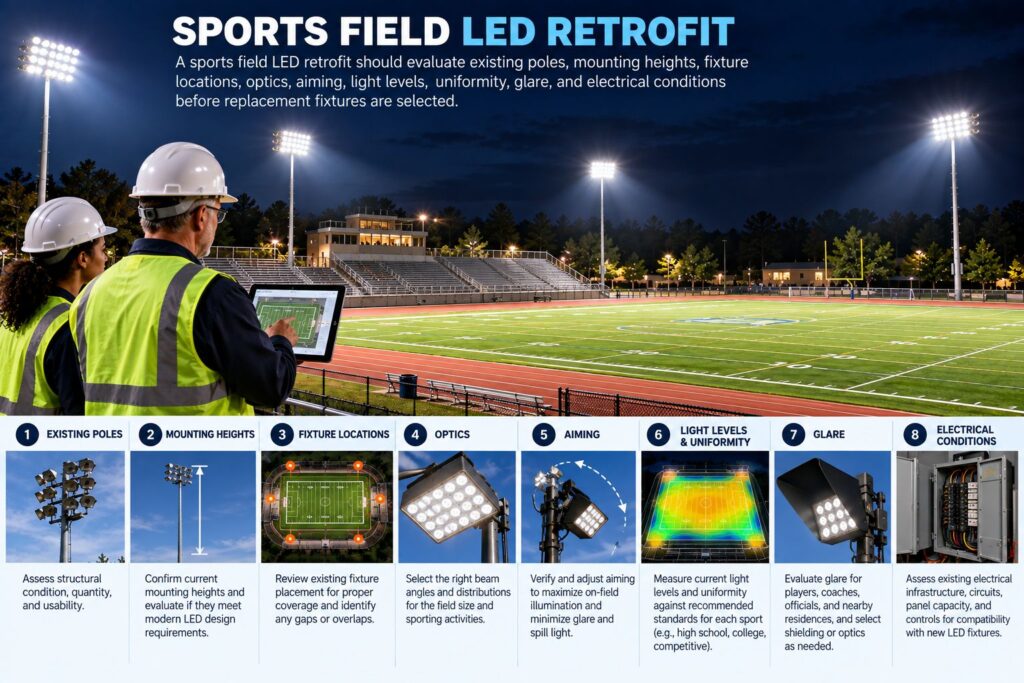
A sports field LED retrofit should evaluate existing poles, mounting heights, fixture locations, optics, aiming, light levels, uniformity, glare, and electrical conditions before replacement fixtures are selected.
Evaluate the Existing Sports Lighting System Before Selecting LEDs
The first step in an LED retrofit is understanding what is already installed.
Important information includes existing fixture type and wattage, fixture quantity, pole locations and heights, crossarm configuration, electrical voltage, field dimensions, current light levels, controls, and known lighting problems.
The project should also identify whether the existing system has problems with uniformity, dark areas, glare, spill light, maintenance, or inadequate illumination.
For commercial LED fixtures designed for athletic fields and competition areas, explore our LED Sports Lighting Fixtures.
Why Sports Fields Are Strong Candidates for LED Retrofits
Traditional sports-lighting systems commonly use high-wattage HID fixtures, particularly metal halide.
These systems can present several operational challenges as they age.
LED technology can provide advantages such as:
-
Reduced energy consumption
-
Instant-on operation
-
Instant restrike
-
Dimming
-
Zoning
-
Improved optical control
-
Reduced relamping
-
Longer maintenance intervals
-
Better integration with modern controls
The actual benefits depend on the existing installation and the proposed LED system.
Do Not Replace Sports Lights Based on Wattage Alone
One of the most common retrofit mistakes is comparing fixture wattage without considering photometric performance.
For example, an existing high-wattage metal-halide fixture cannot be accurately replaced simply by selecting an LED fixture with a lower wattage and assuming it will produce equivalent field performance.
Several variables matter:
Initial lumens describe only the amount of light leaving the source.
Fixture efficiency affects how much of that light leaves the luminaire.
Optical distribution determines where the light travels.
Mounting height and aiming distance affect how the light reaches the playing surface.
Uniformity determines how consistently the field is illuminated.
The correct LED replacement should therefore be selected according to delivered lighting performance rather than wattage alone.
LED Sports Lighting Is Not Necessarily a One-for-One Replacement
A field with 40 existing metal-halide fixtures does not automatically require 40 LED fixtures.
Depending on the existing layout and new fixture performance, the LED design might use:
-
The same fixture quantity
-
Fewer fixtures
-
Different optics
-
Different aiming
-
Different output levels
-
A combination of fixture distributions
Conversely, reducing fixture count should never become the primary goal if doing so compromises uniformity, glare control, or required illumination.
The correct quantity should be determined through photometric design.
Start With Existing Pole Locations
In most retrofit projects, the poles represent one of the largest existing infrastructure investments.
Reusing them can avoid major construction costs.
But existing pole locations also define much of the new lighting geometry.
A retrofit should document:
Pole position relative to the field.
This establishes the distance fixtures must throw light.
Pole height.
Mounting height affects beam selection, aiming, glare, and uniformity.
Pole setback.
A running track, bleachers, fencing, or other site features may place poles substantial distances from the playing surface.
These conditions influence which LED fixtures and optics are appropriate.
Can Existing Sports Lighting Poles Be Reused?
Often, but reuse should not be assumed without evaluation.
Existing poles may have been in service for decades and exposed to wind, weather, vibration, and repeated fixture maintenance.
Factors that may require review include pole condition, corrosion, foundations, crossarms, mounting hardware, fixture weight, effective projected area, wind loading, and the proposed new fixture configuration.
A qualified structural professional should determine structural suitability where required.
Photometric suitability is separate from structural suitability.
A pole can be structurally sound but poorly positioned or too low for the desired lighting design.
Existing Pole Height Matters
Because most retrofit projects retain existing poles, mounting height becomes an important design constraint.
The LED system must work effectively from those established mounting positions.
A fixture designed for a relatively short throw may perform poorly when mounted high and aimed toward the opposite side of a large athletic field.
Likewise, simply choosing the highest-output fixture does not correct an inappropriate beam distribution.
Our Sports Field Lighting Pole Height Guide explains how mounting height interacts with optics, aiming, uniformity, and glare.
Evaluate Existing Crossarms and Mounting
Crossarms determine where fixtures are positioned at the top of the pole.
During a retrofit, evaluate whether existing crossarms can accommodate the proposed LED fixtures.
Considerations can include fixture quantity, fixture dimensions, weight, mounting pattern, aiming range, spacing between luminaires, cable routing, and wind exposure.
Some projects can reuse the existing mounting structure, while others may benefit from new crossarms or mounting hardware designed for the LED system.
Metal Halide vs. LED Sports Lighting
Metal-halide and LED sports systems produce light differently.
Metal-halide systems use lamps and reflectors to distribute illumination. LEDs use arrays of light-emitting diodes combined with engineered optical systems.
Modern LED fixtures can provide more precise control over where light is delivered.
This can create opportunities to improve:
-
Field uniformity
-
Targeted illumination
-
Glare control
-
Spill-light control
-
Energy efficiency
-
System controllability
The retrofit should take advantage of those differences rather than simply trying to duplicate the old fixture arrangement.
Existing Light Levels Should Be Documented
Before removing the old system, consider measuring its current performance.
This establishes a useful baseline.
Measurements can help identify:
-
Existing average illumination
-
Dark areas
-
Bright areas
-
Uniformity problems
-
Areas of inadequate coverage
However, an aging metal-halide system may no longer perform as it did when originally installed.
Lamp depreciation, dirty optics, damaged reflectors, and inconsistent lamp replacement can all affect existing readings.
The current system should therefore be documented without assuming it represents the original design performance.
Establish the Required Lighting Performance
The retrofit should have a defined target.
Required performance depends on factors such as:
-
Sport
-
Competition level
-
Facility classification
-
Governing requirements
-
Spectator use
-
Video or broadcast needs
-
Practice versus competition
-
Local requirements
A community practice field may have different lighting objectives from a high school stadium or collegiate competition facility.
The appropriate criteria should be established before the LED layout is finalized.
Photometric Design Is Critical for a Retrofit
A photometric study allows the proposed LED system to be evaluated using the actual field geometry.
The model can incorporate:
-
Existing pole locations
-
Existing pole heights
-
Field dimensions
-
Proposed fixtures
-
Beam distributions
-
Fixture aiming
-
Fixture quantities
-
Target light levels
The study can then evaluate average illumination, minimum levels, maximum levels, uniformity, and other relevant performance characteristics.
This provides a much stronger basis for fixture selection than comparing manufacturer wattage or lumen tables.
Use Multiple Optics Where Needed
Sports fields often require several optical distributions within the same system.
Fixtures on a single pole may serve target areas at very different distances.
A retrofit may therefore use narrow distributions for distant targets, medium distributions for intermediate areas, and wider distributions for areas closer to the pole.
This allows the lighting designer to build a coordinated pattern across the field.
Replacing every existing fixture with the same LED beam distribution can waste one of the major advantages of modern sports-lighting optics.
Fixture Aiming Should Be Recalculated
Existing metal-halide aiming positions should not automatically be copied to the new LED fixtures.
Different luminaires have different beam patterns and intensity distributions.
The LED photometric design should establish new aiming coordinates based on the selected fixtures and optics.
Field aiming during installation should then follow the approved design.
Small aiming changes can have significant effects when high-output fixtures are projecting light over long distances.
Retrofit Projects Can Improve Uniformity
An older sports field may have acceptable average illumination but poor uniformity.
LED optical control provides an opportunity to redistribute illumination more effectively.
Instead of concentrating excessive light in some areas while leaving others dark, the retrofit can use different distributions and aiming positions to create smoother transitions across the field.
This can improve visual conditions without simply increasing total lumen output.
Use the Retrofit to Address Existing Glare
If athletes, spectators, neighbors, or facility operators have complained about glare from the old system, the retrofit is an opportunity to address it.
LED glare control can involve:
-
More precise optics
-
Revised fixture aiming
-
Appropriate mounting geometry
-
Shielding where necessary
-
Reduced unnecessary output
-
Better fixture placement on crossarms
The goal should be to deliver the required field illumination without placing excessive intensity in important viewing directions.
Our Sports Field Lighting Glare & Spill Light Control Guide explains these relationships in greater detail.
Reduce Existing Spill Light
Older floodlighting systems may send substantial light beyond the playing surface.
This can create problems for:
-
Nearby homes
-
Roads
-
Adjacent properties
-
Other athletic fields
-
Natural areas
Modern LED optics can provide better control, but fixture selection and aiming remain critical.
A retrofit photometric plan should evaluate surrounding areas and property boundaries where unwanted light is a concern.
Electrical Considerations
LED sports fixtures frequently operate at lower wattage than the HID fixtures they replace, but the electrical system should still be reviewed.
Project considerations may include:
-
Supply voltage
-
Existing circuits
-
Breakers
-
Contactors
-
Wiring
-
Disconnects
-
Grounding
-
Surge protection
-
Control wiring
Older athletic facilities may contain electrical equipment that has been in service as long as the original lighting system.
A retrofit is an appropriate time to inspect this infrastructure.
Surge Protection Is Important
Outdoor sports-lighting systems are mounted high above the surrounding area and can be exposed to challenging electrical conditions.
Surge protection should be considered as part of the complete system.
The fixture’s internal protection, external protective devices, grounding, and overall electrical design can all affect long-term reliability.
Protecting drivers and electronic controls is especially important because LED systems contain more electronic components than traditional HID fixtures.
LED Controls Transform Retrofit Projects
Controls are one of the largest functional differences between traditional metal-halide and modern LED sports lighting.
Older HID systems generally offered limited operating flexibility.
LED systems can support configurations such as:
Competition mode — full required output.
Practice mode — reduced output where appropriate.
Partial-field mode — only selected areas operate.
Maintenance mode — illumination appropriate for service work.
Event mode — lighting configured for non-sport activities.
Shutdown scheduling — automatic reduction or shutoff after use.
This flexibility can reduce both energy consumption and unnecessary nighttime illumination.
Instant-On and Instant Restrike
Metal-halide fixtures require warm-up time before reaching full output.
If power is interrupted, hot lamps may also require a cooling period before restriking.
LED fixtures operate very differently.
They can provide immediate illumination and can typically be switched or dimmed without the lengthy warm-up and restrike delays associated with HID lighting.
For schools and community sports facilities, this makes the lighting system significantly easier to operate.
Calculate Energy Savings From the Actual Project
Sports-lighting LED retrofits can produce substantial energy savings, but savings should be calculated from real project data.
A basic comparison considers:
Existing system:
Fixture quantity × existing wattage × annual operating hours
versus
Proposed LED system:
Fixture quantity × LED wattage × annual operating hours
Controls may create additional savings if practice modes, zoning, scheduling, or dimming reduce operating load.
The calculation should also account for actual fixture quantities rather than assuming a one-for-one replacement.
Maintenance Savings Can Be Significant
Replacing lamps on tall sports-lighting poles can be expensive.
Maintenance may require:
-
Lift equipment
-
Specialized crews
-
Field closures
-
Scheduling around games
-
Replacement lamps
-
Ballasts
-
Labor
LED systems eliminate routine lamp replacement and can substantially extend maintenance intervals.
However, LED fixtures still contain service components, particularly drivers and surge-protection devices.
Fixture serviceability should therefore be considered during product selection.
Football Field LED Retrofits
Football fields often provide strong LED retrofit opportunities because older systems may contain numerous high-wattage metal-halide fixtures operating for practices and games.
The retrofit should evaluate field illumination, uniformity, player glare, end zones, sidelines, spectator viewing, and any surrounding running track.
Existing pole setbacks are especially important when a track separates the poles from the football field.
Baseball and Softball LED Retrofits
Baseball and softball retrofits require careful optical planning because poles serve different parts of the field.
Infield and outfield target distances can vary substantially.
Players also need to track high fly balls, making vertical visibility and glare important considerations.
Simply installing identical LED fixtures around the field may not provide the best result.
Soccer Field LED Retrofits
Soccer requires uniform illumination across a large rectangular field.
A retrofit should evaluate whether the existing pole locations and heights provide appropriate geometry for modern LED optics.
Multi-field soccer complexes can also benefit from zoning, allowing individual fields to operate independently.
Track & Field LED Retrofits
Track-and-field facilities frequently combine a running track with football or soccer.
The retrofit should therefore consider both the oval track and central field.
Our LED Track & Field Lighting Guide provides additional guidance on the multiple lighting zones within these facilities.
High School Sports Lighting Retrofits
High schools are particularly strong candidates for LED conversions because athletic facilities may operate throughout the school year for multiple sports, practices, games, community programs, and special events.
A retrofit can combine energy reduction with better controls and reduced maintenance.
Our High School Athletic Field Lighting Guide examines the broader requirements of school sports facilities.
Should You Retrofit or Replace the Entire System?
Not every project should reuse every component.
The decision depends on the condition and suitability of:
-
Poles
-
Foundations
-
Crossarms
-
Electrical infrastructure
-
Controls
-
Wiring
-
Fixture locations
A relatively modern pole system with outdated HID fixtures may be an excellent candidate for fixture-only conversion.
An aging system with deteriorated poles, inadequate mounting geometry, or electrical problems may justify a more extensive redesign.
The objective should be the best long-term system—not simply the fewest components replaced.
Information Needed for a Sports Field LED Retrofit
| Project Information | Why It Matters |
|---|---|
| Existing fixture model | Identifies current equipment |
| Existing fixture wattage | Establishes energy baseline |
| Fixture quantity | Defines existing system size |
| Pole quantity | Establishes layout |
| Pole locations | Determines lighting geometry |
| Pole heights | Influences optics and aiming |
| Crossarm configuration | Affects mounting |
| Field dimensions | Defines target area |
| Electrical voltage | Required for fixture selection |
| Current light levels | Establishes performance baseline |
| Sport and competition level | Establishes target performance |
| Known glare/spill problems | Identifies improvements needed |
| Operating hours | Supports energy analysis |
| Controls | Identifies upgrade opportunities |
Inline Buyer Q&A
Can I replace 1,000-watt metal-halide sports lights with LED?
Yes, many 1,000-watt metal-halide sports systems can be converted to LED, but the appropriate LED fixture should be selected according to delivered photometric performance rather than a simple wattage equivalency.
Do I need to replace my existing sports-lighting poles?
Not necessarily. Existing poles can often be reused if they are structurally suitable and their height and location support the proposed LED design.
Can I use fewer LED fixtures than metal-halide fixtures?
Possibly. Modern LED optics may allow a different fixture quantity, but the correct number should be determined through photometric analysis rather than by assuming LEDs automatically require fewer fixtures.
Should the new LED fixtures use the same aiming as the old lights?
Not automatically. LED fixtures have different optical distributions, so aiming should be recalculated for the new system.
Can an LED retrofit fix glare and light spill?
It can provide an opportunity to improve both through better optics, aiming, shielding, and controls. Existing pole geometry can still limit what is achievable.
Planning a Sports Field LED Retrofit?
LED PROS WorldWide can help schools, municipalities, contractors, facility operators, and project teams evaluate replacement LED sports fixtures for existing athletic fields.
Provide available information about your existing fixtures, wattages, pole heights, pole locations, field dimensions, electrical voltage, and desired lighting performance. We can help evaluate fixture output, optics, aiming requirements, controls, and photometric planning.
Call 844-533-7767 to discuss your sports field LED retrofit or request assistance selecting commercial LED sports lighting fixtures.
Frequently Asked Questions About Sports Field LED Retrofits
Is LED better than metal halide for sports fields?
LED systems can provide lower energy consumption, instant operation, improved optical control, dimming, zoning, and reduced routine maintenance. Actual performance depends on the design and equipment selected.
How much energy can a sports field save by converting to LED?
Savings depend on existing fixture quantity and wattage, proposed LED wattage and quantity, annual operating hours, and control strategy. Project-specific calculations provide a more reliable estimate than a generic percentage.
How long do LED sports lights last?
Service life depends on fixture construction, thermal management, drivers, electrical conditions, operating hours, environmental exposure, and maintenance.
Can LED sports lights use existing electrical wiring?
Often, but existing voltage, wiring, circuits, controls, grounding, and electrical condition should be reviewed as part of the retrofit.
Are photometrics necessary for an LED retrofit?
They are strongly recommended for athletic-field projects. Photometric modeling allows the proposed fixtures, optics, aiming, and existing pole geometry to be evaluated before installation.
Can LED sports lights be dimmed?
Many commercial LED sports fixtures can support dimming and control systems, allowing different operating levels for competition, practice, maintenance, and other uses.
Do LED sports lights need surge protection?
Surge protection is an important consideration for outdoor LED sports systems because drivers and controls contain electronic components that can be affected by electrical surges.
Can I retrofit only part of an athletic complex?
Yes, depending on the electrical and control configuration. A phased project should still consider how the completed areas interact with portions of the facility that retain older lighting.
Stay Connected with Our Lighting Resources
Add IndustrialLightingFixtures.org as a Preferred Source on Google to see more of our lighting guides and technical resources across Google Search experiences.
Sports Lighting Retrofit, Pole & Design Resources
-
LED Sports Lighting Fixtures — commercial LED fixtures for athletic fields, stadiums, courts, and sports facilities.
-
Sports Field Lighting Guide — broader sports-lighting planning and design considerations.
-
Sports Field Lighting Pole Height Guide — how existing and proposed mounting heights affect optics, aiming, uniformity, and glare.
-
Sports Field Lighting Glare & Spill Light Control Guide — controlling unwanted light through optics, aiming, shielding, and photometric design.
-
High School Athletic Field Lighting Guide — LED lighting for football, soccer, baseball, softball, track, and school athletic complexes.
-
LED Track & Field Lighting Guide — lighting design for running tracks, field events, and shared athletic facilities.
-
Sports Stadium & Athletic Complex High Mast Lighting Guide — high mast site lighting for parking, entrances, circulation, and surrounding athletic-complex areas.