
High school athletic facilities often support far more than a single varsity sport. One campus may include football, soccer, baseball, softball, track and field, tennis courts, practice fields, spectator areas, and surrounding pedestrian spaces.
Effective high school athletic field lighting therefore requires more than installing powerful fixtures on tall poles. Light levels, uniformity, pole placement, mounting height, glare control, optical distribution, spill light, controls, and the different visual requirements of each sport should be evaluated as part of the overall facility.
Modern LED sports lighting can provide improved optical control, instant operation, dimming, reduced maintenance, and substantial energy-saving opportunities compared with older metal-halide systems.
For new construction and retrofits alike, the lighting system should be designed around the actual athletic facility and verified through photometric analysis.
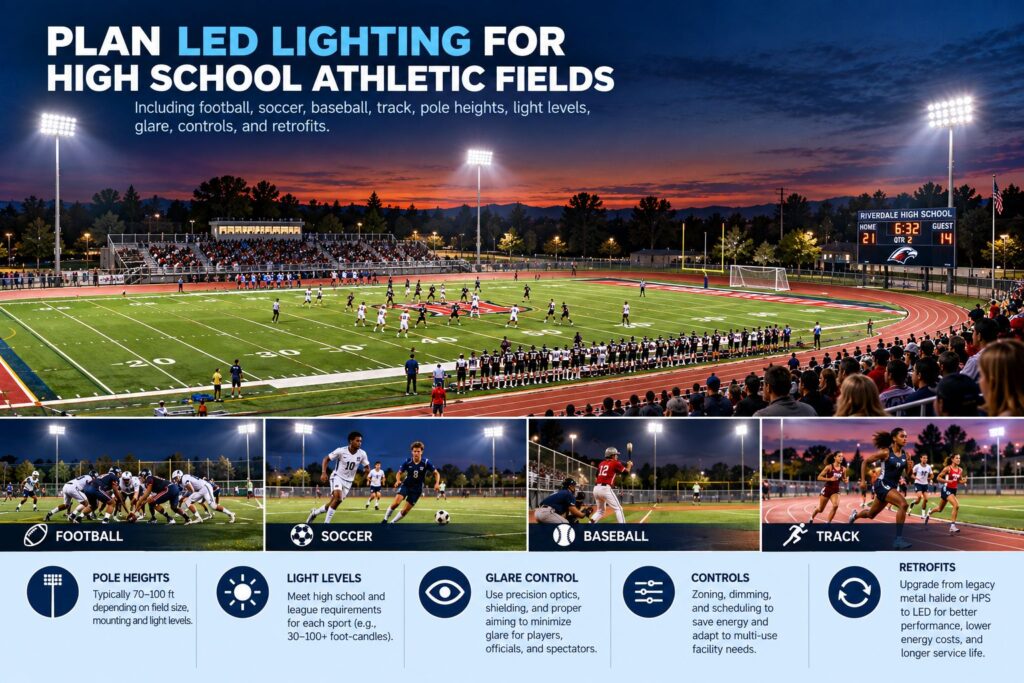
High school athletic field lighting should provide appropriate illumination, uniformity, glare control, and visibility for athletes while limiting unwanted light beyond the school property.
Plan School Sports Lighting Around the Entire Athletic Facility
A high school lighting project should begin with the sports, fields, facility layout, and level of competition—not simply fixture wattage.
Football and soccer fields involve large rectangular playing surfaces. Baseball and softball introduce outfields, infields, and high-ball tracking. Track and field facilities combine running lanes with multiple competition areas. Practice fields may require different performance levels than varsity venues.
Many campuses also contain parking lots, walkways, entrances, bleachers, and other exterior areas that require separate site-lighting strategies.
For commercial fixtures designed for playing surfaces and athletic competition, explore our LED Sports Lighting Fixtures.
Different High School Sports Have Different Lighting Needs
A school district should not assume one lighting design can simply be duplicated across every athletic facility.
| Athletic Area | Important Lighting Considerations |
|---|---|
| Football field | Uniformity, vertical visibility, glare, spectator visibility |
| Soccer field | Large playing area, player visibility, ball tracking |
| Baseball field | Infield/outfield balance, high-ball tracking, vertical illumination |
| Softball field | Similar multi-zone requirements with different field geometry |
| Track & field | Running-track uniformity plus multiple infield events |
| Practice field | Appropriate illumination without unnecessary competition-level output |
| Tennis courts | Glare control, court uniformity, ball visibility |
| Stadium/bleachers | Spectator circulation and viewing conditions |
The lighting criteria should be established for each field according to its actual use.
How Many Foot-Candles Do High School Athletic Fields Need?
There is no single foot-candle requirement for every high school athletic field.
Required illumination varies according to:
-
Sport
-
Competition level
-
Governing requirements
-
Facility classification
-
Spectator use
-
Video or broadcast requirements
-
Practice versus competition
-
Local requirements
-
Project specifications
Football, baseball, soccer, track, and tennis can have different recommended illumination and uniformity criteria.
For that reason, a generic foot-candle number should not be applied to every school facility.
Current applicable sports-lighting guidance and project requirements should establish the target performance before the photometric layout is completed.
Why Uniformity Matters
Average foot-candles alone do not determine whether an athletic field is well illuminated.
Imagine a football field that averages the desired illumination but contains very bright areas near the poles and significantly darker areas between them.
The mathematical average may appear acceptable while athletes experience inconsistent visibility.
Uniformity evaluates how evenly the lighting system distributes illumination.
Good uniformity helps provide consistent visibility as athletes move throughout the playing area and reduces abrupt changes between bright and dark zones.
A photometric analysis should evaluate:
-
Average illumination
-
Minimum illumination
-
Maximum illumination
-
Uniformity
-
Bright spots
-
Dark areas
-
Field boundaries
-
Critical playing zones
Football Field Lighting
Football combines a large playing surface with rapid movement, high passes, kicking plays, officials, spectators, and potentially video recording.
Lighting should support visibility throughout the field while controlling glare for players looking upward.
Important considerations include:
-
Playing-surface illumination
-
Uniformity
-
Vertical visibility
-
End-zone coverage
-
Ball tracking
-
Fixture aiming
-
Glare
-
Pole placement
-
Spectator viewing
If a running track surrounds the football field, both areas should be evaluated within the lighting design.
Soccer Field Lighting
Soccer requires athletes to follow players and the ball across a large field.
The lighting system should provide consistent illumination across the entire playing surface while supporting vertical visibility for airborne balls and players viewed at distance.
Shared football/soccer fields should be modeled for both sports rather than assuming one set of criteria automatically satisfies every use.
Baseball and Softball Field Lighting
Baseball and softball create different visual challenges from rectangular sports fields.
Players must track relatively small balls traveling at high speed and sometimes at significant height.
The lighting system should address:
-
Home plate
-
Pitcher’s mound
-
Base paths
-
Infield
-
Outfield
-
Foul territory
-
High-ball visibility
-
Player and spectator glare
Fixture aiming and vertical illumination can be particularly important for fly balls.
Because the infield and outfield have different geometry, appropriate optical distributions and pole locations are critical.
Track & Field Lighting
Many high school stadiums combine a running track with football or soccer inside the oval.
The track and central field should be treated as related but distinct lighting zones.
Runners require consistent visibility through straightaways and curves, while jumping and throwing events introduce additional target areas.
Our LED Track & Field Lighting Guide examines pole placement, uniformity, optics, track coverage, infield events, and shared football/soccer facilities in greater detail.
Practice Field Lighting
Practice fields do not necessarily require the same lighting system used for varsity competition.
Lower operating levels may be appropriate depending on the sport and applicable requirements.
LED controls can make this distinction particularly useful.
Rather than operating every fixture at maximum output for every activity, schools may be able to establish different lighting modes for:
-
Practice
-
Competition
-
Physical education
-
Maintenance
-
Community use
-
Special events
The lighting system should still provide appropriate visibility and uniformity for the activity taking place.
Pole Placement Around School Athletic Fields
Pole placement affects nearly every aspect of sports-lighting performance.
Important factors include:
-
Field dimensions
-
Sport
-
Pole setbacks
-
Bleacher locations
-
Running tracks
-
Existing utilities
-
Property boundaries
-
Neighboring residences
-
Fixture aiming distances
-
Required mounting height
-
Maintenance access
New facilities provide greater flexibility in pole placement.
Retrofit projects often have to work around existing poles, which makes photometric analysis especially important.
Athletic Field Pole Height
Higher poles can provide greater aiming distances and broader coverage, but height should not be selected independently.
Pole height interacts with:
-
Fixture lumen output
-
Optical distribution
-
Aiming angle
-
Pole location
-
Field dimensions
-
Fixture quantity
-
Glare
-
Uniformity
-
Spill light
A lower pole is not automatically more economical, and a taller pole is not automatically better.
The appropriate mounting height is a system-design decision.
Optical Distribution and Fixture Aiming
Sports lighting frequently requires several beam distributions within the same project.
Fixtures mounted on one pole may illuminate target areas at substantially different distances.
A lighting system might therefore combine:
Narrow distributions for long throws toward distant portions of the field.
Medium distributions for intermediate areas.
Wider distributions for nearer target zones.
The goal is to deliver useful illumination where athletes need it without creating excessive overlap, glare, or spill light.
Glare Control for Student Athletes
Glare is an important consideration because athletes frequently look toward elevated fixtures.
Football receivers track high passes. Baseball and softball players follow fly balls. Soccer players watch airborne balls. Track-and-field athletes face multiple directions throughout competition.
Poor fixture placement or aiming can put intense light directly within an athlete’s field of view.
Glare can be managed through coordinated decisions involving:
-
Pole height
-
Pole location
-
Fixture optics
-
Aiming angles
-
Shielding where appropriate
-
Fixture output
-
Photometric design
More light does not automatically mean better visibility.
Glare control should also be coordinated with spill-light management, particularly where school athletic fields are close to homes or roads. Our Sports Field Lighting Glare & Spill Light Control Guide explains how fixture optics, aiming, shielding, controls, and property-line photometrics work together.
Protecting Neighboring Properties From Spill Light
High schools are frequently located near residential neighborhoods.
This makes control of unwanted light especially important.
A sports-lighting system should evaluate where illumination travels beyond the playing surface, including:
-
Residential properties
-
Roads
-
Adjacent school buildings
-
Parking areas
-
Property boundaries
-
Nearby businesses
Fixture optics, shielding, mounting height, aiming, controls, and pole locations can all affect spill light.
Property-line illumination should be evaluated during photometric design rather than after the system has been installed.
Sports Lighting and BUG Ratings
BUG ratings classify a luminaire’s Backlight, Uplight, and Glare characteristics.
They can provide useful information when evaluating unwanted light, but BUG ratings should not replace a complete sports-lighting photometric analysis.
Athletic-field luminaires involve specialized aiming and long-distance optical distributions. Actual field performance, glare, property-line illumination, mounting conditions, and fixture orientation all matter.
For a deeper explanation of the classification system, see our Commercial Outdoor Lighting BUG Ratings Explained guide.
LED Controls for School Athletic Fields
Controls are one of the strongest operational advantages of modern LED sports lighting.
Older metal-halide systems were poorly suited to frequent switching and required warm-up and restrike time.
LED fixtures can provide instant operation and can be integrated with:
-
Dimming
-
Scheduling
-
Zoning
-
Remote controls
-
Practice modes
-
Competition modes
-
Maintenance modes
-
Automatic shutoff
A school may therefore be able to illuminate only the facilities being used and operate them at an appropriate level.
Reducing Energy Use
Sports lighting fixtures can represent substantial connected electrical loads.
Energy savings from an LED conversion can come from several sources:
-
Lower fixture wattage
-
Improved optical efficiency
-
Reduced operating hours
-
Dimming
-
Zoning
-
Scheduling
-
Instant switching
Actual savings depend on the existing system, new lighting design, operating schedule, and control strategy.
Energy calculations should therefore use project-specific information rather than a generic savings percentage.
Retrofitting Metal-Halide High School Sports Lighting
Many school athletic facilities still have metal-halide sports-lighting systems.
LED retrofits can potentially provide:
-
Reduced energy consumption
-
Instant-on operation
-
Instant restrike
-
Improved optical control
-
Dimming
-
Reduced maintenance
-
Longer service intervals
-
Improved controls
But a retrofit should not automatically be treated as a one-for-one fixture replacement.
Existing poles may have been designed around different fixture weights, wind loads, optical distributions, and electrical requirements.
Before selecting replacement fixtures, evaluate:
-
Pole condition
-
Structural capacity
-
Existing crossarms
-
Fixture quantity
-
Mounting height
-
Electrical voltage
-
Existing aiming
-
Target illumination
-
Required uniformity
Schools converting existing metal-halide fields should evaluate more than fixture wattage. Our Sports Field LED Lighting Retrofit Guide covers existing poles, crossarms, electrical conditions, optics, photometrics, controls, and energy analysis.
Can Existing Sports-Light Poles Be Reused?
Existing poles can often be retained during an LED conversion, but reuse should not be assumed.
A qualified professional should evaluate structural condition and loading when appropriate.
The new fixture configuration may change:
-
Fixture weight
-
Effective projected area
-
Wind loading
-
Crossarm loading
-
Fixture quantity
-
Aiming
-
Electrical requirements
Photometric suitability is another issue.
Even if a pole is structurally capable of supporting the LED fixtures, its location and height still need to produce acceptable lighting performance.
Stadium Lighting vs. Surrounding Site Lighting
The lighting used on the playing field serves a different purpose from lighting used around the athletic complex.
Sports fixtures illuminate competition surfaces.
High mast and other site-lighting systems may instead illuminate:
-
Parking lots
-
Entrance plazas
-
Pedestrian circulation
-
Service roads
-
Drop-off areas
-
Exterior gathering spaces
For these surrounding applications, see our Sports Stadium & Athletic Complex High Mast Lighting Guide.
Separating these functions helps ensure that each lighting system is designed around the area it actually serves.
Emergency and Egress Lighting
Sports-field lighting should not be assumed to provide all required emergency or egress illumination for the surrounding facility.
Bleachers, stairs, walkways, exits, buildings, and other occupied areas may have separate emergency-lighting requirements.
Those systems should be coordinated with the overall athletic-facility design.
Photometric Planning for High School Athletic Fields
A photometric study allows the proposed lighting system to be evaluated before fixtures are purchased or installed.
Depending on the project, the study can evaluate:
-
Average illumination
-
Minimum illumination
-
Maximum illumination
-
Uniformity
-
Pole locations
-
Pole heights
-
Fixture quantities
-
Optical distributions
-
Fixture aiming
-
Playing-surface coverage
-
Property-line illumination
-
Spill light
For multi-sport campuses, separate calculation grids may be needed for individual fields and activity areas.
Information Needed for a School Sports Lighting Project
| Project Information | Why It Matters |
|---|---|
| Sport or sports played | Establishes lighting requirements |
| Field dimensions | Defines illuminated area |
| Competition level | Helps establish performance targets |
| Existing pole locations | Critical for retrofit projects |
| Pole heights | Influences optics and aiming |
| Existing fixture count | Establishes current configuration |
| Existing wattages | Helps establish energy baseline |
| Electrical voltage | Required for fixture selection |
| Site drawings | Improves photometric accuracy |
| Property boundaries | Important for spill-light evaluation |
| Nearby residences | Increases glare/spill considerations |
| Control requirements | Establishes dimming and zoning strategy |
Inline Buyer Q&A
Can one lighting system serve football, soccer, and track?
Often these sports can share poles and fixtures, but each playing area should be evaluated separately. A football/soccer field and surrounding running track can have different illumination and uniformity requirements.
Should a school replace metal-halide sports lights one-for-one with LED?
Not automatically. LED fixtures have different optical characteristics and outputs. Photometric analysis should determine the appropriate fixture quantity, optics, aiming, and output.
Can high school sports lights be dimmed for practice?
Many commercial LED sports-lighting systems can incorporate dimming and controls, allowing schools to establish different operating modes for practice, competition, maintenance, and other activities.
How can a school reduce complaints about sports-field lighting?
Good optical control, appropriate pole placement, fixture aiming, shielding where appropriate, scheduling, dimming, and property-line photometric analysis can help limit unwanted light beyond the athletic facility.
Do schools need a photometric plan before buying sports lights?
For athletic-field projects, a photometric plan is highly recommended. It provides a way to evaluate light levels, uniformity, fixture placement, aiming, and spill light before installation.
Planning a High School LED Sports Lighting Project?
LED PROS WorldWide can help schools, contractors, engineers, and project teams evaluate commercial LED sports lighting for new athletic facilities and retrofit projects.
We can assist with fixture selection, lumen output, optical distributions, mounting considerations, controls, and photometric planning for football, soccer, baseball, softball, track and field, and multi-sport athletic complexes.
Call 844-533-7767 to discuss your high school athletic lighting project or request assistance selecting LED sports lighting fixtures.
Frequently Asked Questions About High School Athletic Field Lighting
What kind of lights are used for high school sports fields?
High-output LED sports luminaires with specialized optical distributions are commonly used for football, soccer, baseball, softball, track, and other outdoor athletic facilities.
Are LED sports lights suitable for high school football fields?
Yes. Properly designed LED systems can provide the illumination, uniformity, optical control, instant operation, and controls required for school football facilities.
How many light poles does a high school football field need?
There is no universal number. Field dimensions, mounting heights, pole locations, fixture output, optical distributions, competition level, bleachers, and surrounding track configuration can all affect pole quantity.
How long do LED athletic field lights last?
Commercial LED sports fixtures can provide long service life, but actual performance depends on fixture construction, thermal conditions, driver quality, operating hours, electrical conditions, and maintenance.
Can schools reuse existing sports-lighting poles?
Often, but pole condition, structural capacity, loading, mounting configuration, height, and location should be evaluated before reuse.
How do schools control sports-field light spill?
Fixture optics, aiming, pole height, shielding where appropriate, dimming, scheduling, and photometric analysis can help limit unwanted illumination beyond the athletic field.
Can LED athletic field lights be remotely controlled?
Many systems can support centralized or remote controls depending on the fixture and control architecture selected.
Are high school stadium lights the same as parking-lot lights?
No. Sports luminaires are designed to illuminate playing surfaces from substantial mounting heights and distances. Parking-lot and site-lighting fixtures serve different optical and application
Stay Connected with Our Lighting Resources
Add IndustrialLightingFixtures.org as a Preferred Source on Google to see more of our lighting guides and technical resources across Google Search experiences.
High School Sports and Athletic Facility Lighting Resources
-
LED Sports Lighting Fixtures — commercial LED fixtures for fields, stadiums, courts, and athletic facilities.
-
LED Track & Field Lighting Guide — detailed guidance for running tracks, infield events, and shared football/soccer facilities.
-
Sports Field Lighting Guide — broader outdoor sports-field lighting design considerations.
-
Outdoor Sports Lighting — LED lighting applications for outdoor athletic facilities.
-
Sports Stadium & Athletic Complex High Mast Lighting Guide — lighting for parking, entrances, circulation, and surrounding areas of large athletic complexes.
-
Indoor Field House & Sports Dome Lighting Guide — specialized lighting for high-ceiling indoor athletic facilities and air-supported sports domes.
-
Commercial Outdoor Lighting BUG Ratings Explained — understanding Backlight, Uplight, and Glare classifications in outdoor lighting.