
Sports field lighting pole height has a major effect on how an athletic lighting system performs.
Mounting height influences fixture aiming, beam distribution, uniformity, glare, spill light, pole quantity, and the distance LED sports fixtures must project usable illumination across a playing surface.
But there is no universal pole height appropriate for every athletic field.
A recreational soccer field, high school football stadium, baseball complex, track and field facility, and large collegiate venue can require substantially different mounting arrangements.
The correct approach is to select pole height as part of the complete lighting system—not as an isolated dimension.
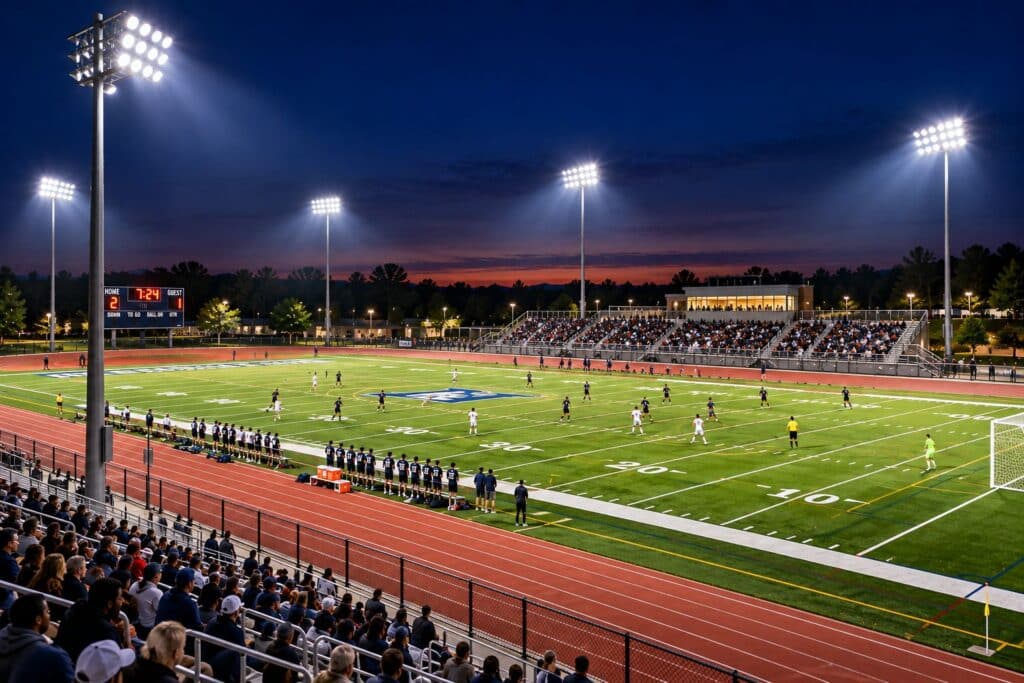
Sports field lighting pole height should be coordinated with field dimensions, pole locations, fixture output, optical distribution, aiming, uniformity, and glare control.
Choose Sports Lighting Pole Height as Part of the Complete Design
Pole height should not be selected simply because a particular height has traditionally been used for a sport.
A successful sports-lighting design coordinates:
Field dimensions – Sport – Level of play – Pole locations – Pole setbacks – Mounting height Fixture output – Beam distributions – Fixture aiming – Required illumination – Uniformity Glare – Spill light
For commercial LED fixtures designed for athletic fields and competition areas, explore our LED Sports Lighting Fixtures.
How Tall Are Sports Field Light Poles?
Sports lighting poles can range from relatively modest mounting heights at smaller recreational facilities to very tall structures at major stadiums and athletic complexes.
Rather than treating the following as universal specifications, these ranges are useful for understanding how athletic facilities can differ.
| General Application | Typical Pole-Height Consideration |
|---|---|
| Small recreational courts/fields | Lower mounting heights may be practical |
| Community athletic fields | Moderate sports-lighting poles are common |
| High school athletic fields | Taller poles may be needed for coverage and glare control |
| Baseball/softball fields | Height can vary substantially by pole location and target area |
| Track & field facilities | Height depends on track geometry and shared infield sports |
| Large stadiums | Tall poles or stadium-mounted systems may be required |
| Major competition/broadcast venues | Project-specific engineering and lighting design |
These are categories rather than prescribed heights.
Actual pole height should be determined from the geometry and performance requirements of the project.
Why Higher Poles Can Improve Sports Lighting
It may seem intuitive that lower poles would be easier and less expensive.
But sports lighting involves projecting illumination across large distances.
Increasing mounting height can provide several potential advantages.
Better Light Distribution
A higher mounting position can allow fixtures to distribute light over a broader portion of the playing surface.
Improved Uniformity
Appropriate mounting height can help reduce extreme bright areas near poles and darker areas farther away.
Better Aiming Geometry
Sports fixtures often need to illuminate targets located considerable distances from the pole.
Additional height can improve the geometric relationship between fixture and target.
Glare Control
A higher fixture position can potentially keep intense luminaires farther above common athlete viewing angles.
However, height alone does not solve glare. Fixture optics and aiming remain critical.
Higher Is Not Automatically Better
Increasing pole height also introduces tradeoffs.
Taller poles can involve:
-
Greater structural requirements
-
Higher pole costs
-
Increased wind-loading considerations
-
Longer aiming distances
-
More demanding optics
-
More difficult maintenance access
-
Increased installation complexity
A lighting design should therefore use the mounting height that best balances lighting performance, structural requirements, site conditions, and project economics.
Pole Height and Beam Angle Work Together
Mounting height cannot be separated from fixture optics.
A high-output LED fixture mounted on a tall pole still needs an appropriate beam distribution to place illumination where it is needed.
Sports-lighting projects frequently combine multiple optical distributions.
Narrow Beams
Narrow distributions can project light toward distant target areas.
Medium Beams
Medium distributions may serve intermediate portions of the playing surface.
Wider Beams
Wider distributions can illuminate areas closer to the pole.
Fixtures on the same pole may therefore use different optics and aiming directions.
The objective is not simply to throw light as far as possible. It is to build overlapping distributions that create appropriate illumination and uniformity across the entire field.
Pole Height and Fixture Aiming
Fixture aiming determines where each luminaire directs its light.
The required aiming angle depends partly on:
-
Pole height
-
Pole setback
-
Target location
-
Fixture optics
-
Field dimensions
Excessively aggressive aiming can increase glare and unwanted light.
Poorly selected mounting height can make the desired target difficult to reach without compromising visual comfort.
This is another reason pole height and fixture aiming should be evaluated together in a photometric model.
Pole Height and Uniformity
Consider two fixtures with identical lumen output.
One is mounted relatively low and close to the playing surface.
The other is positioned higher and uses optics selected for the greater mounting distance.
The resulting illumination patterns can be substantially different.
A properly designed higher mounting arrangement may distribute light over a larger area and produce smoother transitions between fixture beams.
But simply raising a fixture without changing optics or output does not guarantee improved uniformity.
The entire system must be coordinated.
Pole Height and Athlete Glare
Athletes frequently look upward.
Football players track passes. Baseball and softball players follow fly balls. Soccer players watch headers and airborne passes. Tennis players track lobs and serves.
A poorly positioned high-output fixture can create distracting glare.
Pole height can help place luminaires above common sight lines, but glare also depends on:
-
Fixture intensity
-
Optical distribution
-
Aiming angle
-
Pole location
-
Athlete orientation
-
Shielding
-
Background brightness
For that reason, sports-lighting glare should be evaluated from relevant viewing directions rather than inferred from pole height alone.
Mounting height is only one part of glare control. Fixture intensity, optical distribution, aiming, athlete viewing direction, and surrounding properties also matter. See our Sports Field Lighting Glare & Spill Light Control Guide for the complete design relationship.
Football Field Light Pole Height
Football fields require illumination over a large rectangular playing area.
Pole locations are commonly outside the field and may also need to account for:
-
Running tracks
-
Bleachers
-
Sidelines
-
End zones
-
Existing infrastructure
-
Property boundaries
A football field surrounded by a running track can require different mounting geometry from a dedicated football facility because the poles may be farther from the playing surface.
Higher mounting positions may therefore become useful as pole setbacks increase.
Soccer Field Light Pole Height
Soccer fields are large playing surfaces with athletes moving in all directions.
Pole height should support consistent illumination across the field while controlling glare for players who frequently look upward.
Community soccer complexes may also place several fields side by side, creating additional considerations for pole locations, aiming, and spill light between fields.
Baseball and Softball Light Pole Height
Baseball and softball illustrate why one universal sports-lighting pole height does not work.
These fields contain distinctly different target areas:
-
Home plate
-
Infield
-
Base paths
-
Foul territory
-
Outfield
Players also need to track high fly balls.
Pole height and location can vary around the field because the optical task from an infield pole can be different from the task of a pole serving deep outfield areas.
The design must consider both horizontal playing-surface illumination and visibility of airborne balls.
Track & Field Lighting Pole Height
Track and field facilities introduce another challenge because the running track surrounds a large central area.
Poles may need to illuminate:
-
Straightaways
-
Curves
-
Finish areas
-
Jumping areas
-
Throwing areas
-
Football or soccer infield
The distance from the poles to the central field can be substantial.
Our LED Track & Field Lighting Guide examines these multi-zone facilities in greater detail.
High School Athletic Field Pole Height
High school facilities often combine several lighting challenges on one campus.
A football stadium may contain a running track. Baseball and softball fields may be nearby. Practice fields may have different lighting requirements.
Schools may also be located close to residential neighborhoods.
Pole height should therefore be coordinated with both athletic performance and surrounding-site considerations.
Our High School Athletic Field Lighting Guide covers the broader planning requirements for school sports complexes.
Existing Pole Height in LED Retrofit Projects
Pole height is often predetermined during an LED retrofit.
An existing athletic field may already have:
-
Poles
-
Foundations
-
Crossarms
-
Electrical service
-
Underground wiring
Reusing that infrastructure can significantly affect project economics.
But the existence of a pole does not automatically mean it is appropriate for the new LED system.
The project should evaluate:
-
Existing pole height
-
Pole condition
-
Structural capacity
-
Fixture loading
-
Wind loading
-
Crossarm configuration
-
Existing pole locations
-
New fixture optics
-
New fixture aiming
-
Photometric performance
A photometric study can determine whether the existing mounting geometry is capable of meeting the desired lighting objectives.
In retrofit projects, mounting height is often fixed by the existing poles. Our Sports Field LED Lighting Retrofit Guide explains how to evaluate those poles along with crossarms, optics, fixture quantities, aiming, and electrical infrastructure.
Can Taller Poles Reduce the Number of Fixtures?
Sometimes—but not automatically.
Greater mounting height can provide broader coverage, but fixture quantity depends on many variables, including:
-
Required light levels
-
Uniformity
-
Field dimensions
-
Fixture lumen output
-
Optical efficiency
-
Pole quantity
-
Pole setbacks
-
Sport
-
Glare requirements
Reducing fixture count should never be the primary objective if doing so compromises lighting performance.
The goal is an efficient system that provides appropriate visibility across the athletic facility.
Pole Height and Spill Light
Taller poles do not automatically produce more spill light.
In some designs, greater mounting height combined with appropriate optics and aiming can improve control because fixtures can address the playing surface from more favorable angles.
Conversely, poorly aimed fixtures can send unwanted light beyond the field regardless of mounting height.
Property-line performance should be evaluated photometrically.
Important variables include:
-
Pole height
-
Pole setback
-
Fixture orientation
-
Backlight
-
Beam distribution
-
Aiming angle
-
Shielding
-
Surrounding properties
Pole Height and BUG Ratings
BUG ratings classify Backlight, Uplight, and Glare characteristics of outdoor luminaires.
They can provide useful information about fixture optical performance, but sports lighting presents additional complexity because luminaires may be mounted high and intentionally aimed toward distant targets.
Fixture orientation and aiming affect where the light actually travels after installation.
For an explanation of the classification system, see our Commercial Outdoor Lighting BUG Ratings Explained guide.
BUG ratings should be considered alongside the actual sports-field photometric design rather than used as a substitute for it.
Sports Lighting Poles vs. High Mast Lighting
Tall sports-lighting poles and high mast site-lighting systems can look similar from a distance, but they may serve different purposes.
Sports-lighting poles direct specialized luminaires toward competition surfaces.
High mast site lighting may instead illuminate:
-
Parking areas
-
Entrance plazas
-
Pedestrian circulation
-
Service roads
-
Large surrounding exterior areas
At stadiums and athletic complexes, both systems may be present.
Our Sports Stadium & Athletic Complex High Mast Lighting Guide explains this distinction in greater detail.
Structural Considerations for Sports Lighting Poles
Sports-lighting poles are structural systems as well as fixture supports.
Engineering considerations can include:
-
Pole height
-
Pole material
-
Foundation design
-
Soil conditions
-
Fixture quantity
-
Fixture weight
-
Crossarms
-
Effective projected area
-
Wind loading
-
Local environmental conditions
Lighting design and structural design should therefore be coordinated.
Replacing older luminaires with LED fixtures does not eliminate the need to confirm that existing poles and mounting systems can safely support the proposed configuration.
Maintenance Access and Pole Height
Higher mounting positions can improve lighting performance but make fixture access more difficult.
Maintenance planning should consider:
-
Lift access
-
Service vehicle access
-
Lowering systems where applicable
-
Driver replacement
-
Surge protection
-
Fixture serviceability
-
Nearby fencing or bleachers
-
Playing schedules
Long-life LED systems can substantially reduce routine relamping compared with traditional HID sports lighting, making high mounting heights more practical from a maintenance standpoint.
Photometric Analysis Determines the Right Height
Pole height should ultimately be evaluated through photometric design.
A model can compare different mounting arrangements before poles and fixtures are purchased.
The study can evaluate:
-
Average illumination
-
Minimum illumination
-
Maximum illumination
-
Uniformity
-
Pole locations
-
Pole heights
-
Fixture quantities
-
Beam distributions
-
Aiming
-
Glare considerations
-
Property-line illumination
-
Spill light
This allows the designer to evaluate whether changing pole height improves or harms the overall system.
Information Needed to Evaluate Sports Lighting Pole Height
| Project Information | Why It Matters |
|---|---|
| Sport | Establishes visual requirements |
| Field dimensions | Determines target distances |
| Competition level | Influences lighting criteria |
| Proposed pole locations | Establishes geometry |
| Existing pole heights | Critical for retrofits |
| Pole setbacks | Affects aiming distance |
| Bleacher locations | Can influence pole placement |
| Running track | May increase distance to central field |
| Property boundaries | Important for spill-light control |
| Existing fixture information | Establishes retrofit baseline |
| Site drawings | Supports accurate photometric modeling |
Inline Buyer Q&A
Is there a standard height for sports field lighting poles?
No single pole height applies to every sports facility. Sport, field dimensions, pole setbacks, fixture output, optics, glare, uniformity, and competition level all influence the appropriate mounting height.
Are taller sports lighting poles better?
Not automatically. Greater height can improve coverage and aiming geometry in some designs, but it can also increase structural cost, mounting distance, and maintenance complexity.
Can I reuse my existing sports field poles for LED fixtures?
Possibly. Existing pole condition, structural capacity, height, location, crossarms, fixture loading, and photometric suitability should be evaluated before reuse.
Does pole height affect glare?
Yes, but height is only one factor. Fixture intensity, optics, aiming, pole location, and athlete viewing direction also influence glare.
Should pole height be determined before selecting LED fixtures?
The two decisions should be coordinated. Pole height affects the optical distribution and output required from the fixtures, while fixture capabilities can influence the most effective mounting arrangement.
Planning an LED Sports Field Lighting Project?
LED PROS WorldWide can help contractors, schools, municipalities, facility operators, and project teams evaluate LED sports lighting based on actual field dimensions and mounting conditions.
We can assist with fixture selection, lumen output, optical distributions, pole-height considerations, controls, and photometric planning for new athletic facilities and LED retrofit projects.
Call 844-533-7767 to discuss your sports field lighting project or request assistance selecting commercial LED sports lighting fixtures.
Frequently Asked Questions About Sports Field Lighting Pole Height
How tall are football field light poles?
Football-field pole heights vary according to field dimensions, pole locations, setbacks, competition level, fixture optics, and whether a running track surrounds the field. Project-specific photometric design should determine the appropriate height.
How tall are baseball field light poles?
Baseball-field mounting heights can vary around the facility because infield and outfield poles serve different target areas and aiming distances.
How tall are soccer field light poles?
The appropriate height depends on field size, pole quantity, setbacks, fixture optics, required illumination, uniformity, and glare-control objectives.
Does a running track affect sports lighting pole height?
It can. A track surrounding a football or soccer field can place poles farther from the central playing surface, increasing aiming distances and potentially influencing mounting height and optical selection.
Can lower poles save money?
Lower poles may reduce some structural costs, but they can also require different fixture quantities, distributions, or locations. The total lighting system should be evaluated rather than comparing pole cost alone.
Do taller poles require more powerful LED fixtures?
Not necessarily in every case, but increased mounting and aiming distances influence the fixture output and optical distribution needed to achieve target illumination.
Can sports-lighting poles also illuminate parking lots?
They sometimes contribute incidental illumination, but competition-surface lighting and parking/site lighting have different design objectives. Dedicated site lighting may still be required.
Stay Connected with Our Lighting Resources
Add IndustrialLightingFixtures.org as a Preferred Source on Google to see more of our lighting guides and technical resources across Google Search experiences.
Sports Field Pole, Layout & Lighting Design Resources
-
LED Sports Lighting Fixtures — commercial LED fixtures for athletic fields, stadiums, courts, and sports facilities.
-
Sports Field Lighting Guide — broader athletic-field lighting design considerations.
-
LED Track & Field Lighting Guide — track, infield, pole-placement, uniformity, and optical considerations.
-
High School Athletic Field Lighting Guide — football, soccer, baseball, softball, track, controls, and retrofit planning for school facilities.
-
Sports Stadium & Athletic Complex High Mast Lighting Guide — high mast lighting for parking, entrances, circulation, and surrounding venue areas.
-
Commercial Outdoor Lighting BUG Ratings Explained — understanding Backlight, Uplight, and Glare classifications.