For many homeowner associations, exterior lighting is one of the most overlooked capital assets within the community. Street lights, parking lot fixtures, clubhouse lighting, sidewalks, parks, and pedestrian pathways often remain in service for decades, resulting in rising maintenance costs, inconsistent illumination, and aging infrastructure that no longer meets residents’ expectations.
Today’s LED lighting systems offer far more than lower electric bills. Modern fixtures provide improved light distribution, longer service life, enhanced nighttime visibility, reduced maintenance requirements, and greater control over operating costs. When incorporated into a long-term capital improvement strategy, lighting upgrades can improve the overall appearance of the community while simplifying future maintenance planning.
Rather than waiting for fixtures to fail one at a time, many HOA boards now evaluate exterior lighting as part of scheduled reserve planning, allowing entire neighborhoods or common areas to be upgraded in organized phases that maximize both budget efficiency and resident satisfaction.
Explore the HOA Lighting Design Guide for comprehensive planning recommendations.
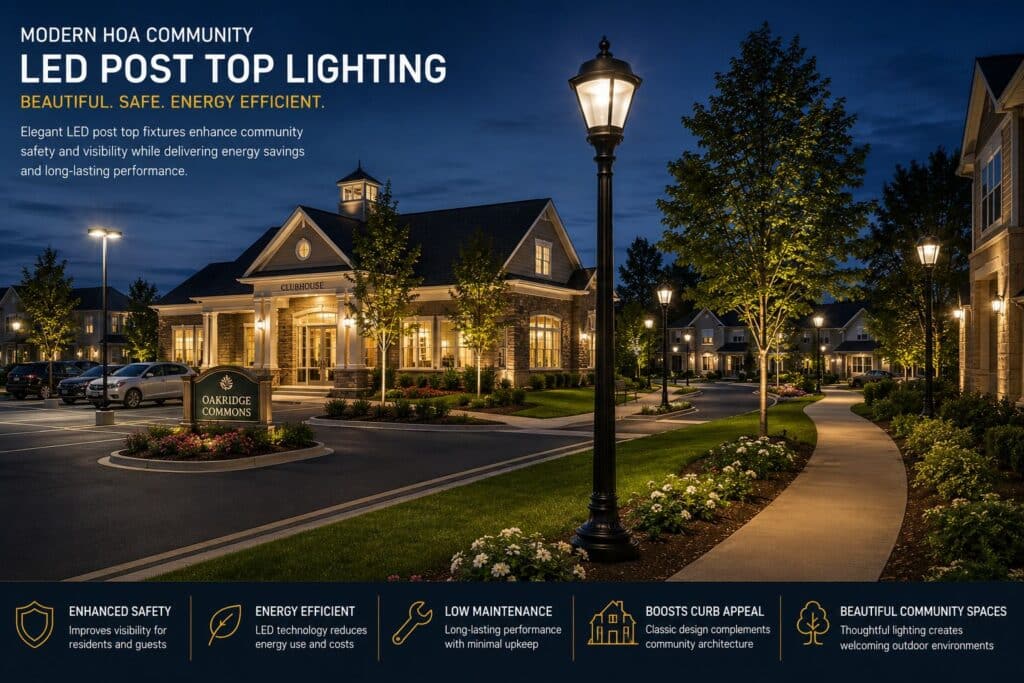
LED lighting upgrades help HOA communities improve safety, reduce maintenance costs, enhance property appearance, and create more inviting outdoor spaces for residents and visitors.
Planning an HOA Lighting Upgrade?
Whether you’re replacing aging neighborhood street lights, improving parking lot visibility, or modernizing common areas, Industrial Lighting Fixtures offers specification-grade lighting solutions designed specifically for residential communities.
👉 Explore our HOA Lighting Design Guide, Commercial LED Post Top Fixtures, Commercial LED Area Lights, and complete Commercial Outdoor Lighting solutions.
Why HOA Boards Are Investing in LED Lighting
Exterior lighting influences nearly every aspect of a residential community’s nighttime experience. Well-designed lighting improves safety, enhances property appearance, supports security, and creates welcoming environments for residents and visitors alike.
Many associations begin evaluating upgrades because of:
- Rising electricity costs
- Increasing maintenance expenses
- Aging fixture inventories
- Resident safety concerns
- Frequent service calls
- Inconsistent nighttime appearance
- Insurance and liability considerations
- Long-term reserve planning
Modern LED systems help address these challenges while providing a predictable maintenance cycle for years to come.
Learn how Commercial LED Post Top Fixtures enhance residential streets and common areas.Signs It's Time to Upgrade Community Lighting
Many communities continue operating lighting systems that were installed twenty or even thirty years ago. Although individual fixtures may still function, declining performance often becomes apparent throughout the property.
Common indicators include:
- Frequent lamp or ballast failures
- Rusted or deteriorating fixtures
- Uneven illumination between neighborhoods
- Dark sidewalks and pedestrian crossings
- Parking lot visibility complaints
- Multiple fixture styles installed over many years
- Increasing electrical maintenance costs
- Outdated HID or high-pressure sodium lighting
Addressing these issues proactively often costs less than responding to continual repairs.
Prioritize the Highest-Impact Areas First
Large communities rarely replace every fixture at once. Instead, successful HOA boards often phase projects based on safety, visibility, and resident use.
Typical upgrade priorities include:
Community Entrances
First impressions matter. Decorative LED lighting enhances monument signs, entrance landscaping, and visitor arrival points.
Parking Lots
Uniform illumination improves vehicle and pedestrian visibility while reducing dark areas.
Clubhouses & Community Centers
Modern lighting creates welcoming gathering spaces for meetings, events, and recreational activities.
Sidewalks & Walking Trails
Improved pedestrian lighting encourages evening use while increasing resident comfort.
Mail Kiosks
Well-lit mailbox areas improve visibility during early mornings and evenings.
Parks & Playgrounds
Family gathering areas benefit from balanced illumination that supports recreation without excessive glare.
Swimming Pools & Recreation Areas
Appropriately selected fixtures improve safety while complementing the surrounding architecture.
Beyond Energy Savings: The Real Return on Investment
While reduced electricity consumption is an important benefit, many associations discover the greatest value comes from lowering long-term ownership costs.
LED upgrades typically provide:
- Reduced maintenance labor
- Longer fixture life
- Fewer replacement parts
- Improved lighting uniformity
- Better nighttime visibility
- Lower service call frequency
- Simplified inventory management
- Consistent fixture appearance across the community
- Improved resident satisfaction
- Enhanced curb appeal
These operational improvements often continue delivering value long after the initial installation has been completed.
🏗️ Property Manager Insight
Communities that replace lighting only after individual fixture failures often end up with multiple fixture styles, inconsistent light color, and higher maintenance costs. Planning upgrades by neighborhood, parking area, or amenity allows associations to standardize equipment, simplify future maintenance, and present a more cohesive appearance throughout the property.
Choosing the Right Fixture for Each Area
Different parts of a community require different lighting solutions.
| Community Area | Recommended Fixture |
|---|---|
| Residential Streets | Decorative LED Post Top Fixtures |
| Parking Lots | LED Area Lights |
| Sidewalks & Walking Paths | LED Bollards & Post Tops |
| Clubhouses | Outdoor Wall Mount Fixtures |
| Maintenance Buildings | Wall Packs |
| Parks & Common Areas | Decorative Post Top Fixtures |
| Entrance Monuments | Architectural Accent Lighting |
Selecting fixtures according to each area’s purpose creates balanced illumination while avoiding unnecessary energy consumption.
Selecting the Right Color Temperature
Color temperature has a significant impact on how residents perceive the community after dark.
3000K
- Warm appearance
- Comfortable residential atmosphere
- Excellent for neighborhoods, parks, and pedestrian spaces
- Supports Dark Sky initiatives by reducing blue-rich light
4000K
- Crisp neutral white
- Excellent color recognition
- Frequently selected for parking lots, clubhouses, maintenance areas, and service roads
Many communities successfully combine both color temperatures depending on the specific application.
Modern Lighting Controls Improve Efficiency
Today’s LED systems provide control options that were unavailable with older lighting technologies.
Common solutions include:
- Photocells
- Astronomical time clocks
- Motion sensors
- Adaptive dimming
- Network lighting controls
- Holiday scheduling
- Energy monitoring
These controls further reduce operating costs while improving flexibility.
Reserve Planning for Long-Term Success
Lighting should be treated as a long-term capital asset rather than an ongoing maintenance issue.
When preparing reserve studies, HOA boards should evaluate:
- Fixture age
- Pole condition
- Electrical infrastructure
- Maintenance history
- Remaining service life
- Community expansion plans
- Future energy costs
- Planned roadway or landscape improvements
Coordinating lighting upgrades with paving, landscaping, or sidewalk improvements often reduces overall project costs while minimizing disruption to residents.
🏗️Project Spotlight
Modernizing a 1990s Residential Community
A homeowner association with more than 250 homes had gradually replaced failed fixtures over several decades, leaving the community with multiple fixture styles, inconsistent light colors, and increasing maintenance expenses.
During its reserve planning update, the board approved a phased LED lighting upgrade beginning with neighborhood entrances, parking areas, and the clubhouse. Decorative LED post top fixtures replaced aging street lights along residential roads, new LED area lights improved parking lot visibility, and architectural wall-mounted fixtures enhanced community buildings.
The result was a more cohesive nighttime appearance, fewer maintenance calls, lower operating costs, and improved resident satisfaction—all while allowing future upgrades to follow a consistent lighting standard.
Common HOA Lighting Upgrade Mistakes
Avoid these common planning errors:
- Replacing lamps instead of aging fixtures
- Mixing multiple fixture styles throughout the community
- Choosing inconsistent color temperatures
- Ignoring pedestrian pathways
- Reusing deteriorated poles without inspection
- Skipping photometric planning
- Overlooking lighting controls
- Delaying upgrades until emergency repairs become frequent
A comprehensive lighting plan produces better long-term results than isolated fixture replacements.
HOA Lighting Upgrade Priority Matrix
| Community Area | Upgrade Priority | Typical Fixture |
|---|---|---|
| Main Entrance | High | Decorative Post Top |
| Parking Lots | High | LED Area Lights |
| Clubhouse | High | Outdoor Wall Mount |
| Sidewalks | High | Bollards & Post Tops |
| Mail Kiosk | Medium | Decorative Post Top |
| Parks | Medium | Post Top Fixtures |
| Playground | Medium | Decorative Area Lighting |
| Maintenance Area | Medium | Wall Packs |
Buyer Q&A
Should every fixture be replaced at the same time?
Not necessarily. Many associations successfully complete upgrades in planned phases that align with reserve funding and capital improvement schedules.
Can existing poles be reused?
Often yes, provided they remain structurally sound and compatible with the new fixtures. A professional inspection is recommended before reusing older poles.
How long do commercial LED fixtures last?
Many specification-grade LED fixtures provide service lives exceeding 100,000 hours under normal operating conditions, greatly reducing maintenance requirements.
Is 3000K or 4000K better for residential communities?
3000K is generally preferred for residential streets and pedestrian areas because of its warmer appearance, while 4000K is often selected for parking lots, maintenance facilities, and areas requiring enhanced visibility.
Should lighting upgrades be coordinated with other projects?
Yes. Combining lighting improvements with paving, landscaping, or utility work often reduces installation costs and minimizes disruption.
Modernize Your Community with Professional LED Lighting Solutions
Whether you’re planning a phased neighborhood lighting upgrade or replacing aging community-wide infrastructure, Industrial Lighting Fixtures provides specification-grade outdoor lighting solutions designed to improve safety, reduce maintenance, and enhance the appearance of residential communities.
Explore our complete line of HOA Lighting Resources, Commercial LED Post Top Fixtures, LED Area Lights, and Commercial Outdoor Lighting Solutions.
Frequently Asked Questions
Can LED lighting increase property values?
While many factors influence property values, attractive and well-maintained common areas—including quality outdoor lighting—can positively contribute to a community’s overall appearance and appeal.
Do HOA lighting upgrades require a photometric plan?
For larger communities, a photometric lighting plan helps verify illumination levels, improve uniformity, and reduce unnecessary light spill before installation.
Can older HID fixtures simply be retrofitted?
In some situations, yes. However, many communities achieve better performance and longer-term value by replacing aging fixtures with modern LED luminaires designed specifically for current lighting requirements.
Are decorative fixtures durable enough for HOA streets?
Yes. Commercial-grade decorative post top fixtures are specifically engineered for long-term outdoor use in residential developments, campuses, municipalities, and mixed-use communities.
Should HOA communities consider Dark Sky principles?
Absolutely. Proper optics, shielding, and thoughtful fixture selection help reduce glare, minimize light trespass, and create more comfortable nighttime environments for residents.