
Although the terms lamp post and street light are often used interchangeably, they describe different types of outdoor lighting systems designed for different environments. Selecting the proper fixture isn’t simply a matter of appearance—it’s about matching the lighting solution to how a space functions after dark.
For example, a decorative post top fixture that creates an inviting atmosphere along a pedestrian promenade would be a poor choice for illuminating a four-lane roadway. Likewise, installing high-output street lights throughout a public plaza could create excessive brightness and reduce the welcoming character of the space.
Modern commercial properties rarely rely on a single type of outdoor luminaire. Instead, they combine multiple lighting systems to address the unique needs of drivers, pedestrians, employees, residents, and visitors. Decorative post top fixtures may define walkways, street lights illuminate roadways, area lights provide parking lot coverage, while wall-mounted fixtures and bollards complete the pedestrian experience around buildings.
Understanding how each fixture contributes to an overall lighting strategy helps property owners, municipalities, architects, and facility managers create outdoor environments that are safer, more attractive, and more energy efficient.
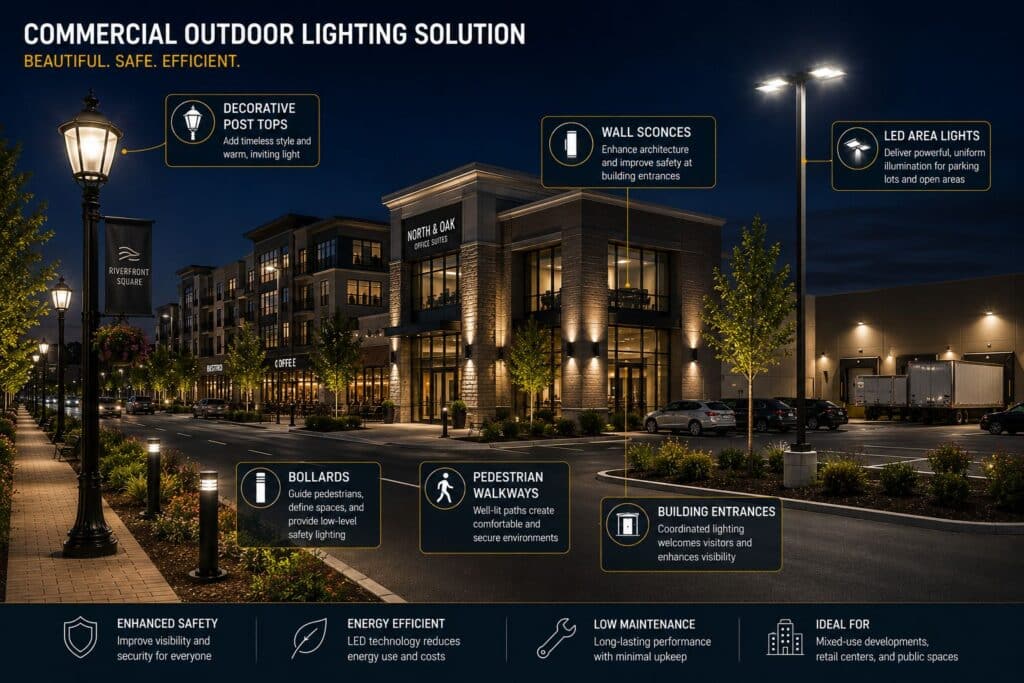
Different outdoor lighting fixtures serve different purposes. Decorative lamp posts enhance pedestrian spaces, while street lights provide roadway illumination, and area lights support parking lots and commercial sites.
Choosing the Right Outdoor Lighting Starts with the Right Fixture
Whether you’re planning a municipal streetscape, commercial development, office campus, or mixed-use property, selecting the proper outdoor lighting system begins with understanding how each fixture is intended to perform.
👉 Explore our collection of Commercial LED Post Top Fixtures, Commercial LED Area Lights, and other Commercial Outdoor Lighting solutions designed for professional applications.
Outdoor Lighting Fixture Comparison at a Glance
| Fixture Type | Primary Purpose | Typical Mounting Height | Typical Applications |
|---|---|---|---|
| Decorative Lamp Posts (Post Top Fixtures) | Pedestrian illumination | 10–16 ft | Parks, campuses, plazas, HOAs |
| Street Lights | Roadway illumination | 20–40 ft | Streets, collector roads, municipalities |
| Area Lights | Large open spaces | 20–35 ft | Parking lots, industrial facilities |
| Wall Mounted Fixtures | Building illumination | 8–20 ft | Entrances, loading docks, walkways |
| Bollards | Low-level pedestrian lighting | 3–5 ft | Sidewalks, courtyards, pathways |
What Is a Commercial Lamp Post?
In commercial lighting, the term lamp post generally refers to a decorative pole supporting a post top luminaire. These fixtures are designed for pedestrian-scale environments where visual comfort, architectural appearance, and wayfinding are as important as illumination.
Rather than maximizing light output, commercial lamp posts create inviting outdoor spaces that encourage people to comfortably navigate plazas, sidewalks, parks, and gathering areas after dark. Their lower mounting heights produce a more human-scale lighting experience while complementing surrounding architecture and landscaping.
Modern LED post top fixtures are widely used throughout:
- Mixed-use developments
- Corporate campuses
- Universities
- Municipal parks
- Downtown streetscapes
- Homeowner associations
- Hospitality properties
If your goal is creating comfortable pedestrian environments, decorative Commercial LED Post Top Fixtures are often the preferred solution.
What Is a Commercial Street Light?
Commercial street lights are engineered primarily to support vehicle traffic by providing consistent roadway illumination over larger areas than decorative lamp posts can effectively serve. Their taller mounting heights, roadway optics, and higher light output improve driver visibility, intersection safety, and traffic guidance while maintaining appropriate illumination uniformity.
Street lighting priorities differ significantly from pedestrian lighting. Instead of emphasizing architectural character, street lights focus on helping motorists identify lane markings, intersections, curves, crosswalks, and potential hazards while reducing excessive glare.
Typical applications include:
- Municipal streets
- Residential roadways
- Commercial access roads
- Industrial parks
- Business campuses
- Transportation facilities
- Public infrastructure projects
Although street lights often appear simple in design, their optical distributions, mounting heights, and spacing are carefully selected to achieve uniform roadway illumination while minimizing unnecessary light spill. Many agencies also require compliance with local roadway lighting standards and dark-sky considerations for new installations.
Why the Terms Are Frequently Confused
One reason “lamp post” and “street light” are commonly confused is that everyday language often differs from commercial lighting terminology. In casual conversation, people may use either term to describe almost any outdoor light mounted on a pole. In professional lighting design, however, the distinction is based on application and performance, not simply appearance. Community discussions reflect this same variation in terminology, with decorative, pedestrian-scale fixtures often being called lamp posts, while taller roadway luminaires are typically referred to as street lights.
For lighting professionals, the more important question isn’t:
“Is this a lamp post or a street light?”
It’s:
“What is this fixture intended to illuminate?”
Answering that question leads to better lighting decisions and ultimately produces outdoor spaces that function more effectively for everyone who uses them.
🛠️Field Experience
One of the most common misconceptions during commercial planning is assuming that a single fixture type can adequately illuminate an entire property. In practice, successful outdoor lighting projects almost always combine multiple fixture types. Decorative post top fixtures may define pedestrian walkways, street lights guide vehicle traffic, area lights illuminate parking lots, and wall-mounted luminaires provide safe transitions at building entrances. When each fixture is selected according to its intended purpose rather than its appearance alone, the result is a property that feels cohesive, comfortable, and functional after dark.
📋 Specification Tip
Before comparing fixture styles, identify who the primary users are. If the area is designed primarily for vehicles, roadway or area lighting is usually appropriate. If pedestrians are the primary users, decorative post top fixtures, bollards, or wall-mounted lighting often provide a more comfortable and visually appealing solution. Starting with the intended use of the space—not the fixture style—leads to better long-term lighting performance.
Beyond Lamp Posts and Street Lights
Commercial outdoor lighting rarely relies on a single fixture type. Most successful lighting projects use a combination of luminaires, with each one serving a specific purpose based on how people use the space after dark.
Understanding where each fixture performs best makes it easier to develop lighting systems that improve safety, enhance aesthetics, reduce energy consumption, and create a comfortable nighttime environment.
LED Area Lights
While street lights illuminate roadways, LED Area Lights are designed for large open spaces where broad, uniform illumination is required.
Area lights are commonly installed in:
- Commercial parking lots
- Shopping centers
- Distribution centers
- Manufacturing facilities
- Business parks
- Municipal parking areas
Unlike roadway lighting, which follows traffic lanes, area lighting is intended to provide even illumination across open spaces where both vehicles and pedestrians interact.
Modern Commercial LED Area Lights are available with multiple optical distributions, allowing designers to tailor light placement based on pole spacing, mounting height, and site layout.
Post Top Fixtures
Although many people refer to decorative post top fixtures as lamp posts, they serve a very different purpose than roadway lighting.
Post top fixtures create comfortable pedestrian environments where appearance and visual comfort are equally important.
Common applications include:
- University campuses
- Parks
- Mixed-use developments
- Corporate headquarters
- Downtown streetscapes
- Hotels and resorts
- HOA communities
Their lower mounting heights and decorative designs help define outdoor spaces without overwhelming pedestrians with excessive brightness.
Learn more about Commercial LED Post Top Fixtures.
Wall Packs
Wall packs remain one of the most widely used commercial security lighting fixtures.
Rather than emphasizing architectural appearance, wall packs prioritize dependable illumination around:
- Service entrances
- Utility rooms
- Equipment yards
- Loading docks
- Rear building access
- Maintenance areas
Their rugged construction and broad forward light distribution make them a practical solution for industrial and commercial facilities where safety and visibility take precedence over decorative design.
Bollard Lights
Bollards provide low-level illumination for pedestrians while helping define pathways and outdoor gathering spaces.
Unlike taller pole-mounted fixtures, bollards create visual guidance close to the walking surface, making them particularly effective for:
Sidewalks
Courtyards
Parks
Building entrances
Outdoor plazas
Campus pathways
Many projects combine Commercial LED Bollard Lights with decorative post top fixtures to establish multiple layers of pedestrian lighting.
Flood Lights
Flood lights deliver highly directional illumination for applications requiring concentrated light over large areas.
Typical uses include:
- Building façades
- Equipment yards
- Sports facilities
- Construction sites
- Security lighting
- Loading yards
Because flood lights can be precisely aimed, they are frequently used to supplement area lighting or highlight architectural features without installing additional poles.
🛠️Contractor Insight
One of the easiest ways to recognize a professionally designed outdoor lighting system is by the variety of fixture types it incorporates. Contractors often install area lights, post top fixtures, wall-mounted luminaires, bollards, and flood lights on the same project—not because one fixture can’t do the job, but because each is optimized for a different lighting objective. Attempting to use a single fixture type throughout an entire property often leads to compromises in visibility, appearance, or energy efficiency.
Choosing the Right Fixture for Your Property
Instead of selecting fixtures based on appearance, begin by identifying what needs to be illuminated.
| If You’re Lighting… | Recommended Fixture |
|---|---|
| Public Roadways | Street Lights |
| Parking Lots | LED Area Lights |
| Parks & Plazas | Post Top Fixtures |
| Building Entrances | Outdoor Wall Mount Fixtures |
| Service Doors | Wall Packs |
| Sidewalks & Pathways | Bollards |
| Building Façades | Flood Lights |
| Large Sports Fields | High Mast or Sports Lighting |
This approach simplifies fixture selection while helping ensure every part of the property receives lighting appropriate to its function.
Selecting the right fixture is only one part of successful lighting design. Learn how layered outdoor lighting improves visitor comfort, strengthens navigation, and creates more inviting commercial environments in our How Commercial Outdoor Lighting Improves Safety, Comfort & User Experience guide.
Typical Mounting Heights
Fixture height influences coverage, glare control, maintenance access, and the overall character of the outdoor environment.
| Fixture Type | Typical Mounting Height |
|---|---|
| Bollards | 3–5 ft |
| Decorative Post Tops | 10–16 ft |
| Wall Mounted Fixtures | 8–20 ft |
| Area Lights | 20–35 ft |
| Street Lights | 25–40 ft |
| High Mast Lighting | 50–150 ft |
Rather than viewing these heights as fixed rules, designers use them as starting points when developing photometric layouts tailored to each project’s lighting objectives.
📋 Specification Tip
Avoid selecting a fixture because it looks similar to one installed on another property. Two shopping centers may appear alike during the day but have completely different nighttime requirements based on traffic volume, pedestrian activity, operating hours, local ordinances, and security priorities. Successful lighting design begins with understanding how the property functions—not by copying another installation.
🏗️Project Spotlight
Downtown Mixed-Use Redevelopment
A downtown redevelopment project sought to create a walkable environment while maintaining safe traffic circulation and attractive public spaces. Instead of relying on one type of fixture throughout the development, the lighting design incorporated multiple systems working together.
Decorative post top fixtures defined pedestrian plazas and sidewalks, creating a welcoming atmosphere for restaurants, retail storefronts, and public gathering areas. LED street lights illuminated adjacent roadways to support vehicle traffic and improve intersection visibility. Area lights provided uniform illumination for parking lots, while wall-mounted fixtures enhanced entrances, service corridors, and parking garage access points. Bollard lights completed the design by guiding pedestrians through landscaped walkways and outdoor seating areas.
The layered approach produced a cohesive nighttime environment where each fixture contributed to the overall lighting strategy while serving a distinct purpose.
Common Fixture Selection Mistakes
Even well-intentioned projects can underperform when fixture selection is based primarily on appearance rather than function.
Common mistakes include:
- Installing decorative post top fixtures where roadway lighting is required.
- Using high-output street lights in pedestrian plazas, creating unnecessary glare.
- Attempting to illuminate an entire property with only one fixture type.
- Ignoring the transition between parking lots and building entrances.
- Selecting mounting heights before evaluating site layout and lighting objectives.
- Overlooking future lighting controls and maintenance access.
- Failing to coordinate fixture styles across the property, resulting in a disconnected nighttime appearance.
A successful outdoor lighting design considers how each fixture contributes to the overall user experience rather than evaluating fixtures independently.
Outdoor Lighting Fixture Comparison Matrix
Choosing the right fixture begins with understanding its primary purpose. Although several fixture types may appear similar during the day, each is engineered to solve a different lighting challenge after dark.
| Fixture Type | Primary Purpose | Typical Users | Common Applications |
|---|---|---|---|
| Decorative Post Top Fixtures | Pedestrian lighting and architectural enhancement | Pedestrians | Parks, plazas, campuses, HOAs, mixed-use developments |
| Street Lights | Roadway illumination | Drivers | Municipal streets, business parks, industrial roads |
| LED Area Lights | Large open-area illumination | Drivers & pedestrians | Parking lots, warehouses, shopping centers |
| Outdoor Wall Mount Fixtures | Building perimeter lighting | Building occupants | Entrances, walkways, loading docks |
| Wall Packs | Security and service area lighting | Employees & maintenance staff | Rear entrances, equipment yards, service corridors |
| Bollard Lights | Low-level pathway guidance | Pedestrians | Sidewalks, courtyards, landscaped pathways |
| Flood Lights | Directional accent and security lighting | Mixed users | Building façades, sports facilities, equipment yards |
No single fixture is designed to perform every task. Successful commercial projects combine several fixture types to create balanced, layered illumination throughout the property.
Layering Outdoor Lighting for Better Results
Professional lighting designers think in terms of lighting layers rather than individual fixtures.
Each fixture contributes to a complete outdoor lighting system:
- Street lights provide safe vehicle circulation.
- Area lights illuminate parking lots and open spaces.
- Post top fixtures create comfortable pedestrian environments.
- Wall-mounted fixtures improve building entrances and transitions.
- Wall packs secure service areas.
- Bollards define sidewalks and landscaped walkways.
- Flood lights highlight architectural features and strengthen perimeter security.
When these layers are coordinated, the property is easier to navigate, more attractive after dark, and often requires fewer fixtures than a design relying on one fixture type for every application.
🏗️ Project Lesson
One of the biggest improvements seen during lighting renovations is not simply installing brighter fixtures—it’s placing the right fixture in the right location. Many older commercial properties rely almost exclusively on roadway or parking lot lighting, leaving entrances, walkways, landscaped areas, and pedestrian gathering spaces under-illuminated. By introducing layered lighting with post top fixtures, bollards, wall-mounted luminaires, and properly positioned area lights, facilities often achieve better visibility, improved curb appeal, and a more welcoming nighttime environment without significantly increasing overall energy consumption.
📋 Specification Tip
Think about how people move through the property after dark. Drivers, pedestrians, visitors, employees, and maintenance personnel all use the site differently. Selecting fixture types based on these user paths creates a safer and more comfortable environment while reducing unnecessary light spill and glare.
Buyer Q&A
Is a lamp post the same as a street light?
Not necessarily. Decorative lamp posts generally refer to post top fixtures designed for pedestrian spaces, while street lights are engineered to illuminate roadways and vehicle traffic.
Can decorative post top fixtures illuminate parking lots?
They can supplement parking lot lighting around pedestrian areas, but large parking lots typically require LED area lights designed for broader coverage and higher mounting heights.
When should I use street lights instead of area lights?
Street lights are intended for roadways where vehicle traffic follows defined lanes. Area lights are better suited for open spaces such as parking lots, loading areas, and industrial facilities.
Can multiple fixture types be used on the same property?
Absolutely. Most commercial developments use a combination of street lights, area lights, post top fixtures, wall-mounted fixtures, bollards, and flood lights to address different lighting needs throughout the site.
Which fixture is best for improving curb appeal?
Decorative post top fixtures and architectural wall-mounted luminaires typically provide the greatest visual enhancement while maintaining safe pedestrian illumination.
Build a Complete Outdoor Lighting System
Whether you’re illuminating city streets, commercial developments, office campuses, parks, or industrial facilities, selecting the proper combination of outdoor lighting fixtures improves safety, enhances appearance, and reduces long-term operating costs.
Explore our complete line of Commercial Outdoor Lighting Solutions, including LED Post Top Fixtures, LED Area Lights, Street Lights, Wall Mount Fixtures, Bollards, and other specification-grade products designed for demanding commercial applications.
Frequently Asked Questions
What mounting height is typical for decorative lamp posts?
Most commercial post top fixtures are installed between 10 and 16 feet, depending on the application and desired light distribution.
Are LED street lights more energy efficient than older HID fixtures?
Yes. Modern LED street lights generally consume significantly less energy while providing improved optical control, longer service life, and reduced maintenance requirements.
Can one fixture type illuminate an entire commercial property?
In most cases, no. Commercial lighting designs achieve the best results by combining multiple fixture types, each optimized for a specific lighting objective.
How do I choose between decorative and functional outdoor lighting?
Begin by determining how the space will be used after dark. Pedestrian-focused environments often benefit from decorative fixtures, while roadways, parking lots, and service areas require performance-driven lighting solutions.
Does fixture appearance matter?
Yes. Outdoor lighting contributes to a property’s nighttime identity. Selecting fixtures that complement the surrounding architecture while meeting illumination requirements helps create a cohesive and professional appearance.
Stay Connected with Our Lighting Resources
Add IndustrialLightingFixtures.org as a Preferred Source on Google to see more of our lighting guides and technical resources across Google Search experiences.

Related Commercial Outdoor Lighting Resources
Compare fixture types and continue planning a complete commercial outdoor lighting system with these related resources:
- Commercial Outdoor Lighting Guide — Explore the major types of commercial outdoor lighting used for roadways, parking areas, pedestrian spaces, building exteriors, campuses, and other exterior environments.
- Commercial LED Post Top Fixtures — Explore decorative and architectural post top lighting for pedestrian areas, parks, streetscapes, campuses, HOA communities, and commercial developments.
- Commercial LED Area Lights — Explore high-output LED area lighting for parking lots, large commercial properties, industrial sites, and other open outdoor spaces.
- Commercial Outdoor Wall Mount Lighting Guide — Learn how wall-mounted fixtures provide building-perimeter, entrance, walkway, and security lighting around commercial properties.
- Commercial LED Bollard Lights — Explore low-level pedestrian lighting for pathways, entrances, plazas, landscaped areas, campuses, and architectural outdoor spaces.
- Commercial Parking Lot Lighting — Explore commercial parking lot lighting designed for broad coverage, visibility, uniformity, and higher mounting heights.
- Dark Sky Outdoor Lighting Guide — Learn how shielding, fixture selection, color temperature, placement, and lighting controls can reduce glare, uplight, and unwanted light spill.