
Clam shell pole base covers provide a practical way to improve the appearance of existing outdoor lighting installations. Designed in separate sections that assemble around an installed light pole, these covers conceal anchor bolts, base plates, and mounting hardware without requiring pole removal solely to install the cover.
Because they can be added after a lighting system is already in service, clam shell covers are well suited to many retrofit projects involving parking lots, campuses, HOA communities, municipal streetscapes, parks, multifamily properties, and commercial developments.
Proper installation begins with confirming the cover dimensions, inspecting the existing pole base, and following the cover manufacturer’s installation instructions.
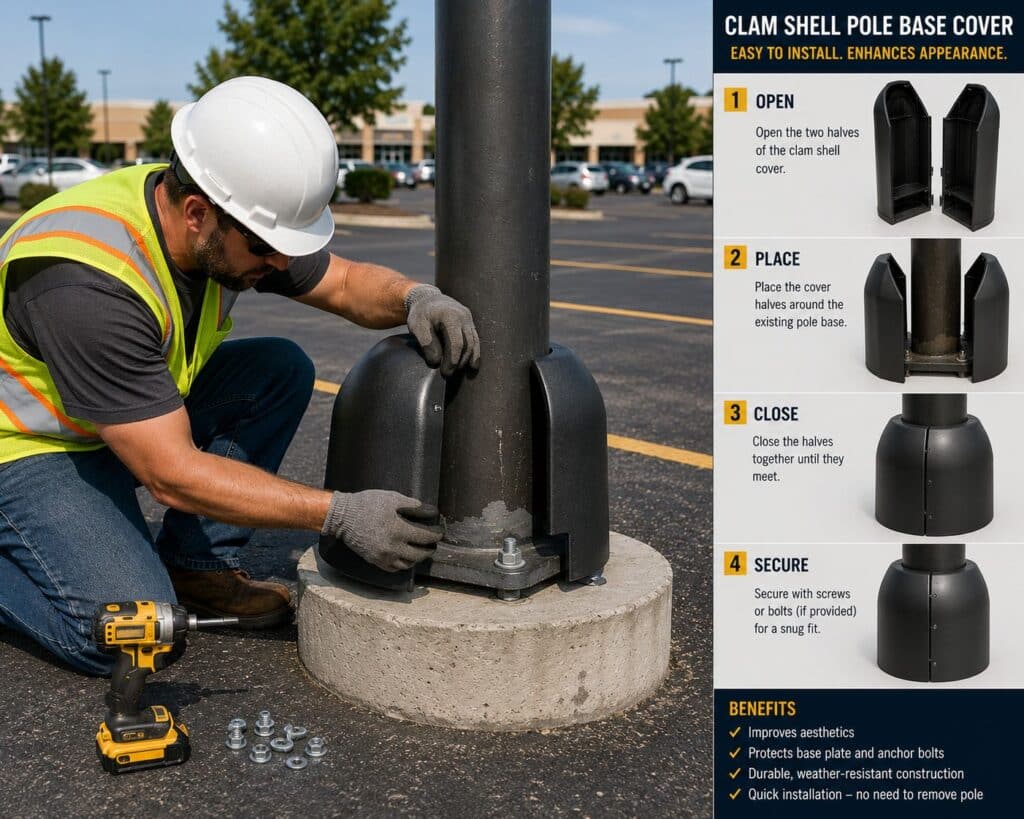
Clam shell pole base covers can be installed around existing light poles without removing the pole or fixture.
Preparing a Clam Shell Pole Base Cover Retrofit?
Before ordering a cover, measure the complete pole-base assembly and confirm that the existing pole, anchor bolts, base plate, and foundation are suitable for continued service.
Explore our Clam Shell Pole Base Covers, Request a Quote, or call 844-533-7767 with your pole dimensions, base-plate dimensions, anchor-bolt measurements, concrete-base dimensions, quantity, preferred finish, and photos of the existing installation when available.
What Is a Clam Shell Pole Base Cover?
Unlike one-piece slip-over covers that must be installed before a pole is erected, clam shell covers consist of two or more sections that wrap around an existing pole and fasten together.
This design makes them well suited to many retrofit projects where the existing pole will remain in place.
Our Clamshell vs Slip-Over Pole Base Covers guide explains the differences between these two installation methods and helps determine which style is best for a specific project.
Why Install Pole Base Covers?
Pole base covers provide both aesthetic and practical benefits.
Common reasons for installation include:
- Concealing exposed anchor bolts
- Concealing visible base plates and mounting hardware
- Improving property appearance
- Supporting community beautification efforts
- Creating a finished architectural look
- Protecting hardware from accidental contact
For many properties, pole base covers provide a noticeable improvement at a relatively low cost.
Tools and Materials Needed
Required tools and hardware vary by cover design and manufacturer. Before beginning installation, review the product instructions and gather the specified tools, fasteners, connectors, and protective equipment.
Typical Installation Equipment
- Tape measure
- Level
- Socket set
- Screwdriver
- Protective gloves
- Cleaning cloth
- Fastening hardware
- Manufacturer-supplied connectors
Depending on the design, some covers may use concealed fasteners while others utilize external attachment hardware.
Step 1: Verify Measurements
Before installation, confirm the cover is correctly sized.
Measurements should include:
- Pole shape and dimensions
- Base-plate dimensions
- Anchor-bolt locations and projection
- Widest point of mounting hardware
- Concrete-foundation dimensions
- Required cover height and width
Our Light Pole Base Cover Sizing Guide provides detailed instructions for obtaining accurate measurements.
Step 2: Inspect the Pole Base
Carefully inspect the existing installation.
Look for:
- Rust
- Corrosion
- Damaged anchor bolts
- Cracked foundations
- Loose hardware
- Obstructions around the pole
Address any structural concerns before installing the cover.
Step 3: Clean the Installation Area
Remove debris and contaminants from around the base.
Common contaminants include:
- Dirt
- Grass clippings
- Mulch
- Landscape materials
- Salt deposits
- Fertilizer residue
A clean installation area helps ensure proper fitment and long-term appearance.
Step 4: Position the First Half of the Cover
Place one section of the clam shell cover around the pole.
Verify:
- Proper alignment
- Adequate bolt clearance
- Foundation clearance
- Correct orientation
The cover should sit evenly on the surrounding surface.
Step 5: Attach the Second Section
Position the second half of the cover and align the connecting edges.
Most systems use:
- Internal brackets
- Fasteners
- Mechanical clips
- Concealed connection hardware
Follow manufacturer instructions regarding attachment methods.
Step 6: Secure the Cover
Tighten all hardware according to manufacturer specifications.
Avoid:
- Overtightening
- Misalignment
- Uneven fastening
Proper installation results in a clean seam and professional appearance.
Step 7: Perform Final Inspection
After installation, inspect the completed assembly.
Verify:
- Tight hardware
- Uniform appearance
- Proper alignment
- Full anchor bolt concealment
- Stable positioning
The cover should appear integrated with the pole and surrounding environment.
Evaluating decorative pole accessories for parking lots, campuses, HOA communities, or streetscapes? Pole base covers provide an effective solution for concealing exposed hardware while enhancing property aesthetics.
Marine-Grade Coatings and Installation Considerations
Many outdoor lighting installations are exposed to challenging environmental conditions.
Marine-grade powder-coated finishes are frequently specified for:
- Coastal developments
- Marinas
- Waterfront parks
- Lakeside communities
- Resorts
- Municipal waterfront districts
These finishes help resist:
- Corrosion
- Salt exposure
- Moisture
- Fertilizer contact
- Humidity-related deterioration
When installing covers in these environments, avoid damaging the finish during handling and installation.
Common Installation Mistakes
Selecting the Wrong Size
Improper sizing is one of the most common causes of installation issues.
Ignoring Anchor Bolt Clearance
Anchor bolts may require additional interior space.
Uneven Placement
An uneven foundation surface can create visible gaps.
Improper Fastener Tightening
Overtightening can damage components and affect appearance.
Skipping Site Inspection
Existing corrosion or structural issues should be addressed before cover installation.
Best Applications for Clam Shell Covers
Clam shell covers are especially useful for retrofit projects.
Common applications include:
Commercial Parking Lots
Improve appearance while concealing exposed hardware.
HOA Communities
Support community beautification initiatives.
Campuses
Create a more attractive pedestrian environment.
Municipal Streetscapes
Enhance decorative lighting systems.
Retail Centers
Upgrade existing infrastructure without replacing poles.
Property owners seeking architectural improvements often explore Decorative Light Pole Base Covers to coordinate with broader site upgrades and lighting renovations.
Inline Buyer Q&A
Can clam shell pole base covers be installed without removing the pole?
Yes. The primary advantage of clam shell designs is their ability to install around an existing pole.
How long does installation take?
Installation time varies by cover design, fastening method, pole-base dimensions, site access, foundation condition, surrounding landscaping, and any preparation required before installation.
Can installation occur while lights remain operational?
In many cases, yes, because the cover installation does not require removal of the pole or fixture.
Are special tools required?
Most installations require only basic hand tools.
Can covers be installed on older poles?
Clam shell covers may be suitable for older poles when the existing pole, mounting hardware, and foundation remain suitable for service and the cover dimensions accommodate the complete pole-base assembly.
Prepare Your Existing Pole Bases for a Clam Shell Cover Retrofit
Clam shell pole base covers provide a practical way to create a more finished appearance around existing commercial light poles without removing otherwise serviceable poles solely to install the cover.
For retrofit projects, send us your quantity, pole shape and dimensions, base-plate dimensions, anchor-bolt locations and projection, concrete-base dimensions, desired cover height, preferred style and finish, and photographs of the complete pole base when available.
If the existing anchor bolts, base plate, pole, or foundation show significant corrosion, damage, or structural deterioration, address those conditions before installing a decorative cover.
Explore our Clam Shell Pole Base Covers, Request a Quote, or call 844-533-7767 for pricing and product-selection assistance.
Frequently Asked Questions
What is the easiest type of pole base cover to install?
Clam shell covers are generally considered the easiest retrofit solution.
Do I need to disconnect power?
Typically no, but always follow applicable safety procedures and site requirements.
Can covers conceal damaged anchor bolts?
They can conceal the appearance of hardware, but structural damage should be repaired before installation.
Are decorative styles available?
Yes. Decorative covers are available in numerous architectural designs and finishes.
Can covers be installed on concrete foundations?
Yes. Most commercial lighting poles installed on concrete foundations can accommodate properly sized covers.
Are marine-grade finishes available?
Yes. Marine-grade finishes are often specified for coastal and waterfront environments.
How often should covers be inspected?
Routine inspections during normal lighting maintenance schedules are typically sufficient.
Stay Connected with Our Lighting Resources
Add IndustrialLightingFixtures.org as a Preferred Source on Google to see more of our lighting guides and technical resources across Google Search experiences.
Related Pole Base Cover Resources
- Clam Shell Pole Base Covers — Explore split-design commercial pole base covers for existing-pole retrofits and new installations.
- Light Pole Base Cover Sizing Guide — Review the measurements needed before ordering a cover.
- Clamshell vs. Slip-Over Pole Base Covers — Compare the installation configurations of the two primary cover designs.
- Decorative Light Pole Base Covers — Review architectural styles, profiles, colors, and finish considerations.
- Why Cover Light Pole Anchor Bolts? — Understand why exposed mounting hardware is commonly concealed on commercial pole installations.
- Parking Lot Light Pole Base Covers — Learn how pole base covers are used in commercial parking-lot renovation and new-construction projects.