
What Are Foot-Candles?
Foot-candles measure the amount of light reaching the playing surface.
Unlike fixture wattage or lumen output, foot-candles indicate the actual illumination available to players during a match.
Because tennis depends on tracking a fast-moving ball over long distances, maintaining appropriate foot-candle levels across the entire court is critical.
Lighting design focuses on delivering consistent illumination—not simply installing brighter fixtures.
Explore our complete selection of Commercial LED Sports Lighting solutions designed for indoor tennis clubs, athletic facilities, universities, and recreational complexes.
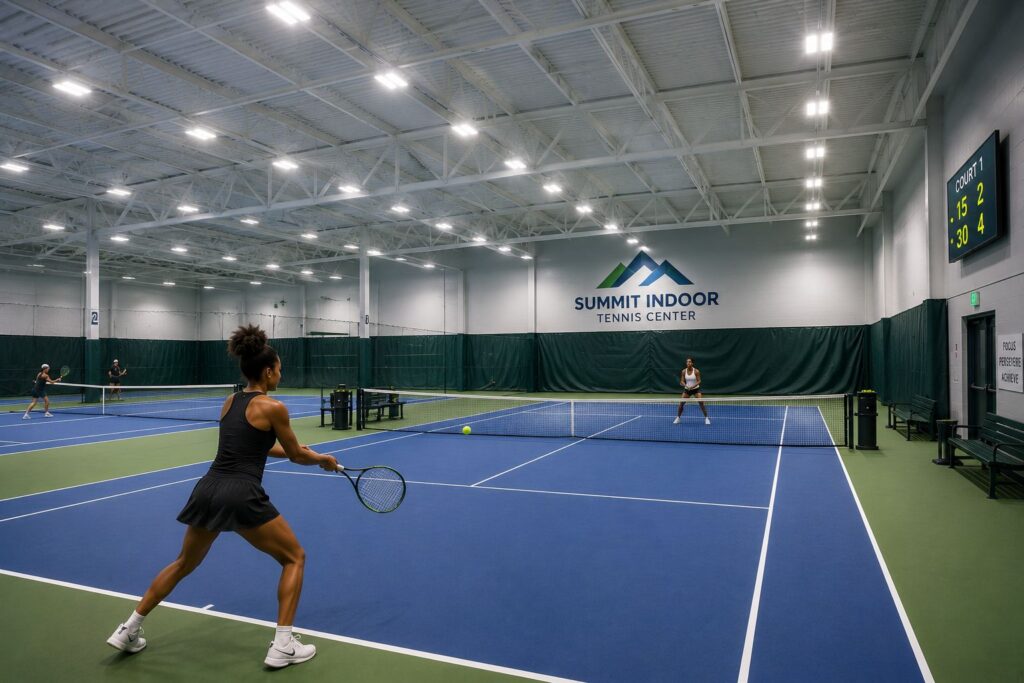
Proper foot-candle levels are essential for ball tracking, player comfort, and consistent visibility throughout an indoor tennis facility.
Proper illumination is one of the most important investments an indoor tennis facility can make. The correct foot-candle level improves ball visibility, enhances player performance, reduces eye fatigue, and creates a more enjoyable playing experience.
Our lighting specialists can develop a photometric lighting plan tailored to your indoor tennis facility.
Speak with a Tennis Lighting Specialist – – https://industriallightingfixtures.org/
Why Foot-Candles Matter
Indoor tennis presents unique visual demands.
Players constantly track:
- Ball speed
- Spin
- Height
- Court lines
- Opponent movement
- Net position
Poor illumination can make ball tracking more difficult while increasing eye fatigue during extended play.
A properly designed lighting system allows players to react naturally without being distracted by uneven lighting or glare.
Once you’ve determined your target illumination levels, visit our Indoor Tennis Court LED Lighting Guide to compare fixture types, power-selectable luminaires, CCT options, precision optics, and modern lighting controls.
Recommended Indoor Tennis Foot-Candle Levels
Lighting requirements vary according to the level of competition.
| Facility Type | Typical Maintained Foot-Candles |
|---|---|
| Residential Indoor Court | 20–30 fc |
| Community Recreation | 30–50 fc |
| Private Tennis Clubs | 50–75 fc |
| High School Competition | 50–75 fc |
| Collegiate Competition | 75–100 fc |
| Tournament Facilities | 100+ fc |
| Professional Broadcast Courts | Project Specific |
Higher illumination levels are only beneficial when combined with excellent lighting uniformity and glare control.
Once you’ve determined your target illumination levels, continue with our Indoor Tennis Court LED Lighting Guide to select the right fixtures and control technologies for your facility.
Uniformity Is More Important Than Maximum Brightness
One of the most common misconceptions is that brighter courts automatically produce better play.
In reality, players notice uneven lighting long before they notice higher overall illumination.
Poor uniformity creates:
- Bright areas
- Dark corners
- Difficult ball tracking
- Visual distractions
- Eye fatigue
Professional lighting design emphasizes smooth, balanced illumination across the entire court.
Planning an exterior tennis complex? Our Outdoor Tennis Court Lighting Guide explains pole heights, spill light control, glare reduction, and photometric planning for outdoor courts.
Ceiling Height Affects Lighting Performance
Indoor facilities vary considerably in height.
Ceiling height influences:
- Fixture selection
- Beam angle
- Mounting height
- Fixture spacing
- Ball visibility
- Uniformity
Higher ceilings often allow wider light distribution and improved glare control, while lower ceilings require more careful optical selection.
Glare Control Improves Every Match
Few lighting problems frustrate tennis players more than glare.
Poor fixture aiming can interfere with:
- High lobs
- Serves
- Overhead shots
- Ball tracking
- Spectator viewing
Modern commercial LED sports luminaires use precision optics that direct light onto the court while reducing direct glare into players’ eyes.
Reflection Control Inside the Building
Indoor lighting design must also consider reflected light.
Bright ceilings and light-colored wall finishes can improve the perception of brightness by reflecting light more evenly throughout the facility.
Conversely, dark ceilings and walls may absorb light, requiring higher fixture output to achieve the same playing conditions.
Selecting appropriate interior finishes can improve lighting efficiency while enhancing overall visual comfort.
Lorem ipsum dolor sit amet, consectetur adipiscing elit. Ut elit tellus, luctus nec ullamcorper mattis, pulvinar dapibus leo.
LED Technology Has Improved Indoor Tennis Lighting
Many indoor facilities continue to replace older metal halide systems with modern LED luminaires.
Benefits include:
- Higher efficacy
- Instant-on operation
- Better optical control
- Longer service life
- Improved color rendering
- Reduced maintenance
- Lower operating costs
- More consistent illumination
Modern LED systems deliver higher-quality lighting while reducing energy consumption and maintenance requirements.
Power & CCT Selectable Fixtures Offer Greater Flexibility
Many commercial indoor tennis facilities now specify luminaires with field-selectable wattage and color temperature.
This allows one fixture platform to accommodate different court layouts and lighting requirements.
Power Selectable
Facility owners can adjust light output to match:
- Ceiling height
- Number of courts
- Target foot-candle levels
- Future renovations
This flexibility simplifies inventory and allows lighting systems to be optimized without changing fixture models.
CCT Selectable
Color temperature also influences player comfort.
Common selectable options include:
- 3000K – Warm appearance for specialty or recreational facilities
- 4000K – Neutral white for clubs and schools
- 5000K – Crisp white light that enhances ball visibility and court markings
Many commercial tennis clubs select 5000K because it provides excellent contrast between the tennis ball, playing surface, and surrounding environment, while some private clubs choose 4000K to create a slightly softer visual atmosphere.
LED vs. Metal Halide Indoor Tennis Lighting
Many indoor tennis facilities still operate older metal halide lighting systems installed years ago.
While these systems were once the industry standard, modern LED technology offers significant performance improvements.
| Metal Halide | Commercial LED |
|---|---|
| Warm-up period after power interruption | Instant-on operation |
| Light output decreases with age | Consistent illumination over time |
| Frequent lamp replacements | Long operating life |
| Higher energy consumption | Lower electrical costs |
| Limited optical control | Precision optics for better court coverage |
| Higher maintenance costs | Reduced maintenance requirements |
Many clubs find that upgrading to LED improves player satisfaction while reducing annual operating expenses.
Every Court Should Have a Photometric Layout
One of the most valuable planning tools for an indoor tennis project is a professional photometric lighting analysis.
Rather than estimating fixture quantities, a photometric layout predicts how light will be distributed throughout the facility before installation begins.
A professional lighting plan evaluates:
- Average maintained foot-candles
- Minimum and maximum illumination
- Uniformity ratios
- Fixture spacing
- Mounting height
- Beam distribution
- Potential glare
- Energy consumption
Photometric planning helps eliminate guesswork and ensures the finished installation meets the facility’s lighting objectives.
Fixture Spacing Affects Ball Visibility
Proper fixture spacing is essential for maintaining consistent illumination.
Fixtures placed too far apart may create:
- Dark areas
- Uneven lighting
- Reduced ball visibility
- Distracting brightness differences
Fixtures placed too close together may:
- Waste energy
- Increase glare
- Add unnecessary installation costs
Careful spacing creates a balanced lighting environment that supports comfortable play across the entire court.
One Court or Multiple Courts?
Lighting design changes depending on the facility layout.
Single Indoor Court
Typically designed for private clubs, schools, or residential facilities where fixtures are optimized for one playing surface.
Two to Four Courts
Shared fixture layouts can improve lighting efficiency while reducing equipment and installation costs.
Large Indoor Tennis Centers
Facilities with multiple courts benefit from complete photometric planning to ensure consistent lighting from court to court, creating a uniform experience for members and tournament participants.
Smart Controls Reduce Operating Costs
Modern commercial LED lighting systems provide much greater flexibility than simple on/off switching.
Available control options may include:
- 0–10V dimming
- Programmable lighting schedules
- Bluetooth-enabled controls
- Occupancy sensors
- Zoned court lighting
- Energy monitoring
These technologies allow facilities to illuminate only the courts in use, reducing electrical consumption while extending fixture life.
Lower Maintenance Means More Court Availability
Lighting maintenance often requires court closures, scheduling adjustments, and rental equipment.
Long-life LED fixtures help reduce interruptions by providing:
- Fewer fixture replacements
- Minimal lamp maintenance
- Consistent light output
- Longer driver life
- Reduced labor costs
- Improved system reliability
For busy clubs, reducing maintenance means more available court time and fewer disruptions for members.
Selecting the Right Color Temperature
Color temperature influences both visibility and the overall appearance of an indoor tennis facility.
| Color Temperature | Typical Applications |
|---|---|
| 3000K | Specialty recreation spaces and warm architectural environments |
| 4000K | Private clubs, schools, and community facilities |
| 5000K | Competitive play, collegiate facilities, and tournament venues |
Most competitive facilities select 5000K because it provides crisp white light and excellent contrast between the tennis ball, court surface, and surrounding environment.
Common Indoor Tennis Lighting Mistakes
Avoid these common specification errors:
- Choosing fixtures based only on wattage
- Ignoring maintained foot-candle levels
- Failing to review a photometric layout
- Poor fixture spacing
- Excessive glare
- Using inconsistent color temperatures
- Overlooking future maintenance access
- Not specifying power-selectable fixtures
- Not utilizing CCT-selectable technology
- Installing fixtures without dimming capability
Proper planning produces better lighting quality while reducing long-term operating costs.
Commercial Buyer Checklist
Before requesting a lighting proposal, gather:
✓ Number of courts
✓ Court dimensions
✓ Ceiling height
✓ Existing fixture information
✓ Electrical service voltage
✓ Desired foot-candle level
✓ Level of competition
✓ Preferred color temperature
✓ Existing ceiling structure
✓ Facility drawings (if available)
✓ Photographs of the courts
Providing this information allows lighting specialists to develop accurate lighting layouts and fixture recommendations.
Inline Buyer Q&A
How many foot-candles do most indoor tennis clubs need?
Most private clubs are designed within the 50 to 75 maintained foot-candle range, although the ideal level depends on the type of play, ceiling height, and player expectations.
Is lighting uniformity more important than brightness?
Yes. Uniform lighting improves ball tracking and reduces eye fatigue, making it one of the most important aspects of tennis court lighting design.
Should every project include a photometric layout?
Absolutely. A photometric analysis confirms light levels, fixture spacing, and uniformity before installation begins, reducing costly field adjustments.
Can LED lighting reduce operating costs?
Yes. Modern LED fixtures typically reduce energy consumption while significantly lowering maintenance requirements compared to metal halide systems.
Why choose power-selectable fixtures?
Power-selectable luminaires allow facilities to fine-tune light output without changing fixture models, making them ideal for different ceiling heights, court configurations, and future renovations.
Deliver Consistent Lighting for Better Indoor Play
The right foot-candle level is only one part of a successful indoor tennis lighting system. Uniform illumination, precision optics, low-glare performance, power-selectable fixtures, CCT flexibility, and professional photometric planning all contribute to a court where players can comfortably track the ball, compete confidently, and enjoy a consistent playing experience.
Ready to Upgrade Your Indoor Tennis Court Lighting?
Whether you’re building a new indoor tennis center, renovating an existing club, or replacing older metal halide fixtures, our lighting specialists can design a complete LED solution tailored to your facility, budget, and level of play.
Explore our complete line of Commercial LED Sports Lighting solutions and let us help you create brighter, more efficient, and tournament-ready indoor tennis courts.
Frequently Asked Questions
What is the ideal foot-candle level for indoor tennis?
The recommended level depends on the type of facility, but most commercial indoor clubs target 50–75 maintained foot-candles, while collegiate and tournament facilities often require higher illumination.
Can existing indoor tennis facilities be upgraded to LED?
Yes. Many facilities successfully replace older metal halide systems with modern LED luminaires while utilizing existing mounting structures when appropriate.
Why is glare control so important indoors?
Players frequently look upward to track serves, lobs, and overhead shots. Proper optics help reduce direct glare while improving player comfort and ball visibility.
Is 5000K always the best choice?
Not necessarily. Many competitive facilities prefer 5000K, while private clubs often choose 4000K to create a slightly warmer and more comfortable playing environment.
How long do commercial LED tennis lights last?
Many premium commercial sports luminaires are designed for 100,000 hours or more, greatly reducing maintenance and minimizing court downtime.