LED Troffer Lighting for Offices, Retail, Education & Institutional Spaces
LED Troffer Lighting Overview
LED Troffer luminaires are linear lighting solutions designed for suspended ceiling systems — particularly those with T-grid configurations. These fixtures integrate modern LED technology with refined architectural profiles to provide uniform, visually comfortable illumination for commercial interior environments. Troffers are specified to enhance task effectiveness, visual comfort, and energy performance in office spaces, classrooms, healthcare settings, retail environments, and other institutional applications.
Planning a retrofit or evaluating whether troffers are right for your facility? Our guide to using drop ceiling light fixtures explains where these fixtures make sense in commercial interiors and what to consider when upgrading an existing ceiling-lighting system.
This guide explains when LED Troffers are specified, typical performance considerations, and how these fixtures are selected to achieve desired illumination goals and interior lighting quality.
Architectural LED Troffers
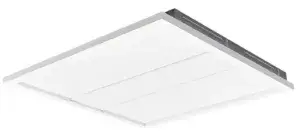
Kenora
Brand: Beyond
Architectural LED Troffers, 2ft and 4ft, Adj Wattage, CCT, from 20W to 46W; Up to 5720 Lumens; Prices start at $125.
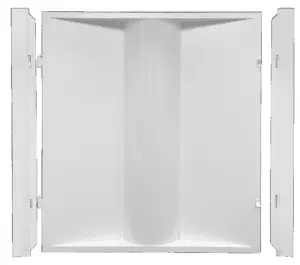
Tupelo
Brand: Beyond
LED Troffers, 2ft and 4ft, Architectural Drop Ceiling Lighting, Adj Wattage, CCT, from 20W to 72W; Up to 9720 Lumens; Prices start at $135.
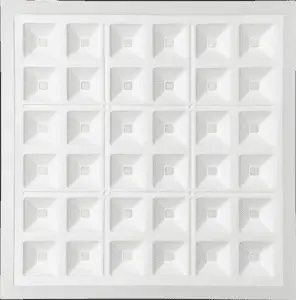
Pixel Square Series
Brand: Beyond
Designer Troffers for drop-in ceilings available in 2×2; an even light diffusion for low-glare lighting; ETL; 40W; Prices start at $85.
TF
Brand: Ledsion
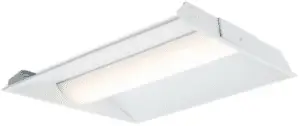
2×2; CCT Tunable, 30W; Prices start at $195.
TF
Brand: Ledsion
2×4; CCT Tunable, 40W; Prices start at $195.
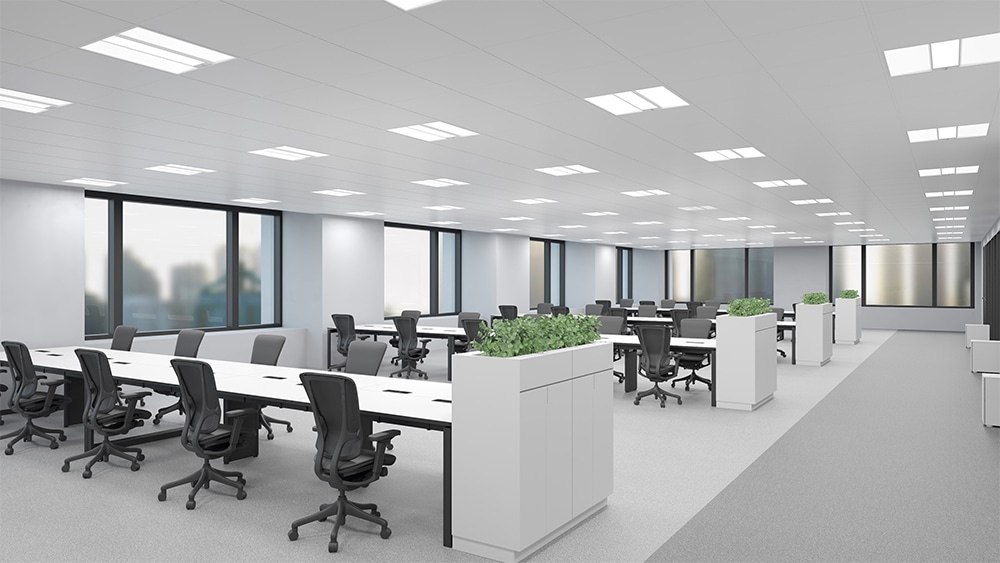
LED troffer fixtures installed in suspended ceiling grids delivering uniform commercial office lighting.
When to Use LED Troffer Lighting
LED Troffer lighting is typically specified when:
-
Ceiling system compatibility with T-grid or modular layouts is required
-
Uniform ambient illumination is desired for work areas
-
Visual comfort and minimal glare are design priorities
-
Energy efficiency and long service life are operational considerations
-
Control integration and adaptability (sensors, dimming, scheduling) are needed
Troffer fixtures are selected based on distribution characteristics, visual performance, and interior function rather than simple lumen output alone.
Selecting the right troffer is only part of the design process. Our Commercial Drop Ceiling Lighting Layout Guide explains how spacing and layout influence lighting quality.
Typical LED Troffer Specifications
Light Output: Lumens tailored to space type and mounting height
Optical Design: Diffusers and lens systems for uniform distribution and reduced glare
Color Quality: Correlated color temperatures (CCT) and Color Rendering Index (CRI) suitable for task performance and occupant comfort
Mounting Configuration: T-grid compatibility, surface mount, or recessed variants
Control Compatibility: Dimming protocols, occupancy sensing, and networked lighting management
Environmental Ratings: Damp location ratings for office and interior conditions
LED Troffer Planning & Selection
How are LED Troffers specified?
LED Troffer systems are specified by evaluating space size, ceiling configuration, task requirements, and visual comfort priorities. Lighting designers often define illumination targets (foot-candles) and use layouts to determine fixture count, aiming, and distribution strategies.
Why is visual comfort important in interior spaces?
Visual comfort reduces glare, eye fatigue, and unnecessary contrast. Appropriately engineered optics and diffusers help ensure that light is distributed evenly, minimizing hotspots and improving overall occupant experience.
How do mounting configuration and ceiling type influence selection?
Troffers are designed to integrate with T-grid or modular ceiling systems, but surface-mount or recessed versions can be used where grid systems are absent. Ceiling geometry informs optical distribution strategy to maintain uniformity and avoid shadows.
When should controls be integrated?
Controls such as occupancy sensing, daylight harvesting, and scheduling reduce energy consumption and help align lighting with space usage patterns. Networked control systems provide advanced management and reporting capabilities.
LED Troffer Planning & Selection
How are LED Troffers specified?
LED Troffer systems are specified by evaluating space size, ceiling configuration, task requirements, and visual comfort priorities. Lighting designers often define illumination targets (foot-candles) and use layouts to determine fixture count, aiming, and distribution strategies.
Why is visual comfort important in interior spaces?
Visual comfort reduces glare, eye fatigue, and unnecessary contrast. Appropriately engineered optics and diffusers help ensure that light is distributed evenly, minimizing hotspots and improving overall occupant experience.
How do mounting configuration and ceiling type influence selection?
Troffers are designed to integrate with T-grid or modular ceiling systems, but surface-mount or recessed versions can be used where grid systems are absent. Ceiling geometry informs optical distribution strategy to maintain uniformity and avoid shadows.
Troffers are designed to integrate with T-grid or modular ceiling systems, but surface-mount or recessed versions can be used where grid systems are absent. Ceiling geometry informs optical distribution strategy to maintain uniformity and avoid shadows. For projects using suspended grid ceilings, our LED Troffers vs. LED Flat Panels Guide compares the two fixture types and explains which may be better suited for different commercial drop-ceiling applications.
When should controls be integrated?
Controls such as occupancy sensing, daylight harvesting, and scheduling reduce energy consumption and help align lighting with space usage patterns. Networked control systems provide advanced management and reporting capabilities.
Common Applications
LED Troffer lighting is widely used in:
-
Offices and open workspaces
-
Educational facilities and classrooms
-
Healthcare examination and waiting areas
-
Retail interiors and showrooms
-
Corridors, lobbies, and common areas
-
Conference and meeting rooms
Learn More About Indoor Lighting Systems
LED troffer fixtures are one of the most widely used lighting solutions in modern commercial interiors due to their ability to deliver uniform illumination across offices, classrooms, healthcare environments, and institutional buildings. Selecting the appropriate fixture type, lumen output, and optical distribution is essential for achieving balanced lighting performance throughout interior spaces.
For a broader overview of fixture categories, lighting design strategies, and performance considerations, explore our Indoor LED Lighting Guide for Commercial & Industrial Spaces.
Space Type vs Troffer Considerations
| Space Type | Lighting Priority | Typical Strategy |
|---|---|---|
| Open Office | Uniform ambient | Balanced lumen, diffuse optics |
| Education | Task visibility | Neutral CCT, high uniformity |
| Healthcare | Comfort + clarity | Higher CRI, controlled distribution |
| Retail | Visual appeal | Tunable optics, accent integration |
CCT & CRI Guide for Interiors
| Environment | Preferred CCT | Typical CRI | Rationale |
|---|---|---|---|
| Office | 3500–4100K | ≥80 | Balanced visibility + comfort |
| Classroom | 4000–5000K | ≥80 | Crisp task lighting |
| Retail | 3000–4000K | ≥80 | Warm product rendering |
| Healthcare | 3500–5000K | ≥90 | Accurate color discrimination |
Visual Comfort Priorities
-
Even light distribution
-
Reduced glare and shadows
-
Consistent color performance
-
Supports multiple work tasks and sightlines
Inline Buyer Q&A
How do I choose the right LED troffer for an existing ceiling grid?
Start with the existing ceiling-grid dimensions, fixture size, mounting configuration, room dimensions, ceiling height, required illumination, voltage, controls, and desired color temperature.
For retrofit projects, also identify the existing fluorescent fixture type, lamp configuration, and condition of the ceiling system. This helps determine whether complete fixture replacement or another retrofit approach is appropriate.
Should I replace an entire fluorescent troffer or retrofit the existing fixture?
Either approach can be appropriate.
Complete LED troffer replacement can provide a new housing, optical system, driver, controls, and updated appearance. Retrofit solutions may allow portions of an existing fixture to remain in place and can reduce installation work in suitable applications.
The decision should consider fixture age and condition, labor, ceiling access, existing wiring, required performance, controls, maintenance objectives, and total project cost.
How many LED troffers does my space need?
Fixture quantity depends on room dimensions, ceiling height, fixture output and distribution, required illumination, spacing, surface reflectance, daylight, and how the space is used.
Simply replacing fluorescent troffers one-for-one may work in some projects, but it does not automatically produce the best lighting layout.
Should I choose a 1×4, 2×2, or 2×4 LED troffer?
The appropriate size depends on the ceiling grid, room geometry, existing fixture openings, desired appearance, and lighting layout.
2×2 and 2×4 troffers are widely used in commercial suspended ceilings, while 1×4 configurations can also be appropriate for certain spaces and layouts.
Fixture size should be coordinated with the ceiling and lighting design rather than selected solely according to light output.
Should I request a photometric layout for a troffer-lighting project?
For larger offices, schools, healthcare facilities, institutional buildings, or projects involving significant layout changes, photometric analysis can help evaluate fixture quantity, spacing, predicted illumination, and uniformity.
It can also help compare different fixture outputs or layouts before equipment is ordered.
Need Help Selecting Commercial LED Troffers?
LED troffer selection involves more than matching the dimensions of an existing fluorescent fixture. Ceiling configuration, room dimensions, fixture output, optical performance, controls, color temperature, and illumination requirements all influence the appropriate solution.
Whether you’re upgrading an office, school, healthcare facility, government building, or other commercial interior, our lighting specialists can help evaluate fixture options, retrofit considerations, controls, and lighting layouts.
Call 1-844-533-7767 to discuss your commercial LED troffer project.
FAQs About LED Troffers
What are LED troffer lights?
LED troffers are ceiling fixtures commonly designed for recessed installation in suspended-grid ceiling systems.
They provide general overhead illumination in offices, schools, healthcare facilities, government buildings, conference rooms, and other commercial and institutional interiors.
Where are LED troffer lights commonly used?
LED troffers are commonly used in offices, classrooms, healthcare facilities, conference rooms, government buildings, administrative areas, and other interiors with suspended ceiling systems.
Their broad distribution makes them useful where relatively uniform general illumination is desired across larger spaces.
What sizes do LED troffer lights come in?
Common commercial configurations include 1×4, 2×2, and 2×4 fixtures.
Available dimensions and mounting configurations vary by manufacturer, so fixture dimensions should be verified against the ceiling grid and existing openings before ordering.
Are LED troffers more efficient than fluorescent troffers?
LED troffers can reduce energy consumption compared with many older fluorescent systems while also eliminating routine fluorescent lamp replacement.
Actual energy savings depend on existing and replacement wattage, fixture quantities, operating hours, required illumination, and lighting controls.
What color temperature is best for LED troffer lighting?
There is no single color temperature appropriate for every commercial interior.
3500K and 4000K are commonly considered for offices, schools, healthcare environments, and institutional spaces, while other color temperatures may be appropriate depending on the desired appearance, visual tasks, surrounding finishes, and facility requirements.
CCT-selectable fixtures can provide additional flexibility where different settings may need to be evaluated.
How long do LED troffer lights last?
Commercial LED troffers can provide operating lives measured in tens of thousands of hours. Published lifetime ratings vary by fixture and manufacturer.
Actual service life depends on LED and driver quality, thermal management, operating hours, ambient conditions, electrical conditions, controls, and other factors.
Can LED troffer lights be dimmed?
Many LED troffers are available with dimming drivers and can be integrated with occupancy sensors, daylight-responsive controls, scheduling, or other lighting-control systems.
Compatibility depends on the fixture, driver, sensor, and control system, so required control capabilities should be identified before equipment is selected.
Are LED troffers suitable for healthcare and education facilities?
They can be. LED troffers are widely used in educational and healthcare buildings where suspended ceilings and general overhead illumination are appropriate.
Fixture selection should consider the specific space, visual tasks, glare, controls, cleaning or environmental requirements, and any applicable facility standards rather than assuming one troffer design is suitable throughout the building.
What is the difference between an LED troffer and an LED flat panel?
Both can be used in suspended-grid ceilings, but their construction and optical appearance can differ.
Traditional troffer designs generally use a recessed housing with optical components that distribute light from within the fixture, while many flat panels use a thinner profile and broad luminous surface.
The better choice depends on ceiling conditions, desired appearance, optical performance, installation requirements, controls, and project specifications.
Stay Connected with Our Lighting Resources
Add IndustrialLightingFixtures.org as a Preferred Source on Google to see more of our lighting guides and technical resources across Google Search experiences.

Related Commercial Ceiling Lighting Resources
- Commercial LED Ceiling Lights — Explore the broader commercial ceiling-lighting category for offices, schools, healthcare facilities, retail spaces, and institutional interiors.
- Benefits of Commercial Drop Ceiling Lighting — Learn why suspended-grid lighting systems remain widely used in commercial and institutional interiors.
- Using Drop Ceiling Light Fixtures Makes Sense — Review practical considerations for selecting 1×4, 2×2, 2×4, and other fixtures for commercial drop ceilings.
- Commercial Recessed Downlights — Compare recessed downlighting with troffer-based general illumination for conference rooms, corridors, reception areas, retail spaces, and other interiors.
- Indoor Lighting — Explore the broader commercial indoor-lighting system, including ceiling, recessed, architectural, and other interior fixture categories.