LED vapor-tight linear lighting is a sealed industrial fixture designed to resist moisture, dust, and contaminants. These IP-rated luminaires provide uniform illumination in washdown, cold storage, and industrial environments where standard strip lights may fail.
LED vapor-tight linear lighting is engineered to deliver uniform, reliable illumination in environments where moisture, dust, airborne contaminants, or washdown exposure are present. These sealed luminaires are designed to protect internal components from water ingress and debris while maintaining consistent light output in demanding industrial and commercial settings.
Unlike open-optical strip fixtures, vapor-tight linear luminaires incorporate gasketed housings, sealed diffusers, and corrosion-resistant materials to prevent failure in humid, refrigerated, or wet locations. Their elongated form factor provides continuous illumination across long corridors, production lines, and service areas with minimal shadowing.
As part of a broader industrial lighting strategy, vapor-tight linear fixtures help reduce maintenance cycles while supporting durability and operational reliability.
Sealed luminaires designed for wet or washdown zones contribute to the durability goals of industrial lighting systems.
LED Vapor-Tight Linear Fixtures
In facilities that combine continuous wet-location zones with dry interior workspaces, vapor-tight linear lighting is often coordinated with both standard linear strip and vapor-tight jelly jar fixtures to create a cohesive and durable illumination strategy.
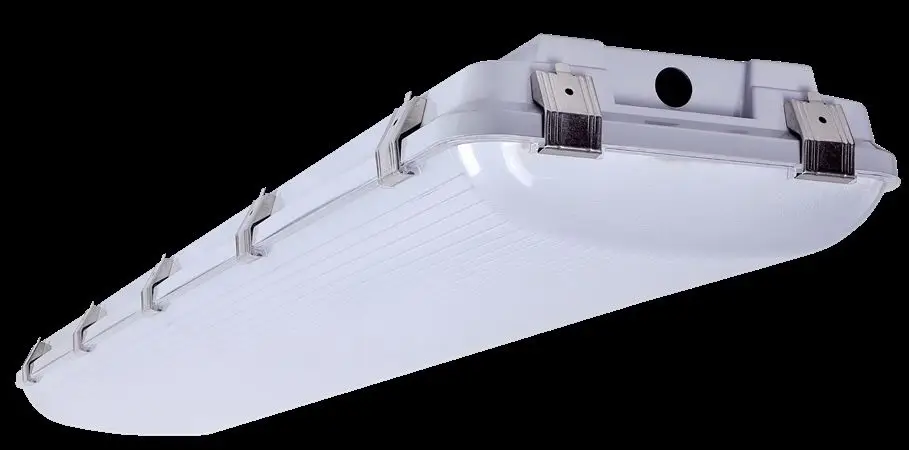
Wide Body Vapor Tight
Brand: Cost Less
Wattage, CCT Select 42/100/150W; Up to 20,000 lumens; Waterproof, Dust-proof; OP. Temp -4°F-122°F; ETL; Prices start at $285.
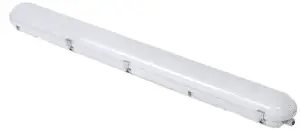
VP
Brand: Nebulite
Wattage, CCT Select 30W/40W/50W; Up to 5750 lumens; Waterproof, Dust-proof; OP. Temp -22°F-122°F; DLC, ETL;
Prices start at $120.
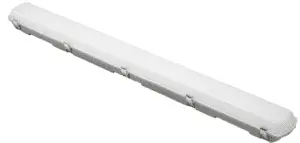
VT
Brand: Ledsion
40/50/60W; Up to 7,800 Lumens; Op Temp -22°F to 104°F
Prices start at $120.
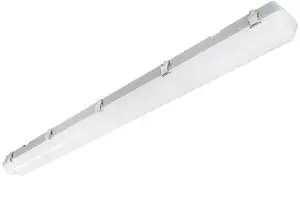
Falcon
Brand: Beyond
resistant to water, dust, dampness, and pressure; adjustable wattage and CCT 38W/46W/54W; 0-10V Dimming, IP65; Oper Temp -40°F to 122°F; up to 7,020 lumens; Prices start at $120.
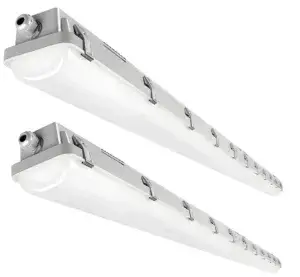
8ft LED Vapor Tight
Brand: Ledsion
Wattage, CCT Select 60/70/80W; Up to 10,400 lumens; Waterproof, Dust-proof; OP. Temp -22°F-140°F; DLC, ETL; Prices start at $285.
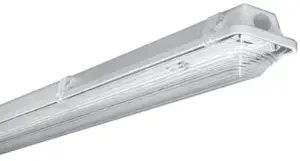
Daisy-14
Brand: Crystal
food processing facilities, Commercial kitchens, Livestock buildings, Parking Garages, Car Washes, Underpasses,
IP67, waterproof, dustproof; 5,545 lumens; DLC listed; Made in USA; 40/56W; Prices start at $140.
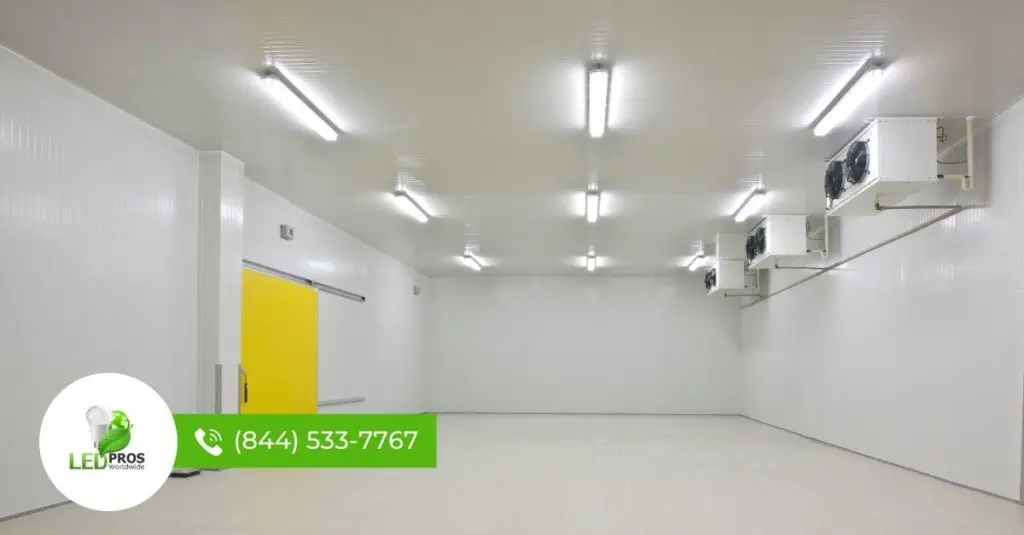
What Is LED Vapor-Tight Linear Lighting?
LED vapor tight linear lighting refers to sealed, gasketed luminaires engineered to deliver reliable illumination in environments exposed to moisture, dust, humidity, and corrosive conditions. These fixtures feature a linear form factor designed for uniform, continuous light distribution across industrial, commercial, and utility spaces.
For a broader introduction to sealed lighting terminology, construction, environmental protection, and common applications, see our Vapor-Proof Light Fixtures Guide.
Unlike standard strip fixtures, vapor tight linear luminaires incorporate sealed housings, impact-resistant lenses, and corrosion-resistant materials that protect internal components from water, airborne contaminants, and chemical exposure.
These systems are widely used in parking garages, cold storage facilities, food processing environments, and washdown areas where conventional lighting cannot maintain long-term performance.
Learn about proper freezer lighting requirements for commercial cold storage facilities including recommended fixture types, temperature ratings, vapor-tight protection, and freezer warehouse illumination standards.
When Should Vapor-Tight Linear Fixtures Be Used?
Specify vapor-tight linear lighting when a facility includes:
-
Long, continuous zones requiring uniform illumination
-
High humidity or routine washdown procedures
-
Airborne dust or particulate exposure
-
Exterior covered areas exposed to moisture
-
Environments where corrosion resistance is critical
Proper refrigerated warehouse lighting helps reduce maintenance costs while improving illumination in low-temperature industrial environments
Planning & Selection Considerations
When specifying vapor-tight linear lighting, evaluate:
✔ Mounting Height & Spacing – Ensure uniform coverage across long runs
✔ Ingress & Impact Ratings – Match to exposure severity
✔ Ambient Conditions – Temperature, humidity, and washdown frequency
✔ Control Integration – Sensors, dimming, and scheduling capability
✔ Corrosion Resistance – Required for chemical or salt exposure
Proper alignment between environmental demands and fixture specifications helps maintain durability, safety, and long-term performance.
In regulated food environments, consider NSF-Certified LED Lighting for additional sanitation compliance.
Linear Vapor Tight vs Other Vapor Tight Fixtures
LED vapor tight lighting is available in several configurations, each suited to different applications.
- Linear Vapor Tight Fixtures: Provide continuous, uniform illumination across long spaces such as corridors, production lines, and parking garages
- Jelly Jar / Bulkhead Fixtures: Designed for compact areas requiring localized lighting
- High Output Vapor Tight High Bays: Used in large industrial environments with higher mounting heights
Linear vapor tight fixtures are preferred when consistent light distribution and coverage across extended areas is required, making them ideal for large-scale commercial and industrial applications.
Vapor-tight fixtures are designed for environments where moisture, dust, washdown conditions, and airborne contaminants can shorten the life of conventional lighting. Learn more about the number one benefit of using vapor-tight lights and why sealed fixture construction matters in demanding commercial and industrial applications.
Technical Standards & Compliance Resources
Selecting LED vapor-tight linear lighting requires attention to applicable electrical and environmental protection ratings to ensure safety and performance. Important considerations include:
✔ UL or ETL listings for wet/damp locations
✔ Appropriate ingress protection ratings
✔ Corrosion resistance for humid or chemical environments
✔ Control compatibility (dimming, sensors)
Ensuring compliance with these standards supports reliability and code-conforming installation performance. For broader lighting design context and classification guidance, see our site’s lighting strategy resources.
Compare fluorescent vs LED refrigeration lighting systems in our cooler door lighting retrofit guide for commercial cooler doors.
Common Applications Include:
-
- Parking garages and covered parking structures
- Industrial facilities and manufacturing environments
- Cold storage and refrigerated warehouses
- Food processing and preparation areas
- Utility corridors and service areas
- Stairwells, tunnels, and transit spaces
- Car washes and high-moisture environments
In these settings, vapor-tight luminaires provide both environmental protection and stable visual performance.
For refrigerated environments, explore our Cold Storage Lighting solutions engineered for low-temperature performance.
Core Specifications & Performance Characteristics
LED vapor tight linear fixtures are engineered to perform in demanding environments while maintaining consistent illumination and durability.
Key specifications include:
- Ingress Protection (IP Rating): Typically IP65–IP69K for moisture and washdown protection
- Housing Construction: Polycarbonate or aluminum with gasket-sealed enclosures
- Lens Type: Impact-resistant, UV-stabilized polycarbonate diffusers
- Fixture Lengths: Commonly 2ft, 4ft, and 8ft linear configurations
- Wattage Range: ~20W to 150W depending on output requirements
- Lumen Output: ~3,000 to 20,000+ lumens depending on application
- Color Temperature (CCT): 3500K, 4000K, 5000K standard
- Voltage Options: 120–277V and 277–480V for commercial installations
- Mounting Options: Surface mount, suspended, or continuous row mounting
- Operating Life: Often 50,000+ hours
These fixtures are designed to maintain performance in environments where exposure to water, dust, and debris would degrade standard lighting systems.
For compact sealed solutions in utility areas, see our LED Vapor Tight Jelly Jar Lights.
Inline Buyer Q&A
How do I choose the right LED vapor tight linear fixture?
Start with the installation environment.
Identify exposure to moisture, dust, washdown, cleaning chemicals, temperature extremes, vibration, and other contaminants. Also consider mounting height, required illumination, fixture length, voltage, controls, and any applicable sanitation or environmental requirements.
The fixture’s published ratings should match the actual conditions where it will be installed.
What IP rating should I look for in a vapor tight fixture?
The appropriate ingress-protection rating depends on the environment and the type of exposure expected.
Many commercial vapor-tight fixtures carry ratings such as IP65 or IP66, but the required rating should be determined from the installation conditions rather than assuming one IP rating is appropriate for every application.
The complete fixture construction, seals, electrical entries, installation method, and manufacturer ratings should also be considered.
Can vapor tight LED fixtures replace fluorescent strip or vapor-tight fixtures?
Yes. LED vapor-tight linear fixtures are commonly used in retrofit projects replacing older fluorescent linear systems.
Before selecting a replacement, verify existing fixture dimensions and locations, mounting method, voltage, wiring, required output, environmental conditions, controls, and installation requirements.
A one-for-one replacement may be practical in some facilities, but fixture quantity and spacing should still be evaluated when lighting performance is being changed.
Are vapor tight fixtures suitable for food-processing and washdown environments?
Some are, but vapor-tight construction alone does not establish suitability for every food-processing or washdown application.
Facilities should evaluate the fixture’s ingress-protection rating, construction materials, resistance to cleaning agents, sanitation requirements, mounting, operating temperature, and any certifications or listings required for the specific application.
Are vapor tight fixtures the same as explosion-proof fixtures?
No.
Vapor-tight fixtures are designed to protect internal components from environmental contaminants such as moisture and dust according to their construction and ratings.
Explosion-proof or hazardous-location fixtures are designed and certified for specific classified hazardous environments.
A vapor-tight or high-IP fixture should not be substituted for hazardous-location lighting where an applicable hazardous-location classification requires appropriately certified equipment.
Should I request a photometric layout for vapor tight lighting?
For warehouses, processing areas, parking garages, cold-storage facilities, manufacturing spaces, or other larger installations, photometric analysis can help determine fixture quantity, spacing, mounting height, output, and predicted illumination.
This is particularly useful when replacing older fluorescent systems with LED fixtures that may have substantially different output and optical characteristics.
Need Help Selecting LED Vapor Tight Linear Lighting?
Vapor-tight lighting should be selected according to both the lighting requirements and the environment in which the fixture will operate.
Whether you’re lighting a food-processing facility, cold-storage warehouse, parking garage, utility area, car wash, manufacturing facility, or other moisture- or dust-prone environment, our lighting specialists can help evaluate fixture construction, environmental ratings, output, controls, and project requirements.
Call 1-844-533-7767 to discuss your vapor-tight lighting project.
Frequently Asked Questions for LED Vapor Tight Linear Lighting
What is LED vapor tight linear lighting?
LED vapor-tight linear lighting consists of enclosed linear fixtures designed to help protect internal electrical and optical components from environmental contaminants such as moisture and dust.
The degree of protection varies by product and should be verified from the fixture’s published ratings.
Where are vapor tight linear lights commonly installed?
Applications can include:
- Food-processing facilities
- Cold-storage and refrigerated facilities
- Parking garages
- Utility and service areas
- Car washes
- Industrial manufacturing areas
- Maintenance facilities
- Other damp, wet, dusty, or contamination-prone environments
Fixture suitability should be verified for the specific environmental conditions.
What does vapor tight mean in lighting?
Vapor-tight fixtures typically use enclosed housings, gaskets, sealed lenses, and protected electrical components to limit the entry of moisture, dust, and other contaminants.
The term itself should not be treated as a universal performance rating. IP ratings, wet-location listings, sanitation requirements, chemical resistance, and other product-specific characteristics provide additional information about where a fixture can be used.
Can vapor tight linear lights replace fluorescent strip fixtures?
Yes. LED vapor-tight linear fixtures can replace many older fluorescent strip and enclosed linear fixtures.
A retrofit should consider existing fixture locations, mounting, wiring, voltage, required illumination, environmental conditions, controls, and installation labor.
Are vapor tight linear lights suitable for washdown areas?
Some vapor-tight fixtures are designed for washdown applications, but suitability depends on the product’s ratings and the severity of the cleaning environment.
Water pressure, cleaning frequency, chemicals, temperature, sanitation requirements, fixture materials, seals, and electrical connections should all be considered.
Can vapor tight fixtures be used in cold storage?
Some vapor-tight LED fixtures are suitable for refrigerated warehouses, coolers, freezers, and other cold-storage environments.
The fixture’s published minimum ambient-temperature rating, moisture protection, thermal characteristics, controls, and any applicable sanitation requirements should be verified for the installation.
Can vapor tight fixtures be used in food-processing facilities?
They can be when appropriately designed and rated for the application.
Food-processing environments may introduce moisture, washdown, cleaning chemicals, temperature changes, oils, dust, or sanitation requirements that go beyond general vapor-tight construction.
Where applicable, required certifications and facility sanitation criteria should be confirmed before fixtures are selected.
How long do LED vapor tight linear fixtures last?
Commercial LED vapor-tight fixtures can provide operating lives measured in tens of thousands of hours. Published lifetime ratings vary by fixture and manufacturer.
Actual service life depends on LED and driver quality, thermal management, operating hours, temperature, moisture, chemical exposure, electrical conditions, controls, and other environmental factors.
Can LED vapor tight fixtures use occupancy sensors or dimming controls?
Many models are available with dimming drivers, occupancy sensing, or compatibility with other lighting-control systems.
Required controls should be identified during fixture selection because sensor performance, driver compatibility, mounting conditions, temperature, and environmental exposure can affect the appropriate equipment.
Does an IP65 or IP66 rating mean a fixture is explosion proof?
No.
An IP rating describes protection against ingress of solids and water under defined test conditions. It does not establish that a fixture is approved for a classified hazardous location.
Where combustible gases, vapors, or dusts create a classified environment, lighting must be selected according to the applicable hazardous-location classification and certification requirements.
Stay Connected with Our Lighting Resources
Add IndustrialLightingFixtures.org as a Preferred Source on Google to see more of our lighting guides and technical resources across Google Search experiences.

Related Industrial & Environmental Lighting Resources
- Industrial Lights — Explore the broader industrial LED lighting category for manufacturing, warehousing, processing, maintenance, and other demanding facilities.
- Cold Storage Lighting — Review LED lighting solutions for refrigerated warehouses, freezers, coolers, and other low-temperature environments where moisture and temperature must be considered.
- NSF Certified LED Lighting — Learn about lighting considerations for food-processing and other facilities where sanitation-related requirements may affect fixture selection.
- LED Parking Garage Lighting — Explore lighting for parking structures where moisture, contaminants, controls, mounting conditions, and continuous operating schedules can influence fixture selection.
- Explosion-Proof LED Lighting — Understand when hazardous-location lighting is required instead of assuming a vapor-tight or high-IP fixture provides explosion-proof protection.