
Pedestrian lighting plays a critical role in creating safe, comfortable, and visually appealing outdoor environments. Whether illuminating sidewalks within a residential community, pathways across a university campus, walkways through a public park, or pedestrian corridors in a mixed-use development, proper lighting improves visibility, enhances security, and supports nighttime navigation.
Modern architectural lighting systems help planners, property owners, municipalities, and designers create outdoor spaces that encourage walking while improving safety and community engagement. Decorative post top fixtures, bollard lights, and pedestrian-scale lighting solutions are commonly used to provide illumination without overwhelming the surrounding environment.
Looking for decorative outdoor lighting solutions for pathways, parks, campuses, multifamily communities, and public spaces? Visit our Architectural Lighting Fixtures Home Page to explore architectural post tops, bollards, area lights, and pedestrian lighting products designed for safety, performance, and visual appeal.
A successful pedestrian lighting design balances safety, aesthetics, energy efficiency, and user comfort.
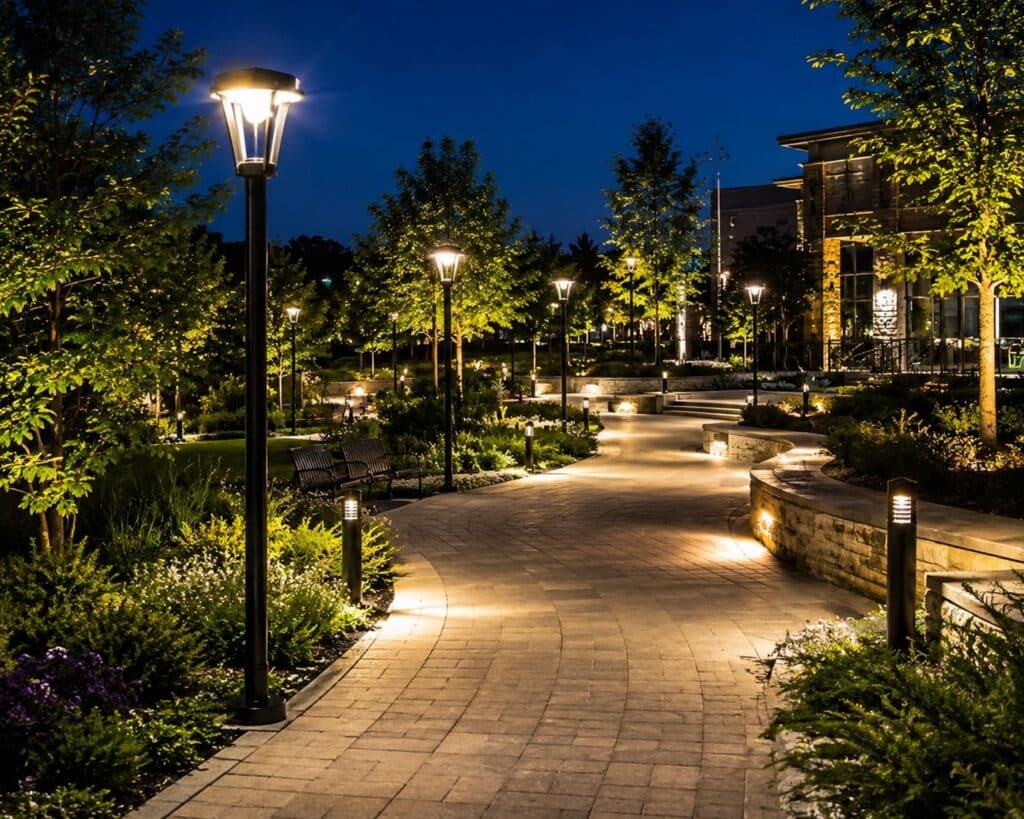
What Is Pedestrian Lighting?
Pedestrian lighting refers to outdoor lighting specifically designed to illuminate areas primarily used by people on foot.
Common applications include:
- Sidewalks
- Community pathways
- University campuses
- Public parks
- HOA common areas
- Multifamily developments
- Mixed-use communities
- Downtown districts
- Transit stations
- Courtyards
- Recreational trails
- Civic plazas
Unlike roadway lighting, pedestrian lighting focuses on human-scale visibility, comfort, and wayfinding rather than vehicle traffic.
Decorative post top fixtures are among the most common pedestrian lighting solutions. Explore our Decorative Post Top Lighting Guide to understand how fixture style, mounting height, and optics affect pathway illumination.
Why Pedestrian Lighting Matters
Improves Safety
Proper illumination helps pedestrians identify obstacles, changes in elevation, and potential hazards.
Supports Security
Well-lit walkways improve visibility and support natural surveillance.
Enhances Wayfinding
Lighting helps guide users toward destinations and improves navigation after dark.
Encourages Activity
Comfortable nighttime environments encourage walking, recreation, and community interaction.
Improves Property Appearance
Architectural lighting contributes to the visual character of outdoor spaces.
Educational campuses represent one of the most demanding pedestrian lighting environments. Visit our Campus Pathway Lighting Guide to learn how universities, schools, and corporate campuses approach pathway illumination and safety.
Primary Goals of Pedestrian Lighting
| Design Objective | Benefit |
|---|---|
| Safety | Improved visibility and hazard recognition |
| Security | Increased surveillance and awareness |
| Wayfinding | Easier navigation and route identification |
| Comfort | Reduced glare and improved visual experience |
| Aesthetics | Enhanced appearance of outdoor environments |
| Accessibility | Improved visibility for all users |
Pedestrian Lighting Applications
Sidewalk Lighting
Public sidewalks require consistent illumination that improves visibility while minimizing glare.
Key considerations include:
- Fixture spacing
- Uniform illumination
- Obstacle visibility
- Crosswalk visibility
- Neighborhood aesthetics
Homeowners associations rely on pedestrian lighting to connect residents with parks, clubhouses, recreational facilities, and common areas. Visit our HOA Lighting Design Guide to learn how communities use architectural lighting to improve safety and neighborhood aesthetics.
Community Pathways
Residential communities often utilize pedestrian lighting to connect:
- Homes
- Parks
- Clubhouses
- Recreation areas
- Mail kiosks
- Parking areas
Decorative post tops and bollards are commonly used.
Apartment complexes and condominium developments often require extensive pedestrian lighting networks that connect buildings, parking lots, and amenities. Explore our Multifamily Site Lighting Guide for recommendations on creating safe and visually appealing residential environments.
Campus Walkways
Educational campuses experience significant pedestrian activity after dark.
Lighting objectives include:
- Student safety
- Wayfinding
- Emergency visibility
- Gathering space illumination
- Building access visibility
Educational campuses present unique pedestrian lighting challenges due to heavy foot traffic and extended evening use. Visit our Campus Pathway Lighting guide to learn how colleges, universities, and corporate campuses approach pathway illumination and safety.
Parks and Recreational Areas
Parks require lighting that balances safety and environmental considerations.
Applications include:
- Walking trails
- Seating areas
- Gathering spaces
- Open lawns
- Recreational facilities
Recommended Pedestrian Lighting Fixtures
Decorative Post Top Lighting
Decorative post top fixtures are among the most common pedestrian lighting solutions.
Advantages include:
- Attractive appearance
- Wide distribution patterns
- Community-friendly aesthetics
- Consistent pathway illumination
Decorative post top fixtures are among the most widely used pedestrian lighting solutions. Our Decorative Post Top Lighting Guide explains how different fixture styles can enhance pathway visibility while complementing the architectural character of a property.
Bollard Lighting
Bollards provide lower-level illumination close to the walking surface.
Ideal applications include:
- Sidewalks
- Courtyards
- Parks
- Amenity areas
- Building approaches
Bollards provide low-level illumination that helps define walking routes, improve wayfinding, and enhance pedestrian safety. View our Architectural Bollard Lighting options for sidewalks, courtyards, amenity areas, and pathway applications.
Architectural Area Lights
Larger pedestrian zones may require area lighting to supplement pathway fixtures.
Common applications include:
- Public plazas
- Gathering spaces
- Transit centers
- Community courtyards
Pedestrian Lighting and CPTED
Crime Prevention Through Environmental Design (CPTED) principles frequently influence pedestrian lighting design.
Natural Surveillance
Lighting improves visibility throughout pathways and gathering areas.
Access Control
Illuminated routes help direct users toward intended destinations.
Territorial Reinforcement
Lighting can define public, semi-private, and private spaces.
Maintenance and Image
Well-maintained lighting contributes to a safer perception of the environment.
For more information, see our CPTED Lighting Principles guide.
Pedestrian Lighting Design Best Practices
Prioritize Uniformity
Avoid alternating bright and dark areas that reduce visibility and comfort.
Minimize Glare
Shielded fixtures improve visibility and reduce eye strain.
Consider Vertical Illumination
Pedestrians recognize people and potential hazards by viewing faces and body movement.
Select Appropriate Fixture Heights
Most pedestrian lighting utilizes mounting heights significantly lower than roadway lighting.
Coordinate Architectural Style
Fixture selection should complement surrounding buildings, landscaping, and site features.
Recommended Pedestrian Fixture Heights
| Application | Typical Mounting Height |
|---|---|
| Bollard Lighting | 30–48 Inches |
| Pathway Lighting | 8–12 Feet |
| Decorative Post Tops | 10–16 Feet |
| Courtyard Lighting | 12–18 Feet |
| Campus Walkways | 12–20 Feet |
| Public Plazas | 14–20 Feet |
Common Pedestrian Lighting Mistakes
Excessive Fixture Spacing
Large gaps between fixtures can create dark areas and reduce user comfort.
Overlighting
More light does not always improve safety.
Ignoring Glare
Poor fixture selection can reduce visibility.
Using Roadway Fixtures on Pedestrian Routes
Pedestrian spaces typically benefit from lower mounting heights and pedestrian-scale lighting.
Lack of Architectural Consistency
Mixed fixture styles can negatively impact aesthetics.
LED Benefits for Pedestrian Lighting
Modern LED systems provide:
- Reduced energy costs
- Long fixture life
- Improved uniformity
- Reduced maintenance
- Better optical control
- Enhanced sustainability
- Improved nighttime visibility
Many municipalities and community planners now utilize LED lighting for both new construction and retrofit projects.
Inline Buyer Q&A
What is pedestrian-scale lighting?
Pedestrian-scale lighting is outdoor lighting designed primarily around people walking through a space rather than vehicle traffic.
It commonly uses lower mounting heights and smaller-scale fixtures than roadway or parking-lot lighting, helping place illumination closer to sidewalks, pathways, plazas, entrances, courtyards, and other pedestrian areas.
What fixtures are commonly used for pedestrian pathways?
Common options include:
- Decorative post-top fixtures
- LED bollards
- Pedestrian-scale poles and fixtures
- Pathway lights
- Architectural area lights
- Wall-mounted fixtures near buildings
- Landscape and accent lighting where appropriate
The right fixture depends on pathway width, surrounding architecture, mounting opportunities, landscaping, desired distribution, glare control, and the overall site-lighting plan.
Why is glare control important in pedestrian areas?
Excessive glare can make it more difficult to see people, objects, changes in elevation, and surrounding conditions.
Fixture optics, shielding, mounting height, output, spacing, and viewing angles should be considered so the lighting illuminates the pathway without unnecessarily directing bright light toward pedestrians.
How high should pedestrian pathway lighting be mounted?
There is no universal mounting height for pedestrian lighting.
The appropriate height depends on fixture type, optical distribution, pathway width, spacing, surrounding landscaping, architecture, desired illumination, and project requirements.
Bollards operate close to the ground, while post-top and pedestrian-scale pole fixtures can be mounted considerably higher.
Fixture photometrics are more useful than a fixed mounting-height rule when determining the appropriate layout.
Can pedestrian lighting support security objectives?
Yes.
Well-planned pedestrian lighting can improve nighttime visibility and support natural surveillance and other CPTED strategies.
Lighting should be coordinated with landscaping, building entrances, sightlines, access points, surveillance systems, and other site-design elements rather than treated as a standalone security measure.
What information should I provide when planning pedestrian lighting?
When possible, provide:
- Site plan or pathway layout
- Pathway widths and dimensions
- Photos of existing conditions
- Building entrances and destinations
- Intersections and gathering areas
- Stairs, ramps, and changes in elevation
- Existing fixture locations
- Landscaping and potential obstructions
- Architectural preferences
- Desired color temperature
- Applicable local requirements
- Existing lighting information for retrofit projects
For larger projects, photometric modeling can help evaluate fixture placement, spacing, distribution, illumination, and uniformity before installation.
Design Pedestrian Lighting Around the People Using the Space
Successful pedestrian lighting should make pathways, entrances, intersections, plazas, and common areas easier to navigate after dark while complementing the surrounding architecture and landscape.
Whether you’re planning an HOA community, multifamily property, university campus, municipal park, hospitality property, mixed-use development, or commercial pedestrian area, our lighting specialists can help evaluate:
- Decorative post-top lighting
- LED bollards
- Pedestrian-scale fixtures
- Pathway and sidewalk lighting
- Architectural area lighting
- Fixture mounting heights
- Spacing and light distribution
- Glare and spill-light control
- Photometric layouts
- New and retrofit lighting projects
Explore Architectural Lighting Fixtures for decorative and architectural outdoor lighting solutions for pedestrian environments.
For project assistance, have your site plan, pathway dimensions, photographs, existing fixture information, and architectural requirements available when possible.
Call 1-844-533-7767 to discuss your pedestrian lighting project.
Frequently Asked Questions About Pedestrian Lighting
What is pedestrian lighting?
Pedestrian lighting refers to outdoor lighting designed primarily for areas used by people on foot, including sidewalks, pathways, plazas, parks, campuses, courtyards, building entrances, and community spaces.
It is typically planned differently from roadway or large parking-area lighting because fixture scale, mounting height, viewing angles, glare, and pedestrian comfort become particularly important.
Why is pedestrian lighting important?
Pedestrian lighting can improve nighttime visibility, wayfinding, recognition of surrounding conditions, and the overall usability of outdoor spaces after dark.
The appropriate design depends on how the space is used, surrounding conditions, architecture, landscaping, and applicable project requirements.
What color temperature should be used for pedestrian lighting?
There is no single color temperature appropriate for every pedestrian environment.
3000K is commonly considered where a warmer nighttime appearance is desired, while other color temperatures may be appropriate depending on the architecture, application, surrounding lighting, local requirements, and project objectives.
Color temperature should be selected as part of the overall site-lighting design rather than by a universal rule.
Are bollard lights suitable for pathways?
Yes.
Bollards are frequently used along sidewalks, pathways, courtyards, plazas, landscaped areas, and building approaches because they provide illumination at a pedestrian scale.
The appropriate bollard and spacing depend on its optical distribution, mounting height, pathway geometry, surrounding lighting, landscaping, and required performance.
Are decorative post-top lights suitable for pedestrian areas?
Yes.
Decorative post-top fixtures can provide pedestrian-scale illumination while contributing to the architectural character of parks, campuses, multifamily communities, hospitality properties, streetscapes, and other public or commercial spaces.
Fixture appearance should be considered together with distribution, glare control, mounting height, output, and environmental suitability.
How far apart should pedestrian lights be spaced?
There is no universal spacing distance.
Spacing depends on fixture output and distribution, mounting height, pathway width, intersections, landscaping, surrounding illumination, desired uniformity, and project requirements.
Photometric information should be used when precise spacing and illumination need to be evaluated.
Should pathways be illuminated uniformly?
Appropriate uniformity can reduce abrupt transitions between brighter and darker areas and improve visual conditions along pedestrian routes.
The appropriate degree of uniformity depends on the application, pathway geometry, surrounding lighting environment, and project requirements.
How should pathway intersections and entrances be treated?
Intersections, entrances, stairs, ramps, crossings, gathering areas, and other decision points can require additional consideration because pedestrian activity and visual tasks may change at these locations.
Fixture placement should help users recognize routes and destinations without creating excessive brightness or glare.
How does landscaping affect pedestrian lighting?
Trees, shrubs, walls, signs, and other landscape elements can block light, create shadows, interfere with sightlines, or eventually grow into the intended distribution.
Lighting and landscape plans should therefore be coordinated, particularly along pathways and around entrances.
Can pedestrian lighting support CPTED principles?
Yes.
Lighting can support CPTED objectives by improving visibility and natural surveillance and by helping people recognize pathways, entrances, gathering areas, and surrounding activity.
For additional design considerations, see our CPTED Lighting Principles guide.
Does brighter pedestrian lighting provide better security?
Not necessarily.
Excessive brightness or poor fixture placement can create glare, harsh contrast, and unwanted spill light.
Effective pedestrian lighting depends on appropriate distribution, visibility, uniformity, glare control, placement, and coordination with the surrounding environment rather than simply increasing light output.
Can pedestrian lighting affect nearby residences?
Yes.
Fixtures positioned near apartments, condominiums, hotels, residences, balconies, or neighboring properties can create unwanted spill light if output and distribution are not properly controlled.
Fixture optics, shielding, mounting height, placement, and applicable local requirements should be considered during design.
Can pedestrian lighting use controls?
Yes, where appropriate for the application.
Photocells, scheduling, dimming, occupancy-based controls, and other strategies can help manage lighting operation and output.
Control strategies should still maintain the illumination needed for the space during required operating periods.
Can existing pathway lighting be upgraded to LED?
Often, yes.
Depending on the existing equipment, a project may involve replacement fixtures, retrofit components, or complete replacement of older poles or bollards.
Existing housings, poles, mounting hardware, wiring, controls, condition, and fixture compatibility should be evaluated before selecting a retrofit approach.
How can pedestrian lighting complement surrounding architecture?
Fixture scale, style, finish, mounting height, color temperature, and placement can be coordinated with buildings, landscaping, signage, street furniture, and other site elements.
A property can use several fixture types while maintaining a coordinated architectural character.
Do pedestrian lighting projects need photometric layouts?
Not every pathway requires a formal lighting study, but photometric modeling can be useful for larger campuses, multifamily communities, parks, streetscapes, mixed-use developments, and other projects where fixture spacing, illumination, uniformity, and spill light need to be evaluated.
Stay Connected with Our Lighting Resources
Add IndustrialLightingFixtures.org as a Preferred Source on Google to see more of our lighting guides and technical resources across Google Search experiences.
Related Pedestrian & Architectural Lighting Resources
- CPTED Lighting Principles — Learn how lighting, visibility, sightlines, and environmental design can support natural surveillance and broader crime-prevention strategies.
- HOA Lighting Design Guide — Explore lighting strategies for residential-community pathways, entrances, common areas, roadways, and amenities.
- Multifamily Site Lighting Guide — Review pedestrian, parking, entrance, and common-area lighting considerations for apartment, condominium, and mixed-use properties.
- Decorative Post Top Lighting Guide — Learn how decorative post-top fixtures can provide pedestrian-scale illumination while supporting the architectural character of outdoor spaces.
- LED Architectural Post Top Lighting — Explore architectural post-top fixtures for pathways, campuses, parks, multifamily communities, hospitality properties, and municipal environments.