
Decorative post top lighting combines architectural aesthetics with functional outdoor illumination. These fixtures are commonly used throughout residential communities, university campuses, parks, municipal streetscapes, mixed-use developments, and public gathering spaces where appearance is just as important as lighting performance.
Unlike traditional utility-style lighting, decorative post top fixtures contribute to the visual identity of a property while providing safe and comfortable illumination for pedestrians and vehicles.
Modern LED decorative post top fixtures offer exceptional energy efficiency, reduced maintenance requirements, improved optical performance, and a wide variety of styles that complement architectural environments.
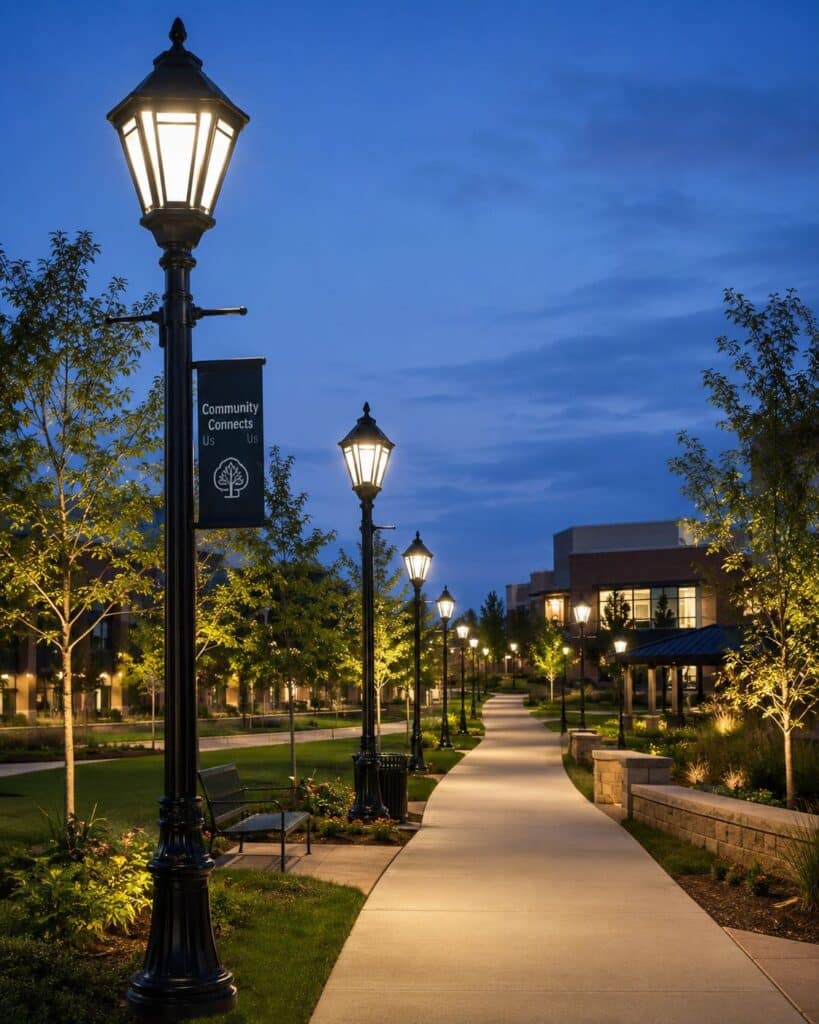
Decorative LED post top lighting combines architectural character with commercial lighting performance for communities, campuses, parks, municipalities, multifamily properties, and pedestrian streetscapes.
Planning decorative outdoor lighting for a community, multifamily property, campus, park, municipality, pedestrian area, or mixed-use development?
LED PROS can help identify decorative and architectural post top fixtures based on fixture style, pole height, spacing, optical distribution, lumen output, CCT, glare control, controls, and project requirements.
Explore LED Architectural Post Top Lighting or Request a Quote for help selecting fixtures for your project.
Call 1-844-533-7767.
What Is Decorative Post Top Lighting?
Decorative post top lighting consists of outdoor fixtures mounted on poles where the luminaire sits directly on top of the pole.
These fixtures are commonly selected for:
- HOA communities
- Multifamily developments
- Universities and campuses
- Parks and recreation areas
- Municipal streetscapes
- Courtyards
- Mixed-use developments
- Pedestrian pathways
- Community gathering areas
- Public plazas
Post top lighting is designed to provide attractive illumination while enhancing the architectural character of an outdoor space.
Looking for decorative lighting fixtures for your next project? Explore our Architectural Post Top Lighting collection featuring solutions for communities, campuses, parks, and municipal applications.
Why Decorative Post Top Lighting Is Popular
Architectural Appearance
Decorative fixtures contribute to a property’s visual identity and create a more upscale appearance than traditional utility fixtures.
Pedestrian-Friendly Scale
Post top fixtures are typically installed at lower mounting heights than roadway lighting, making them ideal for pedestrian environments.
Improved Wayfinding
Well-placed fixtures help guide visitors through pathways, parks, campuses, and community spaces.
Enhanced Safety
Proper illumination improves visibility and supports pedestrian safety after dark.
Versatile Applications
Decorative post tops can be used in a wide variety of outdoor environments.
From Decorative Design to Fixture Selection
Decorative post top lighting should do more than complement the surrounding architecture. For commercial, municipal, and community projects, fixture selection should also account for pole height, spacing, lumen output, optical distribution, color temperature, glare and uplight control, mounting configuration, and controls.
Different architectural environments may call for traditional, contemporary, lantern-style, or acorn-style luminaires. Matching the fixture style with the required lighting performance helps create a cohesive daytime appearance while providing effective illumination for pathways, entrances, streetscapes, parks, and pedestrian areas after dark.
For available styles, specifications, and commercial-grade options, explore LED Architectural Post Top Lighting or Request a Quote for help selecting fixtures for your project.
Common Decorative Post Top Applications
| Application | Primary Objective |
|---|---|
| HOA Communities | Community aesthetics and visibility |
| Multifamily Developments | Safety and architectural appeal |
| University Campuses | Pedestrian safety and wayfinding |
| Parks and Trails | Visibility and comfort |
| Municipal Streetscapes | Community identity |
| Courtyards | Gathering space illumination |
| Public Plazas | Aesthetics and visibility |
Municipal streetscape projects may also require coordination with decorative poles, fixture-specific photometrics, control systems and project specifications. See our Municipal LED Lantern Post Top Lighting Guide for a specification-focused approach to lantern-style streetscape lighting.
HOA Community Lighting
Decorative post top fixtures are among the most common lighting solutions used in homeowner association developments.
Typical applications include:
- Neighborhood streets
- Sidewalks
- Community entrances
- Parks
- Clubhouses
- Recreational amenities
These fixtures help establish a consistent visual theme throughout the community.
Multifamily Property Lighting
Apartment communities frequently use decorative post tops to illuminate:
- Internal roadways
- Sidewalks
- Courtyards
- Resident gathering areas
- Clubhouse entrances
- Amenity spaces
Decorative fixtures provide a more residential appearance compared to traditional commercial lighting.
Apartment communities frequently utilize decorative post top fixtures throughout pathways, courtyards, and common areas. Our Multifamily Site Lighting Guide discusses broader site lighting strategies for residential developments.
Campus Lighting Applications
Universities and corporate campuses often utilize post top lighting because it balances:
- Safety
- Visibility
- Wayfinding
- Campus identity
- Pedestrian comfort
Common locations include:
- Main walkways
- Courtyards
- Public plazas
- Residence hall pathways
- Building entrances
Universities and corporate campuses often use decorative post top fixtures to improve wayfinding and pedestrian safety. Learn more in our Campus Pathway Lighting guide.
Parks and Public Spaces
Decorative fixtures are frequently used in:
- Municipal parks
- Recreational trails
- Civic plazas
- Public gathering areas
- Streetscape projects
These environments often require lighting that enhances safety without creating a harsh appearance.
Typical Decorative Post Top Mounting Heights
| Application | Typical Height |
|---|---|
| Sidewalks | 10–12 Feet |
| Pathways | 10–14 Feet |
| HOA Streets | 12–16 Feet |
| Multifamily Developments | 12–16 Feet |
| Campuses | 12–18 Feet |
| Courtyards | 12–16 Feet |
| Parks and Plazas | 14–20 Feet |
These ranges provide useful starting points, but the appropriate height also depends on fixture output, architectural scale, glare, and the area being illuminated. See our Post Top Lighting Pole Height Guide for a detailed comparison of commercial mounting heights.
Mounting height also affects how far apart fixtures can be installed while maintaining useful illumination and uniformity. Our Post Top Lighting Spacing Guide explains how pole height, lumen output, optical distribution, and photometric performance work together when determining fixture spacing.
Decorative post top fixtures are among the most popular lighting solutions used in homeowner association developments. Explore our HOA Lighting Design Guide to learn how communities use architectural lighting to improve safety and appearance.
Decorative Post Top Fixture Styles
Traditional Acorn Fixtures
Acorn fixtures are commonly used in:
- Historic districts
- Municipal streetscapes
- Parks
- Downtown developments
They provide a classic appearance that complements traditional architecture.
Contemporary Post Tops
Modern designs are frequently selected for:
- Corporate campuses
- Mixed-use developments
- New residential communities
These fixtures often feature clean architectural lines and advanced LED optics.
Transitional Designs
Transitional fixtures blend traditional and contemporary elements and are popular in communities seeking timeless aesthetics.
LED Benefits for Decorative Post Top Lighting
Modern LED decorative fixtures provide:
- Lower energy consumption
- Reduced maintenance costs
- Longer fixture life
- Improved optical control
- Better uniformity
- Enhanced sustainability
- Reduced relamping requirements
Many fixtures are also available with smart controls and adaptive lighting systems.
Larger outdoor environments often require decorative post tops working alongside architectural area lighting systems. View our architectural area lighting solutions for plazas, parking areas, and public spaces.
Decorative Post Top Selection Guide
| Design Consideration | Recommendation |
|---|---|
| Residential Communities | Decorative architectural styles |
| Campuses | Wayfinding-focused optics |
| Parks | Comfortable pedestrian illumination |
| Streetscapes | Consistent fixture family |
| Public Plazas | Enhanced aesthetics and uniformity |
| Mixed-Use Developments | Contemporary architectural styles |
Decorative Post Tops and CPTED
Decorative lighting can support Crime Prevention Through Environmental Design (CPTED) goals when properly designed.
Benefits include:
Natural Surveillance
Improved visibility throughout pathways and gathering spaces.
Wayfinding
Clear pedestrian routes encourage intended circulation.
Territorial Reinforcement
Lighting helps define public and semi-private spaces.
Community Identity
Well-maintained lighting contributes to a safer and more welcoming appearance.
For additional information, see our CPTED Lighting Principles guide.
Common Decorative Lighting Mistakes
Choosing Style Over Performance
Fixture appearance should never come at the expense of lighting quality.
Inconsistent Fixture Selection
Mixing unrelated fixture styles can negatively affect community aesthetics.
Excessive Fixture Spacing
Large gaps between fixtures can reduce visibility.
Ignoring Glare Control
Decorative fixtures should still provide comfortable nighttime visibility.
Neglecting Maintenance
Poorly maintained fixtures can diminish both performance and appearance.
Inline Buyer Q&A
What is decorative post top lighting?
Decorative post top lighting uses outdoor luminaires mounted at the top of poles to combine functional illumination with architectural character.
These fixtures are commonly selected where the appearance of the lighting system during both daytime and nighttime is an important part of the property design.
Where are decorative post top fixtures commonly used?
Common applications include:
- HOA and residential communities
- Multifamily developments
- University and school campuses
- Parks and recreation areas
- Municipal streetscapes
- Sidewalks and pedestrian areas
- Plazas and courtyards
- Hospitality properties
- Mixed-use developments
- Healthcare and corporate campuses
Fixture style and lighting performance should be coordinated with the architecture, landscaping, pedestrian activity, and overall site-lighting plan.
How do I choose the right mounting height for decorative post top lighting?
There is no universal mounting height.
The appropriate pole height depends on fixture output and distribution, pathway or roadway width, desired illumination, spacing, surrounding architecture, landscaping, pedestrian scale, and project requirements.
Fixture photometrics can help evaluate mounting height and spacing rather than relying on a fixed height range.
Are decorative post top fixtures suitable for pedestrian and security-oriented applications?
They can be an effective part of pedestrian and site lighting when their output, distribution, mounting height, and spacing are appropriate.
Well-designed lighting can improve nighttime visibility and support natural surveillance and broader CPTED strategies. It should not be treated as a standalone security system.
How do I balance decorative appearance with lighting performance?
Evaluate the fixture as both an architectural element and a luminaire.
Consider:
- Fixture scale and proportions
- Pole style and height
- Optical distribution
- Light output
- Glare and source visibility
- Uplight
- Color temperature
- Finish
- Architectural compatibility
- Environmental exposure
- Controls
- Maintenance access
A visually attractive fixture still needs to provide appropriate lighting performance for the space.
What information should I provide when planning a decorative post top project?
When possible, provide:
- Site plan or property dimensions
- Photos or architectural renderings
- Application and project type
- Existing or proposed pole locations
- Pole heights
- Pole-top dimensions for retrofit projects
- Existing fixture information
- Voltage
- Desired fixture style and finish
- Color temperature preferences
- Lighting or photometric requirements
- Project quantity
- Applicable municipal or architectural specifications
Plan Your Decorative Post Top Lighting Project
Decorative post top lighting should complement the surrounding architecture while providing appropriate illumination for pedestrian areas, streetscapes, entrances, pathways, and community spaces.
Whether you’re planning a new installation or replacing existing fixtures, LED PROS can help evaluate architectural style, pole configuration, light levels, optics, CCT, controls, fixture quantity, and project specifications.
Request a Quote or call 1-844-533-7767 to discuss your decorative post top lighting requirements.
Frequently Asked Questions About Decorative Post Top Lighting
What are decorative post top fixtures?
Decorative post top fixtures are outdoor luminaires mounted at the top of poles that combine architectural styling with functional illumination.
They are available in traditional, transitional, and contemporary designs for a wide range of commercial, residential-community, institutional, hospitality, and municipal environments.
Are decorative post tops suitable for pathways?
Yes.
Decorative post-top fixtures are frequently used along sidewalks, pathways, parks, campuses, courtyards, and other pedestrian areas.
The fixture’s distribution, mounting height, spacing, glare, landscaping, and desired illumination should be considered when designing the layout.
Can decorative post tops be used along streets and roadways?
Yes, in appropriate applications.
Decorative post-top fixtures are commonly incorporated into downtown streetscapes, community roads, mixed-use developments, and pedestrian-oriented roadways.
Where roadway illumination is required, fixture output, optical distribution, pole placement, mounting height, roadway geometry, and applicable project criteria should be evaluated.
Can decorative post top lighting be used in parking areas?
Yes, depending on the size and function of the parking area and the performance of the selected fixture.
Decorative post tops can be appropriate where architectural character and pedestrian scale are important. Larger parking areas may require dedicated area-lighting optics and mounting configurations to achieve the desired coverage efficiently.
How high should decorative post top lights be mounted?
There is no universal mounting height.
Appropriate pole height depends on fixture distribution, output, pathway or roadway geometry, spacing, surrounding architecture, landscaping, desired illumination, and applicable requirements.
How far apart should decorative post top lights be spaced?
Spacing should be based on the actual fixture and site rather than a universal rule.
Fixture output, optical distribution, mounting height, pathway width, landscaping, surrounding illumination, desired uniformity, and project requirements all affect spacing.
Photometric modeling can help evaluate different layouts.
What color temperature should be used for decorative post top lighting?
There is no single color temperature appropriate for every project.
3000K is often considered where a warmer nighttime appearance is desired, particularly in pedestrian-oriented and traditional architectural environments.
Other color temperatures may be appropriate depending on architecture, surrounding lighting, local requirements, Dark Sky objectives, and project preferences.
Can decorative post top fixtures support CPTED principles?
Yes.
Appropriately designed lighting can support CPTED objectives by improving visibility and natural surveillance and helping people recognize pathways, entrances, gathering areas, and surrounding activity.
Lighting should be coordinated with landscaping, sightlines, access points, building design, and other security measures.
Does brighter decorative lighting provide better security?
Not necessarily.
Excessive brightness can create glare, harsh contrast, and unwanted spill light.
Effective site lighting depends on appropriate distribution, placement, visibility, uniformity, glare control, and coordination with the surrounding environment rather than simply increasing fixture output.
Are LED decorative post top fixtures energy efficient?
LED post-top fixtures can use less lighting energy than many older HID systems.
Actual energy savings depend on existing system wattage, replacement fixture wattage, fixture quantity, operating hours, controls, and required illumination.
Do LED decorative post tops require less maintenance?
They can reduce routine lamp replacement compared with many older HID systems.
Long-term maintenance still depends on LED modules, drivers, controls, electrical conditions, environmental exposure, fixture construction, operating hours, and accessibility.
Can decorative post top lights be installed on existing poles?
Potentially.
Existing poles should be evaluated for condition, mounting dimensions, fixture compatibility, weight and wind-loading considerations, wiring, voltage, and project requirements.
Pole-top dimensions should be verified before replacement fixtures are ordered.
Do the pole and fixture need to have the same decorative style?
They should generally complement each other, but they do not need to be identical in every design detail.
Fixture proportions, pole shape, finish, mounting height, architecture, street furniture, signage, and other site elements can be coordinated to create a consistent overall appearance.
Can decorative post top lighting be Dark Sky friendly?
Potentially.
Dark Sky friendly performance depends on the fixture’s optical design, uplight, shielding, output, color temperature, installation, and applicable project requirements.
Decorative appearance alone does not determine whether a fixture meets a particular Dark Sky standard or local outdoor-lighting ordinance.
Can decorative post top fixtures create glare?
Yes.
Visible light sources, excessive output, inappropriate optics, poor placement, and high contrast with surrounding areas can contribute to glare.
Fixture distribution, shielding, mounting height, output, and normal pedestrian and driver viewing angles should be considered during selection.
Can decorative post top lighting affect nearby residences?
Yes.
Fixtures installed near homes, apartments, balconies, hotels, or neighboring properties can produce unwanted spill light if distribution and placement are not properly controlled.
Fixture optics, shielding, output, mounting height, property boundaries, and applicable local requirements should be considered during design.
Can decorative post top lighting use photocells or other controls?
Yes, when supported by the selected fixtures and drivers.
Photocells, scheduling, dimming, and other control strategies can help manage operating hours and light output. Control requirements should be established before fixtures are specified.
Are decorative post top fixtures suitable for outdoor environments?
Commercial decorative post-top fixtures are available for outdoor applications, but suitability should be verified from the actual product specifications and listings.
Wet-location requirements, ingress protection where relevant, operating temperatures, corrosion exposure, mounting configuration, and other environmental conditions should be considered.
Can decorative post top lighting be coordinated with bollards and other outdoor fixtures?
Yes.
Post tops, bollards, wall-mounted fixtures, pathway lights, and architectural area lights can be selected as a coordinated fixture family or complementary group.
Consistent finishes, proportions, color temperature, architectural styling, and lighting characteristics can help create a unified appearance across the property.
Do decorative post top lighting projects need photometric layouts?
Not every project requires one, but photometric modeling can be valuable for campuses, multifamily communities, streetscapes, parks, hospitality properties, municipalities, and larger pedestrian environments.
A photometric layout can help evaluate fixture quantity, pole height, spacing, distribution, illumination, uniformity, and potential spill light before installation.
Stay Connected with Our Lighting Resources
Add IndustrialLightingFixtures.org as a Preferred Source on Google to see more of our lighting guides and technical resources across Google Search experiences.
Related Architectural Lighting Resources
- LED Architectural Post Top Lighting — Explore decorative and architectural post-top fixtures for communities, campuses, parks, streetscapes, hospitality properties, and pedestrian environments.
- LED Acorn Post Top Lighting — Review traditional acorn-style LED post-top fixtures for streetscapes, parks, campuses, historic districts, and pedestrian-oriented developments.
- Pedestrian Lighting Design Guide — Learn how mounting height, spacing, fixture distribution, glare control, landscaping, and photometrics influence pedestrian lighting design.
- HOA Lighting Design Guide — Explore lighting strategies for community entrances, streets, sidewalks, pathways, common areas, and recreational amenities.
- Campus Pathway Lighting — Review pathway-lighting considerations for universities, schools, healthcare campuses, corporate properties, and other pedestrian environments.