
Campus environments depend on safe and reliable pedestrian circulation. Students, faculty, staff, visitors, patients, and employees often travel throughout a campus after dark, making pathway lighting a critical component of site safety and usability.
Whether serving a university, K-12 school, healthcare campus, corporate headquarters, research facility, or government complex, properly designed pathway lighting improves visibility, enhances security, supports wayfinding, and creates a more welcoming environment.
Modern LED architectural lighting systems allow campus planners to balance safety, aesthetics, sustainability, and long-term operating costs while creating attractive outdoor spaces that encourage pedestrian activity.
Explore decorative post tops, bollards, pathway lighting, and architectural area lights designed for campus environments, public spaces, and pedestrian applications on our Architectural Lighting Fixtures Home Page.
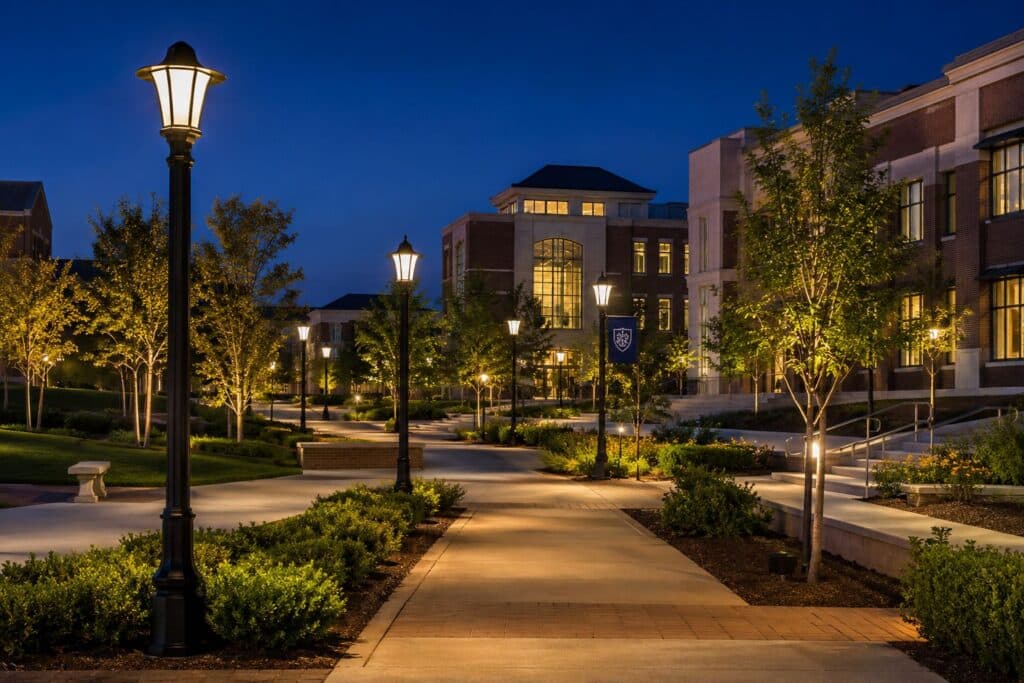
What Is Campus Pathway Lighting?
Campus pathway lighting refers to outdoor lighting systems designed to illuminate sidewalks, pedestrian corridors, walkways, gathering areas, and circulation routes throughout a campus environment.
Common campus lighting applications include:
- Academic building walkways
- Residence hall pathways
- Courtyards
- Public plazas
- Parking lot connections
- Campus entrances
- Transit stops
- Recreational areas
- Medical campus walkways
- Corporate campus pedestrian routes
Unlike roadway lighting, pathway lighting focuses on pedestrian visibility, comfort, and navigation.
Larger gathering spaces, transit stops, and campus plazas often require supplemental illumination. Our architectural area lighting solutions provide uniform coverage while maintaining campus aesthetics.
Why Campus Pathway Lighting Matters
Improves Pedestrian Safety
Lighting helps users identify obstacles, changes in elevation, landscaping features, and other potential hazards.
Supports Campus Security
Well-lit pathways improve visibility and support campus security initiatives.
Enhances Wayfinding
Lighting helps pedestrians navigate between buildings, parking areas, and campus destinations.
Encourages Campus Activity
Comfortable outdoor environments encourage evening use of campus facilities and public spaces.
Improves Campus Appearance
Architectural lighting contributes to campus identity and visual appeal.
Campus Lighting Priorities
| Campus Area | Primary Objective | Recommended Fixtures |
|---|---|---|
| Main Walkways | Safety & Wayfinding | Decorative Post Tops |
| Building Entrances | Visibility & Security | Wall Fixtures, Post Tops |
| Courtyards | Comfort & Gathering | Bollards, Decorative Area Lights |
| Transit Stops | Visibility & Safety | Area Lights |
| Residence Hall Routes | Security & Navigation | Post Tops, Bollards |
| Public Plazas | Aesthetics & Visibility | Architectural Area Lighting |
Main Pedestrian Routes
Primary campus walkways often experience the highest pedestrian traffic volumes.
Lighting objectives include:
- Safe movement
- Consistent visibility
- Improved wayfinding
- Reduced dark areas
- Enhanced security
Decorative post top fixtures are commonly used because they provide broad pedestrian-scale illumination.
Residence Hall and Housing Areas
Student housing and residential campus environments require lighting that balances safety with visual comfort.
Typical goals include:
- Resident safety
- Comfortable nighttime environments
- Reduced glare
- Clear pedestrian routes
- Attractive community spaces
Courtyards and Gathering Spaces
Modern campuses frequently include outdoor social spaces.
Lighting should support:
- Social interaction
- Outdoor studying
- Community events
- Seating areas
- Evening activities
A combination of bollards, decorative post tops, and architectural area lights is often utilized.
Campus Entrance Lighting
Entrances establish first impressions for visitors.
Lighting should:
- Highlight campus identity
- Improve visibility
- Support wayfinding
- Enhance security
- Create welcoming environments
Decorative architectural fixtures are frequently incorporated into gateway designs.
Typical Campus Pathway Lighting Applications
| Application | Recommended Fixture Type | Typical Mounting Height |
|---|---|---|
| Main Pedestrian Walkways | Decorative Post Top | 10–16 Feet |
| Residence Hall Pathways | Post Top or Bollard | 8–14 Feet |
| Building Entrances | Post Top or Wall Fixture | 10–16 Feet |
| Courtyards | Bollards and Area Lights | 3–18 Feet |
| Campus Plazas | Architectural Area Lights | 14–20 Feet |
| Transit Stops | Area Lights | 16–20 Feet |
| Recreational Areas | Post Tops and Area Lights | 12–20 Feet |
Campus Lighting and CPTED
Many campuses incorporate Crime Prevention Through Environmental Design (CPTED) principles.
Natural Surveillance
Lighting improves visibility throughout pedestrian corridors.
Access Control
Illuminated routes encourage use of intended pathways.
Territorial Reinforcement
Lighting helps define campus boundaries and circulation routes.
Maintenance
Consistently maintained lighting contributes to a safer environment.
For additional information, see our CPTED Lighting Principles guide.
Recommended Campus Fixture Types
Decorative Post Top Lighting
Commonly used for:
- Walkways
- Courtyards
- Campus streets
- Gathering spaces
Decorative post top fixtures are among the most widely used campus lighting solutions. Our Decorative Post Top Lighting Guide reviews styles, applications, and design considerations for pedestrian environments.
Bollard Lighting
Ideal for:
- Building approaches
- Sidewalks
- Plazas
- Landscape pathways
Bollards are frequently used along campus sidewalks, plazas, and building entrances to provide pedestrian-focused illumination. Explore architectural bollard lighting options for pathway applications.
Architectural Area Lighting
Suitable for:
- Large open spaces
- Public gathering areas
- Transit stops
- Campus entrances
Typical Pedestrian Fixture Heights
| Application | Typical Mounting Height |
|---|---|
| Bollards | 30–48 Inches |
| Pathway Lighting | 8–12 Feet |
| Decorative Post Tops | 10–16 Feet |
| Campus Courtyards | 12–18 Feet |
| Public Plazas | 14–20 Feet |
| Large Gathering Areas | 16–20 Feet |
Campus pathway lighting is one of the most common applications of pedestrian-scale lighting. Visit our Pedestrian Lighting Design Guide to learn more about fixture spacing, mounting heights, glare control, and pathway illumination best practices.
Campus Lighting Design Best Practices
Maintain Consistent Fixture Styles
Architectural consistency contributes to campus identity.
Prioritize Uniform Illumination
Avoid dark areas that may impact safety and comfort.
Minimize Glare
Select shielded fixtures that improve visibility while reducing eye strain.
Coordinate with Landscaping
Trees, shrubs, and site features should be considered during design.
Plan for Future Expansion
Lighting infrastructure should support future campus growth.
Student housing developments and multifamily communities often share similar lighting challenges. Visit our Multifamily Site Lighting Guide for additional strategies related to pathways, courtyards, and outdoor gathering spaces.
Common Campus Lighting Mistakes
Overlighting
Excessive brightness can create glare and discomfort.
Ignoring Pedestrian Routes
Building lighting alone does not provide adequate pathway illumination.
Poor Fixture Placement
Improper spacing may create dark areas between fixtures.
Lack of Maintenance
Burned-out fixtures negatively affect safety and campus appearance.
LED Benefits for Campus Lighting
Modern LED systems provide:
- Lower operating costs
- Reduced maintenance
- Longer service life
- Improved light quality
- Better uniformity
- Enhanced sustainability
- Improved nighttime visibility
Many campuses also incorporate lighting controls and smart technologies to further improve efficiency.
Inline Buyer Q&A
How do I choose between post-top fixtures and bollards for campus pathways?
Decorative post-top fixtures are well suited to primary pedestrian corridors, larger walkways, plazas, and other areas where broader pedestrian-scale illumination is needed. Bollards provide lower-level illumination and are often used along secondary paths, building approaches, courtyards, landscaped areas, and locations where maintaining an open architectural appearance is important. Many campuses use both fixture types as part of a coordinated lighting system.
How far apart should campus pathway lights be installed?
Spacing depends on fixture mounting height, lumen output, optical distribution, pathway width, surrounding architecture, and required light levels. Rather than relying on a universal spacing rule, larger campus projects can benefit from a photometric lighting plan to evaluate illumination and uniformity before installation.
What color temperature should I choose for campus pathway lighting?
3000K and 4000K are both commonly considered for campus environments. Warmer 3000K lighting can provide a comfortable architectural appearance and may be appropriate where reducing nighttime visual impact is important. 4000K may be selected where a somewhat cooler appearance or different visibility characteristics are desired. Local requirements and campus design standards should also be considered.
Can pathway lighting improve campus security?
Properly designed lighting can support campus security by improving nighttime visibility and helping pedestrians, security personnel, and surveillance systems observe activity throughout circulation areas. Effective security lighting depends on appropriate illumination and uniformity while controlling glare and excessive contrast.
What information should I provide when planning a campus pathway lighting project?
Provide pathway dimensions, site plans when available, existing or proposed pole locations, mounting heights, fixture preferences, voltage, desired color temperature, and information about plazas, intersections, stairs, building entrances, parking connections, or other important pedestrian areas. Architectural requirements and existing campus fixture styles should also be identified.
Ready to Improve Campus Safety and Pedestrian Visibility?
Whether you are planning lighting for a university, K-12 school, healthcare facility, government complex, or corporate campus, our lighting specialists can help you select architectural lighting systems that improve safety, visibility, wayfinding, and campus aesthetics.
From decorative post-top fixtures and bollards to pathway lighting and architectural area lights, we can help evaluate fixture styles, mounting heights, light distribution, color temperature, controls, and photometric requirements for coordinated campus environments.
👉 Visit Architectural Lighting Fixtures to explore product solutions, or call 1-844-533-7767 to discuss your campus lighting project.
Frequently Asked Questions
What is campus pathway lighting?
Campus pathway lighting refers to outdoor lighting systems designed to illuminate sidewalks, pedestrian corridors, plazas, courtyards, building approaches, and other circulation routes throughout educational, healthcare, corporate, institutional, and government campuses.
Why is pathway lighting important on campuses?
Pathway lighting improves nighttime visibility, navigation, pedestrian comfort, and awareness of surrounding conditions. A coordinated system can also reinforce campus identity and help users distinguish primary circulation routes, entrances, gathering areas, and other important destinations.
What fixture types are commonly used?
Decorative post-top fixtures, bollards, pedestrian-scale poles, architectural area lights, and wall-mounted fixtures are commonly used. Different fixture types can be combined to address primary walkways, secondary paths, plazas, entrances, landscaped areas, and other campus environments.
Does campus lighting support CPTED principles?
Yes. Thoughtfully designed lighting can support Crime Prevention Through Environmental Design by improving visibility, supporting natural surveillance, helping define circulation routes, and reducing poorly illuminated areas. Lighting is one component of a broader CPTED strategy rather than a security solution by itself.
Can LED lighting reduce campus operating costs?
Yes. LED fixtures typically use less electricity and require less routine maintenance than many older HID and other legacy lighting technologies. Additional savings may be possible through scheduling, dimming, occupancy-based controls, and other lighting-management strategies.
Stay Connected with Our Lighting Resources
Add IndustrialLightingFixtures.org as a Preferred Source on Google to see more of our lighting guides and technical resources across Google Search experiences.
Related Campus & Pedestrian Lighting Resources
Continue planning campus pedestrian environments with these related resources covering pathway design, security principles, architectural fixture selection, and site lighting:
- Pedestrian Lighting Design Guide — Review pathway lighting fundamentals, fixture placement, illumination, uniformity, glare control, and other considerations for pedestrian environments.
- CPTED Lighting Principles — Learn how lighting can support visibility, natural surveillance, wayfinding, and broader Crime Prevention Through Environmental Design strategies.
- Decorative Post Top Lighting Guide — Explore architectural post-top fixture styles and design considerations for campuses, parks, plazas, pedestrian corridors, and public spaces.
- Multifamily Site Lighting Guide — Review site-lighting strategies for pedestrian pathways, building approaches, common areas, parking connections, and other shared outdoor environments.
- HOA Lighting Design Guide — Explore coordinated outdoor lighting strategies for pathways, entrances, landscaped areas, community amenities, and other pedestrian-scale environments.