
Lighting plays a critical role in creating safer and more secure outdoor spaces. Crime Prevention Through Environmental Design (CPTED) is a planning and design approach that uses the built environment to reduce opportunities for crime while improving occupant comfort and visibility.
Properly designed lighting supports CPTED objectives by increasing natural surveillance, improving visibility, reducing hiding areas, and helping people feel safer when using parking lots, pathways, entrances, recreational areas, and public gathering spaces after dark.
Architectural LED lighting fixtures, decorative post top lights, bollards, pathway lights, and area lighting systems can all contribute to CPTED-compliant site design when properly selected and positioned.
Decorative lighting can support both safety and aesthetics when incorporated into a comprehensive site lighting plan. Our Decorative Post Top Lighting Guide explains how these fixtures contribute to visibility, wayfinding, and community identity.
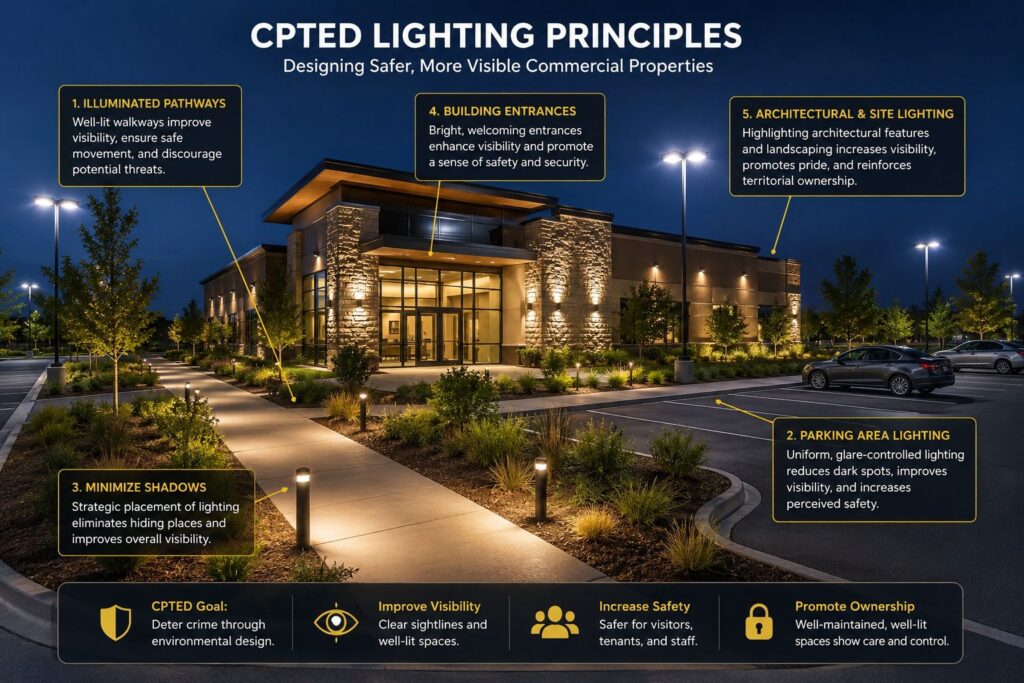
CPTED lighting design coordinates pathways, parking areas, building entrances, landscaping, and architectural site lighting to improve visibility, natural surveillance, wayfinding, and pedestrian safety after dark.
Planning Outdoor Lighting Around CPTED Principles?
Effective CPTED lighting improves visibility without relying on excessive brightness. Fixture placement, uniformity, vertical illumination, glare control, pedestrian routes, building entrances, landscaping, and security camera locations should all be considered when developing the site lighting plan.
Explore our Architectural Post Top Lighting solutions or call 844-533-7767 for help selecting outdoor fixtures that support visibility, wayfinding, and CPTED-focused site design.
What Is CPTED?
Crime Prevention Through Environmental Design (CPTED) is a design philosophy that seeks to reduce crime and improve safety through thoughtful planning of buildings, landscapes, lighting, and public spaces.
The four primary CPTED strategies include:
Natural Surveillance
Designing environments that maximize visibility and allow occupants to observe activity throughout the property.
Natural Access Control
Guiding people toward intended entrances and pathways while discouraging unauthorized access.
Territorial Reinforcement
Creating a clear distinction between public, semi-public, and private spaces.
Maintenance and Management
Maintaining the property to demonstrate active ownership and discourage criminal activity.
Lighting supports all four principles by improving visibility, defining spaces, and increasing user confidence.
Why Lighting Is Essential to CPTED
Many crimes occur in areas where visibility is limited. Poorly illuminated pathways, parking lots, stairways, and building entrances can create opportunities for criminal activity.
Proper outdoor lighting can help:
- Improve facial recognition
- Increase visibility of vehicles and pedestrians
- Eliminate dark hiding areas
- Improve security camera performance
- Enhance occupant confidence
- Support law enforcement visibility
- Reduce trip and fall hazards
Well-designed lighting encourages legitimate activity while discouraging unwanted behavior.
Planning lighting for residential communities? Read our HOA Lighting Design Guide to learn how architectural fixtures improve safety, visibility, and resident satisfaction throughout common areas and amenities.
CPTED Lighting Objectives
| CPTED Principle | Lighting Goal | Primary Benefit |
|---|---|---|
| Natural Surveillance | Improve visibility throughout site | Increased observation of activity |
| Access Control | Guide pedestrian and vehicle movement | Reduced unauthorized access |
| Territorial Reinforcement | Define ownership and boundaries | Reduced trespassing |
| Maintenance & Management | Maintain consistent illumination | Increased perception of safety |
CPTED Principle #1: Natural Surveillance
Natural surveillance is often considered the most important CPTED concept.
The goal is to maximize visibility throughout the site so that people can easily observe activity around them.
Lighting Strategies for Natural Surveillance
- Illuminate pedestrian pathways
- Light parking areas uniformly
- Eliminate dark corners
- Improve visibility at building entrances
- Provide adequate vertical illumination
- Light gathering areas and common spaces
People are less likely to engage in criminal activity when they know they can be seen.
CPTED Principle #2: Territorial Reinforcement
Lighting can help establish boundaries and communicate ownership.
Examples include:
- Illuminated entry monuments
- Decorative post top lighting along pathways
- Lighting around community amenities
- Entrance lighting for multifamily properties
- Defined pedestrian routes
Well-lit spaces appear actively managed and occupied, discouraging trespassing and vandalism.
CPTED Principle #3: Access Control
Lighting helps guide visitors toward approved circulation routes.
Examples include:
- Illuminated walkways
- Path lighting connecting parking areas to entrances
- Lighting at gates and access points
- Parking lot lighting directing vehicle traffic
- Bollard lighting along pedestrian routes
Visitors naturally follow the most visible and comfortable path.
Safe pedestrian movement is a fundamental component of CPTED-based site planning. Our Pedestrian Lighting Design Guide explains how pathway lighting improves visibility, security, and user comfort.
CPTED Principle #4: Maintenance and Image
Broken fixtures, burned-out lamps, and dark areas can signal neglect.
Modern LED systems help support maintenance goals through:
- Long service life
- Reduced relamping requirements
- Improved reliability
- Consistent light output
- Lower maintenance costs
A well-maintained lighting system reinforces positive perceptions of safety and ownership.
Recommended Lighting Applications by Site Area
| Site Area | CPTED Priority | Typical Fixtures |
|---|---|---|
| Parking Lots | Very High | Architectural Area Lights |
| Building Entrances | Very High | Wall Mounted Fixtures |
| Pathways | High | Bollards, Post Tops |
| Courtyards | High | Decorative Area Lighting |
| Parks & Open Space | Medium | Post Tops, Area Lights |
| Gathering Areas | High | Decorative Site Lighting |
Multifamily property managers can explore our Multifamily Site Lighting Guide for recommendations on parking lots, pathways, courtyards, and building entrances.
Recommended Lighting Applications for CPTED
Parking Lot Lighting
Parking lots are among the highest-priority areas for CPTED lighting.
Objectives include:
- Uniform illumination
- Vehicle visibility
- Pedestrian safety
- Security camera support
- Improved facial recognition
Architectural area lights and decorative area fixtures are commonly used.
Decorative fixtures play an important role in CPTED planning. Our Decorative Post Top Lighting Guide explains fixture styles, applications, and design considerations
Pathway and Sidewalk Lighting
Pedestrian routes should remain visible from surrounding areas.
Important considerations include:
- Consistent fixture spacing
- Minimal dark gaps
- Reduced glare
- Adequate vertical illumination
- Clear route identification
Decorative post tops and bollards are common pathway lighting solutions.
Learn how pedestrian lighting supports visibility and safety in educational environments with our Campus Pathway Lighting guide.
Building Entrances
Entrances represent transition points between public and private spaces.
Lighting should provide:
- Visitor recognition
- Security camera visibility
- Door hardware visibility
- Safe access after dark
Wall-mounted architectural fixtures and decorative site lighting are frequently used.
Community Gathering Areas
Outdoor seating areas, courtyards, plazas, and recreational spaces benefit from CPTED lighting.
Goals include:
- User comfort
- Visibility
- Reduced shadows
- Safe circulation
- Enhanced aesthetics
Architectural lighting can improve both safety and visual appeal.
CPTED Lighting Design Best Practices
Prioritize Uniformity
Uniform lighting is often more important than excessive brightness.
Avoid:
- Bright spots surrounded by darkness
- Extreme light-to-dark transitions
- High-contrast shadows
Uniform lighting improves visibility and user comfort.
Minimize Glare
Excessive glare can reduce visibility and create security concerns.
Choose fixtures with:
- Full cutoff optics
- Shielded light sources
- Controlled distribution patterns
Support Security Cameras
Lighting should be coordinated with surveillance systems.
Proper illumination improves:
- Facial recognition
- License plate visibility
- Video image quality
Reduce Shadowing
Trees, walls, landscaping, and architectural features can create dark areas.
Evaluate shadow patterns during the design phase to ensure adequate coverage.
Explore our Architectural Post Top Lighting solutions for decorative outdoor fixtures designed for communities, campuses, and public spaces.
Common CPTED Lighting Mistakes
Overlighting
More light does not always equal more security.
Excessive brightness can create:
- Glare
- Eye fatigue
- Shadowing
- Poor visibility adaptation
Ignoring Vertical Illumination
Many designs focus only on ground illumination.
People identify potential threats by seeing faces and body movements, making vertical illumination equally important.
Inconsistent Fixture Selection
Mixing fixture types and color temperatures can reduce visual consistency and create uneven lighting conditions.
Deferred Maintenance
Failing fixtures can undermine CPTED objectives and create unsafe conditions.
Industries That Frequently Use CPTED Lighting
CPTED lighting principles are commonly applied to:
- Multifamily communities
- HOA developments
- Universities and campuses
- Corporate campuses
- Municipal parks
- Public plazas
- Healthcare facilities
- Retail centers
- Hospitality properties
- Mixed-use developments
Inline Buyer Q&A
How does CPTED differ from traditional security lighting?
Traditional security lighting often focuses solely on brightness. CPTED lighting focuses on visibility, surveillance, wayfinding, occupant comfort, and reducing opportunities for criminal activity through thoughtful design.
What is the most important CPTED lighting principle?
Natural surveillance is generally considered the foundation of CPTED because people are less likely to engage in criminal behavior when they believe they can be observed.
Can decorative lighting fixtures support CPTED goals?
Yes. Decorative post top fixtures, bollards, and architectural area lights can improve visibility while maintaining the appearance of a community, campus, or commercial property.
Does CPTED require very bright lighting?
No. Uniform illumination and reduced glare are usually more important than maximum brightness.
Which properties benefit most from CPTED lighting?
Multifamily communities, HOAs, campuses, mixed-use developments, healthcare facilities, retail centers, municipal parks, and corporate campuses frequently use CPTED lighting principles.
Related Architectural Lighting Resources
- HOA Lighting Design Guide explains how community lighting supports resident safety, amenity visibility, and neighborhood aesthetics while incorporating CPTED design concepts.
- Multifamily Site Lighting Guide explores lighting strategies for apartment complexes and residential developments where CPTED principles help improve security and visibility.
- Campus Pathway Lighting discusses pedestrian safety, wayfinding, and pathway illumination practices that align with CPTED objectives.
- Decorative Post Top Lighting Guide reviews fixture styles commonly used in communities, campuses, and public spaces where visibility and aesthetics are equally important.
- Architectural Post Top Lighting showcases decorative outdoor fixtures suitable for CPTED-focused community, campus, and municipal projects.
For larger commercial parking lots, industrial facilities, and high-output area lighting applications, visit Industrial Lighting Fixtures for additional outdoor lighting resources.
Frequently Asked Questions CPTED Lighting Principles
What does CPTED stand for?
CPTED stands for Crime Prevention Through Environmental Design, a strategy that uses environmental planning and design to reduce opportunities for crime.
Does brighter lighting automatically improve security?
No. Uniform lighting with proper visibility and minimal glare is generally more effective than excessive brightness.
Why is lighting important in CPTED?
Lighting improves natural surveillance, supports access control, increases visibility, and enhances occupant confidence.
What color temperature is typically used for CPTED lighting?
Many commercial and architectural projects use 3000K to 4000K LED fixtures to balance visibility, aesthetics, and occupant comfort.
Can decorative lighting support CPTED goals?
Yes. Decorative post tops, bollards, pathway lights, and architectural fixtures can enhance safety while maintaining attractive site aesthetics.
Ready to Improve Site Safety and Visibility?
Whether you are designing a new HOA community, multifamily development, university campus, municipal park, or mixed-use property, our lighting specialists can help you select architectural lighting systems that support CPTED principles while enhancing the appearance of your site.
From decorative post top fixtures and bollards to pedestrian pathway lighting and architectural area lights, we provide lighting solutions designed for long-term performance, safety, and visual appeal.
Visit Architectural Lighting Fixtures to explore product solutions and request assistance with your next project.