
What Is LED Sports Lighting?
Whether it’s a Friday night football game, an evening tennis match, a youth soccer tournament, or a community baseball league, quality sports lighting makes athletic facilities safer, more enjoyable, and more productive after sunset.
Today’s LED sports lighting systems do much more than simply brighten a playing surface. They are carefully engineered to provide uniform illumination, reduce glare, improve visibility for athletes and spectators, and minimize light spill into neighboring properties. Combined with significant energy savings and lower maintenance costs, LED technology has become the preferred lighting solution for schools, municipalities, universities, parks, sports complexes, and professional venues.
Whether you’re planning a new athletic complex or upgrading aging metal halide fixtures, understanding the fundamentals of sports lighting is the first step toward creating a safe and efficient facility.
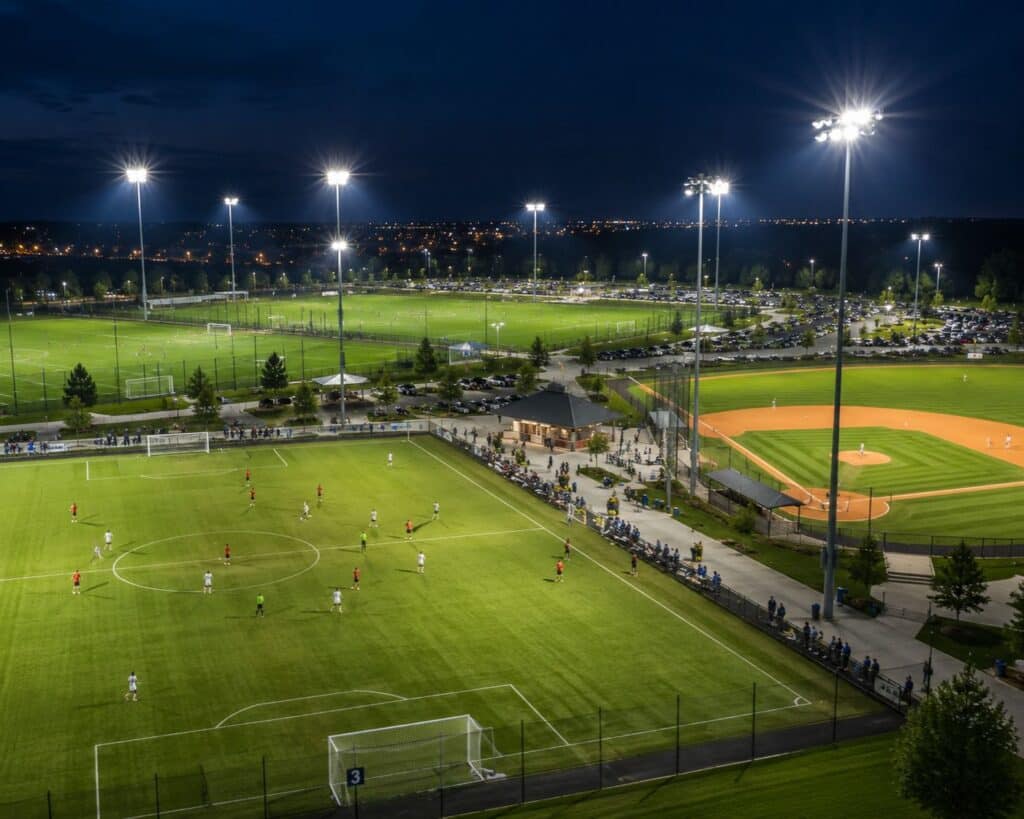
Modern LED sports lighting extends playing hours while improving visibility, safety, and energy efficiency.
Planning a new sports lighting project?
Our lighting specialists provide photometric layouts, fixture recommendations, pole configurations, and LED sports lighting solutions for athletic fields, courts, stadiums, and recreation facilities.
Request a Free Lighting Consultation – – https://industriallightingfixtures.org/
Why Sports Lighting Is Different from Traditional Outdoor Lighting
Sports lighting is one of the most specialized forms of commercial outdoor lighting.
Unlike parking lots or roadways, athletic facilities require lighting that supports fast-moving players, airborne balls, changing weather conditions, television broadcasts, and spectator comfort—all while minimizing glare and maintaining consistent illumination across large playing areas.
Every lighting design must balance several objectives simultaneously:
- Player safety
- Spectator visibility
- Official and referee visibility
- Camera and video performance
- Uniform light distribution
- Reduced glare
- Energy efficiency
- Long-term reliability
A successful sports lighting system is designed around how the facility is used, not simply how bright it appears.
Choosing the right luminaire is one of the most important decisions in any sports lighting project. Compare available wattages, beam distributions, mounting options, and performance features in our LED Sports Lighting Fixtures product guide.
Benefits of Playing After Dark
Extending playing hours provides significant advantages for facility owners and users alike.
Many athletic facilities experience their highest demand during evenings, when students, employees, and families are available to participate.
LED sports lighting allows organizations to:
- Extend practice schedules
- Host evening games and tournaments
- Increase field availability
- Maximize facility utilization
- Generate additional rental revenue
- Support community recreation programs
- Improve scheduling flexibility
- Enhance player and spectator safety
For municipalities and schools with limited athletic space, evening operation often eliminates the need to construct additional playing fields.
Sports lighting systems represent a significant investment, making long service life an important consideration. Learn how premium components maximize reliability in our Commercial LED Lifespan Guide.
Who Uses LED Sports Lighting?
Modern LED sports lighting is installed across a wide range of recreational, educational, and commercial facilities.
Common applications include:
- Public parks
- School athletic fields
- Colleges and universities
- Professional sports venues
- Community recreation centers
- Private sports clubs
- Tennis facilities
- Pickleball complexes
- Baseball and softball fields
- Football stadiums
- Soccer pitches
- Rugby and lacrosse fields
- Cricket grounds
- Track and field facilities
- Multi-purpose athletic complexes
Each application has unique lighting requirements based on the size of the venue, the level of competition, and the activities taking place.
Indoor tennis facilities require careful attention to glare control, fixture placement, and uniform illumination to help players track fast-moving balls. Learn more in our LED Indoor Tennis Court Lighting Guide
Common Goals of a Sports Lighting Project
Every project begins with different priorities, but most owners are trying to achieve several common objectives.
Improve Player Performance
Athletes perform best when they can clearly see teammates, opponents, playing surfaces, and fast-moving equipment without distracting shadows or excessive glare.
Increase Safety
Consistent illumination helps reduce trip hazards, improves depth perception, and allows officials and coaches to better monitor play.
Reduce Operating Costs
Replacing older metal halide systems with LED fixtures can significantly reduce electricity consumption while lowering maintenance requirements through longer fixture life and fewer service interruptions.
Improve the Spectator Experience
Comfortable, well-designed lighting allows spectators to follow the action more easily while minimizing direct glare from high-mounted luminaires.
Larger venues may also require lighting that supports photography, live streaming, scoreboards, and video displays.
Protect Surrounding Properties
Modern optical systems direct more light where it’s needed while reducing spill light and sky glow that can affect nearby homes, businesses, and roadways.
Proper fixture aiming and photometric design play an important role in being a good neighbor.
Tennis courts demand exceptionally uniform lighting to minimize shadows and improve visibility during serves, volleys, and baseline rallies. Our Tennis Court Lighting Design Guide explains how photometric layouts, fixture aiming, and pole placement contribute to optimal court performance.
Components of a Modern LED Sports Lighting System
A sports lighting installation is much more than a collection of fixtures mounted on tall poles.
A complete system may include:
- High-output LED sports luminaires
- Steel, aluminum, or concrete poles
- Crossarms and mounting hardware
- Precision optics
- Surge protection
- Lighting controls
- Photocells or scheduling systems
- Wireless monitoring
- Electrical distribution equipment
- Emergency disconnects
Each component contributes to the overall performance, reliability, and maintainability of the system.
Large athletic venues introduce additional challenges beyond field illumination. Visit our Stadium Lighting Design Guide to learn how lighting enhances spectator comfort, broadcasting, security, and the complete stadium experience.
Why Professional Lighting Design Matters
One of the biggest misconceptions is that brighter fixtures automatically create better sports lighting.
In reality, successful projects depend on careful engineering.
Professional lighting designers evaluate:
- Field dimensions
- Pole locations
- Mounting heights
- Fixture aiming angles
- Beam distributions
- Foot-candle requirements
- Uniformity ratios
- Glare control
- Spill light
- Existing electrical infrastructure
- Future maintenance access
Using photometric software, designers can predict how light will perform before a single fixture is installed, helping owners avoid costly changes after construction.
🏟️ Design Insight
The best sports lighting projects aren’t defined by the highest light levels—they’re defined by the right light levels. Uniform illumination, effective glare control, and precise optical distribution often have a greater impact on player performance and spectator comfort than simply increasing fixture wattage. A professionally designed photometric layout ensures light is delivered where it’s needed most while minimizing wasted energy and unwanted spill light.
Setting the Stage for Better Sports Lighting
Every athletic facility has unique lighting requirements based on the sport being played, the level of competition, the size of the venue, and the expectations of athletes and spectators.
In the next section, we’ll explore why LED technology has become the industry standard for sports lighting, comparing it with older metal halide systems and examining the performance, maintenance, and energy-saving advantages that continue to drive LED adoption across athletic facilities worldwide.
Curious about where athletic lighting is headed? Continue with our Future of Sports Lighting Guide to explore emerging technologies such as AI-assisted controls, smart lighting platforms, RGB entertainment lighting, and the next generation of commercial LED systems.
Understanding Recreational vs. Competitive Sports Lighting
Not every athletic facility requires the same lighting system.
A neighborhood basketball court or community baseball field has very different lighting requirements than a collegiate football stadium or tournament tennis complex. The level of play influences recommended light levels, uniformity, glare control, and the overall sophistication of the lighting system.
Sports lighting projects generally fall into several categories:
Recreational Facilities
Designed for casual play, community leagues, and public parks, these installations emphasize safety, energy efficiency, and cost-effective operation.
Typical examples include:
- Community parks
- HOA sports courts
- Elementary school playgrounds
- Church recreation facilities
- Local baseball and softball fields
Competitive Facilities
High school, collegiate, and tournament venues require more precise lighting to support faster play, improved visibility, officiating, photography, and larger spectator areas.
These projects often demand tighter control of glare, more consistent light distribution, and higher overall illumination levels.
Understanding the intended level of competition helps determine the appropriate lighting strategy before fixture selection begins.
Why Photometric Planning Matters
One of the biggest mistakes made during sports lighting projects is selecting fixtures based solely on wattage or lumen output.
Modern LED sports lighting should always begin with a professional photometric study.
A photometric layout predicts how light will perform across the playing surface before equipment is purchased or installed.
The study evaluates factors such as:
- Average illumination
- Minimum illumination
- Uniformity ratios
- Pole locations
- Mounting heights
- Fixture aiming
- Beam patterns
- Glare
- Spill light
- Light trespass
Rather than relying on trial and error, photometric planning provides confidence that the finished installation will meet the performance goals of the facility while avoiding unnecessary fixture costs.
The Long-Term Value of LED Sports Lighting
Although LED fixtures may require a higher initial investment than older technologies, they often deliver a lower total cost of ownership over their service life.
Facility owners benefit from:
- Lower electrical consumption
- Reduced maintenance
- Longer fixture life
- Fewer lamp replacements
- Instant-on operation
- Smart lighting controls
- Improved reliability
- Better playing conditions
These advantages continue to make LED the preferred choice for new athletic facilities and retrofit projects alike.
💡 Specification Tip
When evaluating sports lighting, look beyond fixture wattage and initial purchase price. A professionally engineered LED system with optimized optics, quality drivers, and smart controls often delivers the best long-term value through lower operating costs, reduced maintenance, and a superior experience for athletes and spectators.
Why LED Has Become the Standard for Sports Lighting
For decades, metal halide fixtures were the industry standard for illuminating athletic fields, stadiums, and sports complexes. While these systems served facilities well for many years, they came with significant drawbacks—including high energy consumption, lengthy warm-up times, frequent lamp replacements, and declining light output as fixtures aged.
Today’s LED sports lighting systems overcome many of these limitations while providing superior visibility, lower operating costs, and greater control over how athletic facilities are illuminated.
From neighborhood parks to collegiate stadiums and professional venues, LED technology has become the preferred solution for both new construction and retrofit projects.
The Evolution of Sports Lighting
Sports lighting has changed dramatically over the past several decades.
Early athletic facilities often relied on high-pressure sodium or mercury vapor lamps before metal halide became the dominant technology. Metal halide fixtures offered improved color quality and higher light output, making nighttime competition possible across a wide variety of sports.
As LED technology matured, fixture performance improved rapidly.
Modern sports lighting systems now deliver:
- Higher luminous efficacy
- Better optical control
- Longer operating life
- Instant-on performance
- Reduced maintenance
- Superior color consistency
- Smart lighting controls
- Lower energy consumption
These improvements have fundamentally changed how athletic facilities are designed and operated.
Why Facility Owners Are Switching to LED
Organizations responsible for athletic facilities are under constant pressure to reduce operating costs while improving the experience for athletes and spectators.
LED sports lighting addresses both objectives.
Common reasons for upgrading include:
- Lower utility bills
- Reduced maintenance expenses
- Better nighttime visibility
- Improved player safety
- Enhanced spectator comfort
- Greater scheduling flexibility
- Reduced downtime
- Environmental sustainability
- Improved reliability
Many facilities also recognize that improved lighting enhances the overall appearance of the venue, making it more attractive for tournaments, community events, and rentals.
LED vs. Metal Halide Sports Lighting
The differences between LED and traditional metal halide systems extend well beyond energy savings.
| Feature | LED Sports Lighting | Metal Halide Lighting |
|---|---|---|
| Energy Efficiency | Excellent | Moderate |
| Warm-Up Time | Instant | 10–20 minutes |
| Restart After Power Loss | Immediate | Significant delay |
| Light Output Over Time | Consistent | Gradually declines |
| Maintenance | Low | Frequent lamp and ballast replacement |
| Color Consistency | Excellent | Changes as lamps age |
| Optical Control | Precision optics | Broader light distribution |
| Smart Controls | Fully compatible | Limited |
| Expected Service Life | Long | Shorter |
Modern LED systems maintain more consistent performance throughout their service life, reducing both maintenance demands and interruptions to facility operations.
Better Visibility for Athletes
Clear visibility directly affects athletic performance.
Players must be able to quickly track:
- Teammates
- Opponents
- Fast-moving balls
- Playing boundaries
- Goal posts
- Bases
- Court markings
- Officials
Modern LED optics produce more uniform illumination across the playing surface, helping reduce distracting shadows and improving depth perception.
The result is a safer, more enjoyable environment for athletes at every level of competition.
Improved Visibility for Officials and Coaches
Referees, umpires, judges, and coaches depend on clear sightlines to make accurate decisions.
Uniform lighting improves visibility during:
- Close plays
- Goal-line decisions
- Boundary calls
- Player positioning
- Coaching instruction
- Training sessions
Better lighting contributes to fair competition while reducing visual fatigue during extended events.
Enhanced Spectator Experience
Lighting influences more than just the game itself.
Well-designed sports lighting helps spectators follow the action comfortably without excessive glare or dark areas.
Benefits include:
- Improved visibility from seating areas
- Better facial recognition
- Reduced eye strain
- Enhanced event atmosphere
- Improved viewing for families and community events
Larger venues also benefit from lighting that supports scoreboards, digital displays, photography, and live streaming.
Contextual Link:
Large athletic venues often require specialized lighting strategies. Learn more in our upcoming Stadium Lighting Design Guide.
Significant Energy Savings
Lighting frequently represents one of the largest electrical loads at an athletic facility.
Replacing older metal halide fixtures with modern LED luminaires can substantially reduce electrical consumption while delivering equal—or better—playing conditions.
Additional savings often come from:
- Reduced cooling loads
- Scheduled operation
- Zoned lighting
- Dimming controls
- Occupancy scheduling
- Smart monitoring systems
For facilities operating multiple fields or courts, these savings can have a meaningful impact on annual operating budgets.
Longer Service Life Means Less Maintenance
Maintenance costs are often overlooked when evaluating sports lighting.
Many fixtures are installed on poles ranging from 30 to more than 100 feet above the playing surface.
Servicing these systems may require:
- Bucket trucks
- Cranes
- Temporary field closures
- Maintenance crews
- Traffic control
- Equipment rentals
Long-life LED fixtures reduce the frequency of maintenance visits, helping facilities minimize labor costs and disruptions.
Precision Optics Improve Lighting Performance
One of LED’s greatest advantages is its ability to control where light is directed.
Unlike older technologies that scatter light in many directions, modern LED optics concentrate illumination precisely where it is needed.
This improves:
- Uniformity
- Player visibility
- Spectator comfort
- Glare control
- Spill light reduction
- Sky glow reduction
Better optical control also allows designers to achieve lighting objectives using fewer fixtures in many applications.
Smart Controls Add Operational Flexibility
Modern sports lighting systems integrate easily with intelligent control platforms.
Facilities can create customized lighting scenes for different activities, including:
- Team practices
- Recreational play
- League games
- Tournament play
- Cleaning
- Maintenance
- Security patrols
- Special events
Operators can often schedule lighting automatically or manage systems remotely through centralized control platforms.
These capabilities improve operational efficiency while reducing unnecessary energy consumption.
🏟️ Project Spotlight
A municipal sports complex replaced aging 1,000-watt metal halide fixtures serving two baseball fields and four multi-purpose athletic fields with high-efficiency LED sports luminaires. The project reduced energy consumption, eliminated lengthy warm-up periods, and allowed staff to schedule lighting independently for each field. Separate practice and game lighting scenes provided additional flexibility while reducing operating costs during evenings with lighter field usage.
Sustainability and Environmental Benefits
Many municipalities, schools, and universities have established sustainability goals that include reducing energy consumption and minimizing light pollution.
Modern LED sports lighting supports these initiatives through:
- Lower electrical demand
- Reduced greenhouse gas emissions associated with power generation
- Longer fixture life
- Reduced waste from lamp replacements
- Improved optical control
- Reduced sky glow
- Better management of light trespass
When paired with thoughtful photometric design, LED systems help create athletic facilities that are both environmentally responsible and community-friendly.
💡 Design Insight
The true value of LED sports lighting extends beyond energy savings. Improved optics, instant-on performance, reduced maintenance, smart controls, and superior light quality combine to create facilities that are safer, easier to operate, and more enjoyable for athletes, officials, and spectators alike.
Designing an Effective LED Sports Lighting System
The quality of a sports lighting system is determined long before the first fixture is installed.
Successful projects begin with careful planning, engineering, and photometric analysis to ensure every athlete, official, coach, and spectator enjoys safe, comfortable, and consistent visibility. Simply selecting the highest-output fixture rarely produces the best results. Instead, the goal is to deliver the right amount of light, in the right locations, with the right optical control.
Whether lighting a neighborhood baseball field or a collegiate stadium, every sports lighting project should be engineered around the unique characteristics of the facility.
Start with a Photometric Lighting Plan
Every successful sports lighting installation begins with a professional photometric study.
A photometric layout uses specialized software to predict how light will be distributed across the playing surface before construction begins. This allows designers to evaluate multiple fixture configurations and optimize the lighting system for the intended sport.
A photometric study typically evaluates:
- Average illumination
- Minimum illumination
- Uniformity ratios
- Pole locations
- Pole heights
- Fixture aiming
- Beam angles
- Vertical illumination
- Glare
- Spill light
- Light trespass
- Existing site conditions
Rather than relying on estimates, photometric modeling provides measurable data that helps ensure the finished installation performs as intended.
Determining the Right Light Levels
Different sports—and different levels of competition—require different illumination levels.
A neighborhood practice field does not require the same lighting as a televised collegiate football game or a championship tennis tournament.
Lighting requirements are influenced by:
- Sport being played
- Level of competition
- Player speed
- Ball size and speed
- Spectator seating
- Television or live streaming
- Camera systems
- Safety requirements
The objective is not maximum brightness but consistent, usable illumination that supports the activities taking place on the field or court.
Understanding Uniformity
Uniformity refers to how evenly light is distributed across the playing surface.
Poor uniformity creates bright areas and dark zones that can interfere with player performance and increase the risk of injury.
Well-designed sports lighting minimizes these variations by carefully selecting fixture locations, beam patterns, and aiming angles.
Benefits of good uniformity include:
- Better depth perception
- Improved ball tracking
- Consistent player visibility
- Reduced eye fatigue
- Improved officiating
- Better spectator viewing
Uniform lighting often has a greater impact on playability than simply increasing overall light levels.
Pole Height and Fixture Placement
Pole height is one of the most important factors affecting sports lighting performance.
Mounting fixtures too low can create excessive glare and poor light distribution, while excessively tall poles may increase project costs without improving visibility.
The ideal pole height depends on:
- Sport
- Field dimensions
- Pole locations
- Fixture output
- Optical distribution
- Site constraints
- Existing infrastructure
Properly positioned poles help improve uniformity while reducing the number of fixtures required.
Precision Optics and Beam Distribution
Modern LED sports luminaires use advanced optical systems that direct light exactly where it is needed.
Instead of relying on broad reflector systems like older metal halide fixtures, LED optics are engineered to match the geometry of each playing surface.
Common beam distributions include:
- Narrow
- Medium
- Wide
- Asymmetric
- Forward throw
- Cross-field optics
By combining different optics on the same pole, designers can illuminate the entire field while minimizing wasted light.
Vertical Illumination Matters
Many people think only about the light reaching the ground.
However, sports lighting also requires excellent vertical illumination.
Players frequently look upward to follow:
- Baseballs
- Softballs
- Footballs
- Soccer balls
- Tennis balls
- Volleyballs
Officials and spectators also rely on vertical illumination to recognize player movements, facial expressions, and ball trajectories.
This becomes even more important in facilities supporting photography, video recording, or live streaming.
Controlling Glare
Glare is one of the most common complaints associated with poorly designed sports lighting.
Excessive glare can affect:
- Athletes tracking airborne balls
- Goalkeepers
- Tennis players serving
- Baseball outfielders
- Officials making close calls
- Spectators watching the event
Modern LED optics help reduce glare through:
- Precision aiming
- Shielding
- Appropriate mounting heights
- Beam selection
- Balanced fixture output
The goal is to place light on the playing surface—not directly into people’s eyes.
Reducing Spill Light and Sky Glow
Sports facilities often operate near residential neighborhoods, schools, businesses, and roadways.
Controlling light beyond the boundaries of the playing area helps minimize community impact while improving energy efficiency.
A well-designed lighting system reduces:
- Spill light onto adjacent properties
- Light trespass through neighboring windows
- Sky glow
- Driver distraction
- Unnecessary energy consumption
Careful fixture selection and photometric planning allow more of the available light to remain where it is needed.
Selecting the Right Color Temperature
Color temperature influences how players, officials, and spectators perceive the playing environment.
Common choices include:
4000K
- Comfortable appearance
- Reduced perceived glare
- Community parks
- Recreation facilities
- Neighborhood athletic fields
5000K
- Crisp white illumination
- Excellent visual clarity
- Collegiate athletics
- Tournament venues
- Professional facilities
The best choice depends on the facility’s purpose, surrounding environment, and owner preferences.
Color Rendering Improves Visibility
Color Rendering Index (CRI) measures how accurately colors appear under artificial lighting.
Higher CRI helps athletes distinguish:
- Uniform colors
- Field markings
- Balls
- Equipment
- Safety hazards
Improved color rendering also benefits:
- Officials
- Coaches
- Athletic trainers
- Photographers
- Spectators
Many commercial sports lighting projects specify fixtures with a CRI of 80 or higher.
Wind Loading and Structural Considerations
Sports lighting fixtures are frequently mounted on poles exposed to significant wind forces.
During the design process, engineers evaluate:
- Pole strength
- Fixture weight
- Effective projected area (EPA)
- Wind ratings
- Foundation requirements
- Existing pole capacity
When retrofitting older installations, existing poles should always be evaluated before new fixtures are installed.
In many cases, modern LED fixtures are lighter than older metal halide systems, but structural verification remains an essential part of the project.
Electrical Infrastructure
A successful retrofit also depends on understanding the facility’s electrical system.
Key considerations include:
- Available voltage
- Existing circuits
- Panel capacity
- Surge protection
- Grounding
- Emergency disconnects
- Control compatibility
Evaluating these items early helps reduce installation surprises and unnecessary change orders.
Smart Lighting Controls
Modern LED systems support sophisticated control strategies that improve both flexibility and efficiency.
Common control options include:
- Individual field control
- Zoned operation
- Scheduled events
- Wireless controls
- Remote monitoring
- Practice mode
- Competition mode
- Maintenance mode
- Security lighting
- Emergency override
Facilities with multiple fields often benefit from independent controls that allow only occupied areas to be illuminated.
Designing for Maintenance
Maintenance should be considered during the initial design—not after installation.
Questions to address include:
- Can lifts safely access every fixture?
- Are drivers field-serviceable?
- Are replacement parts readily available?
- Can fixtures be aimed without specialized equipment?
- Is maintenance possible without interrupting scheduled events?
A design that simplifies maintenance can significantly reduce lifetime operating costs.
📐 Specification Tip
The best sports lighting projects balance performance, efficiency, and maintainability. Selecting premium fixtures with precision optics, robust surge protection, corrosion-resistant construction, and accessible service components can reduce maintenance costs for many years after installation.
🏟️ Project Spotlight: Lighting a Multi-Sport Athletic Complex
A growing municipal recreation department planned to replace aging metal halide lighting serving two baseball fields, three soccer fields, four tennis courts, and a central walking plaza.
Rather than simply replacing fixtures one-for-one, the project team commissioned a complete photometric study. The analysis optimized pole heights, fixture aiming, beam distributions, and lighting zones for each activity area.
The completed system featured:
- Precision LED sports luminaires
- Reduced glare for athletes and spectators
- Improved lighting uniformity
- Independent controls for each field
- Lower energy consumption
- Reduced spill light into nearby neighborhoods
- Simplified maintenance planning
The result was a safer, more efficient athletic complex capable of supporting practices, league play, tournaments, and community events with lighting tailored to each venue.
Project Takeaway
Great sports lighting isn’t achieved by installing brighter fixtures—it’s achieved through thoughtful engineering. A professionally designed photometric layout, combined with the right optics, pole configuration, and control strategy, creates a lighting system that performs reliably for athletes, spectators, and facility operators alike.
Choosing the Right Lighting for Different Sports Facilities
No two athletic facilities have identical lighting requirements.
A neighborhood basketball court, a municipal soccer complex, a collegiate baseball stadium, and an indoor tennis center all present unique challenges that influence fixture selection, pole height, beam distribution, illumination levels, and lighting controls.
The most successful LED sports lighting projects are designed around how each facility is used—not simply the size of the playing surface.
By tailoring the lighting system to the sport and level of competition, facility owners can improve player performance, enhance spectator comfort, reduce operating costs, and extend the useful life of their investment.
Football Fields
Football places significant demands on a lighting system because the ball frequently travels high into the air while players move rapidly across a large field.
Lighting should provide:
- Excellent horizontal illumination
- Strong vertical illumination
- Consistent uniformity
- Minimal glare
- Good visibility along sidelines
- Clear end-zone lighting
Facilities hosting televised games or large tournaments often require higher illumination levels than recreational practice fields.
Proper lighting also assists coaches, officials, photographers, and video recording systems.
Soccer Fields
Soccer fields emphasize continuous visibility across one of the largest playing surfaces found in community athletic facilities.
Lighting should allow players to:
- Track fast-moving passes
- Judge ball trajectory
- Maintain peripheral vision
- Recognize teammates quickly
- See field markings clearly
Uniform lighting is particularly important because play moves continuously from one end of the field to the other.
Well-designed LED optics help eliminate dark zones that could interfere with player performance.
Baseball and Softball Fields
Baseball and softball present unique lighting challenges because athletes frequently track high fly balls while transitioning between brightly illuminated infields and larger outfield areas.
Special attention should be given to:
- Infield illumination
- Outfield visibility
- Batter visibility
- Pitcher visibility
- Base paths
- Dugouts
- Bullpens
Reducing glare behind home plate and in the outfield helps improve player performance while making games more enjoyable for spectators.
Tennis Courts
Tennis requires exceptionally uniform lighting because players constantly follow a small, fast-moving ball that changes direction rapidly.
Lighting should minimize glare during:
Serves
Overhead shots
Lobs
Baseline rallies
Net play
Proper fixture placement helps players maintain visual contact with the ball throughout each point.
Contextual Link:
Planning a tennis facility? Our LED Indoor Tennis Court Lighting Guide explores fixture layouts, glare control, and lighting recommendations for indoor courts.
Pickleball Courts
As one of the fastest-growing recreational sports, pickleball has become a common application for LED sports lighting.
Because players frequently look upward during serves and lobs, minimizing glare is especially important.
Typical design priorities include:
- Comfortable illumination
- Uniform light distribution
- Reduced glare
- Energy-efficient operation
- Neighborhood-friendly lighting
Many community pickleball facilities also benefit from lighting controls that allow individual courts to operate independently.
Basketball Courts
Outdoor basketball courts often operate well into the evening, especially within parks, schools, apartment communities, and recreation centers.
Lighting should provide:
- Uniform court illumination
- Clear visibility of players
- Safe circulation around the court
- Comfortable spectator viewing
- Reduced glare during jump shots
For indoor facilities, lighting should also coordinate with the surrounding architectural environment and ceiling structure.
Track and Field Facilities
Track and field complexes typically include multiple activity areas within one venue.
Lighting may be required for:
- Running tracks
- Jumping events
- Throwing events
- Warm-up areas
- Spectator seating
- Team gathering areas
Because activities occur simultaneously, multiple lighting zones often improve operational flexibility while reducing unnecessary energy consumption.
Stadiums
Large stadiums present some of the most demanding lighting projects in the industry.
In addition to supporting athletic competition, lighting may also need to accommodate:
- Large spectator crowds
- Video scoreboards
- Photography
- Television broadcasts
- Security
- Parking
- Event operations
- Concerts
- Community gatherings
These projects often require extensive photometric analysis and sophisticated control systems to balance performance with operating efficiency.
Multi-Sport Athletic Complexes
Many municipalities and schools operate facilities that include several different sports within one property.
A typical complex may include:
- Football field
- Soccer fields
- Baseball diamonds
- Tennis courts
- Pickleball courts
- Walking paths
- Parking areas
- Concession buildings
Rather than designing each field independently, lighting designers often develop a coordinated site-wide strategy that considers:
- Pole sharing
- Electrical infrastructure
- Lighting controls
- Maintenance access
- Future expansion
- Operating schedules
This integrated approach improves efficiency while simplifying long-term maintenance.
Schools and Universities
Educational institutions often require lighting systems that support multiple users throughout the day and evening.
Facilities may host:
- Physical education classes
- Team practices
- Varsity athletics
- Community recreation
- Youth sports
- Special events
- Graduation ceremonies
Flexible lighting controls allow schools to create different lighting scenes based on the activity while reducing energy consumption during periods of lighter use.
Municipal Parks and Recreation Departments
Parks departments often manage numerous athletic facilities with limited maintenance budgets.
LED sports lighting provides municipalities with:
- Lower utility costs
- Reduced maintenance
- Longer fixture life
- Improved public safety
- Better scheduling flexibility
- Increased community access
Many municipalities also appreciate improved optical control that minimizes spill light into surrounding residential neighborhoods.
Lighting Controls for Different Activities
Modern LED systems allow facilities to adjust lighting according to how each venue is being used.
Examples include:
Practice Mode
Reduced light levels for routine training sessions while maintaining safe visibility.
Competition Mode
Full illumination supporting league play, tournaments, and championship events.
Maintenance Mode
Targeted lighting for inspections, cleaning, and repairs without energizing the entire facility.
Security Mode
Lower illumination levels that improve visibility around buildings, walkways, and parking areas after events have concluded.
Event Mode
Customized lighting scenes for ceremonies, community events, fundraisers, and special activities.
These programmable lighting scenes improve flexibility while helping reduce operating costs.
Planning for Future Expansion
Athletic facilities frequently evolve over time.
A recreation complex that initially contains two soccer fields may later add:
- Additional playing fields
- Tennis courts
- Pickleball courts
- Walking trails
- Parking areas
- Spectator seating
- Concession buildings
Planning future electrical capacity, control systems, and pole locations during the initial project can reduce costs as the facility expands.
🏗️ Design Insight
Sports lighting should be designed with tomorrow’s needs in mind—not just today’s requirements. A scalable lighting system allows facility owners to expand athletic programs, add new venues, and incorporate future technologies without redesigning the entire electrical infrastructure.
🏟️ Project Spotlight: Lighting a Growing Community Sports Complex
A county parks department planned a new athletic complex consisting of two soccer fields, one baseball diamond, four tennis courts, walking paths, parking areas, and space reserved for future pickleball courts.
Rather than designing each venue independently, the lighting team developed a master plan that coordinated pole locations, electrical distribution, fixture optics, and lighting controls across the entire property.
The completed project featured:
- LED sports luminaires tailored to each sport
- Independent lighting zones for every venue
- Reduced glare for players and spectators
- Minimized spill light into nearby neighborhoods
- Energy-efficient LED fixtures throughout the complex
- Capacity for future expansion without major electrical upgrades
The result was a flexible, future-ready sports complex capable of supporting recreational leagues, tournaments, school athletics, and community events while maintaining lower operating costs and simplified maintenance.
Project Takeaway
Every sport has unique lighting requirements, but the most successful athletic complexes share one characteristic: a comprehensive lighting plan that balances player performance, spectator comfort, energy efficiency, maintainability, and long-term flexibility. Matching the lighting system to each facility’s purpose delivers better results than applying the same design approach across every field or court.
Planning Your Sports Lighting Project
Selecting the right LED sports lighting system involves far more than choosing a fixture with the highest lumen output. A successful project balances performance, safety, operating costs, maintenance, and future flexibility while meeting the unique needs of the athletic facility.
Whether you’re planning a new installation or upgrading an existing system, thoughtful planning at the beginning of the project helps avoid costly changes later and ensures the lighting system delivers reliable performance for many years.
Evaluating Your Existing Facility
Before selecting fixtures, conduct a thorough assessment of the existing site.
Important information includes:
- Type of sport
- Level of competition
- Field or court dimensions
- Existing pole locations
- Pole heights
- Electrical service
- Existing fixture quantity
- Fixture wattage
- Mounting hardware
- Operating schedule
- Lighting controls
- Maintenance access
- Future expansion plans
Documenting these conditions provides valuable information for photometric modeling and equipment selection.
Retrofit or Complete Replacement?
Many sports lighting projects begin as simple fixture replacements but quickly reveal opportunities for broader improvements.
A retrofit may be appropriate when:
- Existing poles remain structurally sound
- Electrical infrastructure is adequate
- Field layout remains unchanged
- Light levels meet current needs
A complete redesign may be the better investment when:
- Pole locations are poorly positioned
- Existing fixtures create excessive glare
- Additional fields are planned
- Lighting controls need modernization
- Uniformity is poor
- Spill light has become a concern
Professional evaluation helps determine which approach offers the best long-term value.
Can Existing Poles Be Reused?
In many cases, yes—but they should never be reused without engineering verification.
Older poles must be evaluated for:
- Structural integrity
- Corrosion
- Foundation condition
- Wind loading capacity
- Effective Projected Area (EPA)
- Mounting compatibility
Modern LED fixtures are often lighter than older metal halide luminaires, but differences in fixture size and wind loading still require careful review.
Reusing existing poles can significantly reduce installation costs when structural conditions are suitable.
Selecting Quality LED Sports Lighting Fixtures
Not all sports lighting fixtures are engineered to the same standards.
Commercial-grade LED luminaires should provide:
- High luminous efficacy
- Precision optics
- Durable die-cast aluminum housings
- Corrosion-resistant finishes
- High-impact lenses
- Premium LED drivers
- Surge protection
- Field-serviceable components
- Reliable thermal management
- Long-term manufacturer support
Higher-quality fixtures generally provide more consistent performance and lower maintenance costs throughout their service life.
Understanding Total Cost of Ownership
The lowest purchase price rarely delivers the greatest long-term value.
When comparing lighting systems, consider:
- Equipment cost
- Installation
- Energy consumption
- Maintenance labor
- Lift rentals
- Replacement parts
- Driver replacements
- Warranty support
- Expected service life
- Future upgrades
Premium lighting systems often reduce operating costs enough to offset a higher initial investment over time.
Energy Savings Example
Consider a municipal athletic complex operating:
24 metal halide sports fixtures rated at 1,000 watts each
The facility upgrades to:
24 LED sports luminaires rated at 600 watts each
Annual operating schedule:
6 hours per night
300 nights per year
Annual energy savings:
24 fixtures × 400 watts saved
= 9.6 kW
9.6 kW × 6 hours × 300 days
= 17,280 kWh saved annually
At an electricity rate of $0.15 per kWh
Annual electrical savings are approximately:
$2,592 per year
This estimate does not include additional savings from:
- Reduced maintenance
- Fewer lift rentals
- Elimination of lamp replacements
- Lower labor costs
- Reduced downtime
- Smart lighting controls
For facilities operating multiple fields, these savings can multiply significantly.
💡 Energy Insight
Energy savings are only part of the financial picture. Reducing maintenance on fixtures mounted 50 to 100 feet above the playing surface can save thousands of dollars over the life of the system.
Maintaining Peak Performance
Even the highest-quality LED sports lighting system requires periodic inspection.
Annual maintenance should include:
- Fixture housings
- Lens condition
- Mounting hardware
- Pole connections
- Electrical wiring
- Surge protection
- Driver operation
- Fixture aiming
- Control systems
- Photocells
- Wireless communication devices
Routine inspections help identify minor issues before they affect lighting performance or safety.
Annual Inspection Checklist
✓ Inspect poles for corrosion or damage
✓ Verify mounting hardware remains secure
✓ Clean fixture lenses if necessary
✓ Inspect electrical connections
✓ Test surge protection devices
✓ Confirm lighting controls operate correctly
✓ Verify scheduled lighting scenes
✓ Check wireless communication systems
✓ Confirm emergency disconnects remain accessible
✓ Inspect foundations for movement or deterioration
Maintaining detailed inspection records simplifies future maintenance planning and budgeting.
LED Sports Lighting Buyer Checklist
Before selecting a lighting system, confirm the project addresses each of the following:
Facility Planning
✓ Sport being played
✓ Level of competition
✓ Field dimensions
✓ Pole locations
✓ Future expansion
✓ Photometric layout
Fixture Selection
✓ Precision optics
✓ Appropriate beam distribution
✓ Premium LED drivers
✓ Surge protection
✓ Durable housing
✓ Corrosion-resistant finish
✓ Serviceable components
Lighting Performance
✓ Proper illumination levels
✓ Uniformity
✓ Vertical illumination
✓ Reduced glare
✓ Spill light control
✓ Appropriate color temperature
✓ CRI 80+
Electrical System
✓ Existing voltage
✓ Pole compatibility
✓ Control integration
✓ Surge protection
✓ Emergency disconnects
Warranty
✓ Standard 5-year warranty or premium 10-year warranty
✓ Driver coverage
✓ Housing coverage
✓ Finish protection
✓ Replacement parts availability
Inline Buyer Q&A
How many LED sports lights does my field need?
The number depends on the size of the playing area, pole height, fixture output, beam distribution, and required illumination levels. A professional photometric study provides the most accurate answer.
Can I replace metal halide fixtures with LED using the existing poles?
Often yes, provided the poles are structurally sound and compatible with the new fixtures. Engineering verification should always be completed before installation.
What color temperature is recommended?
Most outdoor athletic facilities use 5000K because it provides excellent visibility and crisp white illumination. Some parks and recreational facilities may prefer 4000K to create a slightly warmer appearance while reducing perceived glare.
How long do LED sports lights last?
Premium commercial luminaires commonly offer 50,000 to 100,000-hour LED ratings, depending on operating conditions, thermal management, and driver quality.
Can LED sports lighting reduce glare?
Yes. Modern precision optics allow lighting designers to direct illumination more accurately than older technologies, significantly improving glare control when combined with proper aiming and mounting heights.
Is a photometric layout really necessary?
Absolutely.
A photometric study verifies illumination levels, fixture quantity, pole placement, beam distribution, uniformity, and spill light before construction begins.
Can sports lighting be dimmed?
Yes.
Most commercial LED sports lighting systems support 0–10V dimming or advanced wireless control platforms that allow operators to create practice, competition, maintenance, and security lighting scenes.
Illuminate Every Game with Confidence
Whether you’re lighting a neighborhood basketball court, a championship baseball field, a university football stadium, or a multi-sport recreation complex, a professionally engineered LED sports lighting system delivers long-term value through improved visibility, enhanced safety, lower operating costs, and greater operational flexibility.
At LED Pros WorldWide, we help municipalities, schools, universities, architects, engineers, contractors, sports clubs, and recreation departments design lighting systems tailored to their facilities and budgets.
Our team can assist with:
Photometric lighting layouts
Fixture selection
Sports lighting retrofits
Pole and mounting recommendations
Smart lighting controls
Energy-saving strategies
Warranty guidance
Budget planning
Technical support throughout your project
Explore our LED Sports Lighting Fixtures or speak with one of our lighting specialists to begin planning your next athletic lighting project.
Call 1-844-533-7767 today to discuss a customized LED sports lighting solution for your athletic facility.
Frequently Asked Questions
What is LED sports lighting?
LED sports lighting is a specialized outdoor lighting system designed to provide safe, uniform illumination for athletic fields, courts, stadiums, and recreation facilities.
What sports can LED lighting support?
LED systems are commonly used for football, soccer, baseball, softball, tennis, pickleball, basketball, lacrosse, rugby, cricket, track and field, and multi-purpose athletic complexes.
Why is glare control important?
Reducing glare improves player comfort, helps officials make accurate calls, enhances spectator viewing, and allows athletes to better track fast-moving balls.
Can LED sports lighting reduce operating costs?
Yes.
Lower energy consumption, longer fixture life, reduced maintenance, and smart controls often result in significantly lower operating expenses than traditional metal halide systems.
What is a photometric study?
A photometric study is a computer-generated lighting analysis that predicts illumination levels, uniformity, beam distribution, spill light, and glare before equipment is installed.
Are smart lighting controls worth adding?
For many facilities, absolutely.
Smart controls improve scheduling flexibility, reduce energy consumption, simplify operation, and allow independent control of multiple fields or courts.
Should I choose a 5-year or 10-year warranty?
Facilities with heavy usage or difficult maintenance access often benefit from premium fixtures backed by longer warranties and higher-quality components.
Stay Connected with Our Lighting Resources
Add IndustrialLightingFixtures.org as a Preferred Source on Google to see more of our lighting guides and technical resources across Google Search experiences.

Related Resources
Continue exploring our sports lighting solutions:
LED Sports Lighting Fixtures
LED Indoor Tennis Court Lighting
Tennis Court Lighting Design Guide
Indoor Tennis Court Foot-Candle Guide