
Temporary lighting plays a vital role in countless commercial and industrial operations. Whether performing equipment maintenance inside a manufacturing plant, completing electrical work at a construction site, preparing an outdoor festival, inspecting warehouse inventory, or restoring power following severe weather, dependable portable lighting improves safety, productivity, and overall job performance.
Modern commercial LED work lights have transformed temporary illumination by providing brighter light, lower energy consumption, longer operating life, and significantly greater durability than older halogen and metal halide work lights. Today’s fixtures also produce less heat, offer instant full brightness, and are available in a wide range of portable configurations designed for demanding jobsite conditions.
From contractors and maintenance personnel to municipal crews, aviation technicians, utility companies, sports facilities, and event organizers, commercial LED work lights have become an essential tool wherever dependable temporary lighting is required.
This guide explains the different types of commercial LED work lights, how to choose the right fixture for your application, and what features provide the greatest long-term value.
Many organizations prefer purpose-built portable LED work lights because they combine high-output illumination, rugged construction, and flexible mounting options for demanding commercial and industrial environments.
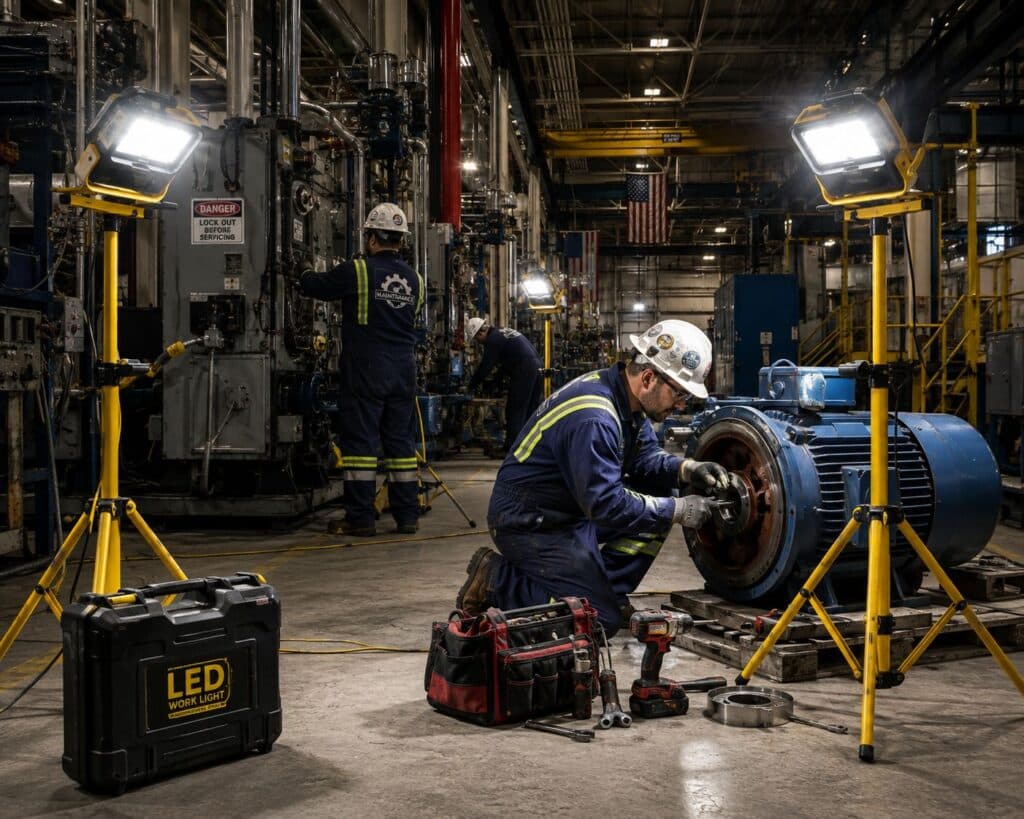
Commercial LED work lights provide dependable temporary illumination for construction, maintenance, industrial operations, emergency response, and special event applications.
Portable Commercial Lighting Built for Demanding Work Environments
Whether you’re illuminating a construction project, warehouse, manufacturing facility, airport, utility repair, municipal jobsite, or outdoor event, commercial LED work lights provide dependable temporary illumination while reducing energy consumption and maintenance requirements.
Browse our complete selection of commercial and industrial LED lighting solutions, or contact our lighting specialists for expert assistance selecting portable lighting designed for your specific application.
What Are Commercial LED Work Lights?
Commercial LED work lights are portable lighting fixtures designed to provide temporary, high-performance illumination wherever permanent lighting is unavailable, inadequate, or impractical.
Unlike permanently installed lighting systems, work lights can be quickly deployed, repositioned, and removed as projects progress. This flexibility makes them indispensable across a wide range of industries where lighting requirements frequently change throughout the workday.
Modern commercial work lights are engineered to withstand demanding environments while delivering reliable illumination for indoor and outdoor applications.
Common uses include:
- Construction projects
- Industrial maintenance
- Equipment inspections
- Manufacturing shutdowns
- Warehouse repairs
- Utility restoration
- Municipal public works
- Aviation maintenance
- Railroad maintenance
- Marine facilities
- Sports venue maintenance
- Temporary special events
Their combination of portability, durability, and energy efficiency makes commercial LED work lights one of the most versatile lighting solutions available.
Why Businesses Choose LED Work Lights
Older portable lighting technologies often presented significant limitations.
Halogen work lights generated excessive heat, consumed large amounts of electricity, and required frequent lamp replacement. Metal halide portable lighting required warm-up time before reaching full brightness and often performed poorly when switched on and off repeatedly.
Commercial LED work lights solve many of these challenges.
Organizations benefit from:
- Instant full brightness
- Lower electrical consumption
- Longer operating life
- Reduced maintenance
- Cooler operating temperatures
- Improved worker comfort
- Greater durability
- Better resistance to vibration
- Higher light quality
- Improved jobsite safety
As discussed in our Lumens Per Watt Explained, today’s commercial LED fixtures produce significantly more usable light while consuming substantially less electrical power than previous lighting technologies.
Common Industries That Depend on Portable Lighting
Commercial LED work lights are used across nearly every industrial sector.
Some of the most common applications include:
Construction
Temporary illumination for building construction, remodeling projects, electrical work, plumbing, framing, concrete placement, and finish work.
Manufacturing
Equipment maintenance, production line repairs, shutdown projects, quality inspections, and facility upgrades.
Warehousing & Distribution
Rack inspections, conveyor maintenance, dock repairs, inventory projects, and temporary workspace lighting.
Facilities upgrading permanent warehouse lighting can also benefit from our Commercial LED High Bay Lighting Guide.
Municipal & Public Works
Road maintenance, parks, public facilities, utility infrastructure, emergency repairs, and community improvement projects.
Aviation
Aircraft inspections, hangar maintenance, fueling operations, and airfield support activities requiring portable task lighting.
Utilities
Power restoration, substation maintenance, storm recovery, telecommunications infrastructure, and field service operations.
Marine & Port Operations
Vessel maintenance, container terminals, dock inspections, cargo handling equipment, and harbor maintenance projects.
Sports & Recreation Maintenance of athletic facilities, temporary practice areas, equipment servicing, tournament setup, and facility improvements. Sports complexes planning permanent upgrades can learn more in our Commercial LED Sports Lighting Guide.
Special Events & Temporary Venues
Commercial LED work lights are widely used during the setup, operation, and teardown of temporary events where safe, dependable illumination is essential.
Typical applications include:
- Outdoor festivals
- Community celebrations
- Concert production
- Sporting tournaments
- Vendor booths
- Food truck events
- Temporary parking areas
- Equipment staging
- Setup and teardown operations
- Emergency access routes
Because portable LED work lights can be relocated quickly, they provide event organizers with flexible illumination that adapts as venue layouts change throughout the event.
🏗️ Project Spotlight
Portable LED Work Lights Improve Facility Maintenance Efficiency
A regional manufacturing company replaced aging halogen portable work lights with modern commercial LED work lights throughout its maintenance department.
The new fixtures provided brighter illumination, reduced electrical consumption, operated at significantly cooler temperatures, and required virtually no lamp replacements.
Maintenance personnel also appreciated the instant-on performance and improved portability, allowing equipment repairs to be completed more safely and efficiently throughout the facility.
Applications
| Industry | Common Work Light Applications |
|---|---|
| Construction | Job sites, renovations, inspections |
| Manufacturing | Equipment maintenance, shutdowns |
| Warehousing | Rack inspections, maintenance |
| Aviation | Hangar maintenance, aircraft servicing |
| Rail & Transit | Track repairs, equipment inspections |
| Utilities | Storm restoration, substations |
| Municipal | Public works, parks, road maintenance |
| Oil & Gas | Temporary hazardous-area lighting |
| Marine | Port operations, vessel maintenance |
| Agriculture | Equipment repair, storage facilities |
| Special Events | Festivals, concerts, vendor areas, event setup |
| Sports Facilities | Practice fields, temporary venues, maintenance |
| Emergency Response | Disaster recovery, shelters, incident command |
Types of Commercial LED Work Lights
Commercial LED work lights are available in a wide variety of configurations, each designed to solve different lighting challenges. Choosing the appropriate fixture depends on the work environment, mounting requirements, available power, and the amount of illumination needed.
Understanding the strengths of each type helps ensure workers have dependable lighting while maximizing safety and productivity.
Tripod-Mounted LED Work Lights
Tripod-mounted work lights are among the most popular portable lighting solutions for commercial and industrial applications.
Their adjustable height and wide beam distribution make them ideal for illuminating large work areas while remaining easy to transport between projects.
Typical applications include:
- Construction projects
- Warehouse maintenance
- Manufacturing shutdowns
- Utility repairs
- Municipal public works
- Aircraft hangars
- Temporary event lighting
- Sports facility maintenance
Many tripod systems feature adjustable light heads that allow users to direct illumination precisely where it is needed.
Whether you’re lighting a warehouse renovation or an outdoor construction project, our commercial portable LED work lights are available in multiple configurations to match your project’s illumination requirements.
Handheld Inspection Lights
Compact handheld work lights provide focused illumination for close-up tasks where precision is important.
These fixtures are commonly used for:
- Equipment inspections
- Electrical troubleshooting
- Mechanical repairs
- HVAC servicing
- Aviation maintenance
- Plumbing repairs
- Fleet maintenance
Rechargeable LED technology allows these portable lights to deliver excellent brightness while remaining lightweight and easy to carry.
Rechargeable Portable Work Lights
Battery-powered work lights eliminate the need for extension cords and provide exceptional flexibility in locations where electrical service is unavailable.
Common uses include:
- Emergency response
- Storm restoration
- Remote construction sites
- Utility field work
- Temporary inspections
- Agricultural facilities
- Outdoor maintenance
Many commercial models utilize lithium-ion battery technology capable of delivering several hours of continuous operation while supporting rapid recharging.
Magnetic-Mount Work Lights
Magnetic work lights allow technicians to securely attach lighting directly to steel structures, machinery, vehicles, or equipment.
Popular applications include:
- Manufacturing equipment repairs
- Vehicle maintenance
- Industrial machinery
- Fleet service centers
- Railroad equipment
- Agricultural machinery
Hands-free illumination allows technicians to work more efficiently while maintaining both hands on the task.
Temporary Area Lighting
Some projects require illuminating entire work zones rather than individual workstations.
Temporary area lighting systems provide broad illumination for:
- Large construction sites
- Manufacturing shutdowns
- Warehouse renovations
- Distribution centers
- Utility staging areas
- Emergency command centers
- Disaster recovery operations
These systems often combine multiple LED fixtures to provide uniform lighting over expansive areas while remaining portable enough for temporary deployment.
Explosion-Proof Portable Work Lights
Hazardous industrial environments require specialized portable lighting certified for use in classified locations.
Explosion-proof portable work lights are commonly used in:
- Oil and gas facilities
- Chemical processing plants
- Refineries
- Fuel storage terminals
- Grain handling facilities
- Mining operations
- Paint spray areas
Unlike standard portable lighting, these fixtures are specifically engineered to prevent ignition of potentially explosive atmospheres.
Facilities operating in hazardous environments can learn more in our Explosion Proof Lighting Guide.
Battery-Powered vs. Corded Work Lights
One of the most common purchasing decisions involves choosing between battery-powered and corded work lights.
Each offers distinct advantages depending on the application.
| Feature | Battery-Powered | Corded |
|---|---|---|
| Mobility | Excellent | Limited by power source |
| Continuous Operation | Limited by battery capacity | Unlimited with power available |
| Outdoor Flexibility | Excellent | Requires extension cords |
| Emergency Response | Ideal | Less practical |
| Large Projects | Supplemental lighting | Continuous operation |
| Maintenance | Battery charging required | Minimal |
Battery-powered fixtures excel where portability is critical, while corded systems remain the preferred choice for extended projects requiring uninterrupted illumination.
Many organizations maintain both types to accommodate different work environments.
Choosing the Right Brightness
Selecting the brightest work light available is not always the best solution.
The appropriate lumen output depends on the size of the work area, task complexity, mounting height, and surrounding ambient lighting.
General recommendations include:
| Application | Recommended Lumens |
|---|---|
| Equipment Inspection | 500–1,500 Lumens |
| Maintenance Tasks | 1,500–3,000 Lumens |
| Small Work Areas | 3,000–5,000 Lumens |
| Construction Sites | 5,000–10,000 Lumens |
| Large Industrial Areas | 10,000+ Lumens |
Higher lumen output should always be paired with appropriate beam distribution to avoid excessive glare while maintaining comfortable visibility.
For a better understanding of fixture efficiency and lumen output, visit our Lumens Per Watt Explained guide.
Beam Patterns Matter
Brightness alone does not determine lighting performance.
Beam distribution affects how effectively the available light is delivered to the work area.
Common beam characteristics include:
Flood Beam
Provides wide illumination for general work areas, equipment maintenance, and temporary site lighting.
Spot Beam
Concentrates light into a narrower pattern for inspections, long-distance visibility, and detailed tasks.
Adjustable Beam Systems
Some commercial work lights allow users to reposition or adjust individual light heads, combining flood and spot illumination within the same fixture.
Selecting the appropriate beam pattern often improves visibility more effectively than simply increasing lumen output.
🏗️Project Spotlight
Temporary Lighting Supports Community Festival Setup
A municipal parks department used commercial LED tripod work lights during the setup of a multi-day outdoor community festival.
Portable lighting provided safe illumination for vendor installation, electrical setup, equipment staging, and temporary parking areas before permanent site lighting became fully operational.
Because the LED work lights produced minimal heat while delivering excellent visibility, crews were able to work efficiently during evening hours while easily relocating fixtures as the event layout evolved.
The same portable lighting equipment is now used throughout the year for park maintenance projects, public works activities, and seasonal community events.
IP Ratings and Environmental Protection
Commercial LED work lights are frequently used in challenging environments where dust, rain, mud, vibration, and temperature extremes are part of the job.
Selecting fixtures with an appropriate Ingress Protection (IP) rating helps ensure dependable performance while protecting internal electronic components from environmental damage.
Common ratings include:
| IP Rating | Typical Protection | Common Applications |
|---|---|---|
| IP54 | Dust protected and resistant to light water spray | Indoor maintenance, warehouses |
| IP65 | Dust-tight and protected against water jets | Construction, public works, outdoor maintenance |
| IP66 | Dust-tight with protection against powerful water jets | Industrial facilities, utilities, marine environments |
| IP67 | Temporary immersion protection | Severe outdoor environments and emergency response |
Choosing the proper environmental protection helps maximize fixture reliability while reducing maintenance costs.
Job Site Safety Considerations
Portable lighting plays an important role in maintaining safe working conditions.
Poor visibility contributes to trips, falls, equipment damage, and reduced productivity. Properly positioned commercial work lights help workers clearly identify tools, obstacles, electrical hazards, and moving equipment.
When planning temporary lighting, consider:
- Uniform illumination throughout the work area
- Minimizing glare
- Reducing deep shadows
- Proper cord management
- Stable fixture placement
- Weather-resistant equipment for outdoor projects
- Appropriate mounting height
- Routine inspection of portable electrical equipment
Providing adequate temporary lighting improves both safety and operational efficiency across virtually every commercial industry.
How to Choose the Right Commercial LED Work Light
Every project has unique lighting requirements.
Before selecting a portable work light, evaluate the following factors.
Work Environment
Will the fixture be used indoors, outdoors, or in hazardous industrial environments?
Environmental conditions influence enclosure ratings, housing materials, and required certifications.
Power Source
Determine whether continuous AC power is available or if battery-powered operation provides greater flexibility.
Many organizations maintain both corded and rechargeable work lights to support different applications.
Required Brightness
Choose lumen output appropriate for the size of the work area rather than simply selecting the brightest fixture available.
Proper light distribution often improves visibility more effectively than increasing lumen output alone.
Our Lumens Per Watt Explained guide discusses how fixture efficiency influences overall lighting performance.
Mounting Requirements
Consider how the light will be positioned.
Common mounting options include:
- Tripod
- Floor standing
- Magnetic base
- Hanging hook
- Adjustable bracket
- Vehicle mounting
- Portable tower
Selecting the appropriate mounting method improves both safety and productivity.
Operating Time
Battery-powered models should provide sufficient runtime to complete the intended work without frequent recharging.
Corded systems remain the preferred solution for extended maintenance projects and long-duration construction activities.
Long-Term Reliability
Commercial work lights often experience rough handling, transportation, and demanding operating conditions.
Premium fixtures typically provide:
- Better impact resistance
- Higher-quality drivers
- Improved thermal management
- Longer service life
- Lower maintenance requirements
As discussed in our Commercial LED Lifespan Guide, component quality significantly influences long-term performance.
Why LED Work Lights Continue to Replace Older Technologies
Commercial LED work lights have largely replaced halogen and metal halide portable lighting because they deliver advantages throughout the entire ownership cycle.
Compared with traditional portable lighting, LEDs offer:
- Lower electrical consumption
- Longer operating life
- Instant full brightness
- Cooler operation
- Better durability
- Improved color quality
- Reduced maintenance
- Lower total cost of ownership
- Better portability
- Greater compatibility with portable power systems
For organizations operating multiple crews or maintaining large equipment fleets, these benefits translate into measurable productivity improvements and lower operating costs.
🏗️Project Spotlight
Utility Crew Improves Storm Restoration Efficiency
Following a severe storm, a regional electric utility deployed rechargeable commercial LED work lights during overnight restoration activities.
Portable lighting was used to illuminate damaged utility poles, transformer installations, temporary staging areas, and equipment repairs in locations where electrical service remained unavailable.
Compared with older halogen work lights previously used by maintenance crews, the LED fixtures provided brighter illumination, reduced generator fuel consumption, generated significantly less heat, and improved worker visibility throughout the restoration effort.
Because the rechargeable units could be rapidly repositioned without extension cords, crews completed repairs more efficiently while improving overall job site safety.
Inline Buyer Q&A
What is the best commercial LED work light for construction?
Tripod-mounted LED work lights remain one of the most versatile solutions because they provide broad illumination, adjustable height, and easy portability across changing job sites.
Are rechargeable work lights bright enough for commercial applications?
Yes. Many commercial-grade rechargeable work lights produce several thousand lumens, making them suitable for maintenance, inspections, utility work, emergency response, and temporary job site lighting.
Should I choose battery-powered or corded work lights?
Battery-powered models provide greater mobility, while corded fixtures offer continuous operation for extended projects. Many organizations use both depending on the application.
What IP rating should I choose?
Indoor maintenance may only require IP54 protection, while outdoor construction, municipal maintenance, and industrial facilities often benefit from IP65 or higher.
Are LED work lights suitable for temporary special events?
Absolutely. Commercial LED work lights are widely used during festivals, concerts, sporting events, vendor setup, public gatherings, and temporary parking operations because they provide flexible, dependable illumination that can be quickly relocated as event layouts change.
Portable Lighting Designed for Commercial Performance
From construction sites and manufacturing facilities to utility repairs, aviation maintenance, sports complexes, municipal projects, and special events, commercial LED work lights provide the dependable temporary illumination needed to keep projects moving safely and efficiently.
By selecting portable lighting built with premium LEDs, commercial-grade drivers, durable housings, and application-specific features, organizations can reduce maintenance, improve productivity, and lower long-term operating costs.
Whether you need portable lighting for industrial maintenance, temporary construction, emergency response, event operations, or specialized commercial applications, our commercial LED lighting specialists can help you select the right solution for your project.
Ready to upgrade your temporary lighting? Explore our complete line of commercial portable LED work lights engineered for construction, industrial maintenance, municipal operations, utilities, aviation, and special events.
Frequently Asked Questions
How long do commercial LED work lights last?
Premium commercial LED work lights typically provide many years of dependable service when properly maintained and used within their rated operating conditions.
Do LED work lights use less electricity?
Yes. Modern LED work lights produce substantially more usable light while consuming considerably less electrical power than traditional halogen or metal halide work lights.
Can portable work lights be used outdoors?
Many commercial models are specifically designed for outdoor operation. Always verify the fixture’s IP rating before selecting lighting for wet or dusty environments.
Are LED work lights appropriate for industrial maintenance?
Yes. Commercial LED work lights are widely used throughout manufacturing facilities, warehouses, utilities, aviation, municipal maintenance, marine terminals, and industrial processing plants.
Can work lights be used in hazardous locations?
Only fixtures specifically certified for hazardous or classified locations should be used where flammable gases, vapors, or combustible dust may be present. Learn more in our Explosion Proof Lighting Guide.
Related Resources
Continue exploring commercial and industrial lighting with these helpful guides:
Commercial Portable LED Work Lights
Commercial Lighting Guide
Commercial LED Lifespan Guide
Commercial LED Driver Guide
Lumens Per Watt Explained
Commercial LED High Bay Lighting Guide
Commercial LED Sports Lighting Guide
Explosion Proof Lighting Guide