
Color-Changing Lighting Has Changed Commercial Architecture
Architectural lighting has evolved dramatically over the past decade.
Originally, color-changing flood lights were used primarily for special events or decorative displays.
Today, programmable RGB lighting systems are installed on:
- Hotels
- Corporate headquarters
- Universities
- Churches
- Bridges
- Stadiums
- Museums
- Casinos
- Government buildings
- Mixed-use developments
- Entertainment venues
Modern RGB lighting allows buildings to maintain elegant white illumination every day while instantly transforming into vibrant architectural landmarks for holidays, branding campaigns, and community events.
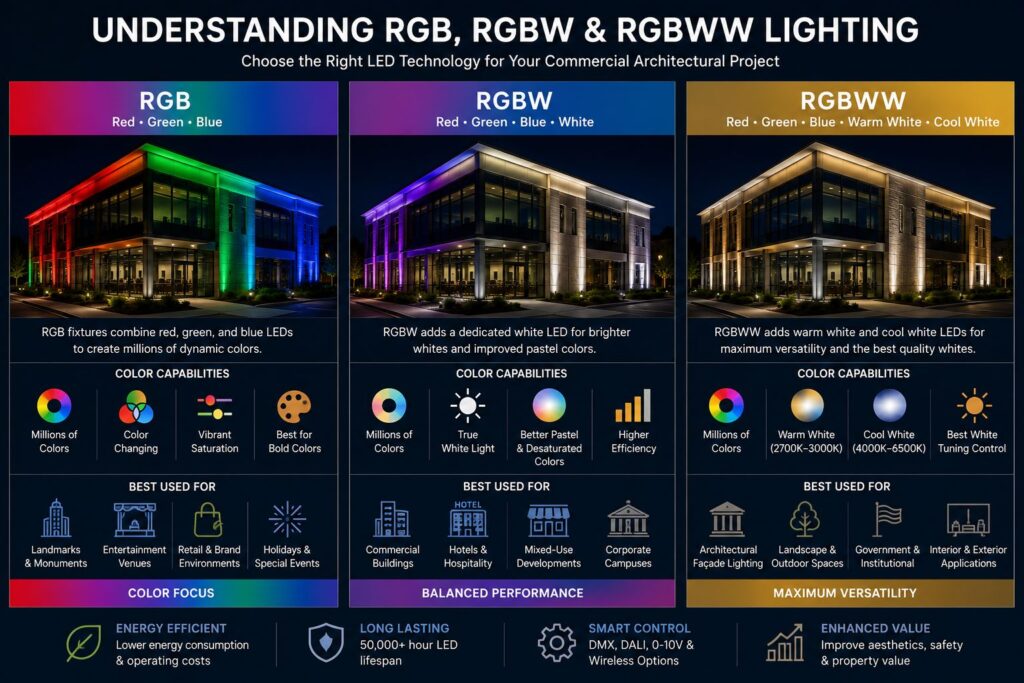
Understanding the differences between RGB, RGBW, and RGBWW lighting helps architects and facility owners select the best lighting technology for commercial architectural applications.
Selecting the proper color-changing lighting system is about more than choosing colors. White light quality, beam angles, control systems, and architectural objectives all influence the success of a commercial lighting project.
Our lighting specialists can help specify the ideal RGB lighting solution for your building.
Speak with an RGB Lighting Specialist – – https://industriallightingfixtures.org/
What Is RGB Lighting?
RGB stands for:
- Red
- Green
- Blue
By combining these three primary colors, LED fixtures can produce millions of different colors.
RGB technology works exceptionally well for:
- Holiday displays
- Decorative lighting
- Entertainment venues
- Stage lighting
- Special events
- Landscape accents
However, RGB systems create white light by mixing red, green, and blue LEDs together rather than using a dedicated white LED.
Although this produces usable white light, it generally lacks the quality and efficiency required for everyday commercial architectural illumination.
Ready to select fixtures? Continue with our Commercial RGBW Color-Changing Flood Lights Guide to compare mounting options, beam angles, commercial applications, and fixture selection.
What Is RGBW?
RGBW adds one important component:
A dedicated White LED.
This single addition dramatically changes the capabilities of the fixture.
Instead of creating white by blending colors, RGBW fixtures produce true white illumination while still offering millions of programmable colors.
Benefits include:
- Superior everyday architectural lighting
- Cleaner white appearance
- Better energy efficiency in white mode
- Improved color rendering
- Greater flexibility
- Better commercial performance
For most commercial architectural projects, RGBW has become the preferred technology.
Learn how lumen output, beam angles, color temperature, and optics influence architectural lighting performance in our RGBW Flood Light Brightness & Color Temperature Guide.
What Is RGBWW?
RGBWW takes RGBW one step further by adding a dedicated Warm White LED optimized for inviting architectural environments.
Instead of relying on one neutral white LED, RGBWW systems provide warm white illumination typically in the 2700K–3000K range.
This produces a softer appearance preferred for:
- Luxury hotels
- Resorts
- Fine dining restaurants
- Historic buildings
- Museums
- Churches
- High-end residential developments
- Boutique retail
RGBWW combines elegant warm architectural lighting with full RGB color-changing capability in one fixture.
After selecting the right lighting technology, the next step is choosing the proper control system. Continue with our DMX512 Architectural Lighting Guide to learn how professional lighting systems are programmed and managed.
RGB vs. RGBW vs. RGBWW
| Feature | RGB | RGBW | RGBWW |
|---|
| Dedicated White LED | No | Yes | Yes (Warm White) |
| Everyday White Lighting | Fair | Excellent | Outstanding |
| Holiday Lighting | Excellent | Excellent | Excellent |
| Architectural Lighting | Good | Excellent | Premium |
| Hospitality Projects | Fair | Excellent | Outstanding |
| Historic Buildings | Fair | Very Good | Excellent |
| Corporate Branding | Excellent | Excellent | Excellent |
| Restaurants | Fair | Very Good | Outstanding |
| Hotels & Resorts | Good | Excellent | Premium |
| Commercial ROI | Good | Excellent | Excellent |
Why Commercial Buildings Prefer RGBW
Commercial buildings rarely need colorful lighting every night.
Instead, they typically require:
- Professional white lighting during normal operation.
- Dynamic color scenes during holidays and special events.
RGBW satisfies both requirements using a single lighting system.
Typical everyday operation includes:
- White architectural lighting
- Building entrances
- Corporate identity
- Architectural accents
- Landscape lighting
Special event operation may include:
- Holiday colors
- University colors
- Charity awareness campaigns
- Sporting celebrations
- Corporate branding
- Grand openings
This flexibility eliminates the need to install separate architectural and decorative lighting systems.
See how RGBW and RGBWW technologies integrate into complete commercial architectural lighting systems by exploring our LED Façade Lighting solutions.
When RGB Is Still the Right Choice
Although RGBW has become the preferred solution for many commercial projects, traditional RGB lighting still performs well in applications where high-quality white illumination is not required.
Examples include:
- Entertainment venues
- Decorative landscape lighting
- Theme parks
- Seasonal displays
- Event lighting
- Stage lighting
- Temporary architectural displays
If the lighting system will operate primarily in color-changing modes, RGB may remain a practical and economical choice
White Light Quality Makes the Difference
One of the most important differences between RGB and RGBW systems is white-light performance.
Commercial buildings typically operate in white mode more than 90% of the year.
Examples include:
- Office buildings
- Hotels
- Universities
- Municipal buildings
- Churches
- Healthcare facilities
- Corporate headquarters
A dedicated white LED produces:
- Cleaner illumination
- Better architectural appearance
- Improved efficiency
- More accurate material colors
- Better visual comfort
This is one of the primary reasons RGBW has become the standard for commercial architectural lighting.
Color Temperature Selection
Commercial RGBW fixtures commonly offer several white-light options.
| Color Temperature | Typical Applications |
|---|---|
| 2700K | Luxury hospitality, restaurants |
| 3000K | Churches, stone buildings, hotels |
| 4000K | Office buildings, universities, hospitals |
| 5000K | Stadiums, industrial buildings, civic infrastructure |
Selecting the proper white light complements the building’s architecture while creating the desired visual atmosphere.
Why RGBWW Is Becoming More Popular
RGBWW is one of the fastest-growing technologies in commercial architectural lighting.
By incorporating a dedicated warm white LED, these fixtures provide an inviting nighttime appearance that is difficult to achieve with standard RGB or neutral-white RGBW systems.
This makes RGBWW particularly attractive for projects where ambiance is just as important as illumination.
Common applications include:
- Luxury hospitality
- Boutique hotels
- Historic preservation
- Upscale restaurants
- Public plazas
- Museums
- Churches
- Waterfront developments
As more designers prioritize visitor experience and architectural character, RGBWW continues to gain popularity in premium commercial projects.
LED Technology Continues to Improve
Today’s commercial RGBW and RGBWW fixtures offer significant performance improvements over earlier generations.
Advantages include:
- Higher efficacy, with many premium fixtures approaching 200 lumens per watt
- Improved optical control
- Better thermal management
- Longer service life
- Higher-quality drivers
- Enhanced surge protection
- Field-selectable wattage on many models
- Improved control compatibility
These advances help reduce operating costs while delivering outstanding architectural performance.
Choosing the Right Lighting Control System
Selecting the proper LED technology is only part of a successful architectural lighting project. The control system determines how easily fixtures can be programmed, synchronized, and managed over time.
Today’s commercial RGB lighting systems typically use one of three control methods.
DMX512 Professional Control Systems
For large architectural installations, DMX512 remains the industry standard.
Originally developed for theatrical lighting, DMX512 is now widely used to coordinate RGBW lighting across commercial buildings, bridges, stadiums, campuses, and civic landmarks.
DMX512 provides:
- Individual fixture addressing
- RGBW color mixing
- Synchronized building-wide lighting
- Animated lighting scenes
- Fade and transition effects
- Holiday programming
- Corporate branding colors
- Zoned lighting control
- Expansion to hundreds of fixtures
DMX512 is ideal for projects requiring professional-level flexibility and future expansion.
Bluetooth Smartphone App Control
Many commercial RGBW fixtures now include Bluetooth connectivity.
Advantages include:
- Easy installation
- Smartphone operation
- Brightness adjustment
- Color selection
- Scene storage
- Fixture grouping
- Scheduling
- No dedicated controller required for many projects
Bluetooth systems work particularly well for:
- Churches
- Restaurants
- Hotels
- Office buildings
- Municipal buildings
- Small commercial campuses
Wi-Fi and Cloud-Based Control
Larger commercial properties often prefer Wi-Fi or network-connected systems.
Benefits include:
- Remote management
- Cloud-based scheduling
- Multiple user access
- Centralized control
- Automatic updates
- Integration with building management systems
- Control from virtually anywhere
These systems simplify management across multiple buildings or large commercial campuses.
Which Control System Is Best?
| Control System | Best Applications | Primary Advantages |
|---|---|---|
| Bluetooth | Small commercial buildings | Easy installation and smartphone control |
| Wi-Fi | Multi-building facilities | Remote access and centralized management |
| DMX512 | Large architectural projects | Professional synchronization and unlimited programming flexibility |
Selecting the right control platform depends on the project’s size, complexity, and long-term operational goals.
Beam Angles and Optical Performance
Even the most advanced RGBW fixture cannot perform properly if the wrong beam angle is selected.
Professional lighting designers use optics to shape light precisely where it is needed.
| Beam Angle | Typical Applications |
|---|---|
| 10° | Columns and statues |
| 15° | Flags and narrow architectural details |
| 25° | Monument signs and building entrances |
| 40° | Medium façade sections |
| 60° | Wall washing |
| 120° | Large building façades |
Many projects combine multiple beam angles to create depth, contrast, and balanced illumination.
RGBW Lighting Scenes Throughout the Year
One RGBW lighting system can support dozens of annual events.
Typical lighting programs include:
| Event | Lighting Theme |
|---|---|
| Independence Day | Red, White & Blue |
| Christmas | Red & Green |
| New Year’s Eve | Gold & White |
| Earth Day | Green |
| Breast Cancer Awareness Month | Pink |
| Veterans Day | Patriotic Colors |
| University Graduation | School Colors |
| Corporate Anniversary | Company Colors |
| Sporting Championship | Team Colors |
| Grand Opening | Animated Welcome Display |
Because these scenes are software-controlled, buildings can change appearance instantly without replacing fixtures.
Commercial Applications
Hotels and Resorts
RGBWW is particularly effective for hotels because it combines warm architectural lighting with dynamic event lighting for holidays, weddings, and special occasions.
Corporate Headquarters
Many businesses illuminate headquarters using company colors during product launches, anniversaries, charitable campaigns, and community events.
Universities
Campus buildings often display school colors during graduations, athletic events, alumni weekends, and fundraising campaigns.
Churches
RGBW lighting highlights steeples, crosses, bell towers, and architectural details while maintaining warm white illumination for everyday operation.
Bridges and Public Infrastructure
Municipalities increasingly use programmable RGBW lighting to transform bridges and civic landmarks into recognizable community icons.
Stadiums and Arenas
Sports venues use RGB lighting to celebrate victories, energize fans, and reinforce team branding before, during, and after events.
Tunable White: The Next Evolution
One of the fastest-growing trends in commercial architectural lighting is Tunable White technology.
Unlike standard RGBW systems with one white LED, Tunable White allows designers to adjust the color temperature of white light throughout the evening.
For example:
- 2700K creates a warm, inviting atmosphere.
- 3000K provides elegant architectural illumination.
- 4000K offers a balanced, contemporary appearance.
- 5000K delivers crisp, high-visibility lighting.
This flexibility allows buildings to adapt to different seasons, events, and architectural goals without changing fixtures.
Return on Investment Beyond Energy Savings
Commercial RGBW lighting provides benefits that extend beyond reduced utility bills.
Property owners often realize value through:
- Lower maintenance costs
- Increased property visibility
- Improved customer experiences
- Stronger corporate branding
- Greater tenant appeal
- Enhanced community engagement
- Reduced fixture replacement
- Long service life
For many commercial projects, these operational and marketing advantages significantly increase the overall return on investment.
Common Specification Mistakes
Avoid these common errors:
- Choosing RGB when RGBW better fits the project
- Ignoring white-light quality
- Selecting incorrect beam angles
- Over-lighting the building
- Failing to plan future lighting scenes
- Mixing inconsistent color temperatures
- Ignoring control system compatibility
- Omitting photometric analysis
- Underestimating maintenance access
- Selecting fixtures without surge protection
Thoughtful planning produces a lighting system that remains attractive, efficient, and easy to maintain for years.
Commercial Buyer Checklist
Before requesting a quotation, gather:
✓ Building elevations
✓ Site photographs
✓ Architectural drawings
✓ Desired lighting effects
✓ White color temperature preference
✓ RGBW or RGBWW requirements
✓ Beam angle requirements
✓ Mounting heights
✓ Electrical service voltage
✓ Preferred control system
✓ Environmental conditions
This information enables lighting specialists to recommend the appropriate fixtures, optics, controls, and layout.
Inline Buyer Q&A
Is RGBW better than RGB for most commercial buildings?
Yes. RGBW provides dedicated white illumination for everyday operation while retaining full color-changing capability for holidays, branding, and special events.
When should I choose RGBWW?
RGBWW is an excellent choice for luxury hotels, fine dining restaurants, museums, churches, and historic buildings where warm, inviting white light is a priority.
Can Bluetooth replace DMX512?
For many small and medium commercial projects, yes. Large installations with numerous fixtures typically benefit from DMX512 because it offers superior synchronization and scalability.
Do RGBWW fixtures consume more energy?
Energy consumption depends primarily on fixture wattage and operating mode rather than the LED configuration. Modern RGBWW fixtures remain highly energy efficient while providing premium white-light quality.
Can one lighting system handle both everyday operation and holidays?
Absolutely. That’s one of the biggest advantages of RGBW and RGBWW technology. Buildings can operate in white mode every day and switch to programmable colors whenever needed.
Choose the Right Technology for Lasting Results
Selecting between RGB, RGBW, and RGBWW involves more than comparing colors. The right choice depends on your project’s architectural goals, desired white-light quality, control requirements, and long-term operational needs. By understanding the strengths of each technology, you can design a lighting system that enhances your building, supports your brand, and delivers exceptional performance for years to come.
Ready to Design Your RGB Architectural Lighting System?
Our lighting specialists can help you compare RGB, RGBW, and RGBWW technologies, recommend the ideal fixtures and controls, and develop a lighting plan tailored to your commercial project.
Explore our complete selection of Commercial RGB LED Lighting solutions and create an architectural lighting system that makes a lasting impression.
Frequently Asked Questions
Which technology is best for office buildings?
RGBW is generally the preferred solution because it provides professional white architectural lighting with programmable color capability for special events.
Which technology is best for luxury hotels?
RGBWW is often preferred because it delivers warmer, more inviting white light while maintaining full RGB color-changing capability.
Can RGB fixtures produce white light?
Yes, but RGB creates white by mixing red, green, and blue LEDs. RGBW and RGBWW provide higher-quality white illumination through dedicated white LEDs.
Is DMX512 difficult to operate?
Modern DMX systems are easier to manage than ever before, and many projects combine DMX controllers with intuitive software interfaces for simplified programming and scheduling.
Is RGBWW replacing RGBW?
Not entirely. RGBW remains the most common commercial solution, while RGBWW continues to gain popularity in hospitality, luxury architecture, and premium commercial developments.