
What Is DMX512?
DMX512 (Digital Multiplex 512) is the industry-standard communication protocol used to control professional architectural, entertainment, and commercial RGBW lighting systems.
Originally developed for theatrical stage lighting, DMX512 has become the preferred control system for commercial architectural lighting because it provides reliable communication between a lighting controller and multiple fixtures.
Instead of manually adjusting each luminaire, DMX512 allows an entire lighting system to operate as one coordinated network.
Modern commercial DMX systems control:
- RGBW flood lights
- Wall washers
- Linear façade lighting
- Bridge lighting
- Monument lighting
- Landscape accent lighting
- Entertainment lighting
- Stadium lighting
- Public art installations
For commercial architectural projects, DMX512 provides precision, flexibility, and scalability that simpler control systems cannot match.
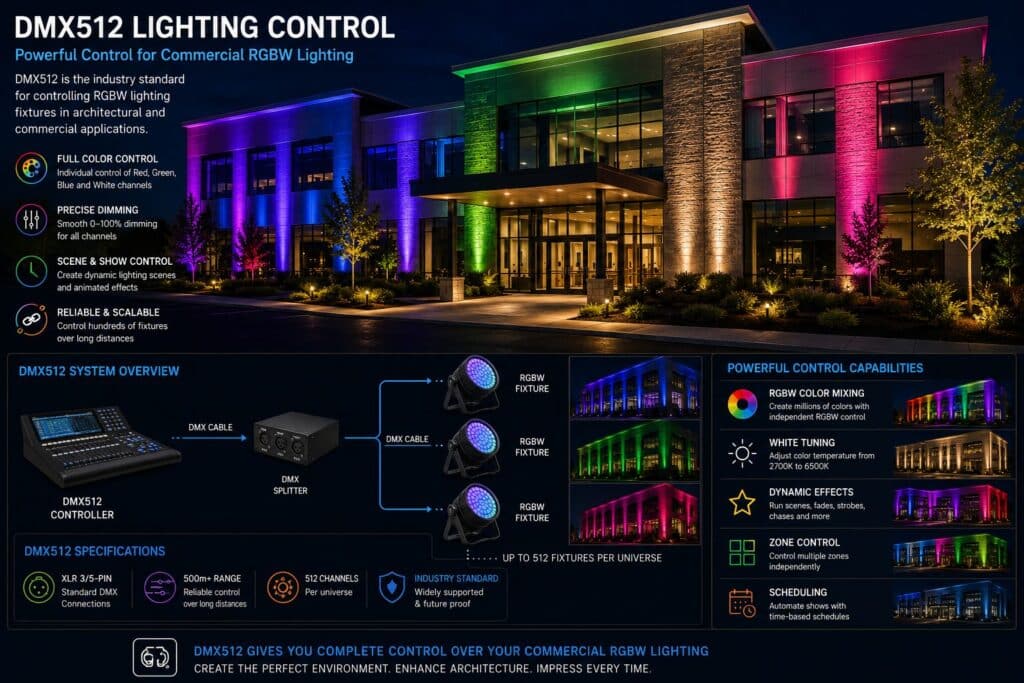
DMX512 lighting control allows commercial RGBW fixtures to operate as one synchronized architectural lighting system, creating dynamic lighting scenes for buildings, bridges, stadiums, hotels, and public spaces.
Large architectural lighting projects require more than quality fixtures
they require intelligent lighting control. DMX512 allows hundreds of RGBW luminaires to operate together, creating synchronized architectural lighting displays that enhance commercial buildings, landmarks, and public spaces.
Our lighting specialists can help design a complete DMX512 lighting system tailored to your project.
Speak with an RGB Lighting Specialist – – https://industriallightingfixtures.org/
Why DMX512 Has Become the Industry Standard
Commercial architectural lighting continues to grow in both size and complexity.
Modern buildings often require dozens—or even hundreds—of fixtures working together to create a unified visual presentation.
DMX512 remains the preferred solution because it offers:
- Reliable communication
- Precise fixture control
- Excellent scalability
- Synchronized lighting scenes
- Professional programming
- Expandable system architecture
- Proven long-term reliability
Unlike independent Bluetooth-controlled fixtures, DMX512 allows every luminaire to function as part of one coordinated lighting system.
Choosing the right control system starts with selecting the right lighting technology. Compare RGB, RGBW, and RGBWW in our RGB vs RGBW vs RGBWW Lighting Guide.
Commercial Applications
DMX512 is used across virtually every sector of commercial architectural lighting.
Common applications include:
Hotels and Resorts
Highlight building façades, entrances, porte-cochères, fountains, and landscaping while creating seasonal lighting displays.
Corporate Headquarters
Display company colors, celebrate product launches, reinforce branding, and illuminate architectural features.
Bridges and Public Infrastructure
Coordinate large-scale RGBW lighting systems across bridges, towers, monuments, and civic landmarks.
Universities
Celebrate graduations, athletic victories, alumni events, and school traditions using programmable lighting scenes.
Churches
Illuminate steeples, crosses, bell towers, stained glass, and architectural details while maintaining elegant everyday white lighting.
Museums and Cultural Centers
Enhance historic architecture while providing programmable lighting for exhibitions, holidays, and public events.
Stadiums and Entertainment Venues
Coordinate dynamic lighting before, during, and after major sporting events and concerts.
Learn how RGBW flood lights, beam angles, mounting options, and architectural applications work together in our Commercial RGBW Color-Changing Flood Lights Guide.
How a DMX512 System Works
Although DMX512 may appear complex, its basic operation is straightforward.
Every system consists of four primary components:
1. DMX Controller
The controller acts as the brain of the lighting system.
It stores lighting scenes and sends commands to every connected fixture.
2. DMX Communication Cable
Specialized DMX cable carries digital communication between the controller and the fixtures.
Unlike ordinary power wiring, DMX cable transmits lighting instructions rather than electrical power.
3. RGBW Fixtures
Each fixture receives commands from the controller.
These instructions determine:
- Brightness
- Color
- Fade speed
- Transition timing
- Dynamic effects
- Scene participation
4. Power Supply
Each fixture receives electrical power separately while simultaneously receiving DMX communication signals.
Power and control operate independently, providing greater system flexibility.
RGBW Flood Light Brightness & Color Temperature Guide
Proper programming begins with proper fixture selection. Explore beam angles, lumen output, optics, and white-light selection in our RGBW Flood Light Brightness & Color Temperature Guide.
Understanding DMX Addresses
Every fixture connected to a DMX network receives its own DMX address.
Think of an address as the fixture’s unique identification number.
The controller uses these addresses to determine which fixture should respond to each command.
For example:
- Address 001 may control the first façade fixture.
- Address 005 may control the second fixture.
- Address 009 may control another section of the building.
Proper addressing allows individual fixtures or groups of fixtures to operate independently while remaining part of the overall lighting system.
Understanding DMX Universes
One of the most common questions about DMX512 concerns the term Universe.
A single DMX universe contains 512 control channels.
Each lighting fixture uses a certain number of channels depending on its capabilities.
For example:
| Fixture Type | Typical DMX Channels |
|---|---|
| RGB Flood Light | 3 |
| RGBW Flood Light | 4 |
| RGBWW Flood Light | 5 |
| Advanced RGBW Fixture | 8–16+ |
Many commercial fixtures also offer multiple DMX personalities, allowing installers to choose between simplified control modes or expanded modes that provide additional functions such as independent dimming curves, strobe effects, macros, color presets, and advanced programming.
Large commercial projects often use multiple universes to control hundreds of fixtures across an entire campus or landmark.
Why Architects and Lighting Designers Prefer DMX512
Professional designers require complete control over the appearance of a building.
DMX512 provides capabilities that simpler lighting systems cannot match.
Advantages include:
- Precise color consistency
- Building-wide synchronization
- Smooth fading and transitions
- Multiple lighting zones
- Repeatable lighting scenes
- Easy future expansion
- Professional programming flexibility
- Integration with sophisticated lighting controllers
Whether illuminating a hotel, corporate headquarters, university, or bridge, DMX512 allows every fixture to contribute to one cohesive architectural presentation.
DMX512 Is About Precision, Not Just Color
Many people believe DMX512 simply changes fixture colors.
In reality, it controls nearly every aspect of an architectural lighting installation.
DMX512 manages:
- Brightness
- Color mixing
- Fade speed
- Transition timing
- Fixture grouping
- Zone control
- Dynamic movement
- Scene synchronization
- Holiday lighting programs
- Building-wide lighting effects
This level of precision is why DMX512 continues to be the preferred control platform for commercial architectural lighting around the world.
DMX512 vs. Bluetooth vs. Wi-Fi Controls
Not every architectural lighting project requires the same level of control.
Modern RGBW lighting systems typically use one of three control methods.
| Control System | Best Applications | Primary Advantages |
|---|---|---|
| Bluetooth | Restaurants, churches, offices, small hotels | Easy setup, smartphone control, economical |
| Wi-Fi | Campuses, municipal facilities, multi-building properties | Remote management, scheduling, cloud access |
| DMX512 | Stadiums, bridges, hotels, corporate headquarters, entertainment venues | Professional synchronization, unlimited programming, expandable architecture |
Bluetooth and Wi-Fi controls work well for many commercial projects, while DMX512 remains the preferred choice whenever multiple fixtures must operate as one coordinated lighting system.
Programming Architectural Lighting Scenes
One of the greatest advantages of DMX512 is the ability to create programmable lighting scenes.
Instead of manually changing colors each time an event occurs, designers can store complete lighting programs that activate automatically.
Typical scene parameters include:
- Color selection
- Brightness
- Fade speed
- Transition timing
- Fixture grouping
- Zone control
- Animation effects
- Scene duration
Once programmed, scenes can be recalled instantly or scheduled to operate automatically.
Scheduling Lighting Throughout the Year
Many commercial properties use DMX512 to update building lighting throughout the calendar year without replacing fixtures.
| Event | Typical Lighting Theme |
|---|---|
| Everyday Operation | White Architectural Lighting |
| Independence Day | Red, White & Blue |
| Christmas | Red & Green |
| New Year’s Eve | Gold & White |
| Earth Day | Green |
| Breast Cancer Awareness Month | Pink |
| Veterans Day | Patriotic Colors |
| University Graduation | School Colors |
| Corporate Anniversary | Company Brand Colors |
| Grand Opening | Animated Welcome Display |
Because everything is software-controlled, changing a building’s appearance often requires only a few clicks rather than physical modifications.
Coordinating Multiple Fixtures
One of DMX512’s greatest strengths is synchronization.
Rather than allowing each fixture to operate independently, DMX512 enables entire groups of luminaires to perform as one coordinated system.
Examples include:
- Entire building façades changing color simultaneously
- Multiple bridge spans operating in sequence
- Stadium entrances synchronized with event schedules
- Campus buildings displaying school colors together
- Hotels illuminating multiple towers with coordinated scenes
The result is a clean, professional presentation that would be difficult to achieve using individual fixture controls.
Beam Angles and Fixture Coordination
DMX512 controls fixtures, but optics determine how light reaches the building.
Professional lighting designers frequently combine several beam angles within one project.
| Beam Angle | Typical Use |
|---|---|
| 10° | Columns, sculptures, flagpoles |
| 15° | Architectural details |
| 25° | Monument signs, entry features |
| 40° | Medium façade sections |
| 60° | Wall washing |
| 120° | Large building surfaces |
By combining multiple beam angles with synchronized DMX programming, designers create depth, contrast, and visual balance throughout the architectural composition.
Hospitality Applications
Hotels and resorts frequently use DMX512 to create memorable guest experiences.
Common lighting applications include:
- Porte-cochères
- Building façades
- Courtyards
- Water features
- Outdoor event spaces
- Landscape lighting
Lighting scenes may change automatically for weddings, holidays, conventions, or seasonal promotions while maintaining elegant white illumination during normal operation.
Municipal and Civic Buildings
Cities increasingly invest in programmable architectural lighting to celebrate holidays and community events.
Common projects include:
- City halls
- Libraries
- Museums
- Bridges
- Government offices
- Public plazas
- Performing arts centers
DMX512 allows municipalities to update lighting programs without replacing fixtures or installing temporary decorative lighting.
Corporate Headquarters
Architectural lighting has become part of many companies’ branding strategies.
DMX512 enables corporate facilities to display:
- Company colors
- Anniversary celebrations
- Product launches
- Charity awareness campaigns
- Community events
These lighting programs reinforce brand identity while creating an attractive nighttime appearance.
Stadiums and Entertainment Venues
Large sports and entertainment facilities often contain hundreds of RGBW fixtures.
DMX512 provides:
- Building-wide synchronization
- Entrance lighting effects
- Team color displays
- Victory celebrations
- Event countdown sequences
- Sponsor branding
- Fan engagement experiences
Professional synchronization is one of the primary reasons DMX512 remains the preferred control system for these venues.
Common Specification Mistakes
Avoid these common design and programming errors:
- Selecting Bluetooth when future expansion requires DMX512
- Ignoring fixture addressing during planning
- Failing to reserve available DMX channels
- Using identical beam angles throughout the project
- Over-lighting the building façade
- Ignoring maintenance accessibility
- Mixing incompatible fixture control modes
- Omitting surge protection
- Neglecting photometric analysis
- Failing to document programming and addresses
Proper planning simplifies installation and future maintenance while improving overall system performance.
Commercial Buyer Checklist
Before specifying a DMX512 architectural lighting system, gather:
✓ Building elevations
✓ Site photographs
✓ Architectural drawings
✓ Number of fixtures
✓ Desired lighting effects
✓ RGBW or RGBWW requirements
✓ Preferred beam angles
✓ Mounting heights
✓ Electrical service voltage
✓ Future expansion plans
✓ Environmental conditions
✓ Maintenance access requirements
This information allows lighting specialists to recommend the proper fixtures, controllers, addressing strategy, and programming approach.
Inline Buyer Q&A
Is DMX512 difficult to operate?
Modern controllers and software have made DMX512 much easier to use than earlier generations. Many systems feature graphical programming interfaces that simplify scheduling and scene creation.
Can DMX512 be expanded later?
Yes. One of DMX512’s greatest advantages is scalability. Additional fixtures, controllers, and universes can often be added as projects grow.
Is DMX512 only for large projects?
No. While commonly used on major architectural installations, DMX512 can also provide excellent control for smaller commercial projects requiring synchronized lighting.
Can DMX512 control white lighting?
Absolutely. DMX512 controls both white illumination and RGBW color-changing functions, allowing buildings to operate in elegant white mode every day while switching to color scenes for special occasions.
Should every RGBW project use DMX512?
Not necessarily. Smaller installations often perform well with Bluetooth or Wi-Fi app control. DMX512 is generally preferred for larger projects requiring synchronized control, advanced programming, and future expansion.
Ready to Design a Professional DMX512 Lighting System?
DMX512 provides the precision, scalability, and programming flexibility required for sophisticated commercial RGBW lighting installations. From hotels and bridges to stadiums, universities, corporate headquarters, entertainment venues, and civic landmarks, properly designed DMX systems can coordinate large groups of fixtures while supporting both everyday white illumination and dynamic color-changing displays.
Our lighting specialists can help evaluate RGBW fixtures, controllers, channel requirements, DMX universes, optics, beam angles, mounting locations, and control strategies for your architectural lighting project.
👉 Explore our Commercial RGB LED Lighting solutions or call 1-844-533-7767 to discuss your architectural RGBW lighting project.
Frequently Asked Questions
How many fixtures can one DMX512 system control?
A single DMX universe supports up to 512 control channels. The number of fixtures depends on how many channels each fixture uses. Larger projects can add additional universes as needed.
Can DMX512 work with RGBWW fixtures?
Yes. DMX512 works with RGB, RGBW, RGBWW, tunable white, and many other commercial LED fixture types.
Can lighting scenes run automatically?
Yes. Most DMX controllers allow scheduled operation based on dates, times, holidays, or recurring events.
Is DMX512 reliable outdoors?
Yes. When paired with commercial-grade controllers, properly rated communication cabling, and weather-resistant fixtures, DMX512 performs reliably in demanding outdoor environments.
Is wireless DMX available?
Yes. Wireless DMX solutions are available for projects where running communication cable is impractical. However, wired DMX remains the preferred choice for many permanent commercial installations because of its proven reliability and consistent performance.
Stay Connected with Our Lighting Resources
Add IndustrialLightingFixtures.org as a Preferred Source on Google to see more of our lighting guides and technical resources across Google Search experiences.

Related Commercial RGBW Lighting Resources
Continue planning your architectural color-changing lighting system with these resources covering fixture technology, RGBW selection, floodlighting, brightness, and façade design:
- Commercial RGB LED Lights — Explore commercial RGB and RGBW lighting solutions for architectural façades, buildings, landscapes, entertainment venues, landmarks, and other color-changing applications.
- RGB vs. RGBW vs. RGBWW Lighting Guide — Compare RGB, RGBW, and RGBWW technologies and understand how dedicated white channels affect everyday white illumination and color-changing performance.
- Commercial RGBW Color-Changing Flood Lights Guide — Learn how RGBW floodlights are used for architectural accents, façades, landscapes, entertainment venues, and other programmable commercial applications.
- RGBW Flood Light Brightness & Color Temperature Guide — Evaluate brightness, color performance, white-light requirements, and other factors when selecting RGBW floodlights.
- Architectural Façade Lighting Design Guide — Review fixture placement, beam angles, architectural features, lighting effects, and other considerations when designing illuminated building façades