Commercial LED Outdoor Lighting for Modern Properties
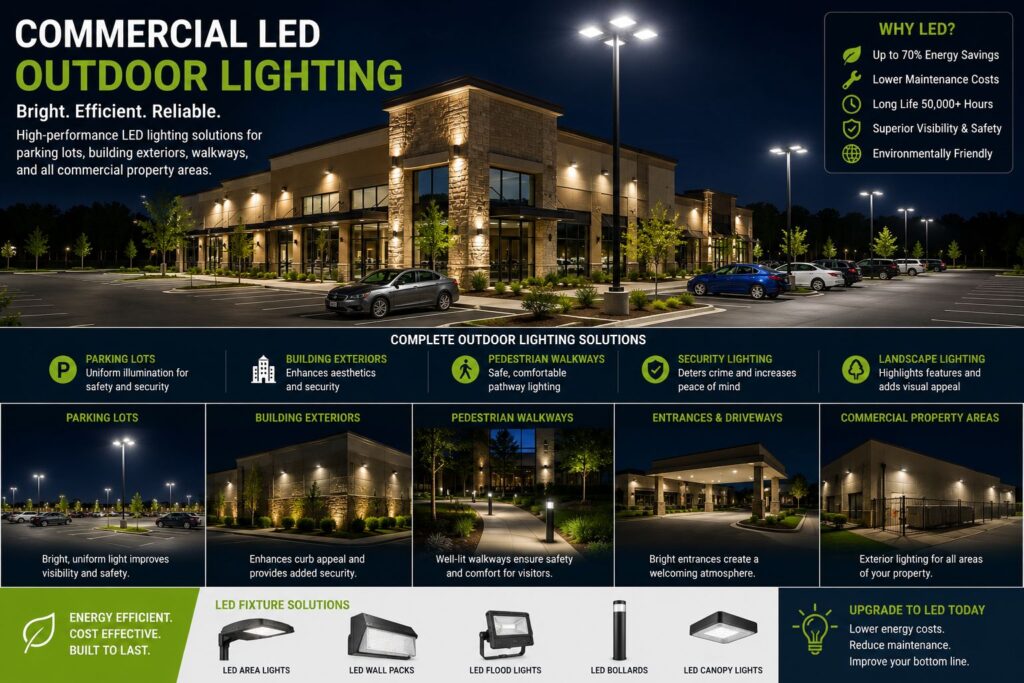
Commercial LED outdoor lighting has become the preferred solution for businesses, municipalities, industrial facilities, educational campuses, and property managers seeking reliable illumination with lower operating costs. Modern LED fixtures provide superior visibility, improved light distribution, longer service life, and reduced maintenance requirements compared to older lighting technologies.
Whether illuminating a parking lot, building perimeter, loading dock, pedestrian walkway, storage yard, or commercial site, LED outdoor lighting can improve nighttime safety while reducing energy consumption.
Unlike traditional metal halide and high-pressure sodium systems, LED fixtures offer instant-on performance, better optical control, and consistent illumination throughout their service life.
Explore our complete range of commercial outdoor LED lighting for parking areas, building exteriors, walkways, security lighting, and other exterior applications.
Need help selecting commercial LED outdoor lighting fixtures?
Our lighting specialists can assist with fixture selection, photometric layouts, pole height recommendations, energy-saving calculations, and outdoor lighting design guidance.
Call us today to discuss your project requirements. 844.533.7767
What Is Commercial LED Outdoor Lighting?
Commercial LED outdoor lighting refers to lighting systems designed to illuminate exterior commercial and industrial environments using energy-efficient light-emitting diode (LED) technology.
Common applications include:
- Parking lots
- Building perimeters
- Sidewalks
- Pathways
- Loading docks
- Storage facilities
- Distribution centers
- Manufacturing plants
- Retail centers
- Educational campuses
- HOA communities
- Municipal facilities
These lighting systems are designed to provide reliable illumination while minimizing energy use and maintenance costs.
Planning a complete property lighting upgrade? Review our Commercial Site Lighting Design Guide for site planning, fixture selection, and lighting layout recommendations.
Why Businesses Are Converting to LED Outdoor Lighting
Many commercial properties originally used:
- Metal Halide
- High Pressure Sodium
- Mercury Vapor
- Fluorescent Outdoor Fixtures
While these technologies served their purpose, they typically consume more energy and require more frequent maintenance than modern LED systems.
LED lighting offers:
- Reduced energy consumption
- Improved fixture efficiency
- Longer service life
- Better light distribution
- Instant-on performance
- Reduced maintenance
- Enhanced visibility
- Improved optical control
Interested in reducing glare and light pollution? Review our Dark Sky Outdoor Lighting Guide and Dark Sky Friendly Compliance resources for dark-sky-friendly lighting strategies.
Benefits of Commercial LED Outdoor Lighting
| Benefit | Advantage |
|---|---|
| Lower Energy Consumption | Reduces utility costs |
| Longer Fixture Life | Less maintenance |
| Improved Visibility | Better nighttime performance |
| Instant On Operation | No warm-up period |
| Better Optical Control | Direct light where needed |
| Reduced Glare Options | Improved visual comfort |
| Smart Controls Compatibility | Additional energy savings |
| Improved Uniformity | Fewer dark spots |
Common Commercial Outdoor Lighting Applications
Commercial outdoor lighting systems are used in a wide range of environments.
Parking Lots
Parking lots require sufficient illumination for:
- Vehicle traffic
- Pedestrian movement
- Security cameras
- Wayfinding
- Property safety
LED area lights are among the most common fixture types used for parking lot applications.
Building Perimeter Lighting
Perimeter lighting helps illuminate:
- Building entrances
- Exit doors
- Service areas
- Sidewalks
- Property boundaries
Common fixtures include wall packs, flood lights, and area lighting systems.
Walkways and Pedestrian Areas
Pedestrian lighting supports:
- Safety
- Accessibility
- Navigation
- Security
Common fixture types include:
- Bollards
- Post top fixtures
- Architectural pathway lighting
- Decorative site lighting
Loading Docks and Service Areas
Loading docks often require higher illumination levels to support:
- Truck movement
- Inventory handling
- Employee safety
- Equipment operation
LED flood lights and wall-mounted fixtures are frequently used in these areas.
Industrial Yards and Storage Areas
Industrial facilities often require outdoor lighting for:
- Equipment storage
- Vehicle operations
- Material handling
- Shipping and receiving
- Yard security
Higher-output LED area lights are commonly selected for these applications.
Looking to improve safety and surveillance visibility? Explore our Parking Lot Security Lighting Guide for security-focused lighting recommendations.
Typical Commercial Outdoor Lighting Applications
| Application | Common Fixture Type | Primary Goal |
|---|---|---|
| Parking Lots | LED Area Lights | Vehicle & pedestrian visibility |
| Walkways | Bollards & Post Tops | Pedestrian safety |
| Building Perimeters | Wall Packs | Security and visibility |
| Loading Docks | LED Flood Lights | Task illumination |
| Industrial Yards | High Output Area Lights | Equipment operations |
| Campuses | Architectural Area Lights | Safety and aesthetics |
| HOA Communities | Decorative Post Tops | Visibility and appearance |
Typical Commercial Outdoor Lighting Applications
| Application | Common Fixture Type | Primary Goal |
|---|---|---|
| Parking Lots | LED Area Lights | Vehicle & pedestrian visibility |
| Walkways | Bollards & Post Tops | Pedestrian safety |
| Building Perimeters | Wall Packs | Security and visibility |
| Loading Docks | LED Flood Lights | Task illumination |
| Industrial Yards | High Output Area Lights | Equipment operations |
| Campuses | Architectural Area Lights | Safety and aesthetics |
| HOA Communities | Decorative Post Tops | Visibility and appearance |
LED Outdoor Lighting Energy Savings
One of the primary reasons organizations upgrade outdoor lighting systems is energy reduction.
Older lighting technologies often operate at higher wattages while delivering less useful light to the target area.
LED fixtures use advanced optics to direct illumination where it is needed, often reducing wasted light and improving efficiency.
Potential savings may come from:
- Lower fixture wattage
- Improved optical performance
- Reduced maintenance requirements
- Longer service life
- Lighting controls
- Dimming schedules
- Occupancy controls
- Photocells
Actual savings depend on the existing lighting system, operating hours, and site conditions.
LED vs Traditional Outdoor Lighting
| Feature | LED Lighting | Metal Halide |
|---|---|---|
| Energy Consumption | Lower | Higher |
| Lamp Life | Longer | Shorter |
| Start-Up Time | Instant | Delayed |
| Maintenance | Reduced | More Frequent |
| Optical Control | Excellent | Limited |
| Uniformity | Improved | Moderate |
| Dimming Capability | Available | Limited |
| Control Integration | Easy | Difficult |
Commercial Outdoor Lighting Design Considerations
Selecting fixtures involves more than choosing wattage.
Important design factors include:
- Pole height
- Fixture spacing
- Mounting location
- Beam distribution
- Foot candle requirements
- Uniformity targets
- Property layout
- Security requirements
- Building placement
- Traffic flow
- Pedestrian movement
- Local lighting ordinances
A photometric lighting plan is often the best method for evaluating fixture performance before installation.
Need help determining pole spacing and fixture placement? Visit our LED Area Lighting Layout Guide for photometric planning guidance.
Pole Height and Fixture Placement
Pole height directly affects:
- Light distribution
- Fixture spacing
- Uniformity
- Glare control
Common commercial mounting heights include:
| Application | Typical Pole Height |
|---|---|
| Walkways | 8–15 ft |
| Small Parking Areas | 15–20 ft |
| Commercial Parking Lots | 20–30 ft |
| Industrial Facilities | 25–40 ft |
| Large Storage Yards | 30–50 ft |
Proper pole height helps achieve better coverage while reducing excessive brightness and glare.
Choosing the Right Color Temperature
LED outdoor fixtures are commonly available in:
| Color Temperature | Typical Application |
|---|---|
| 3000K | Communities, pathways, decorative lighting |
| 4000K | Commercial properties |
| 5000K |
Industrial and security applications |
The best option depends on property goals, visibility requirements, and local lighting regulations.
The Importance of Photometric Lighting Plans
A photometric plan helps determine:
- Average light levels
- Minimum light levels
- Maximum light levels
- Uniformity ratios
- Pole locations
- Fixture spacing
- Property line spill
- Coverage performance
Photometric layouts allow lighting systems to be optimized before installation.
Commercial LED Outdoor Lighting Maintenance Advantages
Maintenance costs often represent a significant portion of ownership expenses.
LED fixtures can reduce maintenance requirements by offering:
- Long service life
- Durable construction
- Fewer lamp replacements
- Reduced labor requirements
- Consistent illumination performance
For facilities operating multiple fixtures, maintenance savings can be substantial over time.
When to Retrofit Existing Outdoor Lighting
A retrofit may be worth considering when:
- Fixtures are aging
- Energy costs are increasing
- Maintenance expenses are rising
- Light levels are inadequate
- Security concerns exist
- Expansion projects are planned
- Existing fixtures use metal halide or HPS lamps
Many organizations upgrade outdoor lighting systems as part of broader energy-efficiency initiatives.
Inline Buyer Q&A
How much energy can commercial LED outdoor lighting save?
Savings vary by application, but LED fixtures often reduce energy consumption compared to older HID and metal halide systems.
What is the best LED lighting for parking lots?
LED area lights designed with proper optics, mounting heights, and photometric planning are commonly used for parking lot applications.
How long do commercial LED outdoor fixtures last?
Commercial LED fixtures are typically designed for long operating life and reduced maintenance requirements.
Is 5000K or 4000K better for outdoor lighting?
Both are common. Industrial sites often use 5000K, while commercial properties frequently select 4000K or 3000K.
Do LED fixtures improve security?
Properly designed LED lighting can improve visibility, eliminate dark areas, and support surveillance systems.
What is a photometric lighting plan?
A photometric plan models fixture performance and light distribution before installation.
Should metal halide fixtures be replaced?
Many property owners upgrade aging metal halide systems to reduce maintenance and improve energy efficiency.
What commercial properties use LED outdoor lighting?
Parking lots, campuses, industrial facilities, warehouses, office parks, retail centers, municipalities, and HOA communities all commonly utilize LED outdoor lighting.
Speak With a Lighting Specialist
Whether you’re illuminating a parking lot, industrial facility, retail center, HOA community, campus, or commercial property, our team can help you select the right LED outdoor lighting solution.
Contact Industrial Lighting Fixtures today for fixture recommendations, photometric layouts, energy-saving calculations, and expert lighting guidance tailored to your project.
Frequently Asked Questions About Commercial LED Outdoor Lighting
What is commercial LED outdoor lighting?
Commercial LED outdoor lighting refers to energy-efficient lighting systems designed for exterior commercial and industrial environments such as parking lots, walkways, building perimeters, loading docks, storage yards, and outdoor work areas.
How much energy can commercial LED outdoor lighting save?
Energy savings vary depending on the existing lighting system, operating hours, and fixture selection. Many facilities experience significant reductions in electrical consumption when upgrading from older HID or metal halide fixtures.
What are the benefits of LED outdoor lighting?
Benefits include lower energy consumption, longer service life, reduced maintenance, improved visibility, instant-on operation, better light distribution, and compatibility with lighting controls.
What is the best LED lighting for commercial parking lots?
LED area lights designed with appropriate optics, mounting heights, and photometric planning are commonly used to provide uniform illumination throughout parking areas.
How long do commercial LED outdoor fixtures last?
Many commercial LED fixtures are designed for long operating lifespans and can operate for years before significant lumen depreciation occurs.
Is 4000K or 5000K better for outdoor lighting?
The ideal color temperature depends on the application. Commercial properties often use 4000K, while industrial facilities and security-focused applications frequently utilize 5000K.
Do LED outdoor lights improve security?
Properly designed LED lighting can improve visibility, reduce dark areas, enhance surveillance camera performance, and support safer pedestrian and vehicle movement.
What is a photometric lighting plan?
A photometric plan is a lighting simulation that predicts fixture performance, illumination levels, uniformity, pole spacing, and overall site coverage before installation.
Can LED outdoor lighting reduce maintenance costs?
Yes. LED fixtures generally require fewer lamp replacements and less maintenance than traditional lighting technologies, reducing labor and material costs.
When should commercial outdoor lighting be upgraded?
A retrofit should be considered when fixtures are aging, energy costs are increasing, maintenance expenses are rising, or lighting performance no longer meets facility requirements.