
Historic lantern post lighting continues to play an important role in streetscapes, downtown districts, parks, plazas, campuses and other public spaces where lighting must provide both functional illumination and architectural character.
Traditional lantern-style fixtures are closely associated with historic streets, town centers and pedestrian districts, but modern LED post top lanterns can preserve that familiar appearance while providing contemporary optical control, energy efficiency, long service life and lighting controls.
For municipalities, commercial properties and redevelopment projects, selecting a lantern is about more than choosing a decorative style. Fixture scale, pole height, optical distribution, lumen output, color temperature, glare, uniformity and compatibility with the surrounding architecture all affect how the finished streetscape looks and performs.
This guide explores how historic and traditional lantern post lighting can be incorporated into modern commercial and public-space projects while maintaining the visual character that makes these fixtures distinctive.
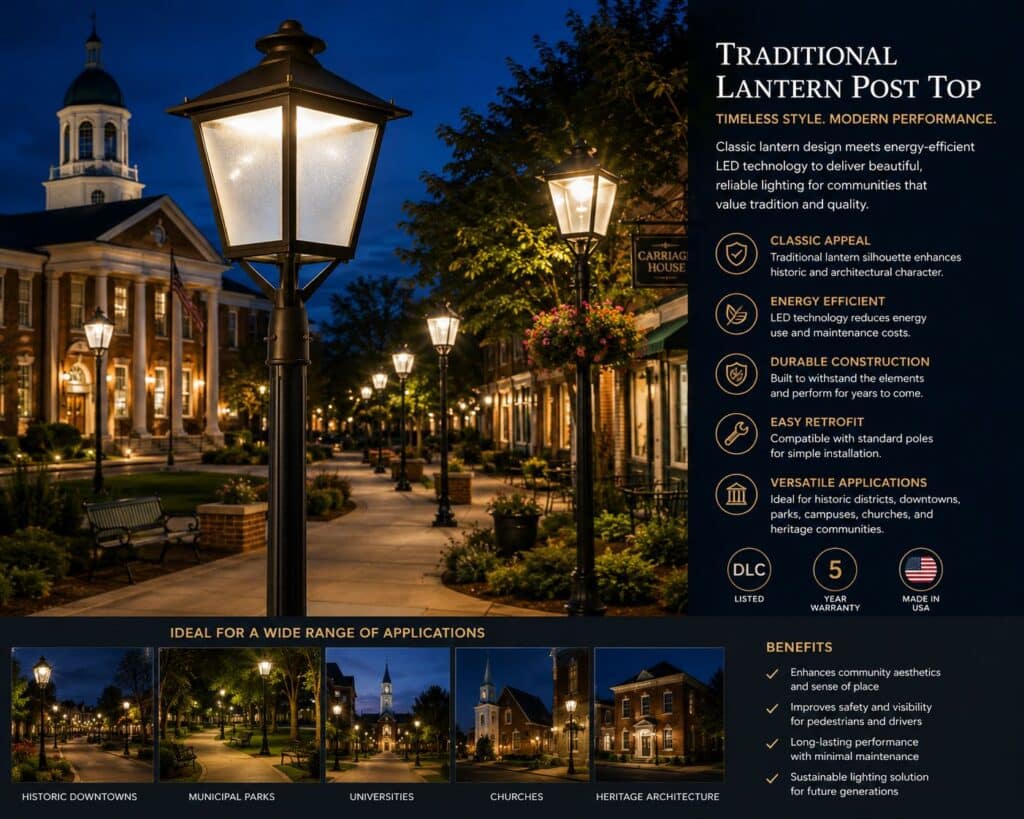
Historic LED lantern post lighting can preserve the architectural character of downtown districts, parks and public spaces while providing modern optical performance, controls and energy-efficient illumination..
Planning Historic or Decorative Lantern Post Lighting?
Historic streetscape lighting requires more than selecting a traditional-looking fixture. Pole height, fixture scale, optical distribution, lumen output, color temperature and controls should work together to provide appropriate illumination while complementing the surrounding architecture.
LED PROS WorldWide can help municipalities, contractors, property owners and commercial buyers identify LED post top lanterns for historic districts, downtown redevelopment, parks, campuses and other decorative outdoor lighting projects.
Call 844-533-7767 to discuss your project or request a quote.
Historic Lantern Lighting Specifications at a Glance
| Specification | Typical Commercial Recommendation |
|---|---|
| Pole Height | 10–18 feet |
| Color Temperature | 3000K (most common), 4000K where appropriate |
| Optical Distribution | Type II • III • V |
| Mounting Options | Pole Mount • Pier Mount • Decorative Multi-Head Assemblies |
| Controls | Photocells • Wireless Controls • Smart City Compatibility |
| Certifications | UL/ETL • DLC Listed (where applicable) • NEMA Options |
| Typical Applications | Historic Districts • Municipal Streetscapes • Universities • Churches • Parks • Courthouses |
Looking for a decorative fixture that complements today’s commercial architecture? Read our Modern LED Lantern Post Top Lighting for Commercial Outdoor Spaces guide to explore contemporary lantern styles, coordinated lighting collections, and modern commercial applications
Why Historic Lantern Lighting Continues to Endure
Certain architectural lighting styles remain relevant because they become part of the identity of the places they illuminate. Lantern post top fixtures are one example.
Historic and traditional lanterns are frequently used where outdoor lighting must complement the surrounding architecture rather than appear purely utilitarian. During daylight hours, the fixture and decorative pole contribute to the streetscape; after dark, the same system provides illumination for pedestrian areas, sidewalks, plazas and other public spaces.
Common applications include:
- Historic downtown districts
- Main Street revitalization projects
- Municipal parks and plazas
- Courthouse and civic grounds
- Churches and religious campuses
- Museums and cultural institutions
- University campuses
- Heritage tourism districts
- Traditional commercial and mixed-use developments
For municipalities and commercial properties, the appeal of lantern lighting is therefore both architectural and functional. A coordinated family of lantern fixtures and decorative poles can help establish a consistent visual identity throughout a district while modern LED technology provides the lighting performance expected from a contemporary outdoor lighting system.
The objective is not simply to recreate an older street lamp. It is to preserve the architectural character associated with traditional lantern lighting while adapting the system to the needs of today’s streetscapes and public spaces.
Preserving Architectural Character While Modernizing Infrastructure
One of the primary challenges in historic streetscape lighting is balancing architectural character with modern lighting performance.
Municipalities, campuses and commercial property owners may want to retain the traditional appearance of an established streetscape while replacing aging HID or high-pressure sodium lighting. Modern LED lantern post top fixtures can provide that transition without requiring the site to abandon its historic or traditional design language.
Depending on the fixture and configuration, modern commercial LED lanterns may offer:
- Precision LED optics
- Multiple lumen or wattage options
- Selectable wattage or color temperature
- 0–10V dimming
- Photocell and lighting-control options
- Surge protection
- Modern LED drivers and thermal management
These technologies can be incorporated within fixtures that retain the proportions, decorative details and familiar appearance associated with traditional lantern lighting.
For retrofit projects, fixture selection should also consider the existing decorative poles, mounting configuration, pole height, electrical system and desired photometric performance. Retaining existing streetscape infrastructure may be possible in some projects, but compatibility should be verified before replacement fixtures are specified.
The result can be a streetscape that maintains its established architectural identity while gaining the efficiency, controllability and reduced maintenance associated with modern LED lighting.
Ideal Applications for Historic Lantern Fixtures
Historic and traditional lantern post top fixtures are particularly well suited to projects where architectural continuity is an important part of the lighting design.
Rather than treating the luminaire as a purely functional component, these projects use the fixture, pole and surrounding streetscape as coordinated architectural elements.
Common applications include:
- Historic downtown streetscapes
- Municipal plazas and town squares
- Courthouse and civic grounds
- Public parks
- Churches and religious campuses
- Universities with traditional architecture
- Museums and cultural institutions
- Government and civic buildings
- Cemeteries and memorial gardens
- Heritage tourism destinations
- Traditional commercial and mixed-use developments
- Community entrances and pedestrian districts
Fixture selection should reflect both the character of the property and the lighting requirements of the space. A lantern appropriate for a pedestrian walkway may require different output, optics, mounting height or spacing than a fixture used along a municipal street or large public plaza.
For larger projects, maintaining a consistent family of lanterns, decorative poles and finishes can also help create a recognizable visual identity throughout the property or district.
Unlike contemporary area luminaires selected primarily for utility, historic lantern fixtures can become part of the architecture itself while still providing the performance required for modern commercial and public-space lighting.
Historic Streetscapes and Main Street Revitalization
Historic downtowns and Main Street districts often use decorative lighting as part of a broader effort to improve public spaces while preserving the character that makes the district distinctive.
LED lantern post top fixtures can support these projects by combining traditional architectural styling with modern outdoor lighting performance. When coordinated with decorative poles and other streetscape elements, lantern lighting can help:
- Preserve the visual character of historic districts
- Create more inviting pedestrian environments
- Complement restored storefronts and civic architecture
- Improve nighttime visibility along sidewalks and public spaces
- Reduce maintenance compared with older HID lighting systems
- Support energy-efficiency and lighting-control objectives
Consistency is particularly important in a streetscape environment. Using a coordinated family of fixtures, poles, finishes and mounting configurations can create a more unified appearance than introducing unrelated lighting styles throughout the district.
Lighting performance should remain part of that planning. Pole locations, mounting heights, fixture output, optical distribution, spacing and pedestrian areas all influence how the streetscape performs after dark.
For Main Street and downtown revitalization projects, the goal is therefore not simply to install decorative fixtures. It is to create a coordinated lighting system that supports the architectural identity of the district while providing appropriate illumination for the people who use it.
When a historic streetscape moves from architectural planning into fixture selection and procurement, additional technical requirements come into play. Our guide to specifying LED lantern post top lighting for municipal streetscapes covers poles, mounting heights, optics, photometrics, controls and project documentation.
Colonial and Traditional Architecture
Historic lantern post top fixtures are closely associated with architectural styles that emphasize symmetry, craftsmanship and traditional detailing. Their proportions and decorative features can complement the masonry, brick, stone, cast iron and other materials commonly found in historic environments.
Lantern-style lighting is frequently used with:
- Colonial architecture
- Georgian architecture
- Federal architecture
- Victorian neighborhoods
- Traditional civic buildings
- Historic churches
- Museums and cultural institutions
- Courthouses
- Heritage parks
- Memorial gardens
Fixture selection should complement the architecture without overwhelming it. The size and shape of the lantern, decorative detailing, finish, pole style and mounting height all contribute to how the lighting system relates visually to surrounding buildings and public spaces.
For restoration and redevelopment projects, consistency can be particularly important. Introducing fixtures that are dramatically different in scale or architectural style can disrupt an otherwise coordinated streetscape.
Modern LED technology allows traditional lantern forms to be retained without relying on legacy light sources. This gives municipalities, institutions and commercial properties greater flexibility to preserve the architectural character of a site while improving the performance of its outdoor lighting system.
Warm Color Temperatures Preserve Historic Character
Color temperature can have a noticeable effect on how historic streetscapes, architecture and traditional building materials appear after dark.
For many historic and decorative lighting projects, 3000K warm white is commonly considered because it can complement materials such as:
- Brick
- Natural stone
- Wood
- Copper
- Bronze
- Decorative ironwork
Warmer color temperatures can also support the visual character of downtown districts, parks, courthouse squares, churches and other public gathering spaces where a softer nighttime appearance is desired.
However, 3000K should not be treated as a universal requirement. The appropriate CCT depends on the project, surrounding architecture, local requirements, existing lighting and the desired nighttime environment. Some commercial or civic applications may use 4000K, while other projects may require or prefer warmer light.
Color temperature should also be evaluated separately from light level, optical distribution and glare. Choosing a warmer CCT does not by itself determine how much illumination reaches the ground or how effectively a fixture controls unwanted light.
For additional guidance, visit our Commercial Outdoor Lighting Color Temperature Guide.
Decorative Poles and Multi-Head Lantern Assemblies
Historic lantern lighting projects often extend beyond the luminaire itself. The decorative pole, mounting configuration and accessories can contribute significantly to the overall character of a streetscape or public space.
Depending on the project, a coordinated lantern installation may incorporate:
- Fluted decorative poles
- Decorative pole bases
- Finials
- Banner arms
- Hanging flower basket arms
- Decorative crossarms
- Dual-head lantern assemblies
- Triple-head lantern assemblies
- Quad-head lantern assemblies
Multi-head configurations can be especially useful as architectural focal points in town squares, civic plazas, university quads, memorial parks, courthouse grounds and prominent downtown intersections. Pasted text
However, adding additional lantern heads is not simply a decorative decision. The number of luminaires, mounting height, fixture output, optical distribution and orientation can all affect light levels, uniformity and glare. A multi-head assembly should therefore be evaluated as part of the complete lighting design rather than assuming that additional fixtures automatically produce better illumination.
Decorative accessories such as banner arms and flower basket arms should also be coordinated with the pole system and project requirements. For municipal and streetscape projects, the complete assembly—including the pole, luminaires and accessories—should be selected with the intended application and installation conditions in mind.
Pier-Mounted Lantern Fixtures
Historic lantern fixtures are not limited to traditional post top installations. In some commercial, municipal and institutional projects, the same architectural lantern style can also be used on masonry piers, columns and other structural elements.
Typical applications include:
- Brick entrance columns
- Stone gate posts
- Monument sign structures
- Courtyard walls
- Church and campus entrances
- Cemetery entrances
- Park gateways
- Historic property entrances
Pier-mounted lanterns can help maintain a consistent architectural theme when a project uses both pole-mounted and structure-mounted lighting. For example, the same or complementary lantern family may be used along pedestrian areas and on masonry entrance columns to create a coordinated appearance throughout the property. Pasted text
Before specifying a pier-mounted fixture, verify that the lantern is designed for the intended mounting method and that an appropriate pier-mount adapter or base is available. Fixture dimensions should also be considered in relation to the size of the column or structure so the installation remains properly proportioned.
As with pole-mounted lanterns, decorative appearance should be balanced with lighting performance. Lumen output, optical distribution, mounting height and fixture location should be appropriate for the entrance, walkway, courtyard or other area being illuminated.
Dark Sky Friendly Historic Lighting
Historic architectural character and responsible outdoor lighting design can work together. A traditional lantern appearance does not require uncontrolled uplight, excessive brightness or unnecessary illumination beyond the intended area.
Depending on the luminaire and optical system, modern LED lantern fixtures may provide greater control over where light is distributed. Historic streetscape projects can consider design strategies such as:
- Controlled optical distributions
- Appropriate lumen output
- Proper fixture spacing
- Suitable mounting heights
- Glare control
- Improved lighting uniformity
- Limiting unnecessary uplight
- Controlling light trespass
- Warmer color temperatures where appropriate
- Dimming or other controls during lower-activity periods
The objective should be to provide the illumination required for streets, sidewalks and public spaces without using more light than the application requires.
It is also important not to assume that a decorative lantern is Dark Sky-friendly simply because it uses LED technology or a warm color temperature. Fixture optics, uplight, output, mounting, orientation and the overall site design all influence nighttime performance.
For historic districts, municipalities and commercial properties, these considerations can help preserve the traditional appearance of lantern lighting while supporting more responsible outdoor lighting practices.
Commercial & Municipal Product Specifications
Historic lantern lighting projects often require more than an appropriate architectural appearance. Municipalities, engineers, architects, contractors and commercial property owners may also need fixtures that meet project-specific electrical, environmental, control and performance requirements.
Depending on the fixture and project, specifications may include:
| Specification | Project Consideration |
|---|---|
| UL or ETL Listed | Electrical safety certification |
| DLC Listed, where applicable | May be relevant to project specifications or utility incentive requirements |
| NEMA Receptacle Options | Can support photocells and compatible lighting controls |
| ANSI C136 Compatibility, where applicable | May be specified for certain roadway or municipal lighting applications |
| IP65 / IP66 | Protection against outdoor environmental conditions |
| Surge Protection | Helps protect LED drivers and electronic components from electrical transients |
| Field-Selectable Wattage | Allows output or wattage configuration where offered |
| Field-Selectable CCT | Provides color-temperature choices where offered |
| Corrosion-Resistant Finish | Important for coastal, humid or other demanding environments |
These features should not be treated as universal requirements for every historic lantern project. The appropriate certifications, controls, electrical characteristics and construction requirements depend on the project specification, application and selected fixture.
For municipal and larger commercial projects, buyers should verify the required configuration before ordering, including fixture model, wattage or lumen package, CCT, optical distribution, mounting, voltage, controls and any required certifications.
This becomes particularly important when lantern fixtures are being incorporated into an established streetscape or municipal lighting system, where compatibility with existing poles, controls and other infrastructure may also need to be confirmed.
Modern LED Technology Behind a Classic Design
Historic lantern fixtures can retain the familiar appearance of traditional streetscape lighting while incorporating modern LED components and controls inside the luminaire.
Depending on the fixture and configuration, commercial LED lanterns may include:
- Precision LED optics
- High-efficiency LED arrays
- Multiple lumen or wattage options
- Field-selectable wattage
- Field-selectable color temperature
- 0–10V dimming
- Photocell options
- Wireless lighting controls
- Modern LED drivers
- Thermal management
- Surge protection
- Smart lighting compatibility
These technologies give municipalities and commercial property owners greater control over how a lantern performs without necessarily changing the architectural character of the fixture.
Modern optical systems are particularly important. Rather than relying only on the shape of the lantern housing to distribute light, LED fixtures can use specific optical distributions to direct illumination toward streets, sidewalks, pedestrian areas and other intended surfaces.
Controls can provide another layer of flexibility. Photocells can automate dusk-to-dawn operation, while compatible dimming or networked controls may allow output to be reduced during lower-activity periods when the project requires it.
Not every lantern offers every feature, so available wattages, optics, CCTs, controls and electrical options should be verified for the specific fixture being considered.
The result is a lighting system that can preserve the visual character associated with historic lanterns while providing the efficiency, controllability and lighting performance expected from modern commercial LED technology
Inline Buyer Q&A
Q: Are LED lantern fixtures appropriate for historic districts?
Yes. Commercial LED lantern fixtures can preserve the traditional architectural appearance associated with historic streetscapes while providing modern LED optics, controls and reduced maintenance. Fixture style and performance should be selected to complement the specific district and project requirements.
Q: Why is 3000K commonly considered for historic lighting projects?
A warmer 3000K appearance can complement traditional materials such as brick, stone, bronze and decorative ironwork and can help maintain the visual character of historic streetscapes. However, CCT should be selected according to the project requirements rather than treating 3000K as a universal standard.
Q: Can historic lantern fixtures support modern lighting controls?
Yes, depending on the fixture. Commercial LED lanterns may be available with photocells, NEMA receptacles, 0–10V dimming, wireless controls or other control options. The required control configuration should be verified before ordering.
Q: Can existing decorative poles be reused when converting older lanterns to LED?
Potentially. Existing poles may be retained when their condition, mounting configuration, dimensions, electrical system and compatibility with the proposed LED lantern are suitable. These conditions should be evaluated before replacement fixtures are selected.
Q: What information should I provide when requesting a quote for commercial lantern lighting?
Useful project information includes fixture quantity, application, existing or proposed pole information, mounting height, voltage, desired CCT, required optical distribution, control requirements and any project specifications or photometric requirements.
For retrofit projects, photographs and information about the existing fixtures and poles can also help identify appropriate replacement options.
Preserving the Past While Lighting the Future
Historic lantern post top lighting demonstrates that architectural character and modern lighting performance do not have to be competing objectives.
Traditional lantern forms can remain an important part of historic downtowns, municipal streetscapes, parks, campuses and civic spaces while modern LED technology provides improved optical control, energy efficiency, lighting controls and reduced maintenance.
A successful project requires more than selecting a fixture that looks historic. Lantern style, decorative poles, mounting height, optical distribution, lumen output, color temperature, glare, controls and surrounding architecture should be considered as parts of the complete lighting system.
When these elements are coordinated, LED lantern lighting can help preserve the identity of a historic or traditional environment while providing the functional illumination required for today’s public and commercial spaces. Pasted text
Ready to Modernize Your Historic Streetscape With LED Lantern Lighting?
Whether you’re restoring a historic downtown district, upgrading a university or civic campus, improving a municipal park, or planning a traditional commercial development, LED PROS WorldWide can help identify commercial LED lantern post top fixtures appropriate for your project.
Provide the fixture quantity, application, pole or mounting information, desired CCT and any available project specifications or photometric requirements. For retrofit projects, existing fixture information and photographs can also help with fixture selection.
Explore our Commercial LED Lantern Post Top Fixtures or call 844-533-7767 to discuss your project and request a quote.
Frequently Asked Questions
Are historic lantern fixtures suitable for municipalities?
Yes. Decorative LED lantern post top fixtures are commonly used for municipal streetscapes, downtown revitalization projects, parks, civic plazas and other public spaces where architectural character is an important part of the lighting design. Fixture selection should also account for the project’s required light levels, optics, mounting, controls and other specifications. Pasted text
Can historic lantern fixtures be mounted on decorative walls or entrance columns?
Yes, when the selected fixture and mounting accessories support that configuration. Pier-mount adapters can allow compatible lantern fixtures to be installed on masonry columns, monument structures, gate entrances and similar architectural features. Mounting compatibility should be verified for the specific fixture. Pasted text
Can older HID lanterns be upgraded to LED?
In many projects, existing decorative poles and other streetscape infrastructure may be retained while older HID luminaires are replaced with LED lantern fixtures. Pole condition, mounting compatibility, electrical requirements and the desired photometric performance should be evaluated before selecting replacement fixtures. Pasted text
What color temperature is appropriate for historic lantern lighting?
3000K is commonly considered for historic and traditional environments because its warmer appearance can complement brick, stone, bronze, wood and other traditional materials. However, the appropriate CCT should be based on the specific project, surrounding architecture and applicable requirements rather than assuming one color temperature is appropriate everywhere. Pasted text
Can LED lantern post top fixtures use photocells and lighting controls?
Depending on the fixture, available options may include photocells, NEMA receptacles, 0–10V dimming, wireless controls and other lighting-control technologies. Required controls and compatibility should be confirmed for the specific fixture and project before ordering. Pasted text
Are historic-style LED lanterns compatible with Dark Sky lighting objectives?
They can be, depending on the fixture and overall site design. Optical distribution, uplight, lumen output, mounting height, spacing, glare, light trespass, CCT and controls should all be considered. A traditional appearance, LED light source or warm CCT alone does not establish Dark Sky-friendly performance. Pasted text
What information is needed to quote a municipal or commercial lantern project?
Provide the fixture quantity, application, existing or proposed pole information, mounting height, voltage, desired CCT, optical requirements, controls and any available project specifications or photometric requirements. For retrofit projects, photographs and information about the existing fixtures and poles are also useful.
Stay Connected with Our Lighting Resources
Add IndustrialLightingFixtures.org as a Preferred Source on Google to see more of our lighting guides and technical resources across Google Search experiences.

Historic & Decorative Streetscape Lighting Resources
Continue exploring commercial and architectural outdoor lighting for historic districts, downtown streetscapes, parks, campuses and public spaces: