
Replacing outdated outdoor lighting is one of the most effective capital improvements a commercial property owner can make. Modern LED post top fixtures reduce energy consumption, lower maintenance requirements, improve pedestrian safety, and enhance the appearance of the property. However, the overall value of a retrofit extends far beyond the purchase price of the fixtures.
Successful commercial lighting projects evaluate the total cost of ownership, including installation, existing infrastructure, maintenance savings, energy efficiency, smart controls, warranty coverage, and expected service life. By considering these factors together, facility managers, municipalities, universities, apartment communities, healthcare campuses, and commercial developers can make informed investment decisions that provide value for many years.
Whether upgrading a small apartment community or modernizing an entire university campus, understanding the elements that influence project cost is the first step toward developing an accurate lighting budget.
Planning a historic restoration or municipal streetscape project? Read our Historic & Colonial LED Lantern Post Top Lighting Guide to learn how traditional lantern designs preserve architectural character while incorporating modern LED technology.
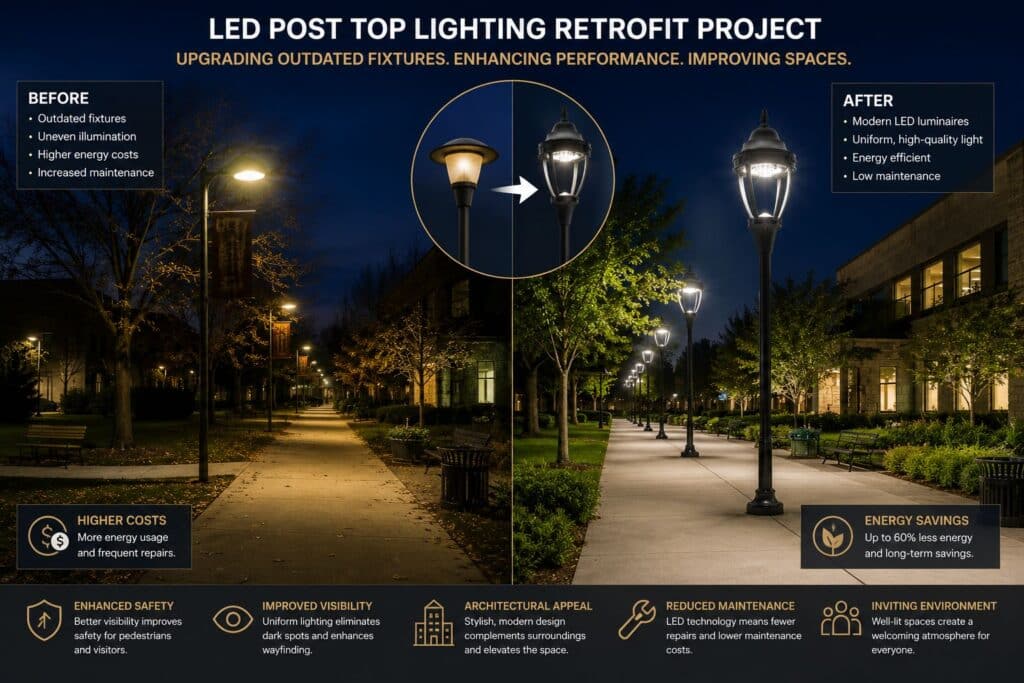
A successful commercial lighting retrofit considers fixture quality, installation, pole reuse, maintenance savings, energy efficiency, and long-term return on investment rather than purchase price alone.
Planning an outdoor lighting retrofit?
Our lighting specialists help municipalities, universities, contractors, HOAs, healthcare facilities, hospitality properties, and commercial developers evaluate retrofit options that improve lighting performance while maximizing long-term return on investment.
👉 Explore our complete line of Commercial LED Post Top Fixtures designed for retrofit and new construction projects.
Commercial Retrofit Planning at a Glance
| Planning Consideration | Typical Evaluation |
|---|---|
| Existing Pole Reuse | Inspect structural condition and wiring |
| Fixture Style | Architectural • Lantern • Acorn • Courtyard |
| Pole Height | 10–20 feet |
| Mounting Options | Pole Mount • Pier Mount • Bull Horn Arms |
| Color Temperature | 3000K • 4000K • 5000K |
| Controls | Photocells • Motion Sensors • Wireless Controls |
| Warranty | Standard 5-Year • Premium 10-Year |
| Primary Goal | Lower lifecycle cost and improved lighting performance |
Decorative lanterns can become defining architectural features within a development. Continue with our Modern LED Lantern Post Top Lighting for Commercial Outdoor Spaces guide to learn how lantern fixtures contribute to cohesive site design and placemaking.
What Determines the Total Cost of a Lighting Retrofit?
Every commercial retrofit project is unique.
Several factors influence the overall investment, including:
- Number of fixtures
- Pole heights
- Fixture style
- Lumen output requirements
- Optical distributions
- Existing electrical infrastructure
- Mounting methods
- Lighting controls
- Installation complexity
- Project phasing
Rather than focusing solely on fixture price, commercial buyers should evaluate how each of these factors affects both the initial project cost and long-term operating expenses.
Can Existing Poles Be Reused?
One of the biggest opportunities to reduce retrofit costs is reusing existing light poles whenever practical.
Many commercial properties already have structurally sound poles that can continue providing years of reliable service after the luminaires are replaced.
Before reusing poles, they should be evaluated for:
Structural integrity
Corrosion
Foundation condition
Anchor bolts
Wiring condition
Pole alignment
Wind loading (EPA ratings)
Mounting compatibility
Reusing poles can significantly reduce installation costs while minimizing disruption to daily operations.
If you’re evaluating an existing installation, our Outdoor Lamp Post Fixture Retrofit Guide explains when pole reuse is appropriate and what should be inspected before upgrading to LED.
Fixture Quality Influences Lifetime Cost
Not every commercial LED fixture delivers the same long-term value.
Lower-cost luminaires may reduce the initial project investment, but higher-quality fixtures often provide greater reliability and lower maintenance costs over their service life.
Premium commercial fixtures commonly include:
- Die-cast aluminum housings
- Premium LED drivers
- High-performance optics
- Better thermal management
- Marine-grade powder-coated finishes
- Replaceable electrical components
- Enhanced surge protection
- Corrosion-resistant hardware
These features help extend fixture life while reducing service calls and unexpected maintenance expenses.
Selecting the right fixture is just as important as budgeting for the project. Explore our Commercial LED Post Top Lighting Buyer’s Guide to compare fixture styles, optics, controls, mounting methods, and warranties.
Don't Compare Fixtures on Purchase Price Alone
The least expensive fixture is not always the most economical choice.
Commercial buyers should compare:
| Initial Purchase | Long-Term Value |
|---|---|
| Fixture price | Service life |
| Installation cost | Maintenance savings |
| Warranty | Reliability |
| Energy consumption | Operating costs |
| Driver quality | Replacement frequency |
| Construction materials | Corrosion resistance |
A slightly higher initial investment often results in lower total ownership costs over the life of the lighting system.
If you’re comparing commercial luminaires, our How to Choose the Best Commercial LED Post Top Lights guide explains what distinguishes premium commercial fixtures from economy alternatives.
Energy Savings Continue Year After Year
One of the primary financial benefits of upgrading to LED is reduced energy consumption.
Compared to older lighting technologies such as metal halide or high-pressure sodium, modern LED post top fixtures generally require less power to produce comparable or improved illumination.
Additional advantages include:
- Improved optical efficiency
- Better light distribution
- Instant-on operation
- Reduced operating temperatures
- Compatibility with dimming and smart controls
Although energy savings vary by application, lower utility costs continue throughout the life of the lighting system and contribute significantly to overall project payback.
Maintenance Savings Often Exceed Expectations
Many commercial property owners initially focus on energy savings but underestimate the value of reduced maintenance.
LED retrofits can significantly reduce:
- Lamp replacement
- Ballast replacement
- Lift truck rentals
- Maintenance labor
- Nighttime service interruptions
- Inventory of replacement lamps
For large campuses, municipalities, healthcare facilities, and apartment communities, these maintenance reductions often represent one of the most significant long-term financial benefits of an LED lighting upgrade.
Warranty Coverage Protects Your Investment
Warranty coverage is more than a marketing feature—it often reflects the confidence a manufacturer has in the quality of its components and engineering.
Most commercial LED post top fixtures include either:
- Standard 5-year warranties
- Premium 10-year warranties on higher-end models
While warranty terms vary by manufacturer, fixtures offering longer warranty periods frequently incorporate:
- Premium LED drivers
- Higher-quality capacitors
- Improved thermal management
- Enhanced surge protection
- Better corrosion-resistant finishes
- More robust housing construction
For campuses, municipalities, healthcare facilities, and commercial developments where maintenance access can be expensive, investing in higher-quality fixtures often reduces lifecycle costs while minimizing service interruptions.
Smart Lighting Controls Increase Return on Investment
Modern lighting controls improve more than convenience—they reduce operating costs throughout the life of the system.
Common control options include:
- Photocells
- Motion sensors
- Occupancy sensors
- 0–10V dimming
- Scheduled dimming
- Wireless lighting controls
- Centralized lighting management
- Energy monitoring
These technologies allow fixtures to operate only when needed or at reduced output during periods of low pedestrian activity, extending component life while lowering energy consumption.
For many commercial properties, intelligent controls become an important contributor to long-term ROI.
Look for DLC Listed Products and Industry Certifications
Commercial LED post top fixtures should be evaluated on more than light output and appearance. Product certifications help verify performance, safety, and eligibility for many utility incentive programs.
Understanding these certifications allows buyers to compare products more confidently while ensuring fixtures meet project specifications and applicable codes.
DLC Listed Products
One of the most recognized certifications for commercial LED lighting is the DesignLights Consortium (DLC®) listing.
Many electric utility rebate programs require qualifying commercial fixtures to appear on the DLC Qualified Products List (QPL).
A DLC Listed fixture has been independently evaluated for criteria such as:
- Energy efficiency
- Light output
- Luminous efficacy
- Product performance
- Product reliability
- Warranty requirements
While not every project requires DLC certification, selecting DLC Listed fixtures may improve eligibility for utility rebates and provide additional confidence in product performance.
UL and ETL Safety Certifications
Commercial outdoor lighting should also be certified for electrical safety.
Many commercial fixtures are tested and listed by organizations such as:
- UL (Underwriters Laboratories)
- ETL (Intertek)
These certifications indicate that the luminaire has been evaluated to applicable electrical safety standards for its intended installation.
IP Ratings
Outdoor lighting must withstand exposure to rain, dust, humidity, and changing weather conditions.
Ingress Protection (IP) ratings indicate how well a fixture protects internal electrical components.
Typical commercial ratings include:
| IP Rating | Typical Protection |
|---|---|
| IP65 | Dust-tight with protection against water jets |
| IP66 | Higher protection against powerful water jets |
| IP67 | Temporary immersion protection for certain applications |
Higher IP ratings are often specified for challenging outdoor environments, coastal locations, and areas exposed to frequent washing or severe weather.
Surge Protection
Outdoor lighting systems are frequently exposed to electrical surges caused by nearby lightning strikes and utility switching events.
Commercial-grade LED post top fixtures commonly include:
- 10kV surge protection
- 20kV surge protection on premium models
Higher surge protection can help extend driver life while reducing unexpected maintenance costs.
Marine-Grade Finishes
Projects located near oceans, lakes, or other corrosive environments should consider fixtures with enhanced protective finishes.
Marine-grade powder coatings help protect against:
- Salt air
- Moisture
- Humidity
- Corrosion
- UV exposure
These finishes are especially valuable for:
- Coastal communities
- Waterfront developments
- Marinas
- Resorts
- Boardwalks
- Bridges
- Municipal parks near bodies of water
ANSI C136 Compatibility
Many municipalities and public agencies reference the ANSI C136 family of standards when specifying roadway and outdoor lighting equipment.
Depending on the application, commercial post top fixtures may be available with features that support compatibility with common municipal lighting practices, including standardized photocontrol receptacles and mounting configurations.
This can simplify maintenance and integration into existing public lighting systems.
Why Certifications Matter
Selecting fixtures that meet recognized industry standards provides benefits beyond regulatory compliance.
Certified commercial lighting products can help:
- Improve confidence in long-term performance
- Simplify project specifications
- Support utility rebate eligibility
- Reduce maintenance risk
- Meet municipal procurement requirements
- Increase owner confidence in product quality
For many commercial projects, certifications become another important factor when evaluating the overall value of a lighting investment.
Utility Rebates May Reduce Initial Project Costs
Many electric utilities and energy-efficiency programs offer incentives for qualifying LED lighting upgrades.
Depending on your location and utility provider, rebate programs may help offset the initial investment in:
- Commercial LED fixtures
- Lighting controls
- Smart lighting systems
- Energy-efficient retrofits
Program requirements vary considerably, so it’s worthwhile to check with your local electric utility or energy provider before beginning a retrofit project.
Even when rebates are unavailable, the ongoing reductions in energy and maintenance costs often provide substantial long-term financial benefits.
Evaluate the Total Cost of Ownership
Commercial lighting should be viewed as a long-term investment rather than a one-time purchase.
When evaluating competing products, consider the complete ownership lifecycle.
| Cost Category | Long-Term Consideration |
|---|---|
| Fixture Purchase | Initial investment |
| Installation | Labor, equipment, wiring |
| Energy Consumption | Annual operating costs |
| Maintenance | Driver replacements, service labor |
| Controls | Additional energy savings |
| Warranty | Reduced financial risk |
| Service Life | Fewer replacements over time |
| Future Expansion | Compatibility with additional phases |
Looking at the complete lifecycle often reveals that higher-quality fixtures provide greater value despite a higher initial purchase price.
Budget for Future Expansion
Many commercial properties evolve over time.
Apartment communities add new buildings.
Universities expand campus facilities.
Municipalities improve parks.
Hotels build additional amenities.
When planning an outdoor lighting retrofit, consider future phases of development.
Planning ahead may include:
- Selecting fixtures from a coordinated architectural lighting collection
- Matching finishes and pole styles
- Installing infrastructure that accommodates future expansion
- Choosing field-selectable fixtures for added flexibility
- Maintaining consistent color temperatures throughout the property
Planning for growth helps preserve architectural continuity while simplifying future projects.
Invest in Coordinated Architectural Lighting Collections
Retrofit projects often replace more than individual fixtures—they modernize the appearance of an entire property.
Many architects and facility managers choose coordinated architectural lighting collections that include matching:
- Commercial LED Post Top Fixtures
- Architectural Area Lights
- LED Bollards
- Wall-Mounted Fixtures
- Wall Sconces
- Pier-Mounted Fixtures
Using a coordinated collection creates a consistent visual identity while making future additions and replacement projects much easier to manage.
This approach is especially valuable for:
- University campuses
- Mixed-use developments
- Healthcare campuses
- Hospitality properties
- Municipal streetscapes
- Corporate headquarters
- HOA communities
Commercial Retrofit Planning Checklist
Before beginning a lighting retrofit, ask the following questions:
| Planning Question | Why It Matters |
|---|---|
| Can existing poles be reused? | Reduces installation costs |
| Are fixture styles appropriate for the property? | Maintains architectural character |
| Is the lumen output correctly specified? | Prevents over- or under-lighting |
| Are optics matched to the application? | Improves lighting uniformity |
| Should smart controls be included? | Reduces operating costs |
| Is a coordinated lighting collection available? | Simplifies future expansion |
| What warranty is provided? | Protects long-term investment |
| Has future growth been considered? | Preserves design consistency |
Inline Buyer Q&A
Q: Is replacing only the fixtures usually more economical than replacing the entire pole?
In many retrofit projects, yes. If existing poles remain structurally sound and meet current project requirements, reusing them can significantly reduce installation costs while allowing the property to benefit from modern LED technology.
Q: Should I purchase the least expensive fixture available?
Not necessarily. Commercial buyers should evaluate construction quality, warranty, maintenance requirements, surge protection, and expected service life in addition to purchase price.
Q: Are smart lighting controls worth the additional investment?
For many commercial applications, smart controls improve energy efficiency, reduce operating costs, and provide greater flexibility for managing outdoor lighting throughout the life of the system.
A Successful Retrofit Is Measured by Long-Term Value
The true value of a commercial LED post top lighting retrofit extends well beyond the initial purchase price. By evaluating fixture quality, installation requirements, existing infrastructure, smart controls, warranty coverage, maintenance savings, energy efficiency, and future expansion plans, property owners can develop lighting systems that deliver reliable performance and lasting financial benefits for many years.
Ready to Plan Your Commercial LED Post Top Lighting Retrofit?
Whether you’re modernizing a university campus, apartment community, municipal streetscape, healthcare facility, hospitality property, HOA, or commercial development, our lighting specialists can help you compare retrofit options, evaluate lifecycle costs, and select coordinated architectural lighting solutions that maximize long-term return on investment.
Explore our complete line of Commercial LED Post Top Fixtures and discover how a well-planned retrofit can improve energy efficiency, maintenance savings, pedestrian safety, architectural appeal, and overall property value.
Frequently Asked Questions
How long does a commercial LED post top fixture typically last?
Many commercial-grade LED post top fixtures are designed for service lives approaching 100,000 hours, depending on operating conditions, driver quality, ambient temperature, and maintenance practices.
Can decorative post top fixtures improve property value?
Professionally designed outdoor lighting can improve curb appeal, enhance architectural character, increase pedestrian comfort, and create a more welcoming environment for tenants, customers, employees, and visitors.
Should retrofit projects include color temperature upgrades?
Yes. A retrofit is an excellent opportunity to evaluate whether 3000K, 4000K, or 5000K lighting is most appropriate for the property’s appearance, customer experience, and operational needs.