
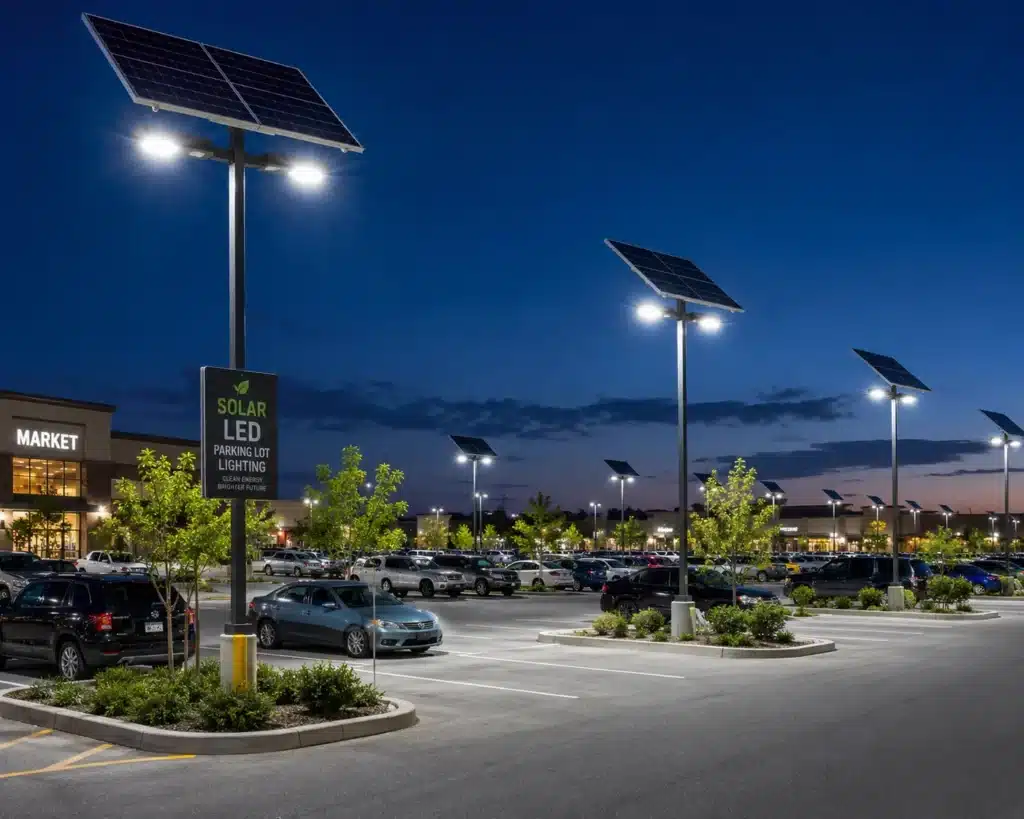
Commercial solar parking lot lighting provides an energy-efficient and cost-effective solution for illuminating parking areas without relying entirely on traditional utility power. Modern solar LED parking lot lighting systems combine high-efficiency solar panels, advanced lithium battery technology, intelligent controls, and commercial-grade LED fixtures to deliver reliable nighttime illumination for a wide range of outdoor applications.
As energy costs continue to rise and infrastructure expansion becomes more expensive, many commercial property owners, municipalities, HOAs, schools, churches, industrial facilities, and storage properties are turning to solar-powered parking lot lighting systems to reduce trenching costs, simplify installations, and improve long-term operating efficiency.
Unlike traditional parking lot lighting systems that require underground electrical conduit and utility coordination, solar parking lot lighting fixtures operate independently using integrated solar power systems mounted directly on the lighting pole.
What Is Solar Parking Lot Lighting?
Solar parking lot lighting uses photovoltaic solar panels to collect and store energy during daylight hours. That energy is stored in high-capacity batteries and used to power LED parking lot fixtures during nighttime operation.
A commercial solar lighting system typically includes:
- LED parking lot fixture
- Solar panel assembly
- Lithium battery storage system
- Solar charge controller
- Mounting arm and pole system
- Motion sensors or programmable controls
Modern commercial solar parking lot lighting systems are designed for reliable dusk-to-dawn operation while minimizing maintenance requirements and electrical infrastructure costs.
Benefits of Solar Parking Lot Lighting
Reduced Installation Costs
One of the largest advantages of solar parking lot lighting is eliminating the need for trenching and underground electrical wiring.
Traditional parking lot lighting projects often require:
-
Electrical conduit installation
-
Concrete cutting
-
Utility coordination
-
Long wire runs
-
Extensive labor costs
Solar lighting systems can significantly reduce installation complexity, especially in remote or large outdoor areas.
Before finalizing a parking lot or site lighting project, review our LED Area Lighting Layout Guide to better understand illumination coverage and lighting uniformity.
Energy Savings
Solar parking lot lights operate using renewable solar energy rather than grid electricity. This can dramatically reduce operating expenses over the lifespan of the lighting system.
LED fixtures also consume substantially less energy than traditional HID parking lot fixtures while providing:
-
Better visibility
-
Improved uniformity
-
Instant-on operation
-
Reduced maintenance
Ideal for Remote Locations
Solar parking lot lighting is especially beneficial for:
-
Remote parking lots
-
Parks and recreation areas
-
Churches
-
Storage yards
-
Walking trails
-
HOA common areas
-
Rural facilities
-
Temporary parking installations
In locations where utility access is limited or expensive, solar lighting often becomes the most practical solution.
Remote outdoor projects often benefit from the installation advantages discussed in our Solar vs Traditional LED Lighting comparison guide.
Improved Sustainability
Many commercial properties and municipalities are implementing sustainability initiatives designed to reduce energy consumption and environmental impact.
Solar LED parking lot lighting supports:
-
Reduced carbon emissions
-
Renewable energy adoption
-
Green building initiatives
-
Energy efficiency programs
-
ESG and sustainability goals
Common Applications for Solar Parking Lot Lighting
Commercial Parking Lots
Retail centers, office complexes, shopping centers, and mixed-use developments often use solar parking lot lighting to improve safety and visibility while reducing utility costs. Many commercial properties upgrading to LED parking lot lights are also evaluating solar-powered systems to reduce trenching costs and improve long-term energy efficiency.
Homeowner Associations (HOAs)
HOAs frequently install solar parking lot lights in:
-
Community entrances
-
Shared parking areas
-
Clubhouse parking
-
Recreational areas
-
Walking paths
Solar lighting reduces long-term electrical expenses while minimizing disruption during installation.
HOA communities frequently combine solar parking area fixtures with decorative site lighting discussed in our HOA Lighting Guide.
Municipal and Public Facilities
Cities and municipalities commonly use solar parking lot lights in:
-
Parks
-
Public parking areas
-
Transit lots
-
Trailheads
-
Public works facilities
Solar systems are particularly useful in locations where extending electrical infrastructure is cost prohibitive.
Industrial and Storage Facilities
Industrial yards, self-storage properties, and equipment storage areas often require dependable nighttime illumination for security and operational safety.
Solar parking lot lighting can provide:
-
Perimeter security lighting
-
Remote area illumination
-
Backup lighting capability
-
Reduced electrical infrastructure costs
Key Components of Commercial Solar Parking Lot Lighting Systems
Solar Panels
Commercial systems typically use high-efficiency monocrystalline solar panels designed to maximize energy collection throughout the day.
Panel sizing depends on:
-
Fixture wattage
-
Geographic location
-
Nighttime runtime requirements
-
Weather conditions
-
Battery capacity
Lithium Battery Systems
Most modern solar parking lot lights use lithium-ion or LiFePO4 battery technology due to:
-
Longer lifespan
-
Faster charging
-
Better temperature performance
-
Reduced maintenance
-
Improved reliability
Battery storage capacity is critical for maintaining operation during cloudy weather or reduced sunlight conditions.
Property owners evaluating off-grid systems should review the battery sizing recommendations provided in our Solar Lighting Battery and Backup Guide.
LED Fixtures
LED parking lot fixtures used in solar systems are designed for high efficacy and reduced energy consumption.
Common features include:
-
Type III, IV, or V optics
-
High lumen output
-
Dark sky compliance options
-
Motion sensors
-
Dimming controls
-
Corrosion-resistant housings
For larger exterior projects, our commercial outdoor lighting solutions include solar-powered area lighting, roadway fixtures, wall-mounted lighting, and perimeter security illumination.
Smart Controls and Motion Sensors
Advanced controls help optimize battery performance and runtime.
Common control options include:
-
Dusk-to-dawn operation
-
Motion-activated dimming
-
Programmable schedules
-
Adaptive brightness control
-
Wireless monitoring systems
Solar Parking Lot Lighting Design Considerations
Pole Height
Pole height significantly impacts light distribution and fixture spacing.
Common mounting heights include:
-
15–20 feet for smaller parking areas
-
20–25 feet for commercial lots
-
25–30 feet for large parking facilities
Proper pole height selection helps improve illumination uniformity while minimizing glare.
Proper pole selection is critical for solar installations, and our commercial light poles guide explains mounting heights, EPA considerations, and pole configurations for outdoor lighting systems.
Geographic Location
Solar lighting performance varies depending on:
-
Available sunlight
-
Seasonal weather patterns
-
Latitude
-
Temperature conditions
Northern climates may require:
-
Larger solar panels
-
Increased battery capacity
-
Extended autonomy days
Battery Autonomy
Battery autonomy refers to how many nights the lighting system can operate without solar charging.
Commercial systems are often designed for:
-
2–5 nights of backup operation
-
Reduced output during prolonged cloudy conditions
-
Intelligent power management
Lighting Levels
Proper foot-candle levels are important for:
-
Security
-
Pedestrian safety
-
Vehicle navigation
-
ADA accessibility
-
Property visibility
Lighting design should consider:
-
Fixture spacing
-
Pole height
-
Optic distribution
-
Uniformity ratios
Advances in LED technology and battery storage have made Commercial Solar Street Lights a viable alternative to traditional utility-powered roadway lighting
Solar Parking Lot Lighting vs Traditional Lighting
| Feature | Solar Parking Lot Lighting | Traditional LED Lighting |
|---|---|---|
| Electrical Trenching | Not Required | Required |
| Utility Costs | Minimal | Ongoing |
| Installation Complexity | Lower | Higher |
| Remote Applications | Excellent | Limited |
| Initial Equipment Cost | Higher | Lower |
| Long-Term Energy Savings | Excellent | Moderate |
| Sustainability | High | Moderate |
Why LED Technology Works Best for Solar Lighting
LED technology has transformed solar outdoor lighting by dramatically reducing power consumption while increasing light output.
Compared to older HID technologies, LED fixtures provide:
- Higher efficacy
- Longer lifespan
- Instant startup
- Better optical control
- Reduced maintenance
- Improved battery efficiency
This makes LED fixtures ideal for off-grid solar applications where energy management is critical.
Inline Buyer Q&A
How long can solar parking lot lights operate at night?
Nightly runtime depends on how the complete solar lighting system is designed.
Solar-panel capacity, battery storage, fixture output, operating schedule, dimming profile, controls, seasonal solar availability, temperature, and site conditions all affect runtime.
Systems can be designed for dusk-to-dawn operation where appropriate, but the required operating profile should be established before the solar array and battery are sized.
Are solar parking lot lights reliable during cloudy weather?
They can be when the system is properly sized for the location and required operating profile.
Commercial systems can incorporate battery reserve, often referred to as autonomy, to support operation during periods of reduced solar charging.
The appropriate reserve depends on local solar conditions, seasonal weather patterns, battery capacity, lighting schedule, fixture load, controls, and the performance objectives of the project.
How many days of battery autonomy should a commercial solar parking lot system have?
There is no universal number appropriate for every project.
Required autonomy depends on the site’s solar resource, weather patterns, operating schedule, lighting load, battery sizing, acceptable performance during extended low-sun conditions, and other project requirements.
Autonomy should be treated as a system-design decision rather than a standard feature assumed from the fixture wattage.
Can solar parking lot lights replace traditional utility-powered pole lights?
Yes, in suitable applications.
A properly designed solar system can provide commercial parking-area illumination without a conventional electrical connection.
However, solar should not automatically be treated as a one-for-one substitute for an existing grid-powered fixture. Required illumination, pole locations, mounting heights, nightly runtime, available solar exposure, battery capacity, controls, and site conditions should be evaluated together.
What makes a parking lot a good candidate for solar lighting?
Solar parking-lot lighting can be particularly attractive where extending electrical service would require substantial trenching, conduit, wiring, pavement disturbance, or utility coordination.
Sites should also have sufficient solar exposure and suitable locations for the solar equipment.
Shading from buildings, trees, structures, terrain, or other obstructions should be evaluated because reduced solar exposure can affect system charging and performance.
Can existing parking-lot poles be used for solar lighting?
Potentially, but this should not be assumed.
Solar equipment can add panels, batteries, brackets, and other components that change the physical and structural loading on the pole.
Pole condition, height, mounting configuration, equipment weight, projected area, wind loading, orientation, and applicable structural requirements should be evaluated before reusing an existing pole.
Do solar parking lot lights require maintenance?
Yes, although maintenance requirements differ from conventional grid-powered lighting.
Depending on the system and environment, maintenance can include inspection or cleaning of solar panels, battery evaluation or eventual replacement, controller checks, fixture inspection, pole and mounting-system inspection, and verification that vegetation or new construction has not created excessive shading.
Maintenance requirements should be reviewed for the specific equipment selected.
What information is needed to size a commercial solar parking lot lighting system?
Useful project information includes:
- Project location
- Site plan and parking-lot dimensions
- Required or desired illumination
- Existing or proposed pole locations
- Mounting heights
- Nightly operating schedule
- Dimming or motion-control strategy
- Required runtime
- Desired battery autonomy
- Solar exposure and potential shading
- Seasonal operating conditions
- Temperature range
- Existing lighting for retrofit projects
- Property boundaries
- Dark Sky or light-trespass objectives
- Wind and structural requirements
- Photographs or drawings when available
Commercial solar lighting should be sized around the application and location rather than selected from fixture wattage alone.
Design the Solar System Around the Parking Lot
Commercial solar parking-lot lighting works as a complete energy and lighting system.
Solar availability, required illumination, nightly runtime, battery capacity, autonomy, pole height, fixture output, optical distribution, controls, temperature, shading, and structural conditions all influence system performance.
Our lighting specialists can help evaluate commercial parking lots, HOA properties, campuses, industrial facilities, municipal sites, schools, and other locations where off-grid lighting may provide an alternative to extending electrical infrastructure.
Explore Commercial Solar Parking Lot Lights or call 1-844-533-7767 to discuss your project.
Frequently Asked Questions Commercial Solar Parking Lot Lighting
What are the advantages of solar parking lot lighting?
Solar parking-lot lighting can eliminate the need to extend grid power to individual lighting locations and can reduce or avoid trenching, conduit, wiring, pavement disturbance, and utility coordination.
It can be particularly useful for new sites, remote areas, expansions, or properties where installing conventional electrical infrastructure would be difficult or expensive.
Actual project economics depend on site conditions and the systems being compared.
Can commercial solar parking lot lights operate from dusk to dawn?
Yes, systems can be designed for dusk-to-dawn operation.
Whether a particular system can support that schedule depends on solar-panel capacity, battery storage, fixture load, controls, seasonal solar availability, temperature, and the site’s operating requirements.
What happens after several cloudy or rainy days?
Performance depends on available battery reserve and how much solar energy the system receives during the period.
A properly designed system accounts for periods of reduced charging, but no battery has unlimited autonomy.
Some systems can also use adaptive dimming or other control strategies to manage stored energy according to the system design.
Are solar parking lot lights suitable for large commercial properties?
They can be.
Large parking areas require careful evaluation of illumination, pole locations, mounting heights, fixture distributions, solar exposure, battery requirements, controls, and system quantity.
A photometric layout can evaluate the lighting portion of the design, while solar and battery sizing address the energy required to operate it.
Do solar parking lot lights work during utility power outages?
Off-grid solar parking-lot lights operate independently of the electrical utility and therefore are not directly dependent on normal grid availability.
Continued operation still depends on the system’s battery state, available solar charging, controls, and system condition.
What type of batteries are used in commercial solar parking lot lighting?
Battery technology varies by manufacturer and system.
Lithium-based batteries, including LiFePO4 designs, are used in many contemporary commercial solar-lighting systems.
Battery chemistry should be evaluated together with capacity, operating temperature, expected cycling, charging system, enclosure, warranty, and replacement requirements.
How long do solar parking lot lighting batteries last?
There is no universal battery replacement interval.
Battery service life depends on chemistry, depth of discharge, charge cycles, temperature, system sizing, charging conditions, controls, manufacturer design, and operating environment.
Review the specifications and warranty for the battery system being considered rather than assuming a fixed service life.
How long do the LED fixtures last?
Commercial LED fixtures can provide operating lives measured in tens of thousands of hours, but published lifetime ratings vary by fixture and manufacturer.
Actual service life can also be affected by thermal conditions, driver and electronic components, operating schedule, environmental exposure, controls, and maintenance.
The LED fixture and solar battery should be considered separate components with different service-life characteristics.
What mounting height should be used for solar parking lot lights?
There is no universal mounting-height range for solar parking-lot lighting.
Mounting height should be coordinated with fixture output, optical distribution, pole spacing, required illumination, uniformity, site geometry, solar-panel configuration, and structural requirements.
Photometric analysis can help evaluate the lighting performance of proposed mounting heights.
Are solar parking lot lights brighter than traditional HID fixtures?
Not inherently.
Solar LED and traditional HID systems should be compared according to delivered illumination, uniformity, distribution, glare, and application requirements rather than fixture brightness alone.
Modern LED optics can provide precise distribution, but performance depends on the fixture and layout selected.
Can solar parking lot lighting reduce installation costs?
Potentially.
Avoiding trenching, conduit, underground wiring, pavement restoration, transformers, and utility-service extensions can make solar particularly attractive at some sites.
The economics depend on the existing infrastructure, site conditions, equipment requirements, installation costs, maintenance, and the conventional system being compared.
Is solar parking lot lighting appropriate for HOA communities?
It can be.
HOA parking areas, entrances, private roads, pedestrian areas, clubhouses, and other common spaces may be candidates where solar exposure and lighting requirements support an off-grid system.
Fixture appearance, glare, neighboring residences, operating schedules, and community requirements should also be considered.
Are solar parking lot lights Dark Sky friendly?
Solar power by itself does not make a lighting system Dark Sky friendly.
Dark Sky considerations involve fixture distribution, uplight, shielding, output, glare, light trespass, color temperature, controls, and the overall site design.
Solar fixtures can be selected and configured with these objectives in mind where appropriate.
Can motion sensors and dimming be used with solar parking lot lighting?
Yes, when supported by the selected system.
Motion sensing, scheduled dimming, and other adaptive controls can reduce the lighting load during periods of low activity and help manage stored battery energy.
Control strategies should still provide the illumination and operating behavior required for the property.
Does a larger solar panel always mean a better lighting system?
No.
Panel capacity should be matched to the lighting load, battery, location, operating schedule, seasonal solar conditions, and system design.
Oversizing or undersizing individual components without considering the complete system is not a substitute for proper solar-lighting design.
Can a photometric layout be used for solar parking lot lighting?
Yes.
The lighting portion of a solar project can be modeled using the same fundamental photometric principles used for grid-powered area lighting.
The photometric plan evaluates predicted illumination and uniformity, while the solar panel, battery, controls, and energy calculations determine whether the system can support the required operating profile.
Stay Connected with Our Lighting Resources
Add IndustrialLightingFixtures.org as a Preferred Source on Google to see more of our lighting guides and technical resources across Google Search experiences.
Related Solar Parking Lot Lighting Resources
- Solar Parking Lot Lights — Explore commercial off-grid parking-lot lighting systems for properties where extending conventional electrical service may be difficult or costly.
- Solar Lighting Battery and Backup Guide — Learn how battery capacity, nightly runtime, autonomy, solar charging, and operating conditions affect commercial solar-lighting performance.
- Solar vs. Traditional LED Lighting — Compare off-grid solar and utility-powered LED lighting when evaluating infrastructure, operating requirements, and site suitability.
- Commercial Solar Street Lights — Review solar lighting options for roadways, private roads, municipal applications, campuses, and other transportation environments.
- LED Parking Lot Lights — Compare conventional grid-powered LED parking-lot lighting and the fixture, optical, mounting, and layout considerations used for commercial parking areas.