
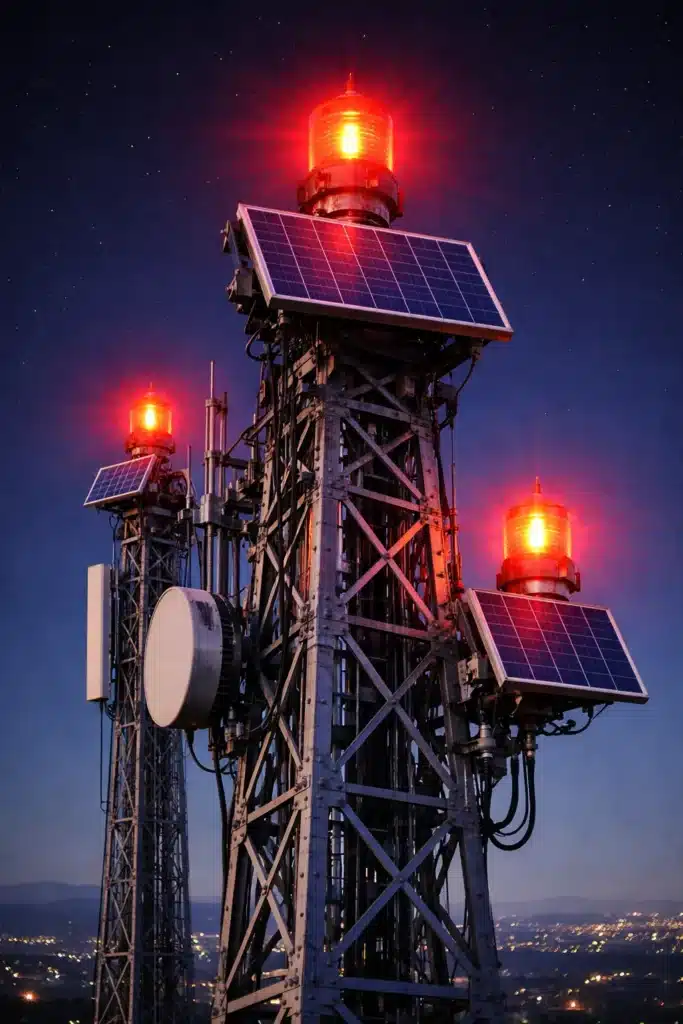
Solar aviation obstruction lights are specialized safety lighting systems designed to mark tall structures that may pose hazards to aircraft. These systems use high-visibility LED lighting powered by photovoltaic solar panels and integrated battery storage to provide reliable warning signals for pilots during nighttime and low-visibility conditions.
Obstruction lights are typically installed on telecommunications towers, wind turbines, cranes, skyscrapers, and other tall structures that extend into controlled airspace. Their purpose is to increase visibility so pilots can identify potential obstacles and navigate safely around them.
Solar-powered aviation warning lights are especially valuable for structures located in remote areas where grid power may be unavailable or costly to install. By generating their own electricity, solar obstruction lighting systems can operate independently while meeting aviation safety requirements.
For a broader overview of off-grid solar lighting technologies used across commercial and infrastructure environments, explore our Solar Lighting Systems resource:
Solar Aviation Obstruction Lighting
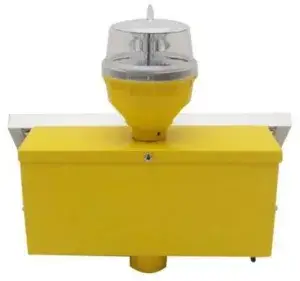
AH-LS-A1 LED Low-intensity L810
Solar Aviation Obstruction Light
Brand: Anhang
self-contained LED solar lighting solution designed for marking obstacles up to 45 meters in height.; Intensity(cd) >32.5cd; Steady/Flashing(20fpm) adjustable; Red LED; Prices start at $400

AH-LS-B LED Low-intensity L810
Solar Aviation Obstruction Light
Brand: Anhang
an integrated high-efficiency solar panel design and advanced lithium-ion battery; Intensity(cd) 32.5cd; Steady/Flashing(20fpm) adjustable; Red LED; Prices start at $400
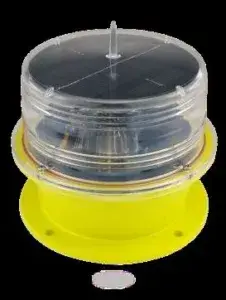
AH-LS-L series LED Low-intensity L810
Solar Aviation Obstruction Light
Brand: Anhang
Low-profile, self-contained, marking structures up to 45M; Intensity(cd) 10cd(Steady), 32.5cd(Flashing); Steady/Flashing(20fpm) adjustable; Red LED; Prices start at $345
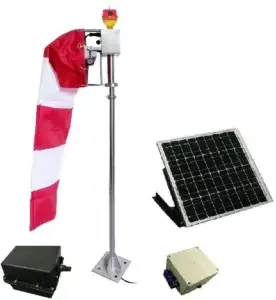
AH-HP-WS Internally Illuminated Airdrome
Solar Wind Cone
Brand: Anhang
Advanced LED lighting solution ensures maximum safety and visibility, whether used in remote airstrips, heliports, or airports.; Prices start at $1400
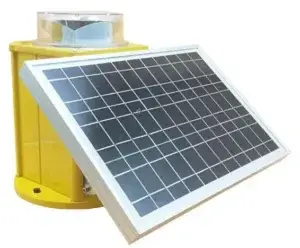
AH-MS-B3 LED LED Medium-intensity Type B L864
Solar Aviation Obstruction Light
Brand: Anhang
Designed for critical infrastructure and tall structures. Perfect for remote locs; Intensity(cd) >2000cd(Night); Flashing 20FPM, Red LED; Prices start at $545
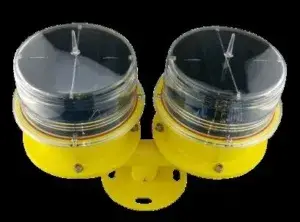
AH-LS-LD Low-intensity L810 Double
Solar Aviation Obstruction Light
Brand: Anhang
self-contained unit combines a primary and backup lamp configuration with integrated high-efficiency solar panels. Steady/Flashing(20fpm) adjustable, Red LED; Intensity(cd) 32.5cd; Prices start at $400
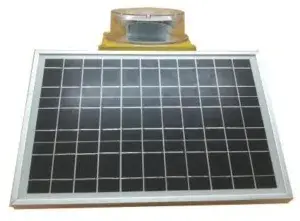
AH-MS-A1 Medium-intensity Type A L865
Solar Aviation Obstruction Light
Brand: Anhang
designed for marking tall structures between 105-150 meters in height; Intensity(cd) ≥20000cd(Daytime), ≥2000cd(Night); flashing White LED; Prices start at $400
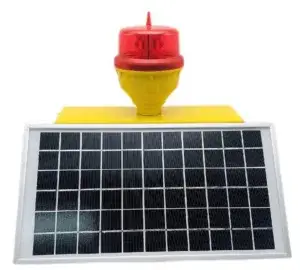
AH-LI-B2 Low-intensity Type B
Solar Aviation Obstruction Light
Brand: Anhang
Intensity(candela) ≥32.5cd(type B),others optional(10cd, 40cd,etc); steady burning Red LED; Prices start at $425

AH-SA-A Type A, TLOF, FATO
Solar Helipad Lights
Brand: Anhang
Integrated Design, Taxiway Lighting, Runway Edge Lighting; Intensity(cd) >50cd; Steady(Flashing mode is optional) Prices start at $400
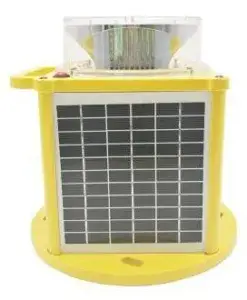
AH-SA-HB LED Solar Heliport Beacon
Solar Helipad Lights
Brand: Anhang
for heliports requiring long-range visual guidance; Intensity(cd) ≥2500cd; Flash Characteristics Morse code “H”; Prices start at $500
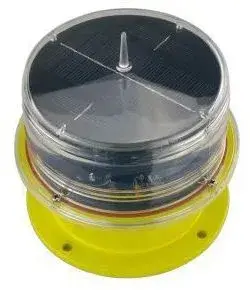
AH-SA-B Type B TLOF, FATO
Solar Helipad Lights
Brand: Anhang
Integrated Design, Taxiway Lighting, Runway Edge Lighting; Intensity(cd) 20cd(Steady), 35cd(Flashing); Flash Characteristics Steady(Flashing mode is optional); Prices start at $400
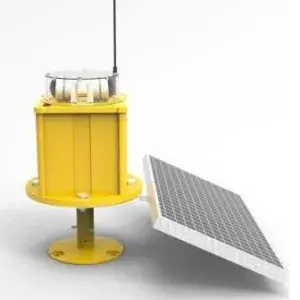
AH-SA-S2 Solar Powered Runway Threshold End Light
Solar Airport Lights
Brand: Anhang
Integrated Design, Taxiway Lighting, Runway Edge Lighting; Prices start at $400
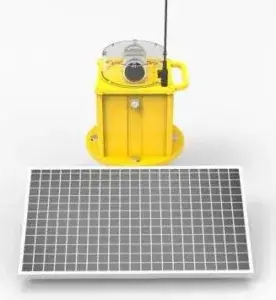
AH-SA-S3 Solar Powered Runway Edge Light
Solar Airport Lights
Brand: Anhang
Integrated Design, Taxiway Lighting, Runway Edge Lighting; Prices start at $400
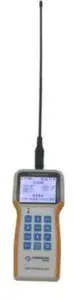
AH-HP-RC Wireless Handheld Remote Controller
Solar Airport Lights
Brand: Anhang
Integrated Design, Taxiway Lighting, Runway Edge Lighting; Prices start at $400
What Are Solar Aviation Obstruction Lights?
Solar aviation obstruction lights are lighting devices designed to alert pilots to tall structures that may interfere with aircraft flight paths. These lights are typically mounted on the highest points of structures to ensure they remain visible from long distances.
For remote sites without dependable utility power, the Solar Low-Intensity L-810 B-Series Aviation Obstruction Light combines an integrated solar panel and lithium-ion battery for off-grid obstruction marking applications.
A typical solar aviation obstruction lighting system includes:
-
photovoltaic solar panel
-
LED obstruction light (steady or flashing)
-
rechargeable battery storage
-
charge controller
-
mounting hardware
During daylight hours, solar panels collect sunlight and convert it into electrical energy stored in onboard batteries. At night, the stored energy powers LED obstruction lights that emit highly visible warning signals to approaching aircraft.
Aviation obstruction lights are commonly required on structures exceeding 200 feet above ground level, depending on local aviation regulations and proximity to airports.
Why Solar Obstruction Lighting Is Used
Solar aviation obstruction lights are increasingly used for aviation safety applications due to their reliability and ease of installation.
Aviation Safety
Obstruction lighting helps pilots identify tall structures and navigate safely around potential hazards, particularly in low-visibility conditions or nighttime operations.
Off-Grid Installation
Solar obstruction lights eliminate the need for electrical infrastructure, making them ideal for remote towers, wind farms, and construction cranes.
For remote or off-grid airfields requiring runway boundary identification, the AH-SA-S2 solar runway threshold and end light provides bidirectional red/green LED guidance without requiring conventional trenching or utility power.
For temporary, portable, or difficult-to-access installations, the OB Series solar-powered LED warning light provides a self-contained option for obstruction marking, airfield, helipad, and other remote aviation applications.
Reduced Installation Costs
Traditional obstruction lighting systems require electrical wiring and power connections. Solar systems eliminate these requirements, simplifying installation.
Reliable Operation
Solar aviation lights are designed with integrated battery storage to ensure continuous operation throughout nighttime hours and during cloudy conditions.
FAA and ICAO Obstruction Lighting Standards
Aviation obstruction lighting systems are typically designed to comply with guidelines established by aviation authorities such as the Federal Aviation Administration (FAA) and the International Civil Aviation Organization (ICAO).
Common obstruction lighting classifications include:
Low-Intensity Obstruction Lights
Low-intensity red lights (often FAA L-810) are commonly used to mark structures such as towers, cranes, and buildings.
For off-grid installations requiring a low-intensity red warning light, the AH-LS-A1 solar L-810 obstruction light provides a self-contained solution for marking structures such as telecommunications towers, cranes, and buildings.
Medium-Intensity Obstruction Lights
Medium-intensity flashing lights are often used on taller structures where greater visibility is required.
High-Intensity Obstruction Lights
High-intensity strobe lights may be required for extremely tall structures or installations near airports.
For additional guidance on fixture classifications, structure marking, and aviation safety requirements, see our Aircraft Warning and Obstruction Lighting Guide.
Applications for Solar Aviation Obstruction Lights
Solar aircraft warning lights are used in a wide range of aviation safety applications.
Telecommunications Towers
Cell towers and communication masts often require obstruction lighting to warn aircraft of tall structures.
Wind Turbines
Wind farms commonly install aviation obstruction lighting on turbine towers to ensure visibility for pilots.
Construction Cranes
Tall construction cranes frequently require temporary obstruction lighting to meet aviation safety requirements.
Industrial Facilities
Smokestacks, storage tanks, and industrial towers may require obstruction lighting depending on height and location.
High-Rise Buildings
Tall buildings located near airports may require aviation obstruction lighting to maintain safe flight paths.
Solar Obstruction Lighting for Telecom Towers and Wind Turbines
Solar aviation obstruction lights are widely used to mark tall infrastructure such as telecommunications towers and wind turbines that may pose hazards to aircraft operating at low altitudes. These structures often extend hundreds of feet above ground level and must be clearly visible to pilots during nighttime operations and low-visibility conditions.
Telecommunications towers are among the most common structures requiring aviation obstruction lighting. Cellular towers, radio towers, and broadcast communication masts are frequently installed in remote locations where electrical infrastructure may be limited. Solar obstruction lighting systems provide an efficient solution for these sites because they operate independently without requiring electrical wiring or grid connections.
Wind turbines also require aviation obstruction lighting to ensure aircraft can identify the location of turbine blades and tower structures. Solar aviation lights are particularly useful in wind farms located in rural areas where installing electrical infrastructure for tower lighting may be costly or impractical.
By combining high-visibility LED warning lights with photovoltaic solar panels and battery storage, solar obstruction lighting systems provide dependable aircraft warning signals while reducing installation complexity and long-term operating costs.
Solar Aviation Lighting Design Considerations
When installing aviation obstruction lighting, several factors must be evaluated.
Structure Height
The height of the structure determines the type and number of lights required.
Visibility Range
Obstruction lights must be visible from sufficient distances to allow pilots to identify hazards.
Solar Exposure
Solar panels must receive adequate sunlight to maintain battery charging capacity.
Environmental Conditions
Lighting systems must be designed to withstand wind, extreme temperatures, and other environmental factors common at elevated installations.
For remote airfields and locations where trenching or utility power is impractical, the Solar-Powered Runway Threshold/End Light provides an off-grid solution with bidirectional red/green illumination and wireless remote-control capability.Inline Buyer Q&A
How do I determine which solar obstruction light is required for my structure?
Start with the structure type, overall height, geographic location, surrounding terrain, proximity to airports or heliports, and any applicable FAA determination or project specification. The required lighting configuration should be established before selecting the solar-powered equipment.
Can solar obstruction lights meet aviation marking and lighting requirements?
Solar power can be used for obstruction-lighting applications when the complete system provides the required lighting performance and is suitable for the applicable installation. The power source does not change the aviation requirements that apply to the structure.
How is a solar obstruction-lighting system sized for reliable nighttime operation?
System sizing should account for the obstruction light’s electrical load and operating mode along with geographic location, available solar resource, panel capacity, battery storage, temperature, seasonal conditions, and required autonomy.
Are solar obstruction lights a good choice for remote towers and structures?
They can be particularly useful where extending utility power to the obstruction light would be difficult or costly. Site-specific solar exposure and the required aviation-lighting performance still need to be evaluated.
What information should I provide for a solar obstruction-lighting quote?
Provide the structure type, height, project location, photographs or drawings, available mounting locations, applicable FAA determination or project specifications when available, and any existing obstruction-lighting information.
Specify the Aviation Requirement Before Selecting the Solar System
Specify the Aviation Requirement Before Selecting the Solar System
Solar obstruction lighting combines two critical design requirements: the aircraft warning light must satisfy the applicable aviation-lighting criteria, and the solar power system must provide sufficient energy and battery capacity to support the required operation.
Our lighting specialists can help evaluate:
- Telecommunications and communication towers
- Tall buildings and structures
- Wind-energy installations
- Cranes and temporary structures
- Industrial and infrastructure projects
- Remote structures without convenient utility power
- Solar-panel and battery requirements
- Required operating modes
- Mounting configurations
- Environmental conditions
- New obstruction-lighting installations
- Replacement and retrofit projects
For project assistance, have the structure type, height, project location, photographs or drawings, and applicable FAA determination or lighting specification available when possible.
Call 1-844-533-7767 to discuss your solar aviation obstruction-lighting project.
Frequently Asked Questions About Solar Aviation Obstruction Lights
What are solar aviation obstruction lights used for?
Solar aviation obstruction lights provide aircraft warning illumination for structures that require marking and lighting but where an independent solar power system is appropriate. Applications can include towers, buildings, wind-energy structures, cranes, and other identified aviation obstacles.
Are aviation obstruction lights required by law?
Requirements depend on the structure, height, location, proximity to airports and flight paths, and applicable regulatory determinations. In the United States, proposed construction or alteration may require FAA evaluation, and the resulting determination can specify marking and lighting requirements. A single structure-height rule should not be used to determine compliance.
Does every structure over 200 feet require the same obstruction lighting?
No. While 200 feet above ground level is an important threshold in U.S. obstruction evaluation, it does not establish one universal lighting system for every structure, and structures below that height may also require evaluation depending on location and circumstances. The applicable FAA determination and current requirements should guide the project.
Do solar obstruction lights require electrical wiring?
A fully off-grid solar obstruction-lighting system does not require connection to utility power. However, electrical cabling may connect the obstruction light, solar panel, battery, controller, and other system components.
Where are solar aviation obstruction lights typically installed?
Applications can include telecommunications towers, communication structures, wind turbines, tall buildings, cranes, industrial structures, remote infrastructure, and other structures requiring aircraft warning lighting.
Do solar aviation obstruction lights work during cloudy weather?
Properly designed systems use battery storage to continue operating during periods of reduced solar production. Available autonomy depends on battery capacity, lighting load, solar-panel sizing, geographic location, weather, temperature, seasonal solar conditions, and battery state of charge.
Can solar obstruction lights operate from dusk to dawn?
Yes, systems can be designed for required nighttime operation when the solar array, battery storage, controls, and obstruction-light load are properly coordinated. The operating characteristics must match the requirements applicable to the obstruction-lighting system.
Can solar power be used for red L-810 obstruction lights?
Solar power can be appropriate for some L-810 obstruction-light applications when the complete system and light meet the applicable project and aviation requirements. The specific equipment should be selected according to the required obstruction-light configuration rather than assuming solar power makes any aviation beacon suitable.
Can solar obstruction lights be used on construction cranes?
Solar systems may be appropriate for some crane applications, particularly where temporary or changing electrical infrastructure makes utility-powered lighting difficult. The required marking and lighting should be determined for the particular crane, location, height, and project.
How much battery backup does a solar aviation obstruction light need?
There is no single battery capacity appropriate for every installation. Required storage depends on the lighting load, operating schedule, desired or specified autonomy, solar resource, temperature, panel sizing, battery chemistry, and project requirements.
Does an IP rating determine whether an obstruction light is suitable for aviation use?
No. An IP rating addresses ingress protection against solids and water under specified test conditions. It does not establish aviation compliance or determine whether a light is appropriate for a particular obstruction-marking application.
Can I replace an existing hardwired obstruction light with a solar system?
Potentially. The replacement must maintain the lighting performance and operating characteristics required for the structure. Existing equipment, mounting, applicable determination or specification, environmental conditions, and solar availability should be reviewed before conversion.
Stay Connected with Our Lighting Resources
Add IndustrialLightingFixtures.org as a Preferred Source on Google to see more of our lighting guides and technical resources across Google Search experiences.

Related Aviation & Solar Obstruction Lighting Resources
- LED Aircraft Warning Lights — Explore aircraft warning and obstruction-lighting systems for towers, buildings, cranes, wind-energy structures, and other aviation obstacles.
- Why Aircraft Warning Lights? — Review aircraft warning-light applications and considerations for towers, buildings, cranes, and infrastructure.
- Solar Lighting — Explore the broader commercial solar-lighting category and the solar-panel, battery, controls, and site conditions involved in off-grid lighting system design. applications.