
Solar lighting systems are transforming how municipalities, commercial properties, and industrial facilities illuminate outdoor spaces. Unlike traditional grid-connected lighting that relies on underground wiring and utility power, solar lighting operates independently using integrated photovoltaic panels, battery storage, and high-efficiency LED luminaires.
These self-contained off-grid lighting systems are increasingly deployed in parking lots, streets, pathways, parks, industrial yards, and remote infrastructure where trenching electrical lines can be expensive or impractical.
One of the fastest-growing drivers of solar lighting adoption is the rise in copper theft affecting traditional electrical lighting systems. Municipalities and property owners are turning to solar lighting because it eliminates underground copper wiring, reducing the risk of theft, vandalism, and costly infrastructure repairs.
Modern solar lighting technology combines high-efficiency LED optics, lithium battery storage, intelligent charge controllers, and durable pole-mounted solar panels to deliver reliable illumination even in challenging environments.
For organizations seeking resilient, energy-independent lighting solutions, solar lighting provides a practical alternative to conventional grid-powered infrastructure.
For a detailed overview of off-grid lighting design, system sizing, battery storage, and municipal infrastructure applications, explore our Solar Lighting Guide.
Available Commercial Solar Lighting LED Fixtures
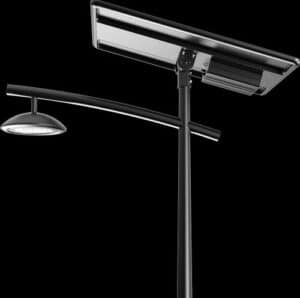
Solis
Brand: E-Lite
Modern-look solar LED street lights; Solar-powered decorative area light with separate panel; up to 12,800 lumens @ 80W; Prices start at $900.
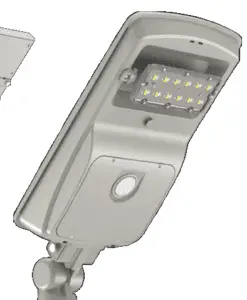
Sunlike PRO
Brand: SolTech
ideal for regions with colder climates and harsher conditions: it can overcome freezing temps with its unique battery-heating technology. can withstand extreme temperatures from
-40°F to 140°F. 30W; Prices start at $1400.

Eris
Brand: Eco
Premium grade solar bollard, asymmetrical lighting pattern; PIR motion sensor to save energy; Dark Sky compliant, 31.50″ Ht: 280 lumens,
Prices start at $400.

AVS
Brand: Beyond
Vandal Resistant Solar Bollards; IK10++ impact Rating; Dome Top;
Marine Grade Coating; dusk to dawn; 31.5″ H; Prices start at $300.
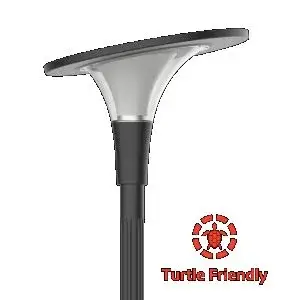
Moraga Turtle Friendly Solar Area Light
Brand: SolTech
Turtle Friendly Waveband 580–590nm; off-grid solar lighting solution; adjustable color temperature-30K and 40K; 18W; Prices start at $1285
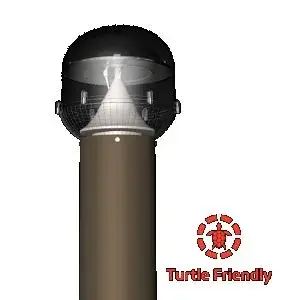
Sundial Turtle Friendly Solar Bollard Light
Brand: SolTech
Marine-Life-Friendly Bollard uses custom LED chips that only emit long 580-595 nanometer amber-colored light; choose from three heights; features a full 360 design to track full sunlight source; 300 lumens; IK10; Prices start at $750.

Solar Variable Speed Limit Sign
Brand: Eco Solar Lights
Typically installed in areas where vehicles are in close proximity to pedestrians such as school zones, construction zones, residential areas, and college campuses.
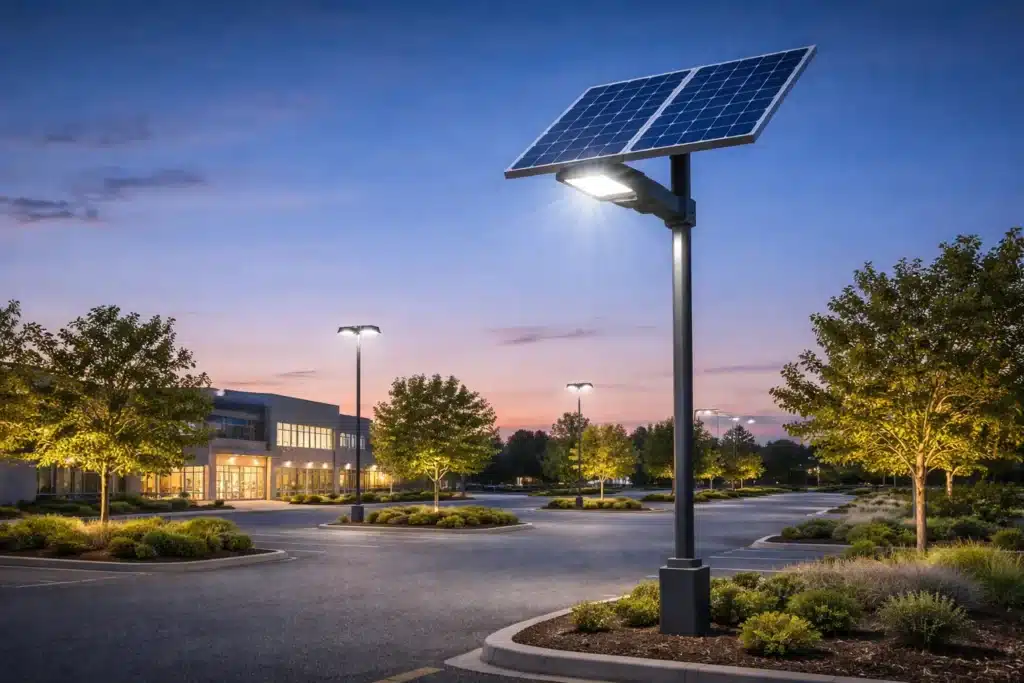
What Is Commercial Solar Lighting?
Commercial solar lighting refers to outdoor lighting systems powered entirely by solar energy rather than utility electricity. Each lighting unit typically includes:
• High-efficiency photovoltaic solar panel
• Integrated lithium battery storage
• LED lighting fixture
• Smart charge controller
• Mounting pole or bracket system
• Motion or adaptive lighting controls
During daylight hours, solar panels generate electricity that is stored in onboard batteries. At night, the stored energy powers the LED luminaire, delivering illumination without drawing power from the electrical grid.
Advanced solar lighting systems incorporate adaptive lighting profiles, automatically adjusting brightness levels throughout the night to conserve energy while maintaining safety and visibility.
Why Cities Are Adopting Solar Lighting
Municipalities across the United States are increasingly deploying solar lighting as part of smart infrastructure and energy resilience initiatives.
Several factors are driving this shift:
Copper Theft Prevention
Traditional lighting infrastructure requires long runs of underground copper wiring. Copper theft has become a widespread issue, leading to power outages, repair costs, and safety hazards.
Solar lighting systems eliminate underground wiring entirely, removing the primary target for theft.
Infrastructure Cost Reduction
Installing grid-connected lighting requires trenching, conduit installation, electrical permits, and utility coordination. Solar lighting avoids these costs because each fixture operates independently.
Energy Cost Savings
Solar lighting uses renewable energy and does not generate electricity bills, making it attractive for municipalities managing large lighting networks.
Remote and Off-Grid Deployment
Solar lighting can be installed in locations where utility power is unavailable or expensive to extend, including:
• Parks and recreational areas
• Rural roads
• Construction zones
• Trails and pathways
• Industrial sites
• Transportation infrastructure
Sustainability Goals
Many cities are adopting solar lighting as part of climate and sustainability programs focused on reducing energy consumption and carbon emissions.
Solar lighting systems represent an off-grid alternative to traditional outdoor lighting infrastructure.
Key Components of Solar Lighting Systems
Solar Panels
High-efficiency photovoltaic panels convert sunlight into electricity. Panels are typically mounted at an optimized tilt angle to maximize energy capture.
Battery Storage
Lithium iron phosphate (LiFePO4) batteries are commonly used for solar lighting because they offer long lifespan, stable performance, and deep discharge capability.
LED Luminaires
LED fixtures used in solar lighting systems are designed for high lumen output with minimal power consumption, allowing longer operating hours with limited stored energy.
Smart Controllers
Charge controllers regulate battery charging and manage nighttime lighting profiles, often incorporating motion sensors and dimming schedules.
Mounting Poles and Structures
Solar lighting systems are commonly installed on:
• Aluminum or steel poles
• Decorative architectural poles
• Direct-burial poles
• Existing infrastructure such as signposts or utility poles
For a deeper technical overview of system design, battery autonomy, solar panel sizing, and infrastructure planning considerations, explore our comprehensive Solar Lighting Guide.
Solar Lighting Applications
Solar lighting technology supports a wide range of outdoor lighting needs across commercial and municipal environments.
Solar Street Lighting
Solar street lights illuminate roadways, intersections, rural roads, and residential developments where extending electrical infrastructure is difficult or costly.
Solar Parking Lot Lighting
Solar parking lot lights provide illumination for retail centers, warehouses, apartment complexes, and remote facilities without requiring underground wiring.
Solar Pathway and Pedestrian Lighting
Walkways, parks, campuses, and recreational trails benefit from solar lighting installations that provide safety without disrupting landscapes through trenching.
Solar Security Lighting
Solar-powered security lights are frequently used in industrial yards, storage areas, construction sites, and remote facilities requiring reliable illumination.
Solar Sign and Traffic Lighting
Solar lighting systems can power illuminated traffic signs, crosswalk signals, and wayfinding signage.
Advantages of Solar Lighting Systems
| Feature | Benefit |
|---|---|
| Off-grid operation | No dependency on electrical infrastructure |
| No copper wiring | Prevents copper theft and vandalism |
| Energy independence | Eliminates electricity costs |
| Rapid installation | No trenching or conduit installation required |
| Scalable deployment | Easy to add additional fixtures |
| Sustainable energy | Supports environmental initiatives |
Solar Lighting Performance Considerations
When specifying solar lighting systems, engineers and planners evaluate several factors to ensure reliable nighttime operation.
Geographic Solar Availability
Regions with strong solar exposure allow smaller panel sizes and battery capacity, while northern climates may require larger systems.
Lighting Duration Requirements
Typical commercial solar lighting systems are designed for 3-5 nights of battery autonomy, ensuring operation during cloudy weather.
Mounting Height and Lighting Distribution
Pole height and LED optics must be selected to provide appropriate coverage for the intended area.
Environmental Conditions
Solar lighting systems must withstand environmental conditions such as:
• Wind loading
• Snow accumulation
• Coastal corrosion
• High temperature environments
Solar Lighting Systems by Application
Commercial solar lighting systems are deployed across a wide range of outdoor environments where grid access is limited, infrastructure costs must be minimized, or energy independence is a priority. Each solar configuration is engineered to balance illumination performance, runtime strategy, and structural requirements.
Large commercial properties and transportation corridors frequently utilize solar street lighting systems to illuminate roadways, campus drives, and municipal streets without trenching or underground conduit. Parking areas, open yards, and remote facilities often rely on solar area and flood lighting systems to provide wide coverage with programmable runtime control.
Parking areas and commercial properties often evaluate solar lighting systems as an alternative to traditional LED parking lot lighting when trenching or electrical access is impractical.
Pedestrian-scale environments introduce a different set of lighting considerations. Walkways, landscaped zones, and campus pathways commonly incorporate solar bollard lighting systems engineered for lower mounting heights and controlled distribution. Building perimeters and structural facades may deploy solar wall pack lighting solutions where wiring access is impractical or cost-prohibitive.
Security and site visibility applications frequently specify solar flood lights designed for directional coverage, perimeter illumination, and work-zone lighting. Off-grid signage and advertising installations utilize solar billboard lighting systems to maintain nighttime visibility without ongoing energy consumption.
Transportation infrastructure often requires specialized signaling solutions. Projects may integrate solar flashing traffic beacons, solar-powered traffic signs, or solar aviation obstruction lights to meet safety and regulatory visibility requirements in remote or municipal environments.
Environmentally sensitive installations require additional considerations. Coastal and wildlife-adjacent sites may incorporate turtle-friendly solar lighting systems designed to reduce ecological impact while maintaining pathway visibility.
Temporary and rapidly deployable lighting applications commonly utilize mobile solar light towers, which combine elevated luminaires, battery storage, and photovoltaic charging in transportable units for construction, emergency response, or event environments.
Decorative and small-scale architectural applications may specify all-in-one solar garden lighting units where compact integration and aesthetic appearance are primary objectives.
Across these applications, system design must account for panel sizing, battery autonomy, runtime strategy, and structural mounting to ensure dependable year-round performance.
Solar Lighting vs Traditional Grid Lighting
| Factor | Solar Lighting | Grid Lighting |
|---|---|---|
| Electrical infrastructure | Not required | Required |
| Copper theft risk | None | High |
| Energy cost | None | Ongoing |
| Installation complexity | Low | High |
| Environmental impact | Renewable | Utility dependent |
Future of Solar Lighting
Solar lighting technology continues to evolve with improvements in LED efficiency, battery energy density, and intelligent lighting controls.
Modern solar lighting systems can integrate with smart city infrastructure, enabling features such as:
• Motion-adaptive brightness control
• Remote monitoring
• Wireless communication networks
• Integrated security cameras
As energy costs rise and infrastructure resilience becomes more important, solar lighting will continue expanding across municipal and commercial environments.
Frequently Asked Questions About Commercial Solar Lighting
1. How reliable are commercial solar lighting systems?
When properly engineered and sized for geographic solar conditions, commercial solar lighting systems provide consistent nighttime illumination. Panel capacity, battery storage, and runtime strategy are calculated together to ensure dependable performance across seasonal and weather variations.
2. How many days of autonomy should a solar lighting system provide?
Most commercial solar lighting systems are designed with multi-day autonomy, meaning they can operate for one or more cloudy days without full recharge. Autonomy requirements vary based on location, criticality of the site, and runtime expectations.
3. Can solar lighting provide full brightness all night?
Continuous maximum output from dusk to dawn requires significantly larger solar panels and battery storage. Many commercial installations use adaptive dimming or motion-based controls to balance illumination needs with energy availability.
4. Is solar lighting suitable for parking lots and municipal roads?
Yes. Commercial-grade solar lighting systems are commonly deployed in parking areas, campuses, parks, transportation corridors, and municipal properties when properly engineered for mounting height, wind load, and runtime demands.
5. What maintenance is required for solar lighting systems?
Solar lighting systems typically require periodic inspection of photovoltaic panels, battery health, and structural mounting components. They eliminate trenching, underground wiring maintenance, and ongoing electrical utility costs.
FAQs
How long do solar lighting systems operate each night?
Most commercial solar lighting systems are designed to operate 10-14 hours per night depending on battery capacity and lighting profiles.
Do solar lights work during cloudy weather?
Yes. Solar lighting systems store energy in batteries and are typically designed with multiple days of autonomy to operate during cloudy conditions.
Are solar street lights bright enough for roads?
Modern solar LED street lights produce high lumen outputs comparable to traditional street lighting systems when properly designed.
Why are cities installing solar street lights?
Solar street lights help cities reduce infrastructure costs, eliminate copper theft risks, and provide reliable lighting in areas where grid power is unavailable.
Can solar lighting replace traditional parking lot lighting?
In many applications solar parking lot lighting can provide equivalent illumination while eliminating electrical trenching and energy costs.
Build a Reliable Solar Lighting System for Your Property
Solar lighting systems provide dependable illumination without electrical infrastructure, helping municipalities and commercial facilities reduce costs while improving energy independence.
Whether you’re planning solar street lighting, parking lot lighting, pathway illumination, or security lighting, selecting the right solar system ensures long-term reliability and performance.
Explore our full range of commercial lighting solutions or speak with our specialists about designing the right system for your project.