LED bollard lights have become one of the most widely used outdoor lighting solutions for pathways, campuses, parks, multifamily communities, commercial properties, and architectural landscapes. Available in numerous styles, heights, optical distributions, and construction materials, bollard fixtures can be customized to meet a wide range of pedestrian lighting requirements.
This guide explains how LED bollards work, the different types available, key specifications to consider, and how to select the right fixture for your project.
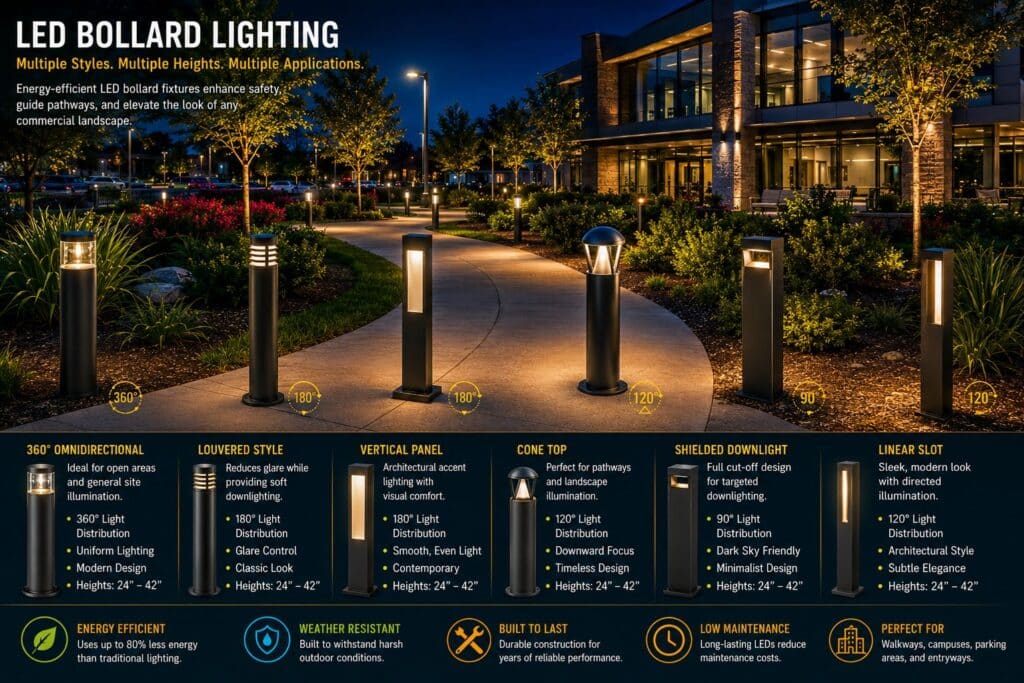
LED bollard fixtures are available in multiple styles, heights, and light distribution patterns to accommodate different outdoor lighting applications.
Need help selecting the right LED bollard fixture for your project?
Speak with a Lighting Specialist for assistance with fixture selection, photometric layouts, and application recommendations.
What Is an LED Bollard Light?
An LED bollard light is a short outdoor luminaire designed to provide pedestrian-scale illumination along pathways, plazas, courtyards, parks, campuses, and commercial landscapes.
Unlike area lights mounted on poles, bollards deliver light close to the walking surface where visibility is needed most.
Bollards are commonly used in:
- Commercial properties
- Educational campuses
- Healthcare facilities
- Multifamily communities
- HOA developments
- Public parks
- Hospitality environments
- Residential pathways
For commercial project examples, see our Commercial LED Bollard Lighting Guide.
Main Types of LED Bollard Lights
Full Cutoff Bollards
Designed to minimize uplight and glare while directing illumination downward.
Common applications:
- Dark Sky projects
- Pathways
- Parks
- Municipal properties
Louvered Bollards
Use internal louvers to control light distribution and reduce direct visibility of the LED source.
Common applications:
- Campuses
- Courtyards
- Pedestrian pathways
Decorative Bollards
Architecturally styled fixtures designed to complement surrounding landscapes and buildings.
Common applications:
- Hospitality properties
- HOA communities
- Mixed-use developments
Area Distribution Bollards
Provide wider light distribution for larger pedestrian spaces.
Common applications:
- Plazas
- Gathering areas
- Large walkways
LED bollards are used across numerous industries and outdoor environments. Explore specific use cases in our Bollard Lighting Applications Guide.
Common Bollard Heights
| Height | Typical Application |
|---|---|
| 30 Inches | Residential pathways |
| 36 Inches | General pedestrian lighting |
| 42 Inches | Commercial pathways |
| 48 Inches | Public spaces |
| 54+ Inches | Specialty applications |
Fixture height impacts both aesthetics and light distribution.
Fixture height affects light distribution, spacing, visibility, and aesthetics. Learn more in our LED Bollard Height Guide.
Proper fixture spacing is critical for achieving consistent illumination and pedestrian safety. Learn more in our Bollard Light Spacing Guide.
Common LED Bollard Base Sizes
The base of a bollard fixture houses mounting hardware and provides structural stability. Most commercial-grade LED bollards utilize either 6-inch or 8-inch diameter bases.
| Base Diameter | Typical Application | Benefits |
|---|---|---|
| 6 Inches | Walkways, residential, decorative applications | Smaller footprint, lower visual impact |
| 8 Inches | Commercial pathways, campuses, public spaces | Greater stability and larger internal wiring cavity |
The larger 8-inch base is often preferred for commercial and municipal installations where durability and long-term performance are priorities.
Understanding Bollard Optics
Optical distribution is one of the most important characteristics when selecting a bollard.
360° Distribution
Provides illumination around the entire fixture.
Directional Distribution
Directs light toward pathways or specific areas.
Shielded Distribution
Reduces glare while controlling light trespass.
Projects seeking reduced uplight and glare should also review our Dark Sky Outdoor Lighting Guide.
Typical Bollard Construction Materials
| Material | Benefits |
| Aluminum | Lightweight and corrosion resistant |
| Steel | High durability |
| Stainless Steel | Excellent corrosion protection |
| Composite Materials | Impact resistant |
| Cast Aluminum | Common commercial option |
Vandal-Resistant Bollard Lighting
Schools, parks, transit facilities, public pathways, and municipal properties frequently require vandal-resistant lighting fixtures. LED bollards designed for these environments utilize reinforced construction and tamper-resistant hardware to withstand abuse and accidental impacts.
Common vandal-resistant features include:
- Heavy-wall aluminum construction
- Stainless steel fasteners
- Tamper-resistant screws
- Impact-resistant lens materials
- Internal driver protection
- Reinforced anchor systems
These features help reduce maintenance costs and improve fixture longevity in high-traffic public environments.
LED technology helps reduce operating expenses while improving outdoor lighting performance. Learn more in our LED Bollard Energy Savings Guide.
Common LED Bollard Applications
| Application | Typical Use |
| Sidewalks | Pedestrian guidance |
| Campuses | Wayfinding |
| Parks | Pathway illumination |
| Courtyards | Architectural lighting |
| Multifamily | Resident safety |
| HOA Communities | Community aesthetics |
| Hotels | Landscape lighting |
| Healthcare Facilities | Visitor navigation |
Educational facilities often utilize bollards as part of larger pedestrian lighting systems. Additional recommendations can be found in our Campus Pathway Lighting Guide.
Key Selection Factors
When evaluating LED bollards, consider:
Fixture Height
Match fixture height to pathway width and surrounding architecture.
Optical Performance
Select optics that provide adequate illumination without excessive glare.
Construction Quality
Choose commercial-grade materials appropriate for the environment.
Color Temperature
Popular options include:
- 3000K
- 4000K
- 5000K
Impact Resistance
High-traffic locations may require more robust fixture construction.
Dark Sky Compliance
Many municipalities require reduced uplight and improved glare control.
Dark Sky Considerations for LED Bollards
As municipalities increasingly adopt Dark Sky requirements, bollard lighting has become an attractive alternative to taller fixtures because it provides illumination closer to the walking surface while reducing unnecessary light spill.
Dark Sky-friendly bollards typically incorporate:
- Full-cutoff optics
- Shielded light sources
- Reduced uplight
- Controlled light distribution
- Lower lumen outputs
- Warm color temperatures such as 2700K or 3000K
Properly designed bollard systems can improve pedestrian visibility while minimizing glare, sky glow, and light trespass.
Projects pursuing Dark Sky objectives should also review our Dark Sky Outdoor Lighting Guide.
Many modern bollard fixtures are designed to reduce glare and uplight. Learn more in our Dark Sky Bollard Lighting Guide. From LED Bollard Height Guide
Typical Reasons Property Owners Install Bollards
| Reason | Importance |
| Safety | High |
| Wayfinding | High |
| Aesthetics | High |
| Security | Moderate |
| Landscape Enhancement | High |
| Energy Savings | Moderate |
Commercial vs Residential Bollards
Commercial bollards typically feature:
- Heavier construction
- Higher durability
- Larger project layouts
- Greater pedestrian traffic
For commercial applications, review our Commercial LED Bollard Lights Guide.
For homeowner-focused installations, visit our Residential Bollard Lighting Guide.
Inline Buyer Q&A
What is the best height for LED bollard lights?
Most commercial projects utilize 36-inch or 42-inch bollards, while residential projects commonly use 30-inch or 36-inch fixtures.
How far apart should bollard lights be spaced?
Spacing typically ranges from 15 to 30 feet depending on fixture output and lighting objectives.
Are bollards Dark Sky compliant?
Many modern full-cutoff bollards are designed specifically to reduce uplight and support Dark Sky initiatives.
What color temperature is best?
3000K and 4000K remain the most common choices for outdoor applications.
Can bollard lights replace area lights?
Generally no. Bollards are intended for pedestrian illumination while area lights provide broader coverage.
LED Bollard Lighting Selection Guide
Selecting the right bollard fixture involves more than choosing a fixture style. Height, optics, construction quality, light distribution, and project requirements all influence performance. By understanding these factors, facility owners, designers, architects, and homeowners can create outdoor lighting systems that improve safety, aesthetics, and long-term reliability.
For assistance selecting LED bollard fixtures and planning outdoor lighting projects, visit the Industrial Lighting Fixtures Home Page and speak with a lighting specialist today.
Frequently Asked Questions
What are LED bollard lights used for?
LED bollards provide pathway illumination, wayfinding, safety lighting, and architectural enhancement.
Are LED bollards energy efficient?
Yes. Modern LED technology significantly reduces energy consumption compared to older lighting systems.
Which bollard style is best?
The best style depends on project goals, aesthetics, optical requirements, and local lighting regulations.
How long do LED bollard lights last?
Commercial-grade LED bollards can provide many years of operation with minimal maintenance.
Can bollards be used in residential and commercial applications?
Yes. Different fixture styles and performance levels are available for both environments.
Stay Connected with Our Lighting Resources
Add IndustrialLightingFixtures.org as a Preferred Source on Google to see more of our lighting guides and technical resources across Google Search experiences.
