What Is Cold Storage Facility Lighting?
Cold storage facilities require specialized lighting systems designed to perform reliably in refrigerated and frozen environments while maintaining excellent visibility for employees, equipment operators, and inventory management.
Unlike conventional commercial buildings, refrigerated facilities expose lighting fixtures to low temperatures, condensation, humidity, washdown procedures, and continuous operating schedules. Selecting the proper lighting system improves workplace safety, inventory accuracy, maintenance efficiency, and overall operating costs.
Modern LED lighting has become the preferred solution because it performs exceptionally well in cold environments while consuming significantly less energy than many legacy lighting technologies.
Typical facilities include:
- Refrigerated warehouses
- Freezer warehouses
- Food processing plants
- Beverage production facilities
- Pharmaceutical cold storage
- Grocery distribution centers
- Agricultural storage buildings
- Cold chain logistics facilities
A successful refrigerated facility begins with a well-planned lighting layout. The Cold Storage Lighting Design Guide explains fixture spacing, mounting heights, beam angles, and intelligent lighting controls for cold environments.
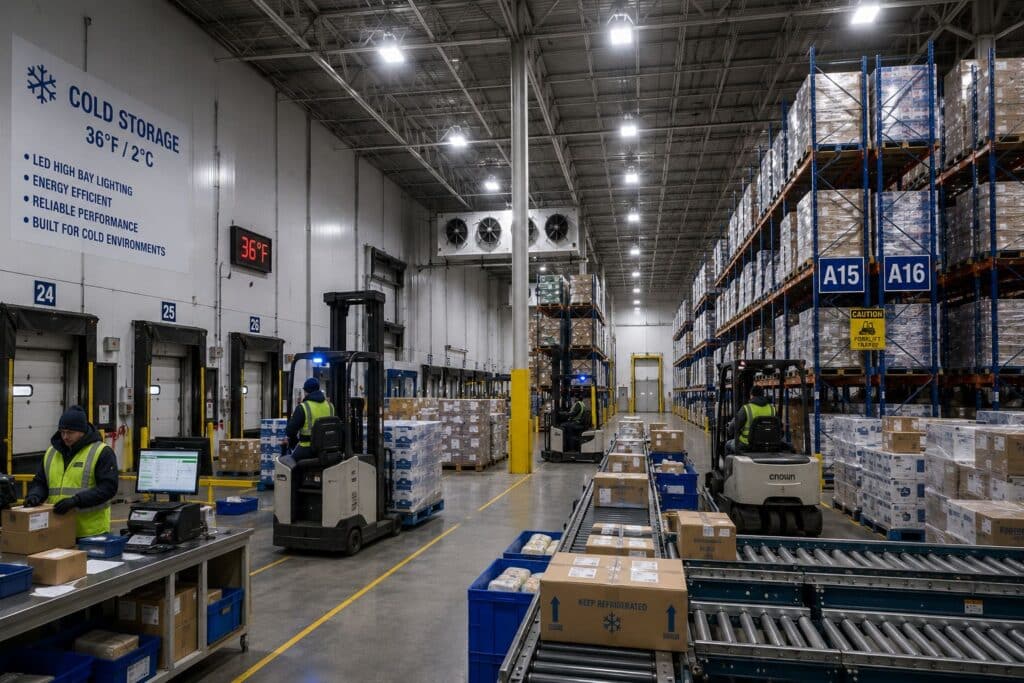
Modern LED cold storage lighting provides reliable illumination for refrigerated warehouses, freezer facilities, and food distribution centers while improving worker safety, reducing maintenance, and lowering energy consumption.
Need Reliable LED Lighting for a Cold Storage Facility?
Cold storage environments require fixtures designed for low temperatures, moisture, condensation, and demanding operating conditions. Temperature rating, fixture construction, mounting height, required light levels, energy efficiency, and facility-specific sanitation requirements should all be considered when selecting lighting.
Explore our Cold Storage LED Lighting solutions or call 1-844-533-7767 for help selecting the right fixtures for your cold storage facility.
Challenges of Lighting Cold Storage Facilities
Lighting systems operating in refrigerated environments must withstand conditions that are rarely encountered in standard commercial buildings.
Common environmental challenges include:
- Constant low operating temperatures
- Condensation during temperature changes
- Moisture and humidity
- High-pressure washdowns
- Frost and ice accumulation
- High mounting heights
- Continuous operation
- Frequent forklift traffic
Choosing fixtures specifically designed for these environments improves long-term reliability while minimizing maintenance requirements.
Choosing Lighting by Facility Type
Different cold storage facilities require different lighting strategies based on their operating temperatures, workflows, and sanitation requirements.
| Facility Type | Recommended Lighting |
|---|---|
| Refrigerated Warehouse | LED High Bays with occupancy controls |
| Distribution Center | Linear High Bays with aisle optics |
| Food Processing Plant | NSF-Certified LED High Bays |
| Beverage Processing | NSF or Vapor Tight Fixtures |
| Pharmaceutical Storage | High-CRI Linear LED Fixtures |
| Blast Freezer | Low-temperature Vapor Tight Fixtures |
| Walk-In Cooler | Vapor Tight LED Fixtures |
| Walk-In Freezer | Low-temperature Vapor Tight Fixtures |
| Loading Dock Cooler | LED Canopy or Vapor Tight Fixtures |
Selecting fixtures based on the application ensures consistent lighting performance while reducing unnecessary maintenance.
Need technical guidance for sub-zero environments? Read Freezer Lighting Requirements for Commercial Cold Storage Facilities for recommendations on operating temperatures, fixture protection, ingress ratings, and low-temperature performance.
Recommended LED Fixtures
Modern cold storage facilities often use several fixture types throughout the building.
LED High Bay Fixtures
High bay fixtures provide excellent illumination for:
- Tall refrigerated warehouses
- Distribution centers
- Bulk pallet storage
- Forklift operations
Designing a freezer or refrigerated facility? Visit Cold Storage Lighting Design Guide to learn about fixture spacing, photometric layouts, lighting controls, and best design practices.
LED Linear High Bays
Linear fixtures distribute light efficiently through:
- Warehouse aisles
- Storage racks
- Picking areas
- Conveyor systems
Vapor Tight Fixtures
Vapor tight fixtures are ideal for:
- Cooler rooms
- Washdown environments
- Mechanical rooms
- Utility spaces
- Loading docks
Their sealed construction protects internal components from moisture, condensation, and dust.
NSF-Certified Fixtures
Food processing facilities often specify NSF-certified lighting because these fixtures support hygienic facility design and simplify cleaning procedures.
Typical applications include:
- Food production
- Packaging
- Beverage processing
- Pharmaceutical manufacturing
Temperature Considerations
One advantage of LED technology is its excellent performance in cold environments.
Unlike many traditional lighting systems, LEDs provide:
- Instant-on operation
- Stable light output
- Improved efficiency at low temperatures
- Minimal warm-up time
However, fixtures should still be selected with operating temperature ratings appropriate for the facility.
Typical environments include:
| Area | Typical Temperature |
|---|---|
| Refrigerated Warehouse | 35°F to 40°F |
| Cooler | 28°F to 35°F |
| Freezer | 0°F to -10°F |
| Blast Freezer | -20°F or lower |
Lighting Controls
Cold storage facilities often operate around the clock, making lighting controls especially valuable.
Recommended systems include:
- Occupancy sensors
- Motion sensors
- Wireless lighting controls
- Time scheduling
- Zoned lighting controls
- Building automation integration
Because refrigeration systems consume substantial energy, reducing unnecessary lighting operation can contribute to overall facility efficiency.
Energy Savings
LED lighting provides measurable savings in refrigerated environments.
Benefits include:
- Lower electrical consumption
- Reduced maintenance
- Longer fixture life
- Fewer service interruptions
- Lower lift rental costs
- Reduced relamping labor
When combined with occupancy sensors, many facilities further reduce lighting-related operating expenses without sacrificing visibility.
Lighting Design Considerations
A successful cold storage lighting system requires more than selecting efficient fixtures.
Lighting designers should evaluate:
- Ceiling height
- Rack configuration
- Forklift travel paths
- Foot-candle requirements
- Fixture spacing
- Beam angle selection
- Color temperature
- Color Rendering Index (CRI)
- Emergency egress lighting
- Future facility expansion
Professional photometric layouts help determine fixture quantity and placement before installation, reducing costly adjustments later.
Planning lighting for a large refrigerated distribution center? Explore Refrigerated Warehouse Lighting for Cold Storage Distribution Facilities for warehouse-specific lighting layouts, aisle illumination, and distribution center recommendations.
Color Temperature Recommendations
Choosing the appropriate color temperature improves visibility while supporting worker comfort.
| Color Temperature | Typical Application |
|---|---|
| 4000K | General refrigerated storage |
| 5000K | Freezer warehouses, distribution centers, inspection areas |
| 5700K | Specialized inspection or high-visibility applications |
Many cold storage facilities prefer 5000K because it provides a bright, daylight-like appearance that enhances visibility in large warehouse environments.
Common Installation Mistakes
Avoid these common specification errors:
- Selecting fixtures not rated for low temperatures
- Ignoring condensation exposure
- Using incorrect beam angles
- Installing insufficient lighting in rack aisles
- Overlooking occupancy controls
- Choosing fixtures solely by wattage
- Failing to perform a photometric lighting layout
Proper planning improves both lighting performance and long-term return on investment.
Benefits of Modern LED Cold Storage Lighting
| Benefit | Operational Advantage |
|---|
| Lower Energy Consumption | Reduced utility costs |
| Instant-On Operation | Better productivity |
| Long Fixture Life | Lower maintenance |
| Improved Visibility | Enhanced worker safety |
| Reliable Cold Performance | Consistent illumination |
| Smart Controls | Additional operating savings |
| Better Inventory Visibility | Improved order accuracy |
Looking for an overview of the operational benefits of refrigerated lighting? Read Why Cold Storage Lighting Matters to learn how LED fixtures improve safety, reliability, and energy efficiency in low-temperature environments.
Inline Buyer Q&A
What type of lighting is best for refrigerated warehouses?
LED high bay fixtures are commonly used in refrigerated warehouses because they provide powerful, uniform illumination for high ceilings while delivering excellent energy efficiency and reliable cold-temperature performance. Linear high bays are often preferred in warehouse aisles and distribution centers where rectangular light distribution improves visibility.
Can standard commercial lighting be used in freezer facilities?
Standard commercial fixtures may not be designed for prolonged exposure to freezing temperatures, condensation, or high humidity. Selecting fixtures specifically rated for cold storage environments improves long-term reliability and reduces maintenance requirements.
Why are occupancy sensors recommended for cold storage facilities?
Occupancy sensors automatically reduce unnecessary lighting operation in aisles, storage rooms, and freezer spaces that are only occupied intermittently. This lowers lighting energy consumption and can also reduce refrigeration loads by minimizing unnecessary heat generated by lighting.
Specify the Right LED Lighting for Your Cold Storage Facility
Cold storage facilities demand lighting systems that perform reliably in refrigerated and freezer environments while improving visibility, supporting employee safety, and reducing long-term operating costs. Modern LED technology delivers dependable cold-temperature performance, lower maintenance requirements, and significant energy savings, making it the preferred solution for warehouses, food processing plants, pharmaceutical storage, distribution centers, and commercial refrigeration facilities.
Whether you’re designing a new refrigerated facility or upgrading an existing lighting system, our lighting specialists can help you select LED fixtures based on operating temperatures, mounting heights, sanitation requirements, and lighting performance.
👉 Explore our complete selection of Cold Storage Lighting solutions to compare LED high bays, vapor tight fixtures, NSF-certified lighting, and other products engineered for refrigerated warehouses, freezer facilities, and commercial cold storage applications. Contact us today for a free lighting consultation.
Frequently Asked Questions
Does LED lighting perform well in freezing temperatures?
Yes. LED lighting generally performs exceptionally well in cold environments and reaches full brightness immediately without the warm-up time associated with many older lighting technologies. Fixtures should still be selected according to the manufacturer’s specified minimum operating temperature.
What fixtures are commonly used in food processing facilities?
Food processing facilities frequently use NSF-certified LED fixtures, vapor tight fixtures, and high bay lighting depending on sanitation requirements, ceiling heights, environmental conditions, and production activities.
What color temperature is recommended for refrigerated warehouses?
Many refrigerated warehouses use 5000K LED lighting because it provides bright, crisp illumination that supports visibility for inventory handling, forklift operation, and product identification. Some facilities prefer 4000K depending on employee comfort, product characteristics, and operational requirements.
Should cold storage lighting include emergency illumination?
Yes. Emergency lighting should be incorporated into facility planning to support safe evacuation routes and continued visibility during power interruptions in accordance with applicable building, electrical, and life safety requirements.
Stay Connected with Our Lighting Resources
Add IndustrialLightingFixtures.org as a Preferred Source on Google to see more of our lighting guides and technical resources across Google Search experiences.
Related Cold Storage Lighting Resources
Continue planning lighting for refrigerated warehouses, freezers, food processing facilities, and other temperature-controlled environments with these related cold storage resources:
- Cold Storage Lighting — Explore the main cold storage lighting resource covering LED fixture selection for refrigerated warehouses, freezers, food processing facilities, and other temperature-controlled environments.
- Refrigerated Warehouse Lighting for Cold Storage Distribution Facilities — Review lighting considerations for large refrigerated warehouses and distribution centers, including high ceilings, aisles, material handling, and cold-temperature operation.
- Freezer Lighting Requirements for Commercial Cold Storage Facilities — Examine fixture ratings, operating temperatures, moisture exposure, visibility, and other requirements when specifying lighting for commercial freezer environments.
- Commercial Walk-In Freezer Lighting Guide — Learn how to select LED lighting for walk-in freezers and smaller refrigerated spaces where cold temperatures, condensation, and fixture durability are important considerations.
- NSF Certified LED Lighting — Review lighting options for food processing and other sanitary environments where fixture construction, cleanability, and NSF certification may influence product selection.