
Proper warehouse lighting is essential for safety, productivity, inventory visibility, equipment operation, and overall facility performance. One of the most important measurements used in warehouse lighting design is foot candles.
Warehouse foot candle requirements help determine how much light is needed across various work zones, aisles, storage areas, loading docks, and operational spaces within a facility.
Insufficient illumination may lead to:
- Reduced visibility
- Worker fatigue
- Inventory errors
- Safety hazards
- Equipment accidents
- Poor operational efficiency
Excessive illumination can also create unnecessary energy costs and glare issues.
At Industrial Lighting Fixtures, we help warehouses, logistics centers, manufacturing facilities, and distribution operations select LED high bay lighting systems based on proper foot-candle requirements, mounting heights, fixture spacing, and application goals.
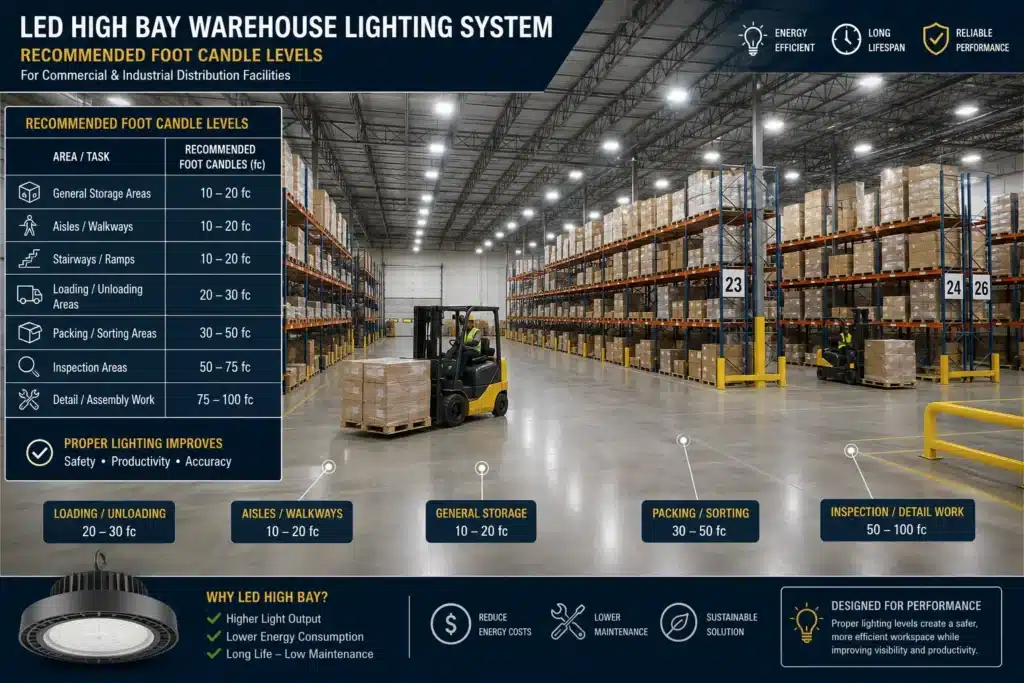
What Are Foot Candles?
A foot candle is a measurement of light intensity representing the amount of illumination reaching one square foot of surface area.
In commercial lighting applications, foot candles help determine whether a workspace has adequate visibility for specific tasks and operational requirements.
Warehouse lighting designs commonly use foot-candle targets to evaluate:
- Aisle visibility
- Picking accuracy
- Forklift operation
- Safety compliance
- Loading operations
- General work conditions
Higher foot-candle levels typically provide better visibility but may increase energy consumption if not designed efficiently.
Need broader illumination guidance? Review our Expert Lighting Level Recommendations guide for common foot candle targets across commercial and industrial applications.
Typical Warehouse Foot Candle Requirements
| Warehouse Area | Recommended Foot Candles |
|---|---|
| General Storage Areas | 10–20 FC |
| Warehouse Aisles | 10–30 FC |
| Active Picking Areas | 20–40 FC |
| Packing & Sorting Areas | 30–50 FC |
| Loading Docks | 20–30 FC |
| Shipping & Receiving | 30–50 FC |
| Manufacturing Areas | 50–100 FC |
| Inspection Areas | 75–100+ FC |
| Maintenance Areas | 50–75 FC |
Actual lighting requirements depend on:
- Facility operations
- Ceiling height
- Inventory type
- OSHA visibility considerations
- Worker task requirements
- Automation systems
- Racking layout
Why Warehouse Foot Candles Matter
Proper illumination directly affects warehouse efficiency and safety.
Correct foot-candle levels help improve:
- Inventory accuracy
- Worker productivity
- Forklift navigation
- Safety visibility
- Product handling
- Operational consistency
Poor lighting may contribute to:
- Picking errors
- Shadowing between racks
- Trip hazards
- Reduced worker comfort
- Increased accident risk
LED warehouse lighting systems help facilities maintain proper illumination while reducing energy and maintenance costs.
Foot Candle Requirements by Warehouse Application
General Warehouse Storage
Basic storage areas typically require:
-
10–20 foot candles
These spaces usually prioritize:
-
Safe navigation
-
General visibility
-
Energy efficiency
UFO High Bay fixtures are commonly used in open warehouse layouts with higher ceilings.
Warehouse Aisles
Warehouse aisles often require:
-
10–30 foot candles
Aisle lighting must account for:
-
Vertical rack visibility
-
Forklift operation
-
Inventory scanning
-
Reduced shadowing
Linear High Bay fixtures are commonly preferred for aisle lighting because they provide broader horizontal distribution patterns.
Active Picking Areas
Facilities with active picking operations generally require:
-
20–40 foot candles
Higher illumination levels help improve:
-
Barcode scanning
-
Order accuracy
-
Worker visibility
-
Picking speed
Packing and Sorting Areas
Packing stations and sorting operations commonly require:
-
30–50 foot candles
These areas involve:
-
Detailed task work
-
Label visibility
-
Product handling
-
Packaging accuracy
Uniform lighting distribution becomes especially important in these environments.
Shipping & Receiving Areas
Shipping and receiving zones often require:
-
30–50 foot candles
These spaces may involve:
-
Dock traffic
-
Equipment movement
-
Product inspections
-
Documentation handling
LED fixtures with strong glare control can improve visibility in active loading environments.
Manufacturing & Assembly Areas
Manufacturing operations typically require:
-
50–100 foot candles
Higher lighting levels support:
-
Precision work
-
Equipment operation
-
Quality control
-
Worker safety
Facilities with detailed assembly tasks may require even higher illumination levels.
Inspection & Quality Control Areas
Inspection stations commonly require:
-
75–100+ foot candles
These environments often involve:
-
Detailed visual inspections
-
Product verification
-
Fine component visibility
-
Color evaluation
High CRI LED lighting is frequently recommended for quality control applications.
How Ceiling Height Affects Foot Candle Levels
Mounting height plays a major role in warehouse lighting performance.
Higher ceilings require:
- Higher lumen output
- Tighter optics
- Larger fixture spacing considerations
Common warehouse mounting heights:
- 18–24 feet
- 25–35 feet
- 35–45+ feet
Improper fixture spacing or beam angles may reduce effective foot-candle levels at floor level.
Review our High Bay Mounting Height Guide for fixture spacing and ceiling height recommendations.
UFO vs Linear High Bay Lighting for Warehouse Foot Candles
| Feature | UFO High Bay | Linear High Bay |
|---|---|---|
| Open Area Coverage | Excellent | Good |
| Aisle Lighting | Moderate | Excellent |
| Higher Ceilings | Excellent | Moderate |
| Beam Concentration | Strong | Wide |
| Fixture Spacing | Wider | Moderate |
| Retail-Type Visibility | Moderate | Excellent |
| Industrial Durability | Excellent | Good |
Many warehouses combine both fixture styles depending on operational zones.
Review our UFO vs Linear High Bay Lighting comparison guide for commercial and industrial applications.
Importance of Photometric Lighting Layouts
Foot-candle performance should always be verified using professional photometric lighting plans.
Photometric layouts evaluate:
- Average foot candles
- Minimum foot candles
- Uniformity ratios
- Fixture spacing
- Beam overlap
- Aisle visibility
This helps facilities optimize:
- Fixture count
- Energy efficiency
- Installation cost
- Lighting performance
Professional lighting layouts are especially important for:
- Large warehouses
- Distribution centers
- Manufacturing plants
- Logistics facilities
LED High Bay Lighting & Energy Efficiency
Modern LED high bay lighting systems provide significant improvements compared to older HID and fluorescent fixtures.
LED warehouse lighting benefits include:
- Lower energy consumption
- Longer fixture lifespan
- Reduced maintenance
- Instant-on operation
- Improved visibility
- Better color rendering
- Reduced operating costs
Many facilities upgrading from Metal Halide or fluorescent systems experience major energy savings while improving foot-candle performance.
Browse our Industrial Lighting Guide for additional warehouse and industrial LED lighting resources.
Inline Buyer Q&A
What foot candle level is recommended for warehouses?
Most warehouses use between 10 and 50 foot candles depending on the operational area and task requirements.
How many foot candles are needed for warehouse aisles?
Warehouse aisles commonly require 10–30 foot candles depending on rack height and visibility requirements.
Are LED high bays better for warehouse lighting?
Yes. LED high bay fixtures provide improved energy efficiency, visibility, lifespan, and maintenance reduction compared to HID systems.
What is the difference between foot candles and lumens?
Lumens measure total light output from a fixture, while foot candles measure how much light actually reaches a surface area.
Do higher ceilings require more foot candles?
Higher ceilings generally require higher lumen output and proper optics to maintain target foot-candle levels at floor level.
Are photometric lighting layouts necessary?
Yes. Professional lighting layouts help ensure proper fixture spacing, illumination uniformity, and foot-candle performance.
Related Warehouse Lighting Resources
Frequently Asked Questions About Warehouse Lighting
What are warehouse foot candles?
Foot candles measure the amount of light reaching a surface area within a warehouse or commercial facility.
How many foot candles are required in a warehouse?
Most warehouse applications require between 10 and 50 foot candles depending on the task and operational area.
What foot candle level is best for warehouse aisles?
Warehouse aisles commonly require 10–30 foot candles for safe navigation and inventory visibility.
Do manufacturing areas require higher light levels?
Yes. Manufacturing and inspection areas often require 50–100+ foot candles for precision tasks and quality control.
Can LED high bays improve warehouse lighting performance?
Yes. LED high bays provide better illumination, reduced maintenance, and lower operating costs compared to HID systems.
Why are photometric layouts important?
Photometric lighting plans help verify fixture spacing, beam distribution, and foot-candle performance throughout a facility.
Looking to improve warehouse visibility, safety, and energy efficiency with properly designed LED lighting?
At Industrial Lighting Fixtures, we help commercial and industrial facilities select LED high bay lighting systems based on warehouse foot-candle requirements, ceiling height, fixture spacing, and operational needs.
👉 Explore Commercial Warehouse LED Lighting Solutions:
Warehouse LED Lighting Solutions