What’s the Difference Between High Bay and Low Bay Lighting?
The primary difference between high bay and low bay lighting is the mounting height.
High bay fixtures are designed for buildings with ceilings typically 20 feet or higher, while low bay fixtures are intended for facilities with ceilings below approximately 20 feet.
Although both provide efficient illumination, selecting the correct fixture improves lighting uniformity, reduces glare, and maximizes energy efficiency.
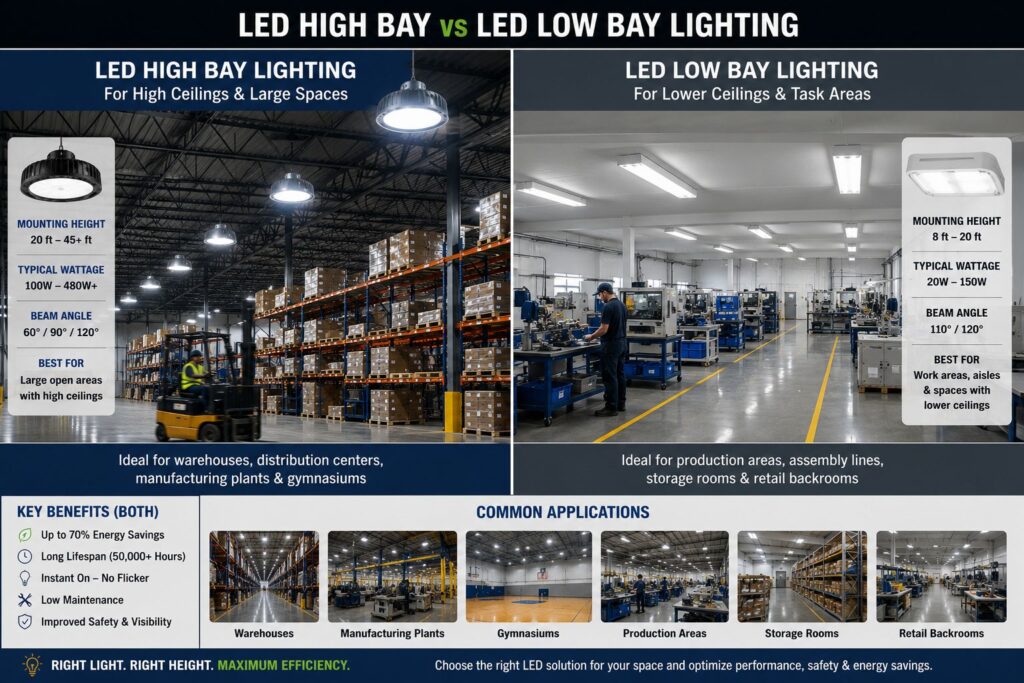
High bay and low bay LED lighting are designed for different ceiling heights and applications. Selecting the appropriate fixture improves visibility, energy efficiency, lighting uniformity, and long-term operating costs.
Not sure whether your facility requires high bay or low bay lighting?
Our lighting specialists can evaluate your ceiling height, workspace, and lighting requirements to recommend the best LED solution for your project.
Request a Free Lighting Consultation – – https://industriallightingfixtures.org/
Ceiling Height Comparison
| Ceiling Height | Recommended Fixture |
|---|---|
| Up to 15 ft | Low Bay |
| 15–20 ft | Low Bay or Small High Bay (application dependent) |
| 20–30 ft | High Bay |
| 30–40 ft | High Bay |
| 40–60 ft | High Output High Bay |
Professional lighting layouts help determine the best fixture based on ceiling height, beam angle, and required illumination levels.
High Bay Lighting
High bay fixtures produce powerful illumination designed to reach work areas from elevated mounting heights.
Typical applications include:
- Warehouses
- Manufacturing plants
- Distribution centers
- Aircraft hangars
- Gymnasiums
- Cold storage facilities
- Food processing plants
Common fixture styles include:
- UFO High Bays
- Linear High Bays
- High Output High Bays
Planning a warehouse or manufacturing lighting project? Read the Industrial LED High Bay Lighting Guide for comprehensive recommendations on fixture selection and lighting design.
Low Bay Lighting
Low bay fixtures provide uniform illumination for facilities with lower ceilings where excessive output from high bay fixtures could create glare.
Common applications include:
- Workshops
- Retail stores
- Auto repair shops
- Maintenance facilities
- Commercial kitchens
- Utility rooms
- Small manufacturing spaces
Typical fixture styles include:
- Linear LED Fixtures
- Low Bay LED Fixtures
- Surface-Mounted Fixtures
Whether you’re upgrading fluorescent fixtures or designing a new warehouse, the LED Linear High Bay Lighting Guide provides practical recommendations for selecting the right lighting system.
High Bay vs Low Bay Comparison
| Feature | High Bay | Low Bay |
| Ceiling Height | 20–60+ ft | Under 20 ft |
| Light Output | High | Moderate |
| Beam Angles | Narrow to Wide | Wide |
| Typical Facilities | Warehouses & Manufacturing | Workshops & Retail |
| Fixture Styles | UFO & Linear | Linear & Surface Mount |
| Mounting Height | Elevated | Lower Ceilings |
Choosing the Right Fixture
Several factors influence fixture selection.
Consider:
- Ceiling height
- Building layout
- Required foot candle levels
- Occupancy patterns
- Equipment locations
- Aisle configurations
- Energy efficiency goals
- Future expansion
A professional photometric lighting layout helps optimize fixture quantity and placement
Lighting Quality
Both fixture types can provide excellent lighting quality when properly selected.
Benefits include:
- Uniform illumination
- Reduced shadows
- Better color rendering
- Improved worker visibility
- Lower glare
Proper beam angle selection is equally important as fixture output.
Energy Efficiency
Modern LED high bay and low bay fixtures both deliver significant energy savings compared to older HID and fluorescent lighting.
Additional savings can be achieved by incorporating:
- Occupancy sensors
- Daylight harvesting
- Wireless controls
- Lighting schedules
Common Mistakes
Avoid these common specification errors:
- Installing high bay fixtures in low ceiling buildings
- Selecting low bay fixtures for tall warehouses
- Ignoring beam angle selection
- Over-lighting work areas
- Under-lighting warehouse aisles
- Choosing fixtures based only on wattage
Proper fixture selection improves both lighting performance and long-term operating costs.
Typical Applications
| Facility Type | Recommended Lighting |
| Warehouse | High Bay |
| Distribution Center | High Bay |
| Manufacturing Plant | High Bay |
| Aircraft Hangar | High Bay |
| Gymnasium | High Bay |
| Workshop | Low Bay |
| Retail Store | Low Bay |
| Maintenance Shop | Low Bay |
High Bay or Low Bay?
If your building has ceilings above approximately 20 feet, high bay lighting is generally the preferred solution.
Facilities with lower ceilings typically achieve better lighting performance using low bay fixtures that distribute light more evenly while minimizing glare.
When projects involve mixed ceiling heights, different fixture types may be used throughout the facility to optimize illumination.
Need help planning your lighting layout? Visit the Industrial Lighting Guide for additional guidance on fixture selection, spacing, and energy-efficient industrial lighting systems.
Inline Buyer Q&A
Can high bay fixtures be installed in buildings with low ceilings?
They can, but excessive light output may create glare and uneven illumination. Low bay fixtures are often a better choice for lower ceiling applications.
Is ceiling height the only consideration?
No. Building layout, beam angle, work activities, fixture spacing, and required lighting levels all influence the best lighting solution.
Are both available with LED technology?
Yes. Modern LED technology is available for both high bay and low bay applications, providing excellent energy efficiency and long service life.
Choose the Right LED Lighting for Your Facility
Selecting between high bay and low bay lighting is one of the most important decisions when designing or upgrading an industrial or commercial lighting system. Choosing the appropriate fixture based on ceiling height, building layout, and operational requirements improves visibility, enhances worker safety, reduces energy consumption, and minimizes long-term maintenance.
👉 Explore our complete selection of LED High Bay Lighting and LED Linear High Bay Lighting to compare commercial-grade lighting solutions for warehouses, manufacturing plants, distribution centers, and other facilities with high ceilings. Our lighting specialists are available to help you select the ideal fixture for your project and provide a free lighting consultation.
Frequently Asked Questions
What ceiling height requires high bay lighting?
High bay fixtures are commonly recommended for ceilings of approximately 20 feet or higher.
Can warehouses use low bay lighting?
Most warehouses with tall ceilings benefit from high bay lighting. Smaller warehouses with lower ceilings may use low bay fixtures.
Which fixture is more energy efficient?
Both high bay and low bay LED fixtures are highly energy efficient when matched to the correct application.
Should I have a lighting layout completed?
Yes. A professional photometric lighting layout helps determine the proper fixture type, quantity, spacing, and expected illumination levels.