
Choosing the correct post top lighting pole height affects far more than the appearance of an outdoor lighting installation. Mounting height influences light distribution, fixture spacing, illumination levels, uniformity, glare, pedestrian comfort, architectural scale, and the number of fixtures required to illuminate a property.
Commercial post top lighting can range from architectural lantern-style fixtures mounted approximately 32 to 42 inches high on walls and masonry columns to high-output post top luminaires installed on poles approaching 20 feet.
A pedestrian courtyard may benefit from a 10- or 12-foot decorative pole that maintains a comfortable human scale. A larger campus walkway or municipal plaza may require 14- to 18-foot mounting heights to distribute light across a broader area. At approximately 20 feet and above, the project may begin transitioning from pedestrian-scale post top lighting toward conventional commercial area lighting.
The correct height therefore depends on what is being illuminated, how the fixture distributes its light, how much illumination is required, and how the lighting should relate visually to the surrounding environment.
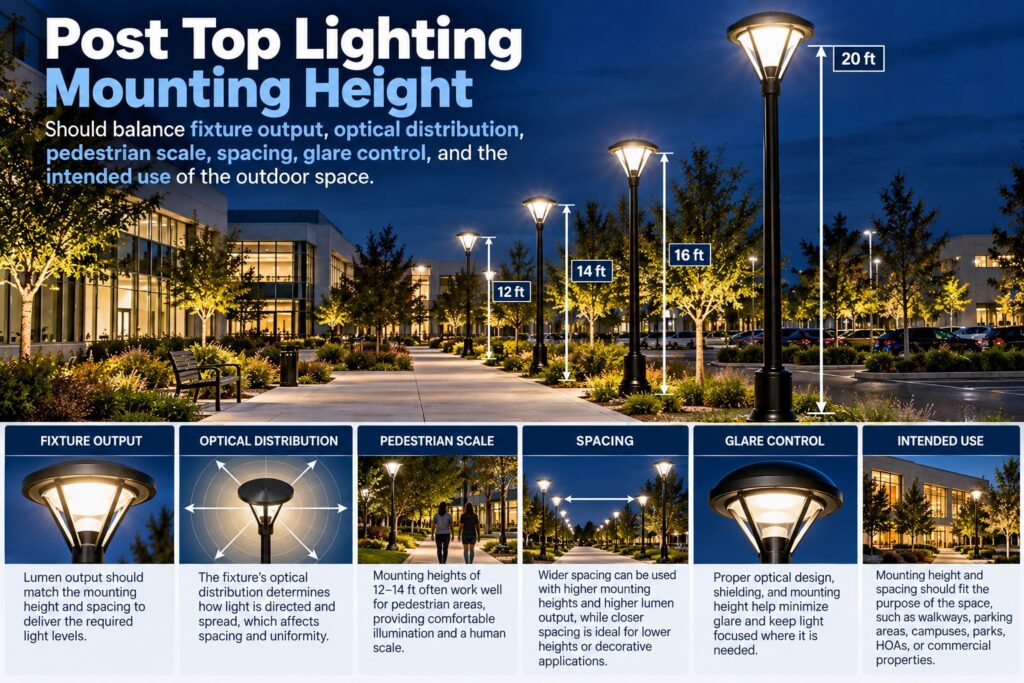
Post top lighting mounting height should balance fixture output, optical distribution, pedestrian scale, spacing, glare control, and the intended use of the outdoor space.
Choose the Right Post Top Mounting Height for Your Project
Selecting a post top pole solely by appearance can create lighting problems later. A pole that is too short may limit coverage and increase glare, while an unnecessarily tall pole can change the architectural character of a pedestrian space and require different fixture output and optics.
LED PROS WorldWide can help match commercial LED post top lighting with appropriate poles, mounting heights, optical distributions, and site-lighting requirements.
What Is the Typical Height of a Post Top Light?
Commercial post top lighting does not have one standard mounting height.
Traditional pedestrian and decorative post top installations frequently fall within approximately 8 to 16 feet, but the complete architectural and commercial category extends considerably beyond that range.
| Mounting Configuration | Approximate Height | Typical Applications |
|---|---|---|
| Pier, wall or column mounted | 32–42 in. | Entrances, gates, perimeter walls |
| Low pedestrian post | 6–10 ft | Gardens, pathways, intimate outdoor areas |
| Decorative post top | 10–14 ft | Courtyards, HOA communities, plazas |
| Commercial pedestrian post top | 12–16 ft | Campuses, parks, sidewalks, commercial properties |
| Higher-output post top | 16–20 ft | Large plazas, municipal spaces, parking perimeters |
| Commercial area lighting | 20 ft+ | Parking lots, roadways and large open areas |
These ranges are design starting points rather than mandatory mounting heights.
The fixture’s photometric performance and the site’s illumination requirements should determine whether a particular height is appropriate.
Understanding the Full Post Top Mounting Height Spectrum
One reason post top mounting height can be confusing is that similar architectural fixture styles can be used at very different heights.
A decorative lantern might appear on a 36-inch masonry entrance column, an 8-foot pedestrian post, or a 12-foot decorative pole.
Although the fixture style may be similar, the lighting function is not.
As mounting height changes, so do:
- Coverage area
- Perceived brightness
- Glare potential
- Pole spacing
- Fixture output requirements
- Optical requirements
- Architectural scale
- Maintenance access
Mounting height should therefore be considered part of the lighting design rather than simply a pole specification.
32–42 Inch Pier, Wall and Column-Mounted Fixtures
The lowest end of the post-top family includes decorative fixtures mounted on masonry walls, gate columns, entrance piers, and perimeter structures.
These fixtures are commonly used to:
- Identify property entrances
- Define gates and driveways
- Highlight masonry columns
- Establish architectural character
- Provide localized pedestrian illumination
- Define property boundaries
At these heights, the fixture is primarily an architectural and localized lighting element.
It should not normally be expected to provide the same broad general illumination as a fixture mounted on a 10-, 12-, or 16-foot pole.
Because the light source is relatively close to eye level, glare control is especially important.
6–10 Foot Pedestrian Post Top Lighting
Mounting heights between approximately 6 and 10 feet create a distinctly pedestrian-scale environment.
These installations work well where the lighting should feel closely connected to people and the surrounding landscape.
Typical applications include:
- Garden paths
- Courtyard walkways
- Hospitality properties
- Small pedestrian plazas
- Resort environments
- Residential-style commercial developments
- HOA common areas
Lower poles generally produce smaller coverage areas and may require closer fixture spacing.
They also place the luminaire closer to the viewer’s normal line of sight. Fixture brightness, shielding, lens design, and optical control therefore become particularly important.
10–14 Foot Decorative Post Top Lighting
The 10-to-14-foot range provides a useful balance between pedestrian scale and broader illumination.
This is one of the most versatile ranges for architectural commercial post top lighting.
Applications can include:
- Commercial courtyards
- Multifamily communities
- HOA properties
- Shopping centers
- Pedestrian plazas
- Building entrances
- Hospitality properties
- Campus walkways
- Civic spaces
At these heights, post tops can provide meaningful general illumination while maintaining the architectural appearance expected from decorative outdoor lighting.
A 12-foot pole, for example, may visually complement a pedestrian courtyard much better than a conventional 20- or 25-foot area-light pole.
12–16 Foot Commercial Post Top Lighting
For larger pedestrian areas, commercial and institutional properties often move into approximately the 12-to-16-foot range.
Potential applications include:
- University campuses
- Healthcare campuses
- Municipal walkways
- Parks
- Commercial developments
- Multifamily communities
- Broad pedestrian corridors
- Public gathering spaces
The additional mounting height allows properly designed optics to distribute illumination over a larger area.
However, simply moving a fixture from 12 feet to 16 feet does not guarantee better coverage.
The fixture must have enough delivered light and the appropriate distribution to perform effectively at the increased height.
16–20 Foot Post Top Lighting
Post tops mounted from approximately 16 to 20 feet can serve larger outdoor spaces while preserving a decorative or architectural appearance.
These heights may be appropriate for:
- Large civic plazas
- Municipal parks
- Campus gathering areas
- Broad pedestrian corridors
- Commercial developments
- Parking lot pedestrian zones
- Parking perimeters
- Large landscaped common areas
At these heights, post top fixtures begin competing functionally with conventional commercial area lights.
That makes fixture selection increasingly important.
The question is no longer simply:
What pole height looks appropriate?
It becomes:
Can the selected post top provide the required illumination, distribution, uniformity, and glare control at that height?
When Does a Post Top Become Too High?
There is no exact height at which a post top automatically becomes inappropriate.
However, approximately 20 feet is a useful design transition point.
Above this range, many projects begin benefiting from fixtures specifically engineered for large-area illumination.
Commercial area lights generally provide:
- Higher lumen packages
- More specialized roadway and area optics
- Greater forward throw
- More precise backlight control
- Wider spacing potential
- Greater flexibility for large parking and roadway applications
Post tops remain valuable when architectural appearance and pedestrian character are important.
The correct decision depends on whether the project is primarily trying to illuminate a large area efficiently or combine illumination with architectural identity.
How Pole Height Affects Light Distribution
As mounting height increases, light has more distance in which to spread before reaching the ground.
That can increase the potential coverage area.
But increased coverage does not come free.
Illuminance decreases as the distance between the light source and illuminated surface increases. A fixture that performs well at 10 feet may not provide acceptable illumination simply because it is installed on a 16-foot pole.
Higher mounting heights may therefore require:
- Greater fixture output
- Different optics
- Different fixture spacing
- More precise photometric analysis
This is why pole height should always be evaluated with the luminaire rather than specified independently.
How Pole Height Affects Post Top Lighting Spacing
Mounting height and pole spacing are closely related.
Higher mounting heights can potentially support wider spacing because the fixture has an opportunity to distribute light across a broader area.
Lower mounting heights generally create smaller coverage patterns and may require closer spacing.
But mounting height alone cannot determine the distance between poles.
Fixture lumens, optical distribution, walkway width, target foot-candles, uniformity, landscaping, and site geometry all influence the final layout.
For a deeper treatment of this relationship, see our Post Top Lighting Spacing Guide.
Pole Height and Pedestrian Scale
Photometric performance is only part of the decision.
Outdoor lighting also contributes to how a space feels.
Lower and moderate-height poles can create a more intimate pedestrian environment because the lighting equipment remains visually connected to walkways, buildings, landscaping, and people.
This can be particularly desirable in:
- Courtyards
- Historic districts
- Hospitality properties
- HOA communities
- Shopping districts
- Pedestrian plazas
- Campus walkways
Very tall poles can visually dominate these environments even when their photometric performance is acceptable.
The best mounting height therefore balances lighting performance with architectural scale.
Pole Height and Glare
Glare is another important reason not to choose mounting height independently from the fixture.
A high-output luminaire mounted too low can place intense brightness close to the pedestrian’s normal field of view.
Potential results include:
- Visual discomfort
- Reduced visibility
- Excessive contrast
- Distracting brightness
- Light entering nearby windows
Increasing mounting height can sometimes reduce the apparent brightness of the fixture from common viewing angles, but the optics must still control high-angle light.
Fixture shielding and optical design remain important at every height.
Pole Height and Dark Sky Lighting
Mounting height can also influence light trespass and nighttime environmental impact.
A taller pole can potentially distribute light over a wider area, including beyond the intended property boundary if the fixture’s optics are not adequately controlled.
Dark Sky-oriented post top design should consider:
- Uplight
- Backlight
- Glare
- Fixture shielding
- Mounting height
- Property boundaries
- Fixture output
- Dimming and controls
A taller fixture is not automatically less Dark Sky friendly, and a lower fixture is not automatically better.
The luminaire’s distribution and the complete site design matter.
See our Dark Sky Friendly Lighting Guide for additional guidance.
Pole Height for Commercial Courtyard Lighting
Courtyards frequently benefit from moderate-height post top lighting because these spaces need both functional illumination and architectural character.
A commercial courtyard might use:
10–14 ft post tops for primary ambient illumination.
These can then be supplemented by:
- Wall-mounted fixtures
- Bollards
- Landscape lighting
- Architectural accent lighting
- Low-level pathway lighting
A layered approach allows post tops to provide general illumination without requiring them to perform every lighting function.
Mounting height should be evaluated together with the fixture’s optical control. Our Commercial Outdoor Lighting BUG Ratings Guide explains how Backlight, Uplight, and Glare classifications provide additional information about where an outdoor fixture sends its light.
Our LED Courtyard Post Lighting Guide provides additional information about fixture selection for these applications.
Pole Height for Campus and Pedestrian Walkways
Campus pathways frequently require a balance between coverage and pedestrian comfort.
Mounting heights around 10 to 16 feet may be appropriate depending on walkway width, fixture output, surrounding buildings, trees, and desired light levels.
Wider primary walkways may support taller fixtures than narrow secondary paths.
Pole locations should also consider:
- Intersections
- Crosswalks
- Stairs
- Building entrances
- Transit areas
- Bicycle routes
- Seating areas
- Landscape obstructions
Uniform illumination and visual guidance are generally more useful than concentrating excessive light immediately beneath each pole.
Pole Height for HOA and Multifamily Properties
Municipal parks can include narrow pathways, open gathering areas, playground surroundings, parking interfaces, and large landscaped areas.
Consequently, one mounting height may not work throughout the entire site.
Lower poles can preserve pedestrian scale along paths, while taller post tops may provide broader coverage in plazas and gathering spaces.
Additional considerations include:
- Vandal resistance
- Maintenance access
- Tree canopies
- Environmental sensitivity
- Curfews and controls
- Light trespass
- Dark Sky requirements
For large open spaces, photometric analysis becomes increasingly important.
Trees and Landscaping Can Affect Pole Height
Trees can significantly alter post top lighting performance.
Installing a fixture directly within or beneath a mature tree canopy can block much of its useful lateral distribution.
Simply selecting a taller pole is not always the solution.
Lighting designers should consider:
- Existing mature trees
- Expected tree growth
- Branch height
- Canopy width
- Pole location
- Fixture distribution
- Landscape maintenance
Coordinating lighting and landscape plans early can prevent future conflicts.
Pole Proportion Matters Too
A technically acceptable mounting height can still look inappropriate if the pole, luminaire, and surrounding architecture are out of proportion.
A large decorative luminaire on a very short pole may appear oversized.
A small lantern on an 18-foot pole can appear visually undersized.
Commercial post top selection should therefore coordinate:
Pole height + pole diameter + fixture size + architectural scale.
This is particularly important for historic-style lanterns, acorn post tops, decorative fluted poles, and large architectural luminaires.
Maintenance Should Influence Mounting Height
Higher poles can provide lighting advantages, but they may also increase maintenance complexity.
Consider:
- Lift equipment requirements
- Fixture accessibility
- Cleaning
- Driver replacement
- Control replacement
- Pole inspection
- Landscape access
LED fixtures substantially reduce routine relamping compared with traditional HID sources, but drivers, photocells, surge protection devices, controls, and other components may still require service during the life of the installation.
Mounting height should therefore consider lifecycle access as well as initial performance.
Why Photometric Analysis Should Confirm Pole Height
Rules of thumb and application ranges are useful for preliminary design.
Photometric analysis provides the better final answer.
A photometric plan can model:
- Mounting height
- Fixture output
- Optical distribution
- Pole locations
- Fixture spacing
- Average foot-candles
- Minimum foot-candles
- Maximum foot-candles
- Uniformity
- Property boundaries
- Buildings and other site conditions
Designers can then compare a 12-foot, 14-foot, or 16-foot installation before poles and foundations are installed.
This allows mounting height to be selected based on measurable lighting performance rather than appearance or assumptions alone.
Inline Buyer Q&A
Is 12 feet a good height for a commercial post top light?
Twelve feet is a common and versatile mounting height for many pedestrian, courtyard, HOA, multifamily, hospitality, and commercial applications. Whether it is appropriate depends on fixture output, optics, required illumination, and site geometry.
Can post top lights be mounted at 20 feet?
Yes. Higher-output commercial post tops can be installed around 16 to 20 feet for larger plazas, parks, campuses, and commercial spaces. At these heights, the fixture’s photometric performance should be compared with conventional area lighting.
Are shorter post top poles better for pedestrian areas?
Shorter poles can help maintain pedestrian scale, but they also reduce potential coverage and can place bright fixtures closer to eye level. Appropriate optics and lumen output are important.
Does mounting a post top higher allow wider spacing?
Potentially, but height alone does not determine spacing. The fixture’s lumen output and optical distribution must provide adequate illumination and uniformity between poles.
Can the same post top fixture be used at several mounting heights?
Sometimes. However, changing mounting height changes the fixture’s illumination pattern at ground level. Photometric data should be evaluated before assuming that a fixture suitable at one height will perform equally well at another.
Select the Right Post Top Fixture and Pole Height
Post top pole height should support both the lighting requirements and architectural character of the property.
A 36-inch pier-mounted lantern, an 8-foot pedestrian fixture, a 12-foot decorative post top, and an 18-foot commercial post top may share architectural characteristics, but each performs a very different lighting function.
LED PROS WorldWide can help evaluate commercial LED post top fixtures, mounting heights, pole configurations, optical distributions, and photometric requirements for courtyards, campuses, HOA communities, multifamily developments, parks, pathways, plazas, and other commercial outdoor spaces.
Call 844-533-7767 to discuss your project and determine the appropriate fixture and mounting configuration.
Frequently Asked Questions About Post Top Lighting Pole Height
How tall should a post top light pole be?
Commercial post top poles commonly range from approximately 6 to 20 feet depending on the application. Decorative courtyard and pedestrian installations frequently use moderate mounting heights, while larger commercial and municipal spaces may require taller poles.
What is the most common height for decorative post top lighting?
Many decorative commercial installations fall approximately within the 10-to-14-foot range, although the correct height depends on architecture, fixture size, required coverage, and photometric performance.
What height should post top lights be for a walkway?
Pedestrian walkway fixtures may range approximately from 8 to 16 feet depending on walkway width, fixture output, optics, landscaping, and required illumination. Narrow intimate paths generally support lower mounting heights than broad primary pedestrian corridors.
Can decorative lanterns be mounted only 32 to 42 inches high?
Yes. Lantern-style fixtures are commonly mounted on entrance walls, masonry piers, gate columns, and perimeter structures. At these heights they typically provide localized architectural and wayfinding illumination rather than broad general site lighting.
What happens if a post top light pole is too short?
A pole that is too short may reduce the fixture’s coverage area, require closer spacing, and increase perceived glare if a high-output light source is close to eye level.
What happens if a post top pole is too tall?
An unnecessarily tall pole may require greater fixture output or different optics and can alter the architectural scale of a pedestrian environment. Taller poles can also increase maintenance requirements.
Is a 20-foot post top pole considered area lighting?
Not automatically. Architectural post tops can be used around this height, but approximately 20 feet represents a useful transition where conventional commercial area-lighting fixtures should also be evaluated for larger spaces.
Stay Connected with Our Lighting Resources
Add IndustrialLightingFixtures.org as a Preferred Source on Google to see more of our lighting guides and technical resources across Google Search experiences.
