
Commercial RGBW flood lights combine programmable color-changing effects with dedicated white illumination, but selecting the right fixture requires more than choosing colors. Light output, beam angle, mounting distance, white-light color temperature, and the size and reflectivity of the illuminated surface all affect the finished result.
For building façades, entrances, columns, monuments, hospitality properties, campuses, and other architectural applications, the goal is to match the fixture’s optical performance and white-light characteristics to the project rather than simply specifying the highest available wattage or lumen output.
This guide explains how to evaluate RGBW flood light brightness, beam angle, mounting conditions, and color temperature for commercial architectural lighting projects.
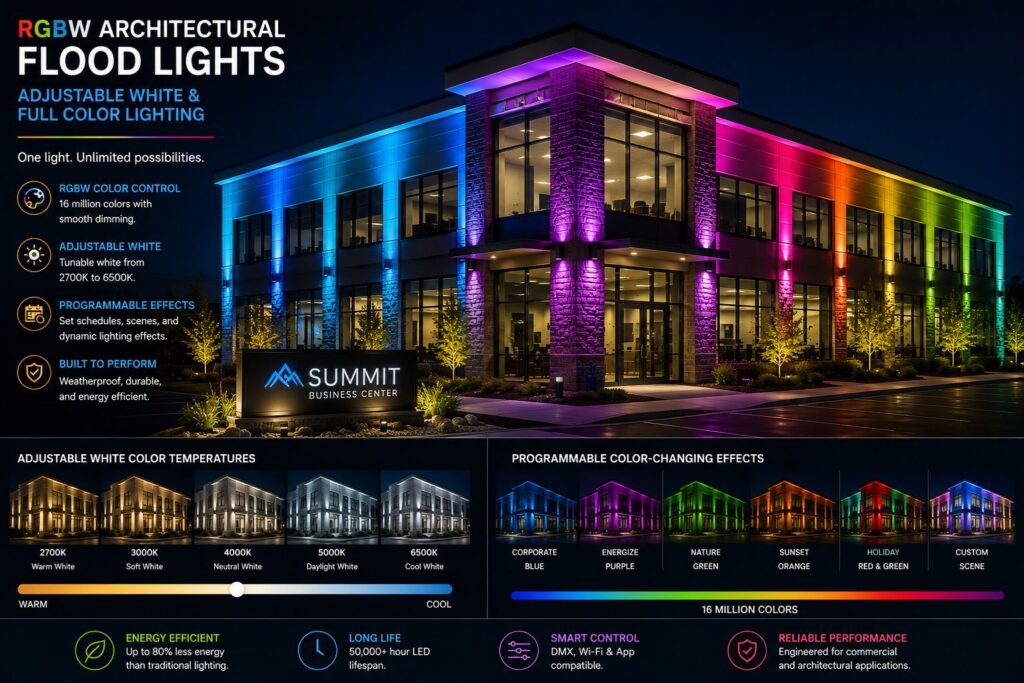
Selecting the proper brightness, beam angle, and color temperature allows RGBW flood lights to deliver exceptional architectural lighting while maximizing energy efficiency and visual impact.
Need Help Selecting RGBW Flood Lights?
LED PROS WorldWide can help evaluate light output, beam angle, mounting distance, white-light requirements, controls, and environmental conditions for your commercial architectural lighting project. Explore our RGB LED Lights for commercial RGB and RGBW fixture options.
Request a Quote or call 844-533-7767 with your building elevations or drawings, mounting information, voltage, quantities, desired lighting effects, and control requirements.
Brightness vs. Color Temperature
Brightness and color temperature describe different characteristics of an RGBW flood light and should be evaluated separately.
Brightness refers to the amount of visible light produced by the fixture and is typically expressed in lumens. The required output depends on the size of the illuminated surface, mounting distance, beam angle, surface reflectivity, ambient light, and the desired visual effect.
Color temperature describes the appearance of white light and is measured in Kelvin (K). Lower color temperatures produce a warmer appearance, while higher color temperatures appear cooler.
For RGBW architectural lighting, these decisions work together. A fixture may need sufficient output to illuminate a large façade while also providing a white-light color temperature that complements the building materials and surrounding environment.
The goal is not simply to select the highest lumen output or a particular Kelvin value, but to match output, optics, mounting conditions, and white-light appearance to the project.
Once you understand brightness and white-light selection, compare RGB, RGBW, and RGBWW technologies in our RGB vs RGBW vs RGBWW Lighting Guide.
How to Select RGBW Flood Light Brightness
Selecting the appropriate light output for commercial and industrial lighting applications starts with the surface being illuminated and the distance between the RGBW flood light and that surface. A larger façade or longer mounting distance generally requires more output, while smaller architectural features may need considerably less.
Key factors include:
-
Target size — Large walls and façades typically require more total light than columns, signs, entrances, or individual architectural features.
-
Mounting distance — As the distance between the fixture and target increases, sufficient output and appropriate optics become increasingly important.
-
Beam angle — A narrow beam concentrates light over a smaller area, while a wider beam spreads the available output across a larger surface.
-
Surface color and reflectivity — Dark or low-reflectance materials generally require more light than lighter, more reflective surfaces to achieve a similar visual effect.
-
Ambient light — Properties surrounded by bright parking lots, street lighting, signage, or neighboring buildings may require greater output for architectural colors to remain visually prominent.
-
Desired effect — Subtle accent lighting requires different output than a highly visible façade intended to display saturated colors or branding.
Avoid selecting an RGBW flood light by wattage alone. Lumen output, beam distribution, mounting distance, and the illuminated surface should be evaluated together.
Beam Angle and Optical Performance
Beam angle determines how concentrated or widely distributed the light from an RGBW flood light will be. Selecting the appropriate optic is especially important in architectural lighting because the same fixture output can produce very different results depending on beam spread and mounting distance.
Narrow beams concentrate light on smaller architectural features or over longer distances. Medium beams provide broader coverage for walls and building features, while wide beams distribute light across larger surfaces at shorter mounting distances.
| Beam Angle | Typical Applications |
|---|---|
| 10° | Columns |
| 15° | Flags |
| 25° | Monument signs |
| 40° | Building entrances |
| 60° | Wall washing |
| 120° | Large building façades |
The beam angles shown are starting points rather than fixed design rules. Final selection should consider mounting distance, target dimensions, fixture output, aiming position, and the desired coverage and intensity.
For larger façades or projects using multiple fixtures, photometric data can help determine appropriate optics, spacing, aiming, and expected coverage before fixtures are ordered.
Ready to apply these specification principles? Our Architectural Façade Lighting Design Guide demonstrates how beam angles, wall washing, uplighting, and lighting controls work together to create exceptional commercial lighting designs.
Selecting White Color Temperature
The dedicated white channel in an RGBW flood light allows the fixture to provide conventional white illumination in addition to programmable colors. When white light will be used regularly, its color temperature should complement the building materials and desired nighttime appearance.
Common white-light ranges include:
| Color Temperature | General Appearance | Example Architectural Use |
|---|---|---|
| 2700K–3000K | Warm white | Hospitality, restaurants, historic architecture, stone and warm-toned materials |
| 3500K–4000K | Neutral white | Commercial buildings, campuses, mixed architectural materials |
| 5000K | Cool white | Contemporary architecture or applications where a cooler, brighter visual appearance is desired |
Color temperature does not determine brightness. Two fixtures with different CCTs can have similar lumen output while producing noticeably different visual appearances.
For RGBW projects, verify the actual color temperature of the fixture’s dedicated white channel before ordering. Available CCTs vary by fixture and manufacturer.
Matching White Light to Building Materials
Building materials can change how white light appears on an architectural surface. The appropriate color temperature should complement the material rather than overpower its natural appearance.
| Building Material | White-Light Starting Point | Design Consideration |
|---|---|---|
| Brick, wood and warm stone | 2700K–3000K | Warmer white can complement red, brown and earth tones |
| Stucco and neutral masonry | 3000K–4000K | Provides flexibility depending on the building color and desired appearance |
| Concrete and modern façades | 3500K–5000K | Neutral or cooler white can complement contemporary architecture |
| Metal, glass and silver finishes | 4000K–5000K | Cooler white can emphasize clean, modern surfaces |
These ranges are useful starting points, not fixed specifications. Surface color, texture, reflectivity, surrounding lighting, and the desired architectural effect should all be considered before selecting the final white-light CCT.
Matching Output Across Multiple RGBW Fixtures
Commercial architectural projects often use multiple RGBW flood lights to illuminate a continuous façade or several related building features. Consistency between fixtures is important when the goal is uniform color and white-light appearance.
When specifying multiple fixtures, consider:
-
Lumen output and wattage — Match fixtures performing the same lighting function.
-
Beam angle — Different optics can create visible variations in coverage and intensity.
-
White-light CCT — Use consistent color temperatures where fixtures are intended to appear uniform.
-
Mounting distance and aiming — Similar fixtures can appear significantly different when installed at different distances or angles.
-
Control compatibility — Fixtures operating together should support the intended dimming, color-changing, and control system.
Different fixture outputs or beam angles may be intentionally used when building heights, mounting distances, or architectural features vary. The objective is not necessarily identical fixtures everywhere, but consistent illumination across the completed project.
Common RGBW Flood Light Specification Mistakes
Avoiding a few common specification mistakes can improve both fixture selection and the finished architectural lighting effect.
-
Selecting by wattage alone — Wattage does not indicate how the light will be distributed. Compare lumen output, optics, mounting distance, and target dimensions.
-
Ignoring beam angle — Too narrow a beam can create concentrated hot spots, while an excessively wide beam may reduce useful intensity on the target surface.
-
Assuming all RGBW fixtures provide the same white light — Verify the dedicated white channel’s color temperature and output for the specific fixture.
-
Choosing RGB, RGBW, or RGBWW without considering normal operation — Determine whether the project needs primarily color effects, a dedicated white-light mode, or additional warm-white flexibility. See our RGB vs RGBW vs RGBWW Lighting Guide for a detailed comparison.
-
Overlooking mounting conditions — Fixture distance, aiming angle, mounting height, obstructions, and available mounting locations can substantially affect performance.
-
Waiting until after fixture selection to consider controls — Establish the required dimming, color-changing, scene, and system-control capabilities before finalizing the fixtures.
For larger architectural projects, reviewing fixture photometric data and project drawings before ordering can help identify potential coverage, spacing, and aiming issues.
Commercial RGBW Flood Light Buyer Checklist
Before requesting a quote or selecting RGBW flood lights, gather as much of the following project information as possible:
-
Building elevations or project drawings
-
Dimensions of the surfaces or architectural features being illuminated
-
Fixture mounting locations and approximate mounting distances
-
Desired fixture quantity, if already established
-
Available voltage
-
Required or preferred lumen output and wattage, if specified
-
Beam angle or desired coverage
-
White-light color temperature
-
Desired RGB color-changing effects
-
Control requirements — including dimming, scenes, scheduling, synchronization, or DMX512
-
Indoor or outdoor installation conditions
-
Environmental or ingress-protection requirements
-
Fixture finish or architectural appearance requirements
For projects requiring coordinated color changes, scenes, dimming, or building-wide control, review our DMX512 Architectural Lighting Guide when establishing the control strategy.
If beam angle, output, CCT, or fixture quantity has not yet been determined, provide the project drawings and application requirements. These details can be evaluated as part of the fixture-selection process.
Inline Buyer Q&A
Q: How do I know what output and beam angle I need for my building?
A: Start with the dimensions of the surface, fixture mounting location, distance to the target, and desired lighting effect. Building elevations or drawings are especially useful for evaluating appropriate output and optics.
Q: Should I choose RGBW flood lights by wattage or lumens?
A: Neither measurement should be used alone. Lumen output indicates the amount of visible light produced, while beam angle determines how that light is distributed. Mounting distance, target size, surface reflectivity, and ambient light also affect the required fixture.
Q: What if I don’t know the correct beam angle or white-light color temperature?
A: Provide the building type, photographs or elevations, mounting information, and the architectural effect you want to achieve. LED PROS WorldWide can help evaluate suitable fixture options for the application.
Q: Can different RGBW flood lights be used on the same project?
A: Yes. Different outputs or optics may be appropriate when mounting distances, building heights, or architectural features vary. Fixtures intended to operate together should also be evaluated for compatible color, white-light, dimming, and control performance.
Q: What information will help you quote an RGBW flood lighting project?
A: Send available drawings or building elevations, target dimensions, mounting locations, quantities, voltage, desired colors and white-light CCT, control requirements, and any existing fixture specifications. If some of these details have not been determined, send what is available and describe the intended lighting effect.
Get Help Selecting Commercial RGBW Flood Lights
Choosing the right RGBW flood light requires matching output, beam angle, mounting distance, white-light color temperature, and controls to the building and desired architectural effect.
LED PROS WorldWide can help evaluate commercial RGBW flood lighting for façades, hospitality properties, campuses, corporate facilities, municipalities, multifamily properties, landmarks, and other architectural projects.
Send us your building elevations or drawings, target dimensions, mounting locations, fixture quantities, voltage, desired colors and white-light CCT, and control requirements. If some specifications have not yet been determined, send what you have and describe the lighting effect you want to achieve.
Request a Quote or call 844-533-7767 to discuss your project.
Frequently Asked Questions About RGBW Flood Lights
What are RGBW flood lights?
RGBW flood lights combine red, green, blue, and a dedicated white LED channel. They can provide programmable color-changing effects while also offering a separate white-light mode for commercial and architectural applications.
How do I choose the brightness of an RGBW flood light?
Consider the size of the illuminated surface, mounting distance, beam angle, surface reflectivity, ambient light, and desired visual effect. Wattage alone should not be used to determine the appropriate fixture.
What beam angle should I use for an RGBW flood light?
Narrow beams concentrate light on smaller features or over longer distances, while wider beams distribute light across larger surfaces. The appropriate beam angle depends on mounting distance, target dimensions, fixture output, and desired coverage.
What color temperature should I choose for the white channel?
Warm white in the 2700K–3000K range can complement brick, wood, stone, and hospitality environments. Neutral white around 3500K–4000K works well for many commercial applications, while cooler white around 5000K may complement contemporary architecture. Available CCTs vary by fixture.
Does color temperature affect RGBW flood light brightness?
Color temperature describes the appearance of white light rather than its brightness. Lumen output and CCT should be evaluated separately when selecting a fixture.
Can RGBW flood lights be used for building façades?
Yes. Commercial RGBW flood lights are commonly used to illuminate façades, entrances, columns, rooflines, monuments, hospitality properties, campuses, and other architectural features where both color-changing effects and white illumination are desired.
Can RGBW flood lights use DMX512 controls?
Many commercial RGBW lighting systems can use DMX512 for color selection, dimming, scenes, and coordinated effects. Compatibility depends on the fixture, driver, controller, and overall system design, so control requirements should be established before final fixture selection.
Stay Connected with Our Lighting Resources
Add IndustrialLightingFixtures.org as a Preferred Source on Google to see more of our lighting guides and technical resources across Google Search experiences.
Related RGB Lighting Resources
-
RGB LED Lights — Explore commercial RGB and RGBW lighting fixtures for façades, buildings, and architectural applications.
-
RGB vs RGBW vs RGBWW Lighting Guide — Compare RGB, RGBW, and RGBWW technologies and determine which color system fits your project.
-
Color-Changing LED Floodlights Guide — Learn how commercial color-changing flood lights are used for architectural and exterior applications.
-
DMX512 Architectural Lighting Guide — Understand DMX512 controls for commercial RGBW lighting systems, scenes, dimming, and coordinated effects.