What Is NSF Certified Lighting?
NSF-certified lighting refers to lighting fixtures that are designed and evaluated for use in sanitary environments where cleanliness, washdown procedures, and food safety are essential. These fixtures are commonly installed in food processing plants, beverage production facilities, commercial kitchens, pharmaceutical manufacturing plants, and other environments where contamination control is a priority.
Unlike standard industrial lighting, NSF-certified fixtures are engineered with smooth, easy-to-clean surfaces, corrosion-resistant materials, enclosed construction, and designs that minimize areas where dust, moisture, bacteria, or debris can accumulate.
For facilities operating under strict sanitation programs, NSF-certified lighting helps support consistent cleaning procedures and long-term operational reliability.
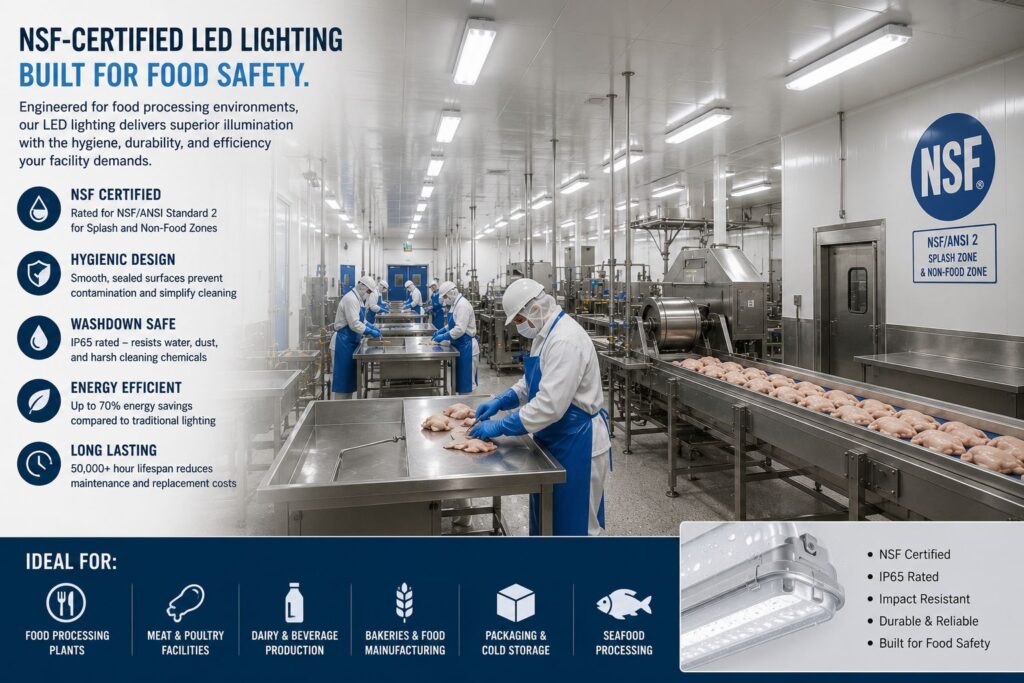
NSF-certified LED lighting is designed for sanitary industrial environments where fixture construction, cleanability, durability, and food safety are essential to maintaining safe and efficient production operations.
Designing or upgrading a food processing facility?
Our lighting specialists can help you select NSF-certified LED lighting that supports sanitation, operational efficiency, and long-term reliability.
Request a Free Lighting Consultation – – https://industriallightingfixtures.org/
What Is NSF?
NSF is an internationally recognized organization that develops standards for products used in food processing, water treatment, public health, and commercial sanitation.
Within industrial lighting, NSF certification focuses on fixture designs that promote:
- Cleanability
- Hygienic construction
- Corrosion resistance
- Safe operation
- Long-term durability in sanitary environments
Although lighting is only one part of a food-safe facility, selecting fixtures designed for hygienic applications supports overall sanitation and maintenance programs.
Designing a food production facility requires more than selecting the right fixtures. Our Food Processing Facility Lighting Guide explains how lighting supports sanitation, employee safety, quality inspections, and operational efficiency throughout every stage of production.
Why NSF Certification Matters
Food production environments require more than adequate illumination.
Lighting fixtures must also support:
- Routine washdowns
- Frequent sanitation
- Moisture resistance
- Corrosion protection
- Long service life
- Consistent lighting performance
Fixtures designed for sanitary environments help reduce maintenance while making cleaning procedures easier and more effective.
Looking for lighting requirements specific to food production? Read Understanding Food Safety Lighting Requirements for facility design considerations and best practices.
Industries That Use NSF-Certified Lighting
Food Processing Plants
Production areas, preparation rooms, and packaging lines frequently use NSF-certified lighting.
Beverage Manufacturing
Breweries, beverage bottling plants, and processing facilities often require lighting designed for frequent cleaning.
Dairy Processing
Milk, cheese, yogurt, and dairy production facilities benefit from fixtures capable of withstanding moisture and sanitation procedures.
Meat and Poultry Processing
Washdown-resistant lighting helps support sanitary production environments throughout processing operations.
Pharmaceutical Manufacturing
Many pharmaceutical facilities select hygienic lighting systems that support controlled production environments.
Commercial Kitchens
Restaurants, institutional kitchens, and food preparation areas often benefit from easy-to-clean lighting fixtures.
Cold Storage Facilities
Refrigerated environments require durable fixtures capable of operating reliably in low temperatures while resisting condensation.
Food Packaging Facilities
Packaging operations frequently utilize sanitary lighting designed for easy maintenance and dependable performance.
Want to compare fixture types? Visit Vapor Tight vs NSF Fixtures to understand the differences between sanitary and sealed industrial lighting.
Types of NSF-Certified Lighting
Several fixture styles are available depending on the application.
Common examples include:
- NSF High Bay Fixtures
- NSF Vapor Tight Fixtures
- Clean Room Lighting
- Food Processing High Bays
- Refrigerated Facility Lighting
- Washdown-Rated LED Fixtures
Each fixture is selected based on the operating environment and cleaning requirements.
NSF-Certified vs Standard Industrial Lighting
| NSF-Certified Lighting | Standard Industrial Lighting |
|---|
| Smooth, easy-to-clean housing | General-purpose housing |
| Corrosion-resistant materials | Standard industrial materials |
| Hygienic construction | General industrial construction |
| Designed for sanitation | General industrial applications |
| Washdown compatible | Limited washdown capability |
| Reduced contamination points | More exposed hardware |
New to sealed lighting? Explore What Are Vapor Proof Light Fixtures? to learn how enclosed fixtures protect against moisture, dust, and environmental contaminants.
When Is NSF Certification Required?
Not every industrial facility requires NSF-certified lighting.
Facilities should evaluate:
Processing Areas
Production spaces where food is prepared or processed often benefit from NSF-certified fixtures.
Washdown Areas
Facilities using frequent cleaning procedures typically select fixtures designed to withstand repeated washdowns.
Packaging Operations
Many food packaging environments choose sanitary fixtures that simplify cleaning and maintenance.
Refrigerated Production
Cold environments often combine NSF-certified lighting with moisture-resistant construction.
Dry Warehouses
General warehouse storage areas may not require NSF-certified fixtures unless specific sanitation standards apply.
Understanding Food Safety Zones
Food processing facilities are typically divided into operational zones based on the likelihood of product exposure and the level of sanitation required. Understanding these areas helps facility owners and lighting designers select fixtures that support hygienic operations while simplifying cleaning and maintenance.
Although lighting fixtures are normally mounted above food production areas rather than in direct contact with food products, the construction and placement of the fixtures should complement the sanitation requirements of the surrounding environment.
| Facility Zone | Typical Environment | Recommended Lighting |
|---|---|---|
| Food Processing Zone | Areas above or adjacent to food preparation and processing equipment where hygienic design is essential | NSF-certified LED high bays or NSF-certified sanitary lighting |
| Splash & Washdown Zone | Production areas exposed to routine washdowns, moisture, cleaning chemicals, and frequent sanitation | NSF-certified vapor tight LED fixtures or washdown-rated luminaires |
| Non-Food Processing Zone | Warehouses, utility rooms, mechanical spaces, offices, and dry storage areas | Standard industrial LED fixtures or vapor tight fixtures, depending on environmental conditions |
Properly matching the lighting system to each operational area improves cleanability, supports maintenance procedures, and helps facilities maintain consistent lighting performance throughout the building.
High-Pressure Washdown Considerations
Many food processing facilities clean production areas using high-pressure water, hot water, foam cleaning systems, and approved sanitation chemicals. Lighting fixtures installed in these environments should be capable of withstanding repeated cleaning without allowing moisture or contaminants to reach internal electrical components.
When specifying lighting for washdown environments, consider the following characteristics:
- Fully enclosed fixture construction
- Corrosion-resistant aluminum or polycarbonate housings
- Stainless steel mounting hardware and retaining clips
- Durable silicone or EPDM sealing gaskets
- Moisture-resistant LED drivers
- Appropriate ingress protection (IP) ratings for the application
- Smooth exterior surfaces that simplify cleaning and reduce areas where contaminants may accumulate
Understanding IP Ratings
Ingress Protection (IP) ratings indicate how well a fixture resists dust and water intrusion.
| IP Rating | Typical Protection |
| IP66 | Dust-tight and protected against powerful water jets from any direction |
| IP67 | Dust-tight and protected against temporary immersion in water |
| IP69K* | Designed for extremely demanding washdown environments using high-pressure, high-temperature water spray (only where specifically certified by the manufacturer) |
Not every NSF-certified lighting fixture carries an IP69K rating. Always verify the manufacturer’s published specifications before selecting fixtures for aggressive washdown environments.
By selecting fixtures with the appropriate enclosure design, corrosion-resistant materials, and ingress protection, facility owners can reduce maintenance requirements, improve lighting reliability, and support long-term sanitation programs in demanding food processing environments.
Selecting NSF-Certified Lighting
Before selecting fixtures, evaluate:
- Cleaning procedures
- Moisture exposure
- Ambient temperature
- Ceiling height
- Corrosion resistance
- Fixture construction
- IP rating
- Mounting method
- Required illumination levels
Matching the fixture to the facility environment helps maximize both lighting performance and long-term reliability.
Common Mistakes to Avoid
Avoid these common specification errors:
- Installing standard fixtures in washdown environments
- Selecting inadequate IP ratings
- Ignoring corrosion resistance
- Choosing fixtures that are difficult to clean
- Overlooking maintenance accessibility
- Using lighting not designed for sanitary environments
Careful planning reduces maintenance while supporting consistent sanitation practices.
Interested in the advantages of sealed lighting? Read The #1 Benefit of Vapor Tight LED Lighting to discover why these fixtures perform well in demanding industrial environments
Typical NSF Lighting Applications
| Facility | Recommended Lighting |
| Food Processing | NSF High Bays |
| Beverage Production | NSF Vapor Tight Fixtures |
| Dairy Facilities | NSF LED Fixtures |
| Meat Processing | Washdown-Rated LED Fixtures |
| Pharmaceutical Manufacturing | Hygienic LED Lighting |
| Commercial Kitchens | NSF Vapor Tight Fixtures |
| Cold Storage | NSF Refrigerated Lighting |
| Packaging Facilities | NSF LED High Bays |
Planning a complete facility lighting upgrade? Our Industrial Lighting Guide explains fixture selection, lighting design, and LED retrofit strategies across industrial applications.
Inline Buyer Q&A
Is NSF certification required for every food facility?
Not necessarily. The need for NSF-certified lighting depends on the specific environment, sanitation procedures, regulatory requirements, and facility operations.
Is NSF certification the same as UL listing?
No. UL focuses primarily on electrical safety, while NSF certification emphasizes hygienic design and suitability for sanitary environments.
Can vapor tight fixtures also be NSF certified?
Yes. Many vapor tight LED fixtures are also manufactured with NSF certification, making them well suited for food processing and washdown applications.
Specify NSF-Certified Lighting with Confidence
Sanitary industrial environments require lighting systems designed for more than illumination alone. NSF-certified LED lighting supports hygienic facility design, simplifies cleaning procedures, improves durability, and delivers dependable performance in food processing, beverage production, pharmaceutical manufacturing, and other sanitation-sensitive industries.
Whether you’re designing a new processing facility or modernizing an existing operation, our lighting specialists can help you select NSF-certified LED fixtures that align with your operational requirements and long-term maintenance goals
👉 Explore our complete selection of NSF Certified LED Lighting to find high bays, vapor tight fixtures, and sanitary lighting solutions engineered for demanding industrial environments, or contact us for a free lighting consultation.on today.
Frequently Asked Questions
What is NSF-certified lighting?
NSF-certified lighting consists of fixtures designed for sanitary environments where cleanability, corrosion resistance, and hygienic construction are important.
Which industries commonly use NSF-certified lighting?
Food processing plants, beverage manufacturers, dairy facilities, meat processing operations, pharmaceutical plants, commercial kitchens, refrigerated warehouses, and food packaging facilities commonly use NSF-certified lighting.
Does NSF certification improve fixture durability?
Many NSF-certified fixtures are designed using durable materials that withstand frequent cleaning, moisture exposure, and corrosive environments.
Can existing facilities upgrade to NSF-certified LED lighting?
Yes. Many facilities replace older fluorescent or HID fixtures with modern NSF-certified LED lighting as part of facility modernization projects.