Industrial lighting fixtures do far more than simply illuminate a building. They improve workplace safety, increase employee productivity, reduce maintenance costs, and lower energy consumption throughout industrial facilities.
Every application has unique lighting requirements. A warehouse with 35-foot ceilings requires a completely different fixture than a refrigerated food processing facility or a machine shop exposed to dust and moisture. Choosing the correct fixture ensures reliable performance while meeting operational and environmental requirements.
This guide explains the most common industrial lighting fixtures, where they are used, and how each contributes to creating a safer and more efficient workplace.
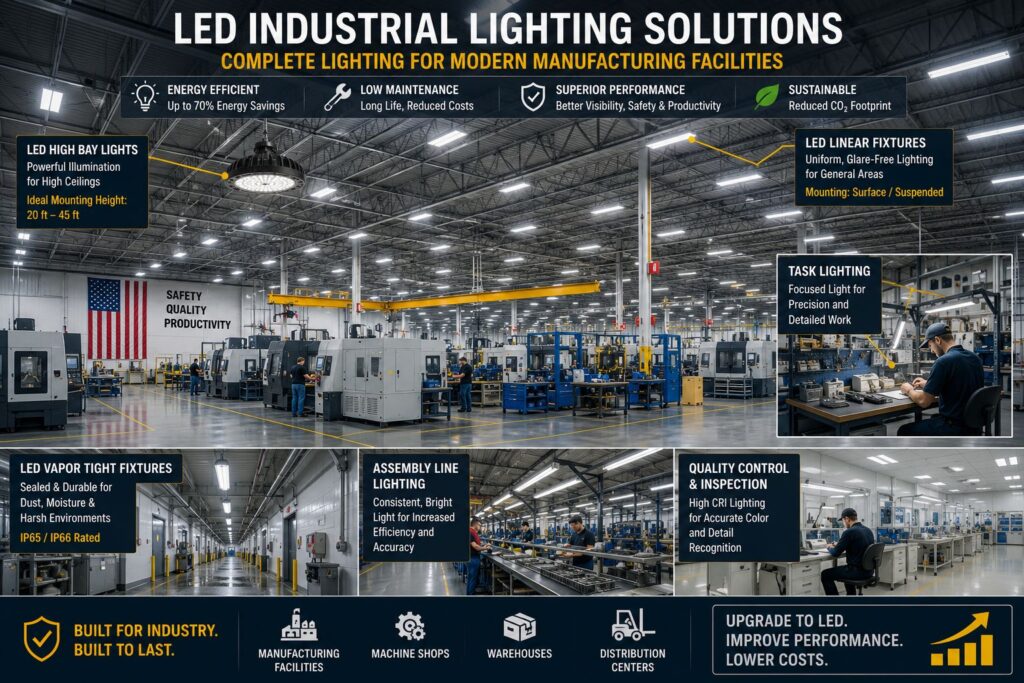
Industrial lighting fixtures are designed for specific environments, providing safe, efficient illumination for manufacturing plants, warehouses, production facilities, and industrial operations.
Need Help Choosing the Right Industrial Lighting Fixtures?
Industrial facilities require different lighting solutions depending on ceiling height, operating conditions, environmental exposure, mounting requirements, and required illumination levels.
Explore our industrial LED lighting solutions for warehouses, manufacturing plants, distribution centers, and specialized applications.
Need fixture recommendations or project pricing? Request a Quote or call 844-533-7767 for assistance.
What Are Industrial Lighting Fixtures?
- Designed for demanding commercial environments
- Higher lumen output
- Longer operating life
- Better thermal management
- Durable construction
- Continuous operation
- Low maintenance
- Available for wet, dusty, hazardous, and food-safe environments
Before selecting fixtures, read What Is Industrial Lighting? for an overview of industrial lighting systems, common applications, and key design considerations.
Looking for lighting that performs in wet or dusty environments? The #1 Benefit of Vapor Tight LED Lighting explains why these fixtures have become the preferred solution across many industrial applications.
Common Types of Industrial Lighting Fixtures
| Fixture Type | Common Applications | Typical Ceiling Height |
|---|---|---|
| LED High Bay | Warehouses, manufacturing | 20–60 ft |
| LED Low Bay | Workshops, assembly | Under 20 ft |
| Linear High Bay | Distribution centers | 20–40 ft |
| Vapor Tight Fixtures | Washdown, parking garages, food processing | Any |
| Explosion Proof Fixtures | Hazardous locations | Any |
| High Mast Lighting | Ports, rail yards, airports | 60–150 ft |
| Flood Lights | Exterior industrial yards | Outdoor |
| Wall Packs | Building perimeter | Outdoor |
| Task Lighting | Assembly stations | Localized |
Before selecting fixtures for your next project, explore Exploring the Different Types of Industrial Lights to compare LED high bays, linear fixtures, vapor tight lights, flood lights, and specialized industrial lighting solutions.
Choosing the Right Fixture
Ceiling height
Higher ceilings require higher lumen packages.
Environment
Dust
Heat
Cold
Moisture
Corrosion
Chemicals
Washdown
Hazardous gases
Lighting distribution
Wide beam
Narrow beam
Aisle optics
Task lighting
Controls
Occupancy sensors
Daylight harvesting
Network controls
Emergency backup
Vapor proof fixtures are widely used throughout industrial facilities. What Are Vapor Proof Light Fixtures? explains their construction, applications, and how they differ from conventional lighting.
Looking to improve long-term operating efficiency? The Industrial Lighting Technologies Guide explains why LED technology has become the preferred lighting solution for modern industrial facilities.
Industrial Applications
Warehouses
High bays
Motion sensors
Uniform lighting
Designing an efficient warehouse? Explore our Warehouse Lighting Layout Guide for recommendations on fixture spacing, mounting heights, and aisle illumination.
Manufacturing Plants
Task lighting
High CRI
Machine visibility
Whether you’re building a new manufacturing plant or upgrading an existing facility, the Manufacturing Facility High Bay Lighting Guide provides practical guidance for designing an effective LED lighting system.
Distribution Centers
Linear high bays
Racking optics
Forklift visibility
Food Processing Facilities
NSF fixtures
Vapor tight fixtures
Washdown construction
Whether you’re building a new food processing facility or upgrading an existing plant, the NSF Certified Lighting Guide provides practical guidance for selecting hygienic LED lighting solutions.
Installing lighting in food processing facilities? Read our Understanding Food Safety Lighting Requirements guide for NSF-certified lighting recommendations.
Cold Storage
Instant-on LEDs
Cold temperature operation
Minimal maintenance
Hazardous Locations
Explosion proof fixtures
Class I Division 1
Class I Division 2
Outdoor Industrial Facilities
Flood lights
High mast
Wall packs
Parking lot lighting
Whether you’re managing a commercial building project or large infrastructure development, the Construction Site Lighting Guide provides practical
Benefits of LED Industrial Fixtures
| Benefit | Operational Advantage |
|---|---|
| Lower Energy Use | Reduced utility costs |
| Longer Life | Less maintenance |
| Better Visibility | Improved productivity |
| Instant Start | No warm-up delay |
| Better Color Rendering | Improved inspection accuracy |
| Lower Heat Output | Improved facility comfort |
| Smart Controls | Additional energy savings |
Whether you’re planning a new lighting installation or upgrading an existing facility, the Industrial Lighting Controls Guide demonstrates how intelligent controls enhance modern LED lighting systems.
Looking to reduce operating costs? Our Industrial LED Energy Savings Guide explains how LED retrofits lower maintenance and utility expenses.
How to Select the Best Fixture
✔ Ceiling height
✔ Mounting method
✔ Beam angle
✔ Lumen requirements
✔ Color temperature
✔ IP rating
✔ Hazardous location requirements
✔ NSF requirements
✔ Motion controls
✔ Emergency lighting
Choosing fixtures for tall ceilings? Visit our Manufacturing Facility High Bay Lighting guide to learn how high bay fixtures improve visibility in production environments.
Inline Buyer Q&A
Which industrial lighting fixture is used most often?
LED high bay fixtures are the most common choice for warehouses, manufacturing plants, and distribution facilities because they provide high lumen output while reducing operating costs.
What fixture works best in wet environments?
Vapor tight LED fixtures are designed to resist water, dust, humidity, and washdown conditions commonly found in food processing facilities, parking garages, and utility spaces.
Are LED fixtures suitable for hazardous locations?
Only fixtures specifically certified for hazardous locations should be installed in Class I, Division 1 or Division 2 environments
Need Industrial LED Lighting Fixtures for Your Facility?
Selecting the right industrial lighting fixtures requires matching product specifications to the facility’s operating conditions, mounting heights, illumination requirements, and environmental challenges.
LED PROS WorldWide supplies industrial LED lighting solutions for warehouses, manufacturing plants, distribution centers, food processing facilities, and specialized industrial applications.
Explore our industrial lights and LED lighting systems and send us your fixture quantities, mounting heights, voltage requirements, environmental conditions, and project specifications.
Request a Quote or call 844-533-7767 for pricing and product selection assistance.
Frequently Asked Questions
How long do industrial LED fixtures last?
Most quality industrial LED fixtures provide 100,000 hours or more of service life.
Are industrial fixtures more energy efficient?
Yes. Modern LED fixtures typically reduce lighting energy consumption by 50–80% compared to legacy HID or fluorescent systems.
Can industrial lighting be controlled automatically?
Yes. Occupancy sensors, daylight harvesting controls, and centralized lighting management systems help maximize energy savings.
Which fixture is best for warehouses?
LED high bay fixtures are generally the preferred solution for warehouse applications because they provide excellent uniformity, long life, and high efficiency.
Related Industrial Lighting Resources
-
Industrial Lights — Explore commercial and industrial LED fixtures for warehouses, manufacturing plants, distribution centers, and demanding operating environments.
-
Industrial Lighting Guide — Review industrial lighting planning, fixture specifications, mounting heights, illumination requirements, and facility design considerations.
-
Exploring the Different Types of Industrial Lights — Compare common industrial fixture categories and their applications.
-
Manufacturing Plant Lighting — Understand lighting requirements for production floors, assembly lines, fabrication areas, and industrial workstations.
-
Industrial Facility Lighting Design — Learn how fixture placement, mounting heights, photometrics, uniformity, and controls influence industrial lighting performance.
-
Industrial LED Energy Savings Guide — Evaluate potential energy savings, maintenance reductions, and operating-cost considerations when upgrading industrial facilities.